A Titan Protect guide. Educational, not advice. First published 16 August 2026; figures updated 18 October 2026, with the date of each one stated.
If you are buying a home or thinking about refinancing this year, you are doing it in a market that has turned. The stretch of rate cuts that carried the country through late 2025 is over, and in September the Federal Reserve raised rates for the first time since 2023. For a lot of buyers who have been waiting for rates to drop back toward the numbers their neighbors locked in a few years ago, that is a hard message. It is also the honest one. So it is worth slowing down and understanding the ground you are standing on before you sign anything.
This guide walks through where rates actually are right now, how conventional and Islamic home financing compare on cost, and how to think about the decision rather than what to decide. Your circumstances are yours. Ours is to make the picture clear.
What this guide does and does not do. It compares cost and fit with your circumstances. It gives no religious ruling either way. Whether a particular product meets your religious requirements is a question for a qualified scholar you trust.
Where rates actually are, October 2026
Start with the anchor. On 16 September 2026 the Federal Reserve raised its benchmark federal funds rate by a quarter point to a target range of 3.75% to 4.00%, its first hike since July 2023, in a unanimous vote. That followed a July meeting where three members had already dissented in favour of a hike. The next decision is due on 27 to 28 October. The minutes of the September meeting said most officials expected another hike by year-end, without committing to one. The message underneath the number matters more than the number itself: the easing cycle is over for now, and the committee is leaning the other way. Do not assume the next move is down.
Against that backdrop, here is the shape of the conventional market, using Freddie Mac’s weekly Primary Mortgage Market Survey for 15 October 2026:
- The 30-year fixed rate averaged 7.40%, up from 6.67% on 13 August.
- The 15-year fixed rate averaged 6.71%, up from 5.96% on 13 August.
For context, that is a rise of about three-quarters of a point in two months, as the 10-year Treasury yield that lenders price from moved up with the Fed. Repricing happens week to week, in both directions. Treat any headline number, including ours, as a snapshot rather than a promise.
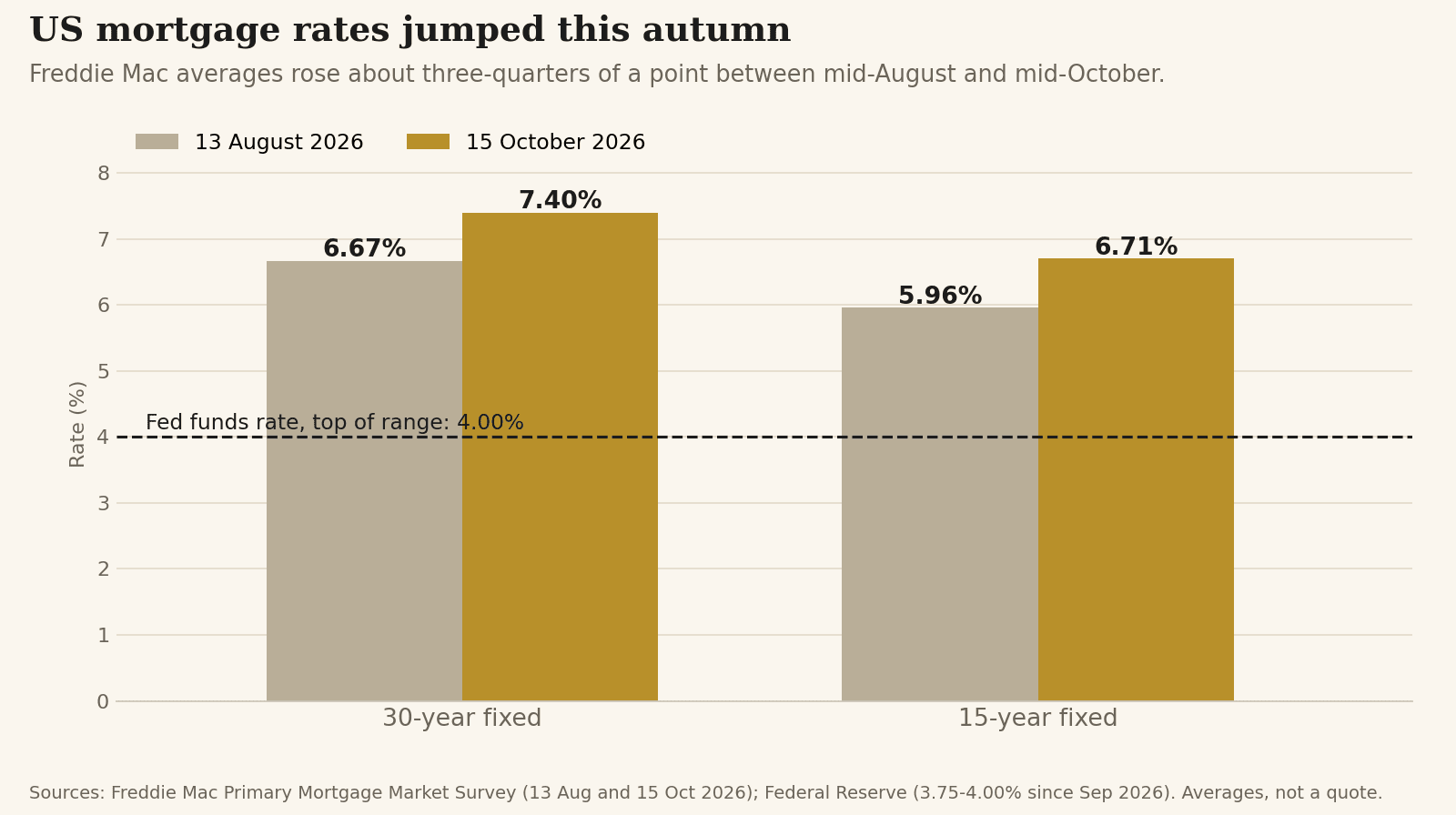
Two things deserve your attention. First, the 15-year fixed is about seven-tenths of a percentage point cheaper than the 30-year. That gap is the price of certainty and speed: a shorter term means a higher monthly payment but far less total profit paid to the lender over the life of the loan. Second, the averages hide a wide range. Your own rate depends heavily on your credit, your down payment, and whether you pay points, which we come to below.
This is not just an American story. In the United Kingdom the average five-year fix reached about 6% on 5 October 2026 (Moneyfacts), with the Bank of England holding at 3.75% and some members leaning towards a hike. The European Central Bank has also raised rates this year. The common thread is that last year’s easing story has stalled, and inflation is the reason. Nobody serious is promising you cheaper money soon.
The conventional decision, in plain terms
Once you accept that rates may not fall much from here, the conventional choice comes down to a few honest trade-offs.
A 30-year fixed keeps your monthly payment as low as the term allows and locks it for the life of the loan. You pay for that with a higher rate than the 15-year and far more total interest over three decades. It is the default for good reason: it maximizes flexibility and cash flow.
A 15-year fixed at 6.71% (15 October) saves an enormous amount of interest and builds equity fast, but the monthly payment is meaningfully higher. It suits buyers with room in their budget who want to be debt-free sooner.
An adjustable-rate mortgage usually starts below the 30-year fixed and resets after a fixed period, often five, seven or ten years. In a market where some policymakers are voting to raise rates, an ARM is a view on the future, not a safe default. It follows rates up just as readily as down.
Then there is the lever many buyers overlook: discount points. One point costs 1% of the loan amount and typically buys down your rate by somewhere between 0.125% and 0.25%, according to lender disclosures from Citizens Bank and NerdWallet. The math is a break-even calculation. NerdWallet’s own example: on a $300,000 loan, one point costs $3,000 and might drop the rate from 7% to about 6.755%, saving roughly $50 a month, which takes 60 months to earn back. Points are worth it only if you will stay in the home past that break-even. A seller-paid temporary buydown is a different tool with a different math, so ask your loan officer to show you both.
Qualification sets the floor under all of this. Per LendingTree’s 2026 requirements (checked August 2026), a conventional loan generally wants a credit score around 620, a debt-to-income ratio up to about 45% (and up to 50% with strong compensating factors), and a down payment as low as 3% for first-time buyers or 5% for repeat buyers. Note one recent change: since November 2025, Fannie Mae’s automated underwriting no longer enforces a hard minimum credit score, using a broader risk assessment instead, though file strength still drives your pricing (Cream City Mortgage). Put down less than 20% and you will pay private mortgage insurance, which LendingTree pegs at roughly 0.58% to 1.86% of the loan per year until you build enough equity to drop it. And the conforming limit that separates a standard conventional loan from a pricier jumbo sits around $832,750 in most of the country for 2026, rising to roughly $1.25 million in the most expensive markets.
None of these choices is right or wrong in the abstract. The right answer depends on how long you plan to stay, how much certainty your budget needs, and how much cash you can put to work up front.
Islamic home finance: a genuinely different structure, priced in the same weather
For many buyers the conventional route is not on the table at all, because a conventional mortgage charges interest, and interest is something they will not pay on principle. This is where Islamic, or Sharia-compliant, home financing comes in, and it deserves a clear-eyed look rather than either dismissal or salesmanship.
The mechanics are genuinely different. Instead of lending you money and charging interest, the provider transacts in the property itself. Three structures do most of the work in the US market:
- Diminishing Musharaka is a partnership. You and the provider co-own the home through a purpose-built arrangement, and each month you make a payment split two ways: an acquisition portion that buys another slice of the provider’s share, and a usage or profit portion for the part you do not yet own. Your ownership rises until you own it outright. This is the dominant US structure, used by Guidance Residential and UIF.
- Murabaha is a cost-plus sale. The provider buys the property and sells it to you at an agreed, disclosed markup, paid in fixed installments, with title passing to you at closing. There is no ongoing partnership and no variable rate. This is Devon Bank’s model.
- Ijara is a lease-to-own. The provider holds title and leases the home to you, with ownership transferring over the term. IjaraCDC, a nonprofit operating in all 50 states, is built on this structure.
The important honesty here is about pricing. In every one of these structures the provider still sets its profit rate with reference to a conventional market benchmark, typically SOFR or the prime rate plus a margin, because those are the most consistent and widely accepted benchmarks available. Devon Bank says as much openly. So while the contract is structured to avoid interest, the cost still moves with the same rate weather as everyone else. A buyer choosing this route for conviction should understand that they are buying a different structure and a different risk-sharing arrangement, not immunity from the rate cycle. Scholars themselves debate how far these products deliver genuine shared risk versus how far they mirror conventional finance in economic substance. The Assembly of Muslim Jurists of America, for instance, has endorsed Guidance Residential’s Musharaka model as permissible while treating some other providers more cautiously. That debate is worth reading before you sign, not after.
What the gap actually is today
Here is where honesty about the numbers earns its keep. Unlike conventional lenders, US Islamic providers do not publish a live public rate sheet. Every quote is built from your credit, down payment, term, property and state, so the only reliable figure is the one they put in writing for your file. What the providers and independent marketplaces consistently say is that the profit rates come out generally competitive with conventional financing, which Freddie Mac put at 7.40% for a 30-year fixed on 15 October 2026. A widely cited May 2026 comparison-site table showed the main providers between roughly 6.7% and 7.1% for strong-credit borrowers, when conventional rates were lower than today. We could not check provider-level rates for October 2026, so treat that table as an old illustration and get your own written numbers.
The providers themselves are worth knowing, because the landscape shifted this year (details as published by the providers, checked August 2026):
- Guidance Residential is the largest by volume, with over $10 billion funded for more than 40,000 families across 35 states, using its Declining Balance Co-Ownership program. Down payments start at 5% for a primary home, as low as 3% for qualifying buyers, on 15, 20 and 30-year terms. Its contract is non-recourse, it charges no prepayment penalty, and it caps late fees at $50 or less rather than taking a percentage penalty.
- UIF Corporation offers a Musharaka product as the Islamic finance arm of University Bank, a Michigan community bank, which brings FDIC-insured banking alongside the financing. It operates in around 32 states, has marketed as little as 3% down for qualified buyers, and is an AAOIFI member.
- Devon Bank has offered Murabaha home financing since 2003 through an FDIC-insured community bank, currently across roughly 34 states, with title passing to you at closing.
- American Finance House LARIBA, a pioneer founded in the late 1980s, merged into UIF on April 1, 2026 and no longer accepts new applications under its own name. Existing customers are now serviced by UIF. If you see LARIBA quoted as a live option, that information is out of date.
Set the competitive picture against conventional best pricing and the premium for staying Sharia-compliant is far narrower than the old folklore suggests, though it is not always zero, and it can widen for a well-qualified borrower who could reach an especially sharp conventional rate. Whether any premium is worth it is a question of conviction and budget, and only you can weigh that for your own household.
A calm way to approach the decision
Whatever route fits your principles and your numbers, the same discipline applies.
1. Get at least two written quotes, and for Islamic financing get them from more than one provider, because there is no public rate sheet to compare against. The number that matters is the one on paper for your file.
2. Mind your rate lock. Conventional locks typically run 30 to 60 days, far shorter than in some other countries, so time your lock to your expected closing and ask about a float-down option if pricing improves before you close.
3. Do the points math before you pay for points. A buydown only pays off if you stay past the break-even, which on a single point is often around five years.
4. Compare total cost over the full term, not the monthly payment or the headline rate alone. Origination and lender fees, appraisal, title, PMI where it applies, and any acquisition-payment structure on an Islamic plan all change the real answer. This is doubly true when weighing an Islamic plan against a conventional one, because the fee structures differ.
5. Match the term to your life. If your budget is tight, the lower payment of a 30-year fixed can be worth more than the interest saved on a 15-year. If you have room and plan to stay, the 15-year or extra principal payments build equity far faster.
6. Take the religious question to a scholar. This guide can help you compare cost. It cannot tell you which product is right for your faith. A qualified scholar can.
The market in 2026 is not the emergency it was at the peak, but it is not the bargain of 2021 either. Rates are elevated, the direction is genuinely uncertain, and the cutting cycle has stalled. That is not a reason to panic. It is a reason to make a deliberate choice, understand the structure you are buying, and know the real cost before you commit.
This guide is for education only and is not personal financial advice, religious advice, or a recommendation of any specific product or provider. Rates move daily and the figures here are dated snapshots: Freddie Mac (15 October 2026), the Federal Reserve (16 September 2026 decision), Moneyfacts (5 October 2026), and LendingTree, NerdWallet, Citizens Bank and named provider sources (August 2026). US Islamic providers do not publish public rate sheets, so provider-specific profit rates could not be checked for October 2026; any quoted rate should be confirmed in writing. Islamic home financing products are structured to avoid interest but their pricing still references conventional benchmarks such as SOFR, and scholarly views on them differ; please ask a qualified scholar about the religious question. Always check current terms directly with a provider and seek qualified, independent advice before making a decision.
Sources
- Freddie Mac Primary Mortgage Market Survey: 15 Oct 2026, 30-year 7.40%, 15-year 6.71%; 13 Aug 2026, 30-year 6.67%, 15-year 5.96%
- Federal Reserve, open market operations: target range raised to 3.75% to 4.00%, September 2026
- Moneyfacts: UK average five-year fix about 6%, 5 Oct 2026
- LendingTree, 2026 minimum mortgage requirements (credit 620, DTI 45%, 3% down, PMI 0.58% to 1.86%, conforming limit $832,750 to $1,249,125)
- Cream City Mortgage: Fannie Mae automated underwriting dropped the hard minimum score, Nov 2025
- NerdWallet, discount points break-even and Citizens Bank, what are discount points
- Guidance Residential
- UIF Corporation, including the LARIBA merger of 1 April 2026
- Devon Bank, Murabaha
- May 2026 comparison table (illustration only, not checked for October): Fair Meridian