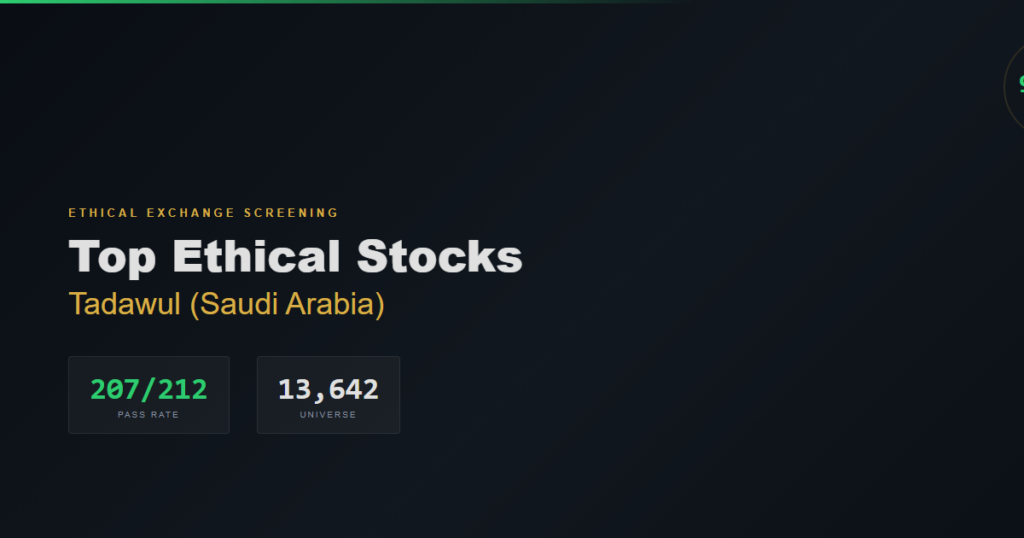
Top Ethical Stocks on Tadawul (Saudi Arabia): A Multi-Framework Analysis for 2026
Screening 212 tickers across Shariah compliance, ESG, socially responsible investing, and faith-based criteria. Published by Alpha Insights Ethical Screener.
Why Tadawul Matters for Ethical Investors
Saudi Arabia’s Tadawul is the largest stock exchange in the Middle East by market capitalisation, and it sits at the centre of the world’s largest Islamic finance ecosystem. With over $800 billion in listed equity and a regulatory framework deeply influenced by Shariah principles, Tadawul offers a unique proposition: a market where ethical-trading/” style=”color:#D8AF44;text-decoration:underline” title=”Ethical Trading”>ethical screening is not an afterthought but a structural feature.
Vision 2030 — the Kingdom’s sweeping economic diversification programme — has accelerated the listing of non-oil companies, expanded foreign investor access via the Qualified Foreign Investor (QFI) framework, and introduced ESG disclosure requirements that align Saudi capital markets with global standards. For ethical investors, whether driven by Islamic finance principles, environmental concerns, or socially responsible mandates, Tadawul now represents one of the most accessible and deeply screened emerging markets on the planet.
The exchange’s composition is also notable: unlike Western markets where banks, alcohol producers, and defence contractors form a significant share of indices, Tadawul’s listed universe skews naturally towards sectors that pass most ethical screens — petrochemicals, building materials, healthcare, agriculture, and Islamic banking. This structural advantage means that the pass rate for ethical screening on Tadawul is among the highest of any major exchange globally.
Our Screening Methodology
Every ticker in our universe passes through a multi-layered screening process that goes well beyond simple Shariah compliance. Our blended ethical score integrates:
- Shariah/AAOIFI compliance: Debt-to-market-cap ratios, interest-bearing securities as a percentage of assets, revenue purity (permissible vs impermissible income), and business activity screening against prohibited sectors.
- ESG scoring: Environmental impact metrics, social responsibility indicators (labour practices, community engagement), and governance quality (board independence, audit transparency).
- Socially Responsible Investing (SRI) criteria: Exclusion of weapons manufacturers, tobacco, gambling, and companies with significant controversies.
- Faith-based screening: Additional criteria relevant to Christian, Jewish, and Buddhist ethical investment frameworks, including usury restrictions and life-ethics considerations.
- Environmental impact assessment: Carbon intensity, resource depletion metrics, and alignment with transition pathways.
Our full methodology, including threshold values and weighting logic, is detailed on our Ethical Trading Screener page. Scores range from 0 to 100, with higher values indicating stronger alignment across all frameworks.
The Numbers: Tadawul Ethical Screening Summary
The five tickers that fail our screen do so primarily due to excessive exposure to conventional interest-based financial activities or insufficient revenue purity. In some cases, companies pass Shariah screens but fail ESG criteria due to environmental controversies, or vice versa — which is precisely why a multi-framework approach is essential.
Top 10 Ethical Stocks on Tadawul
Scores as of latest screening cycle. Compare any ticker at /compare-tickers/. Full country guide: /country-guides/.
Spotlight: Top 3 Ethical Stocks
1. Al Jazira Bank (1120.SR) — Blended Score: 75.0
Bank AlJazira is one of Saudi Arabia’s oldest fully Shariah-compliant banks, operating exclusively under Islamic banking principles since its restructuring in the early 2000s. All products — from retail accounts to corporate financing — are structured as murabaha, ijara, or musharaka contracts, with zero conventional interest exposure.
From an ESG perspective, AlJazira scores well on governance through its independent Shariah board and transparent audit processes. Its relatively small environmental footprint (as a service-sector business) and strong community programmes contribute to solid SRI alignment. For faith-based investors beyond the Islamic framework, the absence of usury-based products and the focus on asset-backed financing resonate with principles shared across multiple traditions.
Key financials: market capitalisation of approximately SAR 15 billion, dividend yield around 3.2%, and debt-to-equity ratios well within AAOIFI thresholds. The bank has consistently grown its Islamic financing book at 8-12% annually over the past five years.
2. Al Rajhi Bank (1180.SR) — Blended Score: 72.5
Al Rajhi is the world’s largest Islamic bank by market capitalisation and a cornerstone of the Saudi financial system. With over 500 branches and a dominant position in retail Islamic banking, it serves as the benchmark for Shariah-compliant banking globally. Every product offered is vetted by its Shariah board, and the bank publishes detailed compliance reports annually.
The slight discount to Al Jazira’s score reflects Al Rajhi’s scale-related ESG challenges: its larger operational footprint generates higher absolute emissions, and its extensive branch network raises governance complexity. However, its investment in digital banking (the “Neo” platform) has significantly reduced its per-customer environmental impact. SRI frameworks give it high marks for financial inclusion — Al Rajhi’s agent banking programme reaches underserved communities across the Kingdom.
Key financials: market capitalisation exceeding SAR 300 billion, return on equity consistently above 20%, and a dividend yield of approximately 2.5%. It is the most liquid stock on Tadawul and the primary vehicle for international investors seeking Saudi Islamic banking exposure.
3. Saudi Kayan (4200.SR) — Blended Score: 65.6
Saudi Kayan Petrochemical Company is a SABIC subsidiary that produces ethylene, propylene, polypropylene, and other basic chemicals. It passes Shariah screens comfortably — its business activities are entirely permissible, and its debt ratios remain within AAOIFI limits. Revenue purity is not a concern as there is no involvement in prohibited activities.
Where Kayan’s score diverges across frameworks is on the environmental dimension. ESG-focused investors will note the inherently high carbon intensity of petrochemical production, though Kayan has invested in energy recovery systems and water recycling that place it ahead of many global peers. SRI frameworks evaluate it neutrally — it produces essential industrial materials without direct consumer harm. Faith-based screens across traditions find no objectionable business activity.
Key financials: market capitalisation around SAR 20 billion, cyclical earnings tied to global chemical prices, and a variable dividend policy. The stock offers exposure to Saudi Arabia’s downstream energy value chain at a lower valuation than Aramco.
Multi-Framework Comparison: How Different Ethical Lenses See These Stocks
A stock that passes one ethical framework does not automatically pass all of them. Each lens evaluates different dimensions, and Tadawul’s listed universe provides instructive examples of where frameworks converge and diverge.
How to Invest: Access by Region
Tadawul opened to direct foreign investment in 2015 through the QFI programme, and access has expanded significantly since. Here is how investors from different regions can gain exposure:
United States
Interactive Brokers offers direct access to Tadawul for US residents, with trading in Saudi Riyals (SAR). The SAR is pegged to the USD at 3.75, eliminating currency risk — a significant advantage over most emerging market investments. No major Saudi ADRs trade on US exchanges, making direct access the primary route. The iShares MSCI Saudi Arabia ETF (KSA) provides passive exposure but includes all Tadawul stocks, not just ethically screened ones.
United Kingdom
Interactive Brokers and Saxo Bank both provide Tadawul access for UK investors. Trading is in SAR, and the SAR/GBP rate benefits from the dollar peg’s stability. ISA eligibility varies by platform — check with your provider. The HSBC Saudi Arabia Equity Fund and Franklin FTSE Saudi Arabia ETF offer fund-based alternatives.
Europe
European investors can access Tadawul through Saxo Bank (Denmark-based, available across the EU), Interactive Brokers, and select private banks. The Invesco MSCI Saudi Arabia UCITS ETF is available on European exchanges for those preferring fund wrappers. MiFID II regulations apply to Saudi securities traded through EU-regulated brokers.
Asia & Middle East
Regional investors have the broadest access. Saudi Fransi Capital, Al Rajhi Capital, and SNB Capital offer direct brokerage accounts. GCC nationals face minimal restrictions. For investors in Malaysia, Singapore, and Hong Kong, Interactive Brokers remains the most practical route. The SAR peg to USD means Asian investors should monitor their local currency against the dollar rather than against the riyal directly.
Regulatory Context: Saudi Capital Markets
The Capital Market Authority (CMA) regulates all securities activity on Tadawul. Key regulatory features relevant to ethical investors:
- Shariah governance: All listed Islamic financial institutions are required to maintain independent Shariah boards. The Saudi Central Bank (SAMA) oversees Shariah compliance at the institutional level.
- ESG disclosure: Since 2021, the CMA has required listed companies to publish sustainability reports. Compliance is evolving but coverage is expanding annually.
- Foreign ownership limits: Most sectors allow up to 49% foreign ownership. Strategic sectors (banking, telecoms) may have lower thresholds. The QFI framework has been progressively liberalised.
- Settlement: Tadawul operates on a T+2 settlement cycle, aligned with international standards.
- Zakat and tax: Saudi companies pay zakat (Islamic wealth tax) rather than corporate income tax. Foreign investors are subject to a 20% withholding tax on dividends, though this may be reduced under bilateral tax treaties.
Vision 2030 has introduced additional market infrastructure including a derivatives market (Tadawul Derivatives), a parallel market for smaller companies (Nomu), and an expanded ETF ecosystem — all of which are expanding the toolkit available to ethical investors seeking targeted exposure.
For halal status reviews on specific Saudi tickers, visit our Is It Halal? page. For the full Saudi country guide, see /country-guides/.
Disclaimer: This article is for informational and educational purposes only and does not constitute financial, investment, or religious advice. Ethical screening scores are based on publicly available data and our proprietary methodology. They do not guarantee Shariah compliance, ESG alignment, or suitability for any specific investment mandate. Individual scholars, Shariah boards, and advisory committees may reach different conclusions on the permissibility of specific securities. Always consult a qualified financial adviser and, where relevant, a recognised religious authority before making investment decisions. Past performance is not indicative of future results. Alpha Insights by Titan Protect is not a licensed financial adviser.