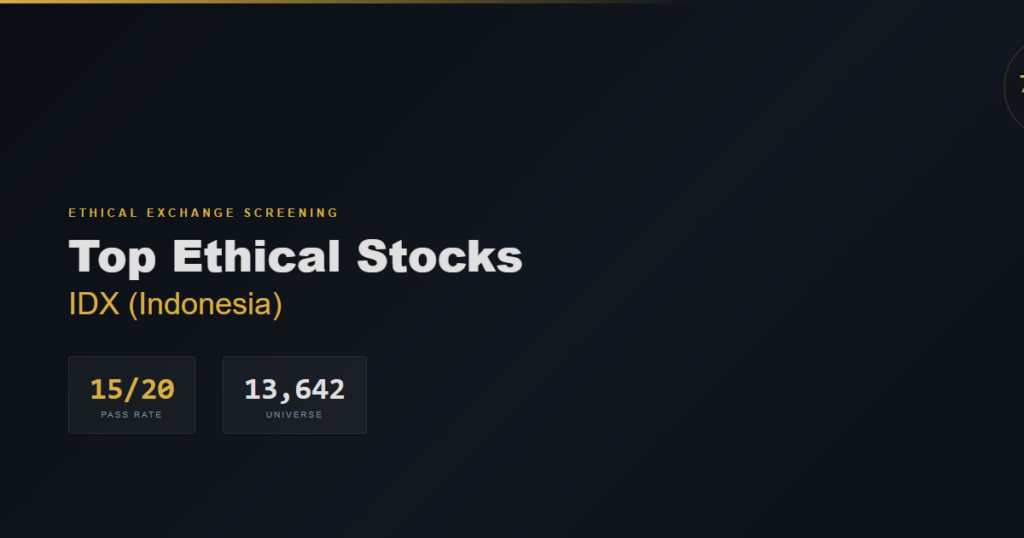
Top Ethical Stocks on IDX (Indonesia): A Multi-Framework Analysis for 2026
Screening 20 tickers across Shariah compliance, ESG, socially responsible investing, and faith-based criteria. Published by Alpha Insights Ethical Screener.
Why IDX Matters for Ethical Investors
Indonesia is the world’s largest Muslim-majority nation, home to approximately 230 million Muslims — more than the entire population of most countries. This demographic reality has shaped the country’s capital markets in ways that create natural alignment with ethical-trading/” style=”color:#D8AF44;text-decoration:underline” title=”Ethical Trading”>ethical investing principles, even as the regulatory framework continues to evolve.
The Indonesia Stock Exchange (IDX), based in Jakarta, is Southeast Asia’s second-largest exchange by market capitalisation. Since 2000, the exchange has operated the Jakarta Islamic Index (JII), which tracks the 30 most liquid Shariah-compliant stocks. The Otoritas Jasa Keuangan (OJK), Indonesia’s financial services authority, maintains a biannual list of Shariah-compliant securities (Daftar Efek Syariah or DES) that now covers over 500 of the exchange’s listed companies.
Indonesia’s Islamic finance ecosystem is distinct from its GCC and Malaysian counterparts. While the regulatory framework is younger, the scale of the addressable market is enormous. The government has issued sovereign sukuk (SBSN) since 2008, and the sukuk market is growing at double-digit rates annually. Bank Syariah Indonesia (BSI), formed from the 2021 merger of three state-owned Islamic banks, is now among the world’s largest Islamic banks and is accelerating the shift of retail banking towards Shariah-compliant products.
For international ethical investors, Indonesia offers exposure to a rapidly growing consumer economy with a young population and rising middle class — factors that are difficult to replicate in more mature markets. The challenge lies in data availability and market access, both of which are improving but remain more complex than in GCC or Malaysian markets.
Our Screening Methodology
Our multi-framework screening for Indonesian equities integrates:
- Shariah/AAOIFI compliance: Cross-referenced against OJK’s Daftar Efek Syariah (DES) list and independently verified using AAOIFI thresholds. Indonesia’s screening methodology differs slightly from Malaysia’s — it uses a total-debt-to-total-assets ratio of 45% rather than debt-to-market-cap.
- ESG scoring: Environmental metrics (deforestation is a critical factor for palm oil and mining companies), social indicators (minimum wage compliance, community impact), and governance (family ownership structures are common and require scrutiny).
- Socially Responsible Investing (SRI) criteria: Tobacco exclusion is significant — Gudang Garam and HM Sampoerna are among Indonesia’s largest listed companies. Weapons and gambling exclusions are less material.
- Faith-based screening: Multi-tradition analysis with particular attention to usury restrictions and environmental stewardship.
- Environmental impact assessment: Indonesia’s role as a major palm oil producer, coal miner, and deforestation hotspot makes environmental screening especially consequential.
Full methodology on our Ethical Trading Screener page.
The Numbers: IDX Ethical Screening Summary
The five failures break down as follows: conventional banks (Bank Central Asia Tbk passes due to its mixed banking model, but some smaller conventional banks fail on revenue purity), tobacco manufacturers (Gudang Garam fails SRI and faith-based screens despite passing Shariah screens under some interpretations), and companies with excessive conventional debt ratios. Indonesia’s reliance on tobacco revenue makes this a more consequential exclusion than in most markets.
Top Ethical Stocks on IDX
Scores as of latest screening cycle. Compare any ticker at /compare-tickers/. Full country guide: /country-guides/.
Spotlight: Top 3 Ethical Stocks
1. Bank Central Asia (BBCA.JK) — Blended Score: 66.4
Bank Central Asia is Indonesia’s largest private bank by market capitalisation and one of the most profitable banks in Southeast Asia. While BCA is primarily a conventional bank, it operates BCA Syariah as a subsidiary — a fully Shariah-compliant banking unit that has grown rapidly as Indonesian consumer demand for Islamic financial products increases.
BCA’s inclusion on the OJK Shariah-compliant list reflects Indonesia’s more accommodating screening methodology, which evaluates the consolidated entity’s financial ratios rather than requiring pure Islamic banking operations. For investors applying stricter Shariah standards (AAOIFI), BCA’s conventional banking revenue would be a concern. However, its ESG profile is strong: BCA leads Indonesian banks in digital banking adoption (reducing branch footprint), financial literacy programmes, and governance transparency. SRI frameworks approve its exclusion of weapons financing and its community investment track record.
Key financials: market capitalisation exceeding IDR 1,200 trillion (approximately $75 billion), making it the most valuable company on IDX. Return on equity consistently above 20%, dividend yield around 2.5%. BCA is the benchmark stock for Indonesian equity exposure.
2. Kalbe Farma (KLBF.JK) — Blended Score: 64.2
Kalbe Farma is Indonesia’s largest pharmaceutical company, producing prescription drugs, over-the-counter medicines, nutritional products, and health foods. The business is entirely permissible under Shariah screening — healthcare is considered a beneficial activity, and Kalbe’s halal-certified product lines add further compliance assurance. Debt ratios are conservative, well within all screening thresholds.
Kalbe excels across ethical frameworks. ESG scores benefit from healthcare’s inherently positive social impact, strong governance (the Kalbe Foundation’s community health programmes), and relatively low environmental impact compared to extractive industries. SRI frameworks score it highly for positive health outcomes. Faith-based screens across traditions view healthcare as aligned with stewardship principles. The only area of scrutiny is environmental — pharmaceutical manufacturing generates chemical waste, though Kalbe’s waste management practices are audited and compliant.
Key financials: market capitalisation around IDR 80 trillion, consistent revenue growth driven by Indonesia’s expanding healthcare spending, and a dividend yield of approximately 2.5%. Kalbe offers a rare combination of ethical alignment and defensive earnings characteristics.
3. Telkom Indonesia (TLKM.JK) — Blended Score: 63.5
PT Telkom Indonesia is the country’s dominant telecommunications provider, majority-owned by the Indonesian government. It operates fixed-line, mobile (through Telkomsel), and digital services. Telecommunications passes Shariah screens as a permissible activity, and Telkom’s debt ratios are managed conservatively despite significant capital expenditure programmes.
Telkom’s ethical profile is bolstered by its role in digital inclusion — connecting Indonesia’s 17,000-island archipelago is inherently a social good. Its IndiHome fibre broadband programme reaches underserved areas, aligning with SRI positive-impact criteria. ESG scores are moderate: governance is transparent (as a state-owned enterprise, it publishes extensive reports), but the environmental footprint of tower infrastructure and data centres is notable. Faith-based frameworks find no objectionable activity.
Key financials: market capitalisation around IDR 380 trillion, dividend yield of approximately 4%, and stable cash flows from a subscriber base exceeding 160 million. The stock provides defensive, utility-like characteristics within an emerging market wrapper.
Multi-Framework Comparison: How Different Ethical Lenses See Indonesian Stocks
Indonesia presents sharp framework divergences, particularly around tobacco and coal — two sectors that are economically significant but ethically contentious.
How to Invest: Access by Region
United States
Interactive Brokers provides direct IDX access, trading in Indonesian Rupiah (IDR). Telkom Indonesia has an ADR (TLK) on the NYSE, offering the most accessible entry point for US investors. The iShares MSCI Indonesia ETF (EIDO) provides passive exposure. Currency note: IDR is a managed float and has historically been volatile against USD — expect swings of 5-15% annually.
United Kingdom
Interactive Brokers UK offers IDX access. No major Indonesia-specific funds or ETFs trade on the LSE, but ASEAN-focused and emerging market funds typically include Indonesian names. Fidelity Indonesia Fund and Aberdeen Standard Indonesia Equity Fund are available through fund platforms. The IDR/GBP cross rate adds meaningful currency exposure.
Europe
European investors can access IDX through Interactive Brokers and, for larger accounts, through Saxo Bank. The Xtrackers MSCI Indonesia Swap UCITS ETF provides fund-based exposure on European exchanges. Indonesia’s inclusion in MSCI Emerging Markets means most broad EM UCITS funds carry some Indonesian exposure.
Asia & Middle East
Indonesian residents use local brokers such as Mandiri Sekuritas, BCA Sekuritas, or Indo Premier. Singapore and Hong Kong investors can access IDX via Interactive Brokers or Philip Securities. For GCC investors, Indonesia represents a natural diversification play — a large Muslim-majority economy with a very different economic structure from oil-dependent GCC markets.
Regulatory Context: Indonesian Capital Markets
The Otoritas Jasa Keuangan (OJK) is the integrated financial services authority overseeing the IDX and all capital market activity. Key features for ethical investors:
- Daftar Efek Syariah (DES): The OJK publishes a biannual list of Shariah-compliant securities. Over 500 stocks currently qualify. The screening uses a total-debt-to-total-assets ratio of 45% and a non-halal-income-to-revenue ratio of 10%.
- Jakarta Islamic Index (JII): Tracks the 30 most liquid Shariah-compliant stocks on IDX. Reconstituted biannually. Serves as the benchmark for Indonesian Islamic equity mandates.
- Sustainability reporting: Mandatory for financial services companies and gradually expanding to all listed companies. The OJK’s Sustainable Finance Roadmap (Phase II) sets targets for ESG integration across the financial sector.
- Foreign ownership: Generally liberal, with most sectors allowing up to 100% foreign ownership. Banking has a 40% limit for individual investors (higher for institutional). Media and certain strategic sectors have tighter restrictions.
- Settlement: T+2 settlement cycle. Indonesian Central Securities Depository (KSEI) handles settlement.
- Withholding tax: 20% on dividends for non-resident investors, reducible under bilateral tax treaties (many treaties reduce this to 10-15%).
For halal reviews on specific Indonesian tickers, visit Is It Halal?. For the full Indonesia country guide, see /country-guides/.
Disclaimer: This article is for informational and educational purposes only and does not constitute financial, investment, or religious advice. Ethical screening scores are based on publicly available data and our proprietary methodology. They do not guarantee Shariah compliance, ESG alignment, or suitability for any specific investment mandate. The OJK’s Daftar Efek Syariah is an independent reference and may differ from our scoring. Always consult a qualified financial adviser and, where relevant, a recognised religious authority before making investment decisions. Past performance is not indicative of future results. Alpha Insights by Titan Protect is not a licensed financial adviser.