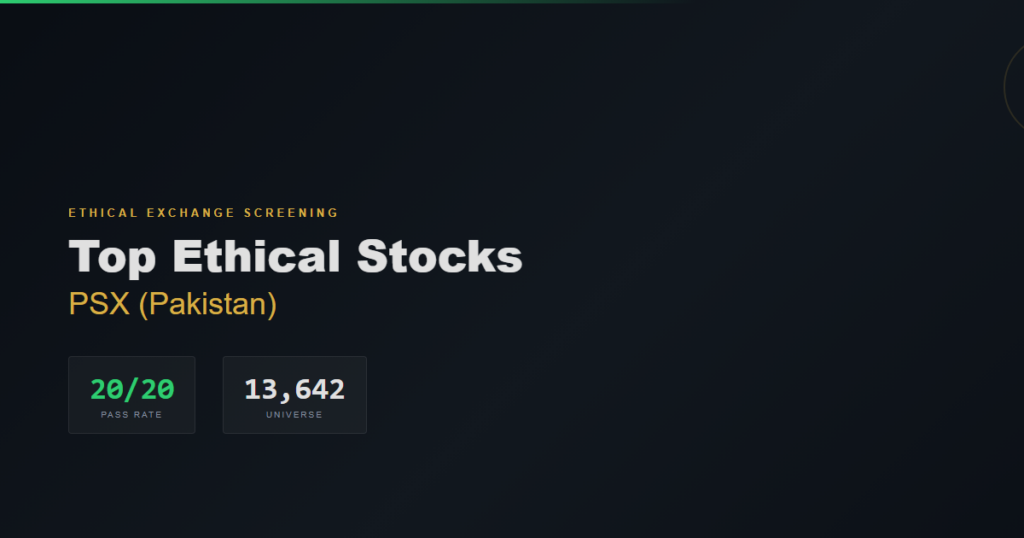
Top Ethical Stocks on PSX (Pakistan): A Multi-Framework Analysis for 2026
Screening 20 tickers across Shariah compliance, ESG, socially responsible investing, and faith-based criteria. Published by Alpha Insights Ethical Screener.
Why PSX Matters for Ethical Investors
The Pakistan Stock Exchange (PSX) serves a nation of over 230 million people — the world’s fifth most populous country and one where more than 95% of the population identifies as Muslim. Pakistan’s capital markets sit at an inflection point: a young, digitally connected population, a government actively promoting Islamic finance, and a regulatory framework that is integrating Shariah governance into the fabric of the financial system.
PSX was formed in 2016 from the merger of Karachi, Lahore, and Islamabad stock exchanges, creating a unified national exchange. The exchange’s benchmark, the KSE-100, has been one of the strongest-performing frontier market indices over the past decade, delivering returns that outpaced many emerging market peers despite significant macroeconomic volatility.
What makes Pakistan distinctive for ethical-trading/” style=”color:#D8AF44;text-decoration:underline” title=”Ethical Trading”>ethical investors is the depth of Islamic finance infrastructure. Meezan Bank, the country’s largest Islamic bank, publishes its own Shariah-compliant stock index (KMI-30) and maintains a team of scholars who screen the entire PSX universe. The Securities and Exchange Commission of Pakistan (SECP) has established a dedicated Islamic Finance Department and published a comprehensive Islamic Finance regulatory framework. State Bank of Pakistan has set ambitious targets for Islamic banking’s share of total banking assets, currently targeting 30% by 2025.
Pakistan’s market also offers exposure to sectors that are underrepresented on GCC exchanges: fertiliser companies, cement manufacturers, textile producers, and energy utilities. These sectors cater to domestic demand in a rapidly urbanising economy and tend to pass ethical screens more comfortably than financial or extractive-sector companies.
Our Screening Methodology
Our multi-framework screening for Pakistani equities integrates:
- Shariah/AAOIFI compliance: Cross-referenced against Meezan Bank’s KMI-30 methodology and independently verified using AAOIFI thresholds. Meezan’s screening applies stricter criteria than some international standards, including a total-illiquid-assets-to-total-assets test unique to their methodology.
- ESG scoring: Environmental metrics (energy sector emissions, water usage in agriculture), social indicators (labour standards, community development), and governance quality (family ownership structures, minority shareholder protections).
- Socially Responsible Investing (SRI) criteria: Pakistan’s listed universe is largely free of SRI exclusion triggers — no listed tobacco manufacturers, gambling operators, or weapons producers of significance.
- Faith-based screening: Multi-tradition analysis with usury restrictions and stewardship principles.
- Environmental impact assessment: Energy generation mix (coal vs gas vs hydro), fertiliser production emissions, and cement sector carbon intensity.
Full methodology on our Ethical Trading Screener page.
The Numbers: PSX Ethical Screening Summary
The 100% pass rate reflects both the composition of Pakistan’s blue-chip universe and our coverage selection. It is important to note that the broader PSX-listed universe of over 500 companies would include conventional banks, insurance companies, and firms with higher debt ratios that might fail under stricter thresholds. Our current 20-ticker coverage is focused on the most liquid, well-documented names — many of which naturally align with ethical screening criteria.
Top 10 Ethical Stocks on PSX
Scores as of latest screening cycle. Compare any ticker at /compare-tickers/. Full country guide: /country-guides/.
Spotlight: Top 3 Ethical Stocks
1. Meezan Bank (MEBL.KA) — Blended Score: 68.7
Meezan Bank is Pakistan’s largest and first dedicated Islamic bank, and it has become the standard-bearer for Shariah-compliant banking in the country. Every product and service is structured under Islamic principles, vetted by a Shariah board chaired by Justice (Retd.) Muhammad Taqi Usmani — one of the world’s most respected Islamic finance scholars. The bank operates over 1,000 branches and has grown its asset base at over 25% annually for the past five years.
Meezan scores well across all ethical frameworks. Its pure Islamic banking model eliminates usury concerns for faith-based investors of all traditions. ESG performance benefits from strong governance (independent Shariah board, transparent reporting) and significant community banking programmes reaching rural and underserved populations. SRI frameworks approve the absence of any excluded activities. The bank’s relatively low environmental footprint as a service-sector company rounds out the profile.
Key financials: market capitalisation around PKR 450 billion, return on equity above 30% (among the highest of any Pakistani listed company), and a dividend yield of approximately 5%. Meezan is increasingly viewed as the bellwether for Pakistan’s Islamic finance sector.
2. Engro Corporation (ENGRO.KA) — Blended Score: 65.3
Engro Corporation is Pakistan’s premier conglomerate, operating across fertilisers (Engro Fertilizers), energy (Engro Energy), food (Friesland Campina Engro Pakistan), petrochemicals, and telecommunications infrastructure. The diversified business model provides natural hedging against Pakistan’s macroeconomic volatility.
Engro passes Shariah screens on business activity (all segments are permissible) and financial ratios (conservative debt management). The multi-framework picture is nuanced: ESG scores benefit from Engro’s leadership in corporate governance (it is widely regarded as Pakistan’s best-governed company) and its sustainability programmes, but face challenges from the environmental impact of fertiliser production and energy generation. SRI frameworks approve the food security contribution of the fertiliser business while flagging the carbon footprint. The company’s Thar coal mining venture adds complexity — it provides energy security for Pakistan but raises climate transition questions.
Key financials: market capitalisation around PKR 300 billion, diversified revenue streams reducing cyclicality risk, and a dividend yield of approximately 4%. Engro is often the first stock recommended to international investors seeking Pakistan exposure due to its governance standards and operational transparency.
3. Fauji Fertilizer Company (FFC.KA) — Blended Score: 63.8
Fauji Fertilizer is Pakistan’s largest fertiliser producer by capacity, part of the Fauji Foundation group (a military-affiliated charitable trust that is one of Pakistan’s largest conglomerates). The company produces urea and other agricultural inputs essential for Pakistan’s food security — a business activity that passes Shariah screens cleanly and aligns with positive-impact criteria under SRI and faith-based frameworks.
FFC’s ethical profile benefits from its connection to Fauji Foundation, which allocates profits to charitable purposes including hospitals, schools, and welfare programmes. Governance is structured but faces scrutiny over the military-foundation ownership model, which some ESG frameworks flag for transparency concerns. Environmental impact centres on natural gas consumption (feedstock for urea production) and nitrous oxide emissions — areas where FFC has invested in efficiency improvements but remains a significant emitter by Pakistani standards.
Key financials: market capitalisation around PKR 200 billion, consistently high dividend yields (often above 8%, making it one of PSX’s premier income stocks), and stable cash flows driven by domestic fertiliser demand. The stock is a staple of Pakistan-focused income portfolios.
Multi-Framework Comparison: How Different Ethical Lenses See Pakistani Stocks
How to Invest: Access by Region
United States
Direct access to PSX is limited for US retail investors. Interactive Brokers does not currently offer PSX trading. The primary access routes are: (1) the Global X MSCI Pakistan ETF (PAK), which trades on the NYSE and provides passive exposure; (2) frontier market funds that include Pakistan allocations; or (3) opening an account with a Pakistani broker (requires a Special Convertible Rupee Account for foreign investors). Currency risk is significant — PKR has depreciated substantially against USD in recent years.
United Kingdom
UK investors face similar access challenges. No PSX-listed stocks have London-traded ADRs or GDRs. Frontier market funds available on UK platforms (such as those managed by Franklin Templeton or T. Rowe Price) may include Pakistani names. For direct access, UK investors would need to open an account with a Pakistani broker and use the SCRA (Special Convertible Rupee Account) framework.
Europe
European access is primarily through frontier market UCITS funds with Pakistani exposure. No Pakistan-specific UCITS ETFs are widely available. Mobius Capital Partners and similar frontier-focused managers may hold Pakistani positions. Direct brokerage access requires the same SCRA framework as other international investors.
Asia & Middle East
Pakistani residents and overseas Pakistanis can use domestic brokers including AKD Securities, JS Global Capital, Arif Habib Limited, and BMA Capital. For GCC-based investors, the SCRA framework allows repatriation of capital and dividends. Pakistan’s inclusion in MSCI Frontier Markets indices means some ASEAN and Middle Eastern institutional investors already carry passive exposure through index funds.
Regulatory Context: Pakistani Capital Markets
The Securities and Exchange Commission of Pakistan (SECP) regulates PSX and all capital market activity. Key features for ethical investors:
- Islamic Finance Department: The SECP has a dedicated department for Islamic capital markets, responsible for Shariah-compliant securities regulation, sukuk market oversight, and Islamic mutual fund supervision.
- Meezan KMI-30: The KSE Meezan Index tracks 30 Shariah-compliant stocks selected by Meezan Bank’s Shariah board. It is reconstituted biannually and serves as the benchmark for Islamic equity investing in Pakistan.
- State Bank of Pakistan Islamic banking targets: The central bank has set explicit targets for Islamic banking market share, creating a regulatory tailwind for Shariah-compliant institutions.
- Foreign investor framework: The SCRA system allows foreign investors to buy, sell, and repatriate proceeds from PSX investments. Capital gains tax for non-residents is 15% on gains from stocks held less than one year, 12.5% for holdings of one to two years, and zero for holdings exceeding two years.
- Settlement: T+2 settlement cycle. Central Depository Company of Pakistan (CDC) handles settlement and custody.
- Withholding tax on dividends: 15% for non-resident investors, potentially reduced under bilateral tax treaties.
For halal reviews on specific Pakistani tickers, visit Is It Halal?. For the full Pakistan country guide, see /country-guides/.
Disclaimer: This article is for informational and educational purposes only and does not constitute financial, investment, or religious advice. Ethical screening scores are based on publicly available data and our proprietary methodology. They do not guarantee Shariah compliance, ESG alignment, or suitability for any specific investment mandate. Pakistan’s frontier market status means liquidity, settlement, and currency risks are elevated compared to developed or emerging markets. Always consult a qualified financial adviser and, where relevant, a recognised religious authority before making investment decisions. Past performance is not indicative of future results. Alpha Insights by Titan Protect is not a licensed financial adviser.