
A Titan Protect guide. Educational, not advice. First published 16 August 2026; figures updated 18 October 2026, with the date of each one stated.
If your fixed deal is ending this year, you are joining a very large crowd. Roughly 1.8 million UK fixed-rate deals are due to expire in 2026, and a good share of those were locked in when money was cheap. The reset from a sub-3% rate to today’s market is the single biggest financial change many households will face this year. So it is worth slowing down and understanding the ground you are standing on before you sign anything.
This guide walks through where rates actually are right now, how conventional and Islamic home finance compare on cost, and how to think about the decision rather than what to decide. Your circumstances are yours. Ours is to make the picture clear.
What this guide does and does not do. It compares cost and fit with your circumstances. It gives no religious ruling either way. Whether a particular product meets your religious requirements is a question for a qualified scholar you trust.
Where rates actually are, October 2026
Start with the anchor. The Bank of England Base Rate is 3.75%. The Bank held it there at its June, July and September meetings, and at the July meeting three of the nine committee members wanted to raise it, not cut it. The next decision is on 5 November 2026. The message underneath the number matters more than the number itself: the run of cuts that carried us down from the highs has stopped, and some members are watching energy-driven inflation and leaning towards a hike. Do not assume the next move is down.
The conventional market has moved since the summer. Moneyfacts figures:
- The average two-year fixed rate was 5.98% on 5 October 2026, up from about 5.62% in mid-August and the highest since December 2023.
- The average five-year fixed rate reached about 6% on 5 October, up from about 5.66% in mid-August, the first time at that level in roughly three years.
- The average standard variable rate, the rate most deals quietly roll onto if you do nothing, was 7.13% in mid-August. We could not confirm a newer figure.
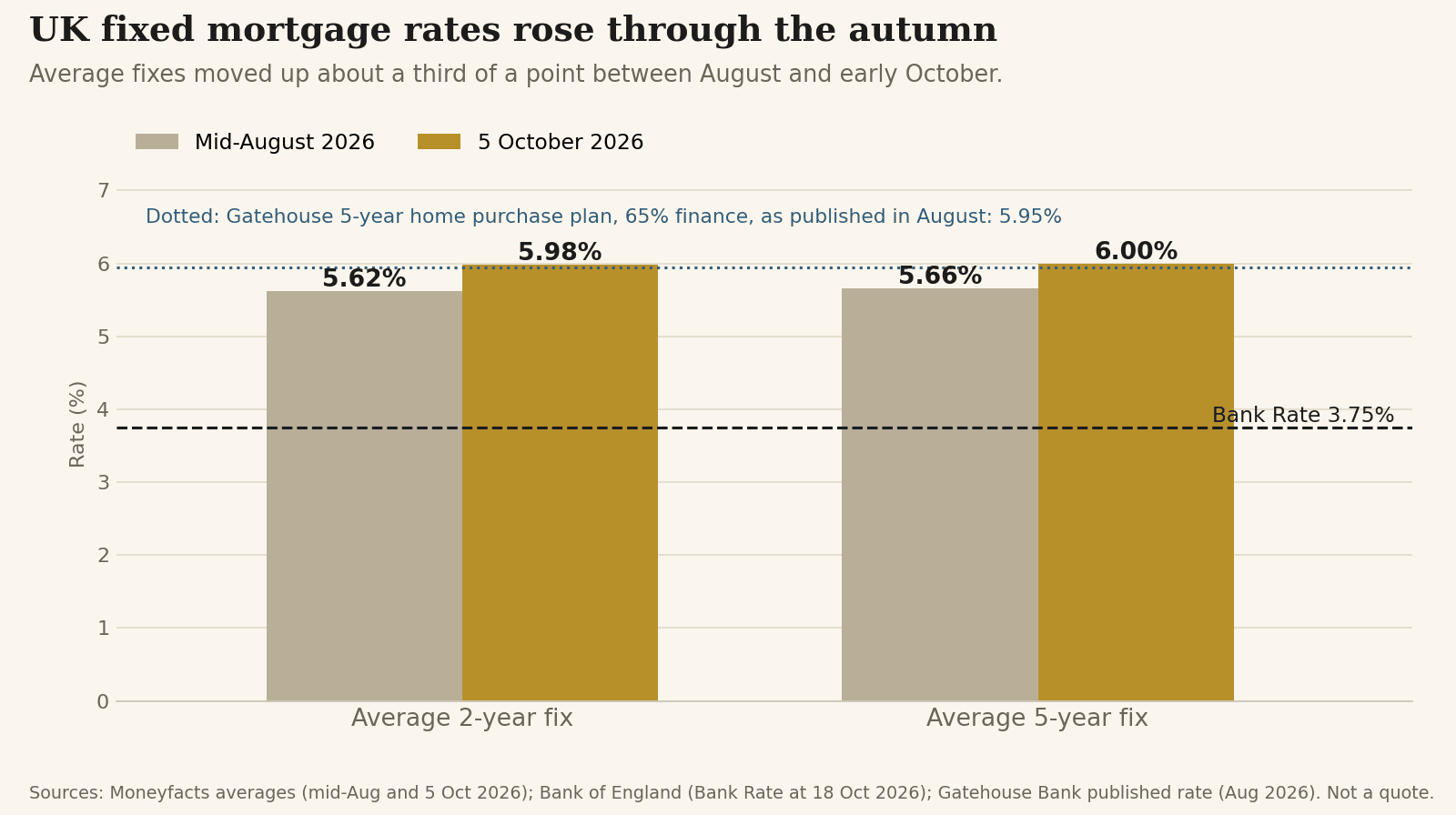
Two things deserve your attention. First, the five-year fix is priced at or slightly above the two-year, which is the reverse of the old rule of thumb. The market is telling you it does not expect rates to fall far or fast, so it is not offering much of a discount for committing longer. Second, the gap between the average deal and the standard variable rate is large. On a 250,000 pound balance, drifting onto a 7.13% SVR instead of a 5.66% fix (the mid-August figures) costs roughly 230 pounds a month more. Letting a fix lapse by accident is the most expensive kind of doing nothing.
The sharp end of the market has thinned out. In mid-August, borrowers with plenty of equity could find five-year fixes around 4.5% to 4.8% at 60% to 75% loan-to-value. By 5 October, Moneyfacts counted just 9 fixed deals priced under 5%, down from about 1,500 at the start of September. The spread between the average and the best deals still matters, which is why shopping the whole market, or using a broker who does, is worth real money.
Direction of travel: rates fell to a spring low, rose again from early August, and kept rising through September as the wholesale swap rates that lenders price from moved up and UK gilt yields hit an 18-year high. Big lenders repriced several times in September alone. A rate that led its category on Monday can be withdrawn by Friday. Treat any headline number, including ours, as a snapshot rather than a promise.
For context, this is not just a British story. In the United States the 30-year fixed averaged 7.40% on 15 October 2026 (Freddie Mac), and the Federal Reserve raised its rate to 3.75% to 4.00% in September, its first hike since 2023. The European Central Bank has also raised rates this year. The common thread is that the easing story of last year has stalled, and energy prices are a big part of the reason. Nobody serious is promising you cheaper money soon.
The conventional decision, in plain terms
Once you accept that rates may not fall much from here, the conventional choice comes down to a few honest trade-offs.
A two-year fix keeps your options open. If rates do drift down, you are back in the market sooner to capture it. You pay for that flexibility with slightly more frequent arrangement fees and the risk that rates are higher, not lower, when you come to remortgage.
A five-year fix buys certainty. You know your payment for five years, which is worth a great deal if your budget is tight or your income is variable. You give up the chance to benefit quickly if rates fall, and you usually accept early repayment charges if you need to exit.
A tracker follows the Base Rate down automatically if the Bank cuts, and many allow penalty-free exit. The catch is symmetry: it follows the Base Rate up just as fast. In a market where some policymakers are voting to raise rates, a tracker is a view, not a safe default.
The quiet fourth option, the standard variable rate, is not really a strategy. At over 7% on average it is where you end up when you stop paying attention, and it is almost always the most expensive room in the house.
None of these is right or wrong in the abstract. The right answer depends on how much certainty your household actually needs, how much equity you hold, and how long you plan to stay put.
Islamic home finance: a genuinely different structure, priced in the same weather
For many buyers the conventional route is not on the table at all, because a conventional mortgage charges interest, and interest is something they will not pay on principle. This is where Islamic, or Sharia-compliant, home finance comes in, and it deserves a clear-eyed look rather than either dismissal or salesmanship.
The mechanics are genuinely different. Instead of lending you money and charging interest, the provider buys the property with you and you buy their share back over time. Three structures do most of the work:
- Diminishing Musharaka is a partnership. You and the provider co-own the home. Each month you pay rent on the share you do not yet own, plus an amount that buys another slice of their share. Your ownership rises, the rent falls, and eventually you own it outright. This is the dominant structure in the UK.
- Ijara is a lease. The provider holds the title and leases the property to you, with ownership transferring at the end of the term. In the UK it is usually combined with Diminishing Musharaka.
- Murabaha is a cost-plus sale. The provider buys the asset and sells it to you at an agreed, disclosed mark-up, paid in instalments. There is no variable rate, but there is also no ongoing partnership. It is more common in bridging and in some overseas markets than in mainstream UK home purchase.
The important honesty here is about pricing. In a Diminishing Musharaka the rent you pay is not interest, and the ownership structure is real. But UK Islamic banks openly set that rent with reference to the Bank of England Base Rate plus a margin, because it is the most consistent and widely accepted benchmark available. So while the contract is structured to avoid interest, the cost still moves with the same interest-rate weather as everyone else. A buyer choosing this route for conviction should understand that they are buying a different structure and a different risk-sharing arrangement, not immunity from the rate cycle. Scholars themselves debate how far these products deliver genuine shared risk versus how far they mirror conventional finance in economic substance. That debate is worth reading, with a scholar you trust, before you sign, not after.
What the gap actually is today
The most recent home purchase plan prices we could confirm are from mid-August 2026:
- Gatehouse Bank: two-year fixed rental rate around 5.99% and five-year around 5.95% at 65% finance-to-value, rising to 6.09% and 6.05% at 80%.
- StrideUp: home finance advertised from 5.99%.
We could not confirm October rates from either provider on 18 October 2026, and they may have repriced as the wider market rose. Get a live quote.
In mid-August, set against the conventional averages of 5.62% for two years and 5.66% for five, the gap against the average deal was modest, on the order of 0.3 to 0.4 of a percentage point. By 5 October the conventional averages had risen to about 6%, level with those August Islamic prices. If the Islamic providers have held their prices, the gap against the average has closed for now; if they have repriced upward, it will be similar to before. Either way, the premium is much narrower than the folklore suggests, and it reflects a more competitive Islamic market than a few years ago.
The gap looks larger when you compare against the conventional best buys. Because there are only a handful of Sharia providers, they compete less fiercely at the very sharp end. In August, a well-qualified borrower with plenty of equity who could reach a 4.5% conventional five-year fix was looking at a difference of more like 1.2 to 1.5 percentage points. With sub-5% fixed deals almost gone by early October, that best-buy gap has likely narrowed too. Whether any premium is worth it is a question of conviction and budget, and only you can weigh that for your own household.
Two practical notes that are easy to miss. First, Al Rayan Bank, for years the household name in this space, now lists home finance only under its Premier banking service, so most new applicants look mainly to Gatehouse and StrideUp. Second, community-model providers such as Pfida price off local rental values rather than the Base Rate, which some buyers prefer, but in August they were running long waitlists. The market is small enough that who is open for business genuinely matters.
A calm way to approach the decision
Whatever route fits your principles and your numbers, the same discipline applies.
1. Find out exactly when your current deal ends, and note that most mortgage offers are valid for up to six months. You can usually lock a new rate now and still switch to a better one if pricing improves before completion. That protects your downside without giving up the upside.
2. Do not sleepwalk onto the standard variable rate. At over 7% on average it is the single most avoidable cost in this whole exercise.
3. Shop the whole market, not the first table you see. The distance between the average and the best deal can be worth a lot for borrowers with equity. A broker who covers both conventional and Sharia-compliant products can compare them side by side.
4. Compare total cost over the full term, not the monthly payment or the headline rate alone. Arrangement fees, product fees, valuation and legal costs, and any early repayment charges all change the real answer. This is doubly true when weighing an Islamic plan against a conventional one, because the fee structures differ.
5. Match the certainty to your life. If your budget has little room, the value of a fixed payment for five years can outweigh a slightly lower but variable cost. If you expect to move or overpay heavily, flexibility may be worth more than the lowest rate.
6. Take the religious question to a scholar. This guide can help you compare cost. It cannot tell you which product is right for your faith. A qualified scholar can.
The market in 2026 is not the emergency it was at the peak, but it is not the bargain of 2021 either. Rates are elevated, the direction is genuinely uncertain, and the cutting cycle has stalled. That is not a reason to panic. It is a reason to make a deliberate choice, understand the structure you are buying, and know the real cost before you commit.
More on the structures: How Islamic home purchase works in the UK and Islamic mortgage structures explained.
This guide is for education only and is not personal financial advice, religious advice, or a recommendation of any specific product or provider. Rates move daily and the figures here are dated snapshots: Bank of England (Bank Rate, 18 October 2026), Moneyfacts (averages for mid-August and 5 October 2026), Freddie Mac (15 October 2026), the Federal Reserve (September 2026 decision), and named provider sources (mid-August 2026). Islamic home finance products are structured to avoid interest but their pricing still references conventional benchmarks, and scholarly views on them differ; please ask a qualified scholar about the religious question. Always check current terms directly with a provider and seek regulated, independent advice before making a decision.