The question nobody asks at enrolment
You ticked a box when you joined your employer. You chose “moderate” or “balanced” because it sounded sensible, and you never looked again. That one choice may have put 30-60% of your retirement savings into bonds, which pay interest, the very thing Islamic finance treats as off-limits.
In the news · 18 October 2026
On 14 October, Middle East Eye reported its reading of the HSBC Islamic Global Equity Index Fund’s half-year report: it says the fund bought about $130m of shares in five companies in the first half of 2026. HSBC did not respond to its request for comment.
We ran the same five stocks through our own screen. Four fail and one passes. That is a result about those five stocks under our tests, not a finding about HSBC or the fund’s scholars. It is also a good reason to do the check below: a fund’s label tells you a screen was run, not what it checked.
This is not a fringe concern. It affects many Muslim workers across the UK who are auto-enrolled into workplace pensions under rules that never considered faith-based finance. The money leaves your pay before you see it, goes into a default fund you did not choose, and compounds for decades in assets you may never have agreed to hold.
Here is what the problem is, how to spot it in your own pension, and what you can do about it today.
The default fund problem
Since 2012, UK employers have had to auto-enrol eligible workers into a workplace pension. The default option, the fund your money goes into if you do not pick one, is almost always a “balanced” or “moderate risk” mix of assets.
These funds typically hold:
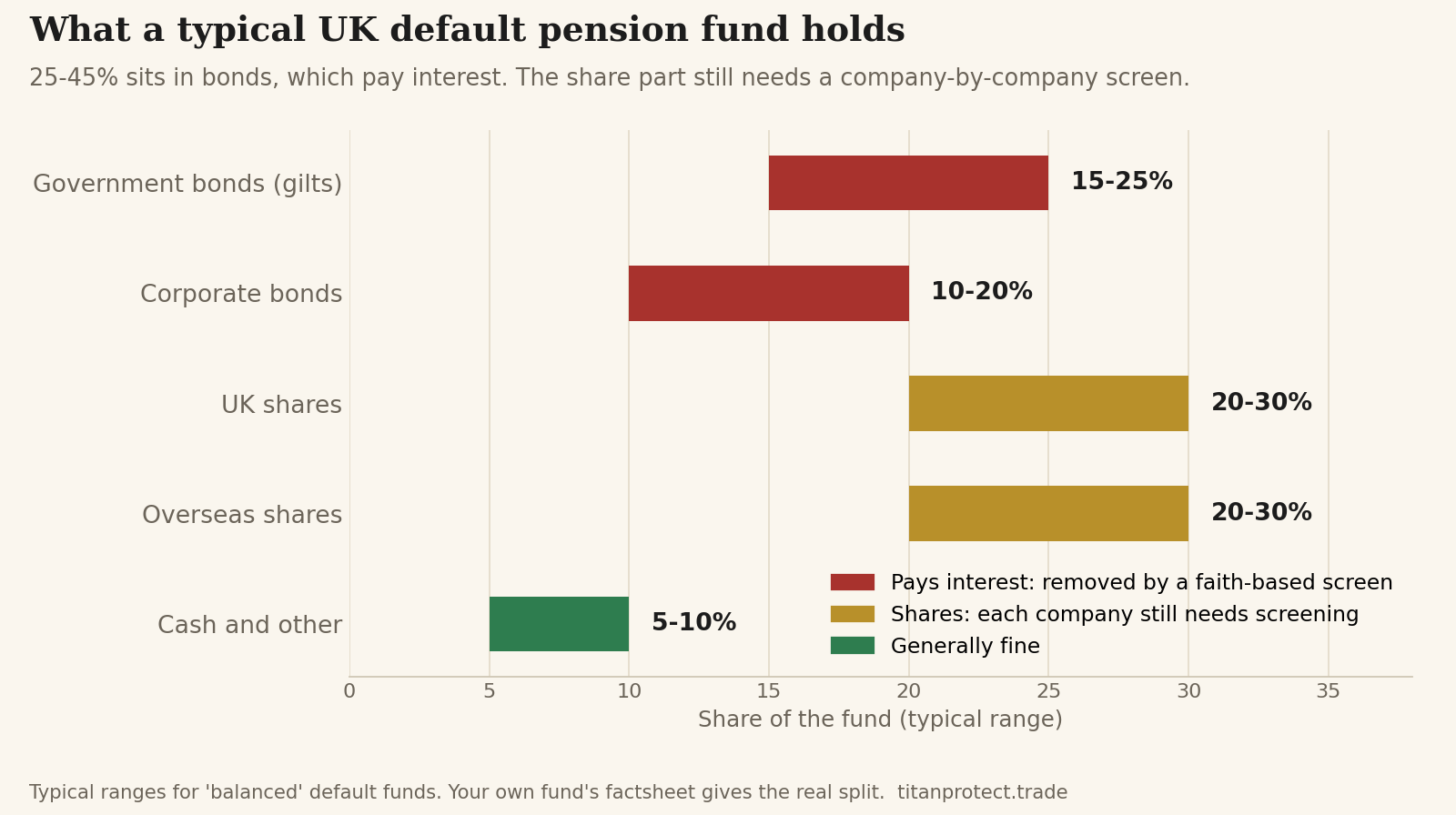
| Asset type | Typical share | The concern |
|---|---|---|
| Government bonds (gilts) | 15-25% | Pays interest (riba) |
| Corporate bonds | 10-20% | Pays interest (riba) |
| UK shares | 20-30% | May include companies that fail a screen |
| Overseas shares | 20-30% | May include companies that fail a screen |
| Cash and other | 5-10% | Generally fine |
So between 25% and 45% of a typical default fund sits in assets that earn their return through interest. That is before you look at the shares, which can include banks, brewers, gambling firms and weapons makers.
Why bonds are the core issue
A bond is, at heart, a loan. When you buy a UK gilt or a company bond, you lend money in return for regular interest payments (coupons) and your money back at the end.
The ban on riba (interest) is one of the clearest and most widely agreed principles across the schools of Islamic law. The Quran names it in several places, and scholars agree on it almost without exception.
This is not a grey area. Scholars can differ on revenue limits or how to classify an industry when screening shares, but a conventional bond pays interest, plainly. If your pension holds bonds, part of your retirement return comes from riba.
How big can it get?
Say you pay £300 a month into a default fund with 40% in bonds. That is £120 a month going into bonds. Over 30 years at a 4% yield, the bond part alone could earn around £40,000 in interest on top of what you paid in. It grows quietly every year, with no prompt to opt out.
How to check what your pension actually holds
This is the first practical step, and it takes less than 15 minutes.
Step by step: check your pension
1. Log in to your pension provider’s website (NEST, Scottish Widows, Aviva, Legal & General, Royal London and so on).
2. Find your current fund. It will have a name like “Default Fund”, “Balanced Fund” or “Moderate Growth”.
3. Open the fund factsheet. Every regulated fund must publish one.
4. Find the asset allocation, usually a pie chart or a table of percentages.
5. Look for “Fixed Income”, “Bonds”, “Gilts”, “Credit” or “Debt Securities”. These all pay interest.
6. Read the top holdings list. If you see company names, check whether any are banks, alcohol makers, gambling firms or weapons makers.
If your fund shows any bonds, gilts or fixed income, you have found the issue. The next question is what to do about it.
The workplace pension limit
This is where it gets frustrating. Most workplace schemes offer a short menu of funds. Your employer picks the provider, the provider sets the list, and that list does not always include a Shariah option.
What the main providers offered when we last checked:
| Provider | Shariah fund on the menu? | Notes |
|---|---|---|
| NEST | Yes | NEST Sharia Fund, open to any NEST member |
| Scottish Widows | Limited | Not offered in most schemes |
| Aviva | Limited | Ethical and ESG options, but rarely a Shariah one |
| Legal & General | Partial | An Islamic equity index fund in some schemes |
| Royal London | Rarely | Not a standard option |
| The People’s Pension | Yes | A Shariah fund is on its menu |
Fund menus change and differ from scheme to scheme. Treat this as a starting point and check your own scheme’s fund list. Table last reviewed 18 October 2026.
Even where a Shariah option exists, you usually have to switch to it yourself. It is never the default. And if your employer’s provider has no Shariah option, your choices narrow.
Option 1: switch to a shares-only fund
If your provider has no Shariah fund, the next best step is a 100% equity (shares) fund. That removes the bond problem in one move.
Most providers offer at least one global or UK share tracker. These will still hold companies that fail a wider screen (banks, alcohol, weapons), but they do take out the direct interest from bonds.
It is a practical halfway step. It does not solve every concern, but it deals with the clearest one.
Worth knowing
A 100% shares fund swings more in the short term than a balanced fund. Many investors with ethical aims accept that, especially if retirement is decades away. Over 20-30 years, shares have historically beaten bonds, so this is a different risk profile rather than a certain sacrifice in returns. Past returns do not guarantee future ones.
Option 2: the SIPP route
A Self-Invested Personal Pension (SIPP) gives you full control over what your retirement money holds. It is the most complete way to invest a pension by your own rules in the UK.
With a SIPP, you can:
- Choose Shariah-screened ETFs and funds directly
- Leave out all bonds and fixed income
- Screen each company you hold
- Keep the pension tax relief
SIPP providers include AJ Bell, Hargreaves Lansdown, Interactive Investor and Vanguard (with a narrower fund range). Most let you hold Shariah-screened funds and ETFs, such as the iShares MSCI World Islamic UCITS ETF.
The catch: if your employer pays into a workplace scheme, moving everything to a SIPP can mean losing those employer payments. Many people keep the workplace pension for the employer match and send any extra savings into a SIPP they control.
Option 3: the ISA route
A Stocks and Shares ISA gives you full freedom over what you hold, with tax-free growth. You lose the upfront tax relief a pension gives, but you gain:
- Full control over every holding
- Access before retirement age (pensions lock your money until 55, rising to 57 from April 2028)
- Tax-free dividends and gains
- The option to hold individual screened companies
The ISA allowance is £20,000 a year for the 2026/27 tax year. If you can save beyond your workplace pension minimum, an ISA of screened shares or Shariah-screened ETFs is a strong partner to it.
It is not either/or. A layered approach works for many people:
Layer 1: Workplace pension at the level that gets the full employer match (free money)
Layer 2: Switch that pension’s fund to shares-only, or a Shariah option if there is one
Layer 3: A SIPP for extra pension saving, under your control
Layer 4: A Stocks and Shares ISA of screened holdings
The Shariah pension options growing today
The market is slowly responding. A few worth knowing:
NEST Sharia Fund. NEST, the government-backed auto-enrolment scheme, offers a dedicated Sharia fund. That matters because NEST covers millions of workers. If your employer uses NEST, you can switch online. The fund holds shares that pass a Sharia screen and no bonds. Its factsheet names the fund and index it follows.
Islamic global equity index funds. Several large managers, HSBC and Legal & General among them, run index funds that follow a published Islamic equity index. They are on many pension and SIPP platforms. They screen out companies with high debt or banned business lines. Check the current factsheet for the index used, as benchmarks can change.
iShares MSCI World Islamic UCITS ETF. A global ETF listed on the London Stock Exchange that you can hold in a SIPP or ISA. It follows MSCI’s Islamic screening rules.
These options exist, but few people know about them. Most Muslim workers we speak to had no idea they were there, let alone that their current pension might not fit their faith.
Beyond bonds: screening the shares
Even with the bonds gone, the shares in a standard pension fund include companies that fail a screen. A typical FTSE All-Share or global index fund holds:
- Major banks (HSBC, Barclays, Lloyds), whose main business is lending at interest
- Alcohol makers (Diageo is in the FTSE 100)
- Gambling firms (Flutter, Entain)
- Weapons makers (BAE Systems)
- Tobacco (British American Tobacco, Imperial Brands)
It is not only the obvious sectors. A household name can fail on its balance sheet alone. Unilever, which sits in most UK share funds, clears the business test but carries more debt than the screen allows:
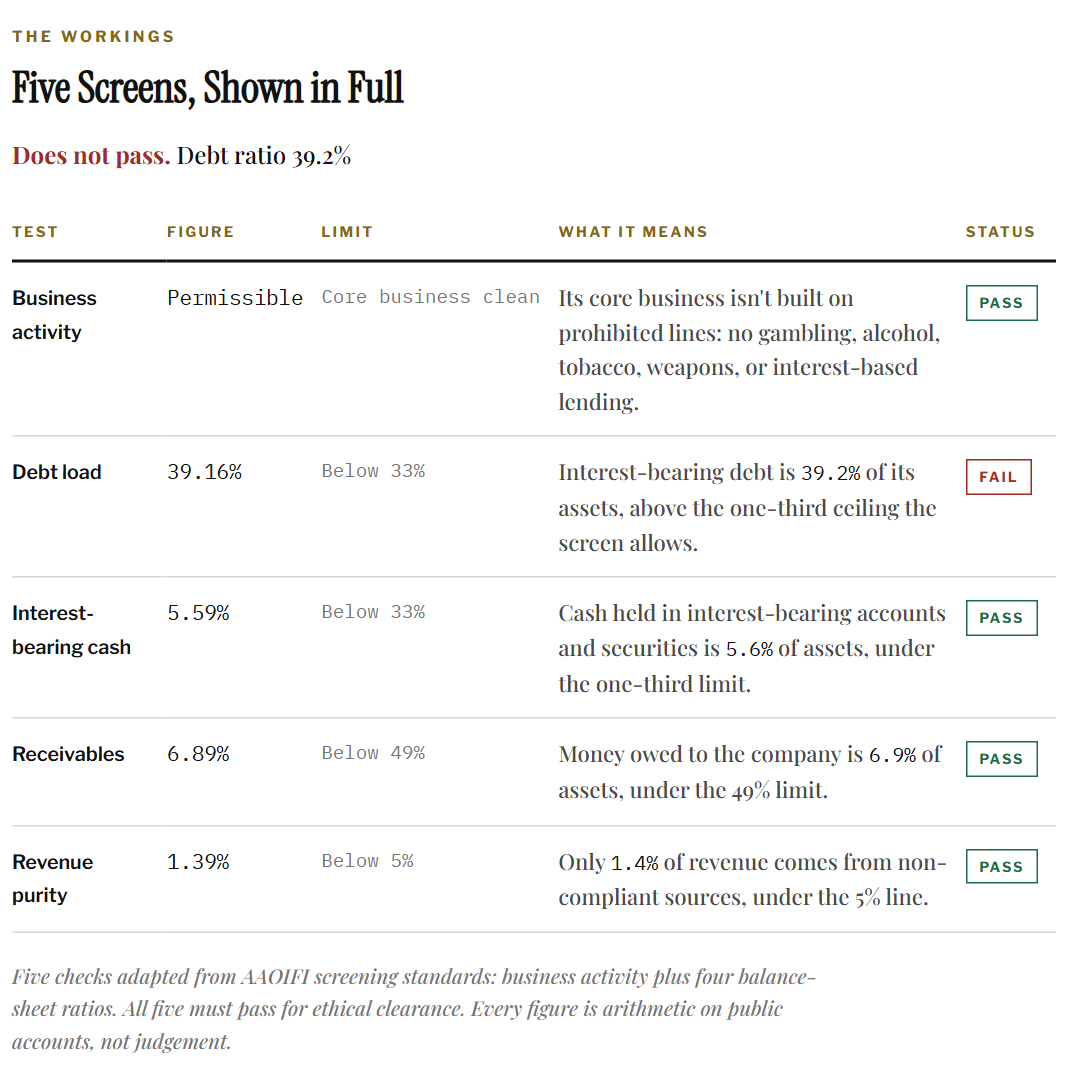
This is why screening matters. Removing bonds is step one. Screening the shares that are left is step two. You need both for a portfolio that fits your principles.
How we help: free screening tools
At Titan Protect we built screening tools for investors who want to see what they hold and what to consider instead.
Ethical Trading Guide. Our framework for what passes and what fails across several tests, from Shariah rules to wider ethical concerns. Read the guide →
Ethical Screener. Look up any stock and see each test, the figure and the limit, as in the Unilever example above. Open the screener →
ETF Screener. Break an ETF down by its holdings and see which pass or fail. Useful for checking Shariah-labelled ETFs against ordinary ones. Explore the ETF Screener →
Dividend Screener. For income portfolios inside an ISA or SIPP: screened companies with steady dividends. Explore the Dividend Screener →
What to do this week
If you have read this far and think your pension may have this problem, here is a plan:
Today: Log in to your pension and download your fund’s factsheet. Check how much is in bonds or fixed income.
This week: Check whether your provider has a Shariah fund or a 100% shares option. With NEST, the switch takes about five minutes online.
This month: If your workplace scheme has nothing suitable, look into opening a SIPP. AJ Bell and Interactive Investor both offer Shariah-screened ETFs.
Ongoing: Check any fund or stock before you invest. Know what you own, not just what it is called.
The bigger picture
The pension bond problem is not only a Muslim investor’s problem. Anyone uneasy about lending to governments or companies whose actions they disagree with faces the same thing: the default assumes you have no view on where your money goes.
The difference is that in Islamic finance the question is yes or no, not a matter of taste. Riba is not a matter of degree or personal comfort; it is a clear prohibition. That makes the default fund not just a poor fit but at odds with the saver’s principles.
The good news is that options exist and are getting better. The bad news is that the system will not show them to you. You have to look.
That is what we are here for.
Related reading
Four of the five stocks in the HSBC fund story fail our screen. One passes.
Ethical Trading: the complete guide
ETF Screener: what is inside your fund?
Disclaimer: This article is information and education only. It is not financial, tax or religious advice, or a recommendation to buy or sell anything. Whether an investment fits your faith is a matter for you; please ask a qualified Islamic scholar and a regulated financial adviser about your own situation. Pension rules and fund menus change, so check current options with your provider. Titan Protect’s screening tools help with research, but investment decisions and scholarly rulings rest with each investor. First published 13 June 2026; updated 18 October 2026.