Titan Playbook Series — 4/10

The Power of Process
Every professional uses checklists. Pilots. Surgeons. Engineers. They don’t use them because they’re incompetent—they use them because under pressure, even experts make mistakes.
Trading is pressure. Real money. Real time. Real consequences.
The checklist isn’t bureaucracy—it’s your protection against yourself when emotions run high and markets move fast.
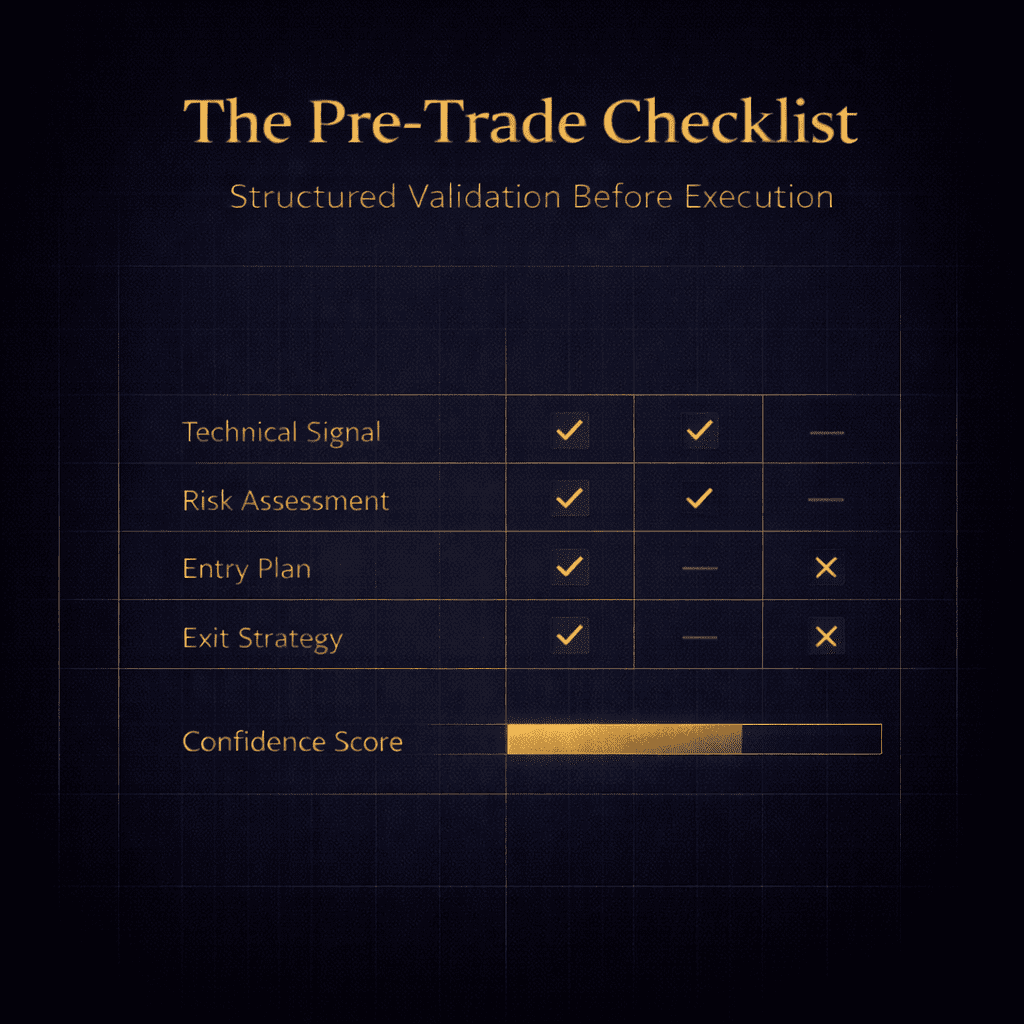
The Complete Pre-Trade Checklist
SECTION 1: Market Analysis
Before considering any trade, confirm:
- [ ] Market regime identified
- Risk-on or risk-off?
- Trending or ranging?
- High or low volatility?
- Why it matters: Context determines strategy
- [ ] Correlated markets aligned
- Sector healthy?
- Major indices supportive?
- Intermarket relationships positive?
- Why it matters: No trade exists in isolation
- [ ] No major events within 48 hours
- Earnings for this stock?
- Fed announcement?
- Economic data release?
- Why it matters: Event risk destroys edge
- [ ] VIX/market volatility appropriate
- VIX below 25 (normal trading)?
- Or: Strategy works in current volatility?
- Why it matters: Volatility affects position sizing and stops
SECTION 2: Setup Quality
Confirm your trade thesis is valid:
- [ ] Confluence confirmed
- Minimum 2-3 factors aligning?
- (Price action + indicator + support/resistance)
- Why it matters: Single factors fail. Confluence succeeds.
- [ ] Timeframe alignment
- Setup valid on your trading timeframe?
- Higher timeframe supportive?
- No conflicting signals on lower timeframes?
- Why it matters: Timeframe conflicts = failed trades
- [ ] Risk-to-reward viable
- Minimum 1:1.5 (or your required ratio)?
- Target achievable based on structure?
- Stop logical based on invalidation?
- Why it matters: Poor R:R = negative expectancy
- [ ] Edge present
- Why will this move happen?
- What do you see that others don’t?
- What makes you right and the counterparty wrong?
- Why it matters: No edge = gambling
SECTION 3: Risk Management
Calculate and confirm all risk parameters:
- [ ] Stop loss defined
- Specific price level (not percentage)?
- Based on technical invalidation?
- Distance calculated?
- Why it matters: Stops must be logical, not emotional
- [ ] Position size calculated
- Risk amount: $____ (2% of account)
- Stop distance: $____
- Position size: ____ shares/contracts
- Why it matters: Position size adapts to volatility and stop distance
- [ ] Maximum portfolio heat checked
- Total risk if all stops hit: $____
- Correlated positions: ____
- Portfolio risk acceptable?
- Why it matters: Correlated drawdowns destroy accounts
- [ ] Volatility accounted for
- ATR measured: ____
- Volatility multiplier: ____×
- Position sized accordingly?
- Why it matters: Volatility changes everything
SECTION 4: Trade Plan
Define exactly how you’ll manage this trade:
- [ ] Entry strategy
- Market order at current price?
- Limit order at specific level?
- Stop entry on breakout?
- Why it matters: Entry method affects fill quality
- [ ] Exit strategy selected
- Static target at: $____
- Trailing stop: ____ (method)
- Partial exits: ____% at ____ level
- Time stop: ____ days maximum
- Why it matters: Know your exit before you enter
- [ ] Adjustment rules
- When will I move to breakeven?
- When will I trail the stop?
- Under what conditions will I exit early?
- Why it matters: Prevents emotional decisions
- [ ] Psychological readiness
- Am I calm and focused?
- No recent losses affecting judgment?
- Not forcing a trade out of boredom?
- Position size appropriate for my comfort?
- Why it matters: Emotional trading = expensive mistakes
SECTION 5: Execution Readiness
Confirm you can execute properly:
- [ ] Platform ready
- Order ticket prepared?
- Alerts set for key levels?
- Stop and target orders ready?
- Why it matters: Fumbling execution costs money
- [ ] Capital available
- Sufficient buying power?
- No conflicting orders pending?
- Margin requirements met?
- Why it matters: Rejected orders = missed opportunities
- [ ] Distractions minimized
- Won’t be interrupted during trade?
- Phone on silent?
- Full attention available?
- Why it matters: Distractions = missed exits
- [ ] Documentation ready
- Journal open?
- Screenshot tool ready?
- Notes template prepared?
- Why it matters: Tracking enables improvement
The Decision Point
After completing the checklist, ask:
“”Does this trade deserve my capital?””
- If all boxes checked: Execute with confidence
- If any box unchecked: No trade. Wait for better setup.
One unchecked box = no trade.
This is discipline. This is professionalism. This is edge.
The Checklist in Action
Example 1: Pass
- [x] Market regime: Risk-on, trending
- [x] Correlated markets: QQQ strong, sector leading
- [x] No events: Nothing major for 3 days
- [x] Volatility: VIX 18, normal
- [x] Confluence: Support + volume spike + momentum
- [x] Timeframe: Daily setup, weekly trend
- [x] R:R: 1:2.5, target at resistance
- [x] Edge: Accumulation pattern visible
- [x] Stop: Below support at $48
- [x] Position: Risk $200, stop $2, size 100 shares
- [x] Portfolio heat: Only 2 other positions, uncorrelated
- [x] Volatility: ATR $1.50, using 2× multiplier
- [x] Entry: Limit order at $50
- [x] Exit: Target $55, trail below swing lows
- [x] Adjustments: Breakeven at $52, trail active at $53
- [x] Psychology: Calm, focused, no recent losses
- [x] Platform: Ready, alerts set
- [x] Capital: Available, no conflicts
- [x] Distractions: 2 hours clear
- [x] Documentation: Journal open
Decision: TRADE
Example 2: Fail
- [x] Market regime: Risk-on
- [ ] Correlated markets: Sector weakening ( FAIL)
- [x] No events
- [x] Volatility normal
- [x] Confluence present
- [ ] Timeframe: Conflicting signals on 4H ( FAIL)
- [x] R:R acceptable
- [x] Edge present
- [x] Stop defined
- [x] Position sized
- [x] Portfolio heat OK
- [x] Volatility accounted
- [x] Entry strategy clear
- [ ] Exit strategy: Haven”’t decided ( FAIL)
- [ ] Psychology: Just lost on last trade, frustrated ( FAIL)
- [x] Platform ready
- [x] Capital available
- [x] Distractions minimized
- [x] Documentation ready
Decision: NO TRADE
Why: Sector weakness + timeframe conflict + no exit plan + emotional state = disaster waiting to happen
The Discipline of “No”
The hardest part of the checklist isn”’t completing it. It”’s honoring it when it says “no.”
You”’ll see setups that are “almost” there. Good but not great. 80% checked boxes.
Resist the temptation.
Those “almost” trades cost you money. They erode your edge. They teach bad habits.
Wait for the A+ setups. The ones where every box checks. They”’re worth the wait.
Customizing Your Checklist
This is a template. Make it yours:
Add items specific to your strategy:
- Options traders: Check IV rank, time to expiration
- Forex traders: Check session overlap, economic calendar
- Crypto traders: Check funding rates, exchange liquidity
Remove items that don”’t apply:
- Day traders: Remove overnight considerations
- Long-term investors: Remove short-term volatility checks
Adjust for your psychology:
- If you overtrade: Add “Have I traded today already?”
- If you size poorly: Add “Am I trying to make back losses?”
The Long-Term Benefit
Using a checklist consistently creates:
Consistency: Same process, same quality, every trade
Accountability: Can”’t blame the market when you skipped steps
Learning: Failed checklist items reveal weaknesses
Confidence: When you do trade, you know it”’s valid
Longevity: Survive long enough for edge to pay off
The Bottom Line
This checklist represents everything you”’ve learned in the SL/TP Intelligence series:
- Market context (Articles 1-3)
- Risk management (Articles 1-3)
- Position sizing (Article 3)
- Exit strategies (Articles 5-7)
- Psychology (Article 6)
- Advanced techniques (Article 7)
Use it. Every time. Without exception.
Risk management isn”’t a chapter in your trading education. It”’s the foundation.
Master these concepts, apply them consistently, and you”’ll survive long enough to thrive.
Process beats prediction. Discipline beats intelligence. Survival beats heroics.
Trade smart. Protect your capital.
— The Titanprotect Team
Action Items
- [ ] Focus on process over outcome for one week
- [ ] Journal every trade including the R-multiple achieved
- [ ] Review and adjust your position sizing monthly
Next in series: The Power of the Trading Buddy →
Word Count: ~1,500 words
Reading Time: 7 minutes
Level: Beginner-Friendly
Try Our Position Calculator
Calculate your optimal position size, risk/reward ratio, and portfolio heat in seconds.
Get the daily framework intelligence
Trade the framework, not the noise.
The principles in this article are how we read markets every day. Members get the live application: daily Pre-Asia, Pre-London, Pre-NY and Post-Close briefs across 20+ instruments, the indicator suite, the Foundry library, and live community.
Free Explorer tier · No card required · Upgrade when you’re ready