Graham, Buffett, and the Quran: The Surprising Alignment Between Value Investing and Islamic Finance
By the Titan Protect Research Team
- Shared Philosophy: Both classical value investing and Islamic finance emerged as reactions against speculative excess, prioritising the real economy over financial engineering.
- Risk Management: Benjamin Graham’s concept of a “margin of safety” maps directly to the Islamic prohibition on gharar (excessive uncertainty and deception).
- Debt Aversion: Warren Buffett’s strict aversion to highly leveraged companies closely mirrors the debt limits used in Islamic screening (AAOIFI: debt below 30% of market value; many index providers use 33%).
- Equity Focus: The Islamic prohibition on riba (interest) naturally pushes investors toward equity markets, exactly where value investors argue the best long-term returns are found.
- Performance, Honestly: Screening does not guarantee outperformance. On our own live ledger the Titan Ethical 500 is up 38.9% against 45.1% for the S&P 500 (May 2024 to 8 Jun 2026): it trails, because the screen removes some of the names that led the market.
At first glance, the worlds of classical value investing and Islamic finance appear to have little in common. One was born in the bustling classrooms of Columbia Business School in the 1920s, pioneered by Benjamin Graham and later perfected by Warren Buffett in Omaha, Nebraska. The other is rooted in a 1,400-year-old religious tradition, governed by the Quran and the Sunnah, and codified by modern scholars into a comprehensive system of ethical commerce.
Yet, when you strip away the terminology and examine the underlying mechanics of both frameworks, a surprising and profound alignment emerges. Both systems are fundamentally conservative. Both are deeply suspicious of financial engineering, excessive leverage, and speculative frenzy. And both insist that true wealth creation must be tethered to the real economy, to tangible assets, productive enterprises, and sustainable cash flows.
For the crossover audience, value investors curious about Islamic finance, or Muslim investors seeking a robust intellectual framework for their portfolios, this convergence is not merely an academic curiosity. It is a practical blueprint for navigating modern financial markets. By understanding how the principles of halal investing intersect with the tenets of value investing, investors can construct portfolios that are not only ethically sound but also structurally resilient.
In the news · 18 October 2026
This week Middle East Eye reported that the HSBC Islamic Global Equity Index Fund bought about $130m of shares in five companies in the first half of 2026. HSBC did not respond to its request for comment. It is a useful reminder of the theme below: a faith-based index screen checks what a company does and its debt and cash ratios, not everything an investor may care about. We ran the same five stocks through our own screen: four fail and one passes. That is a result about those stocks under our tests, not a finding about HSBC or the fund’s scholars.
The Shared Enemy: Speculation and Financial Engineering
To understand the alignment between value investing and Islamic finance, one must first understand what both systems fundamentally oppose: speculation.
In the aftermath of the 1929 Wall Street crash, Benjamin Graham sought to draw a hard line between investment and speculation. In his seminal work, Security Analysis, Graham defined an investment operation as one which, “upon thorough analysis, promises safety of principal and an adequate return.” Anything that did not meet this strict criterion was deemed speculative. Graham abhorred the idea of buying a stock simply because one hoped a “greater fool” would pay a higher price for it later.
Islamic finance shares this exact aversion, articulated through the prohibition of maysir (gambling or speculation). In Islamic commercial law, transactions must be based on genuine economic activity. Buying an asset solely to profit from short-term price fluctuations, without any intention of participating in the underlying business, borders on maysir. Both Graham and Islamic scholars agree: the stock market should not be treated as a casino.
Gharar and the Margin of Safety
Perhaps the most striking parallel between the two philosophies lies in their approach to risk and uncertainty. In Islamic finance, there is a strict prohibition against gharar, which translates to excessive uncertainty, hazard, or deception in a contract. A transaction involving gharar is one where the outcome is highly ambiguous or where one party exploits the ignorance of another. This principle effectively outlaws complex derivatives, naked short selling, and highly opaque financial instruments.
Benjamin Graham’s antidote to uncertainty was his famous “margin of safety.” Graham argued that because the future is inherently unpredictable, an investor must demand a significant discount to a company’s intrinsic value before purchasing its stock. This discount acts as a buffer against errors in calculation, unforeseen economic downturns, or sheer bad luck.
The conceptual overlap here is profound. Both gharar and the margin of safety are mechanisms designed to protect the investor from the unknown. By demanding a margin of safety, a value investor is essentially refusing to engage in transactions characterized by excessive uncertainty. They are, in a secular sense, avoiding gharar. When a value investor insists on buying a dollar for fifty cents, they are ensuring that the transaction is grounded in tangible reality rather than speculative hope.
The Debt Aversion: Buffett Meets AAOIFI
If Benjamin Graham laid the foundation of value investing, Warren Buffett built the house. And one of the central pillars of Buffett’s philosophy is a deep-seated aversion to debt. Buffett has repeatedly warned against the dangers of leverage, noting that “if you’re smart, you don’t need debt; if you’re dumb, it’s poisonous.” For Buffett, a company that relies heavily on borrowed money is fragile. In a severe economic downturn, debt becomes an existential threat, capable of wiping out equity holders entirely.
This secular aversion to leverage finds a direct and strict counterpart in Islamic finance. The Accounting and Auditing Organization for Islamic Financial Institutions (AAOIFI) sets the global standard for Shariah-compliant investing. One of its primary financial screens says a company’s interest-bearing debt should stay below 30% of its market value. Many index providers, and our own screen, use a similar one-third (33%) line.
While Buffett’s aversion to debt is rooted in risk management and the AAOIFI standard is rooted in the religious prohibition of riba (interest), the practical outcome is identical: both frameworks systematically filter out highly leveraged, fragile companies.
Comparing Debt Perspectives
This shared intolerance for excessive debt naturally tilts both value and Islamic portfolios toward companies with strong balance sheets, robust cash flows, and sustainable business models. It is no coincidence that many of the companies that pass strict Islamic screens are the exact same high-quality, wide-moat businesses that Warren Buffett loves to buy.
The Real Economy Focus: Tangible Assets Over Paper Wealth
Another core tenet of value investing is the preference for tangible assets and productive enterprises. Value investors are notoriously skeptical of “paper wealth”, profits generated purely through financial engineering, accounting gimmicks, or the trading of abstract derivatives. They want to own real businesses that produce real goods and services, generating real cash flows.
Islamic finance is entirely predicated on this exact concept. The Islamic economic system demands that all financial transactions be backed by tangible assets or genuine services. Money, in Islamic jurisprudence, is merely a medium of exchange; it has no intrinsic value and cannot generate more money on its own. Wealth can only be created through legitimate trade, manufacturing, or the provision of services.
Riba and the Push Toward Equity
The prohibition of riba (interest) is perhaps the most well-known aspect of Islamic finance. Because a Muslim investor cannot lend money at interest, they are effectively barred from the traditional fixed-income market (conventional bonds, certificates of deposit, etc.). This prohibition forces Islamic investors to seek returns through equity participation, sharing in the actual risks and rewards of a business enterprise.
Fascinatingly, this religious constraint aligns perfectly with the long-term empirical observations of value investors. Both Graham and Buffett have long argued that over extended periods, equities vastly outperform fixed-income instruments. Buffett has frequently pointed out that bonds, which offer a fixed nominal return, are highly vulnerable to inflation and currency debasement. Equities, on the other hand, represent ownership in productive assets that can raise prices and adapt to inflationary environments.
By prohibiting interest-bearing debt, Islamic finance naturally herds its adherents toward the equity markets, exactly where value investors argue the best long-term, inflation-protected returns are to be found. The Islamic investor, by necessity, becomes a business owner rather than a money lender. This is the very essence of the value investing mindset.
The Titan Ethical 500: Where Value Meets Values
The theoretical alignment between value investing and Islamic finance is compelling, but does it work in practice? The honest answer is: it builds a sturdier portfolio, but it does not promise to beat the market in every window. Our own Titan Ethical 500 shows both sides.
The Titan Ethical 500 is a rules-based index of 500 globally diversified stocks (as held on 18 October 2026) screened for both ethical compliance and financial strength. The screen is adapted from AAOIFI standards: interest-bearing debt below 33% of assets, interest-bearing cash below 33%, receivables below 49%, and non-compliant revenue under 5%. Furthermore, the index systematically excludes industries that violate ethical principles, such as alcohol, tobacco, conventional banking, weapons, and gambling.
But the Titan Ethical 500 goes beyond mere negative screening. It incorporates deep value metrics, assigning Discounted Cash Flow (DCF) grades to its constituents. Stocks rated A+ boast a margin of safety of 40% or greater, perfectly marrying Graham’s core principle with Islamic compliance. When this article was first written in May 2026, the top A+ rated names included Cencora (COR), McKesson (MCK), CVS Health, Centene (CNC) and EPAM Systems. Ratings change, so check the live index page for today’s list.
Here is how the combined approach has done against the broader, unconstrained market.
Performance: Titan Ethical 500 vs. S&P 500
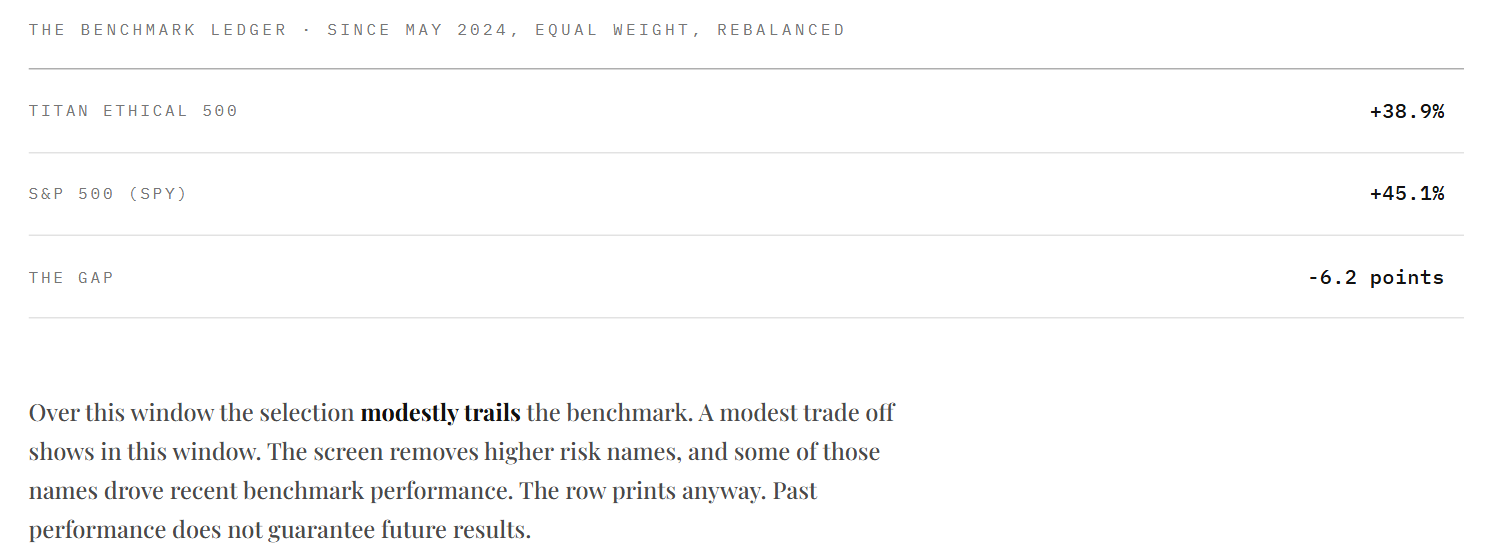
Since May 2024, the Titan Ethical 500 is up 38.9% against 45.1% for the S&P 500, a gap of 6.2 points in the market’s favour (equal weight, rebalanced, May 2024 to 8 Jun 2026). An earlier version of this article, written in May 2026, showed the index well ahead over the 12 months to that date. That figure came from an earlier method that looked back with today’s winners, and it no longer reflects our live ledger, so we have replaced it.
The trade-off is real and worth stating plainly. The screen removes heavily indebted companies, banks and some of the fastest-growing technology names, and some of those names have led the market in this period. What the screen buys you is a portfolio built on lightly indebted, real businesses. Whether that is worth a gap in some windows is a choice each investor makes. Most of this window is a rules-based reconstruction; we began recording index membership live in mid-2026, and past performance does not guarantee future results.
The Intellectual Synergy of Halal Value Investing
The intersection of value investing and Islamic finance is not a compromise; it is a synergy. When an investor applies the rigorous financial screens of AAOIFI alongside the valuation discipline of Benjamin Graham, they are effectively double-filtering their portfolio for quality and resilience.
A halal value investor demands that a company be ethically sound, lightly indebted, engaged in the real economy, and trading at a significant discount to its intrinsic value. This is an incredibly high bar to clear. The companies that survive this dual-screening process are typically wide-moat, cash-generating fortresses capable of weathering severe economic storms.
For the Muslim investor, value investing provides a rigorous, secular framework for identifying high-quality equities that comply with Shariah law. It offers a mathematical and logical foundation for navigating the stock market without running afoul of religious principles.
For the secular value investor, the principles of Islamic finance offer a fascinating, time-tested framework for risk management. The strict prohibitions on excessive debt, speculation, and opaque financial instruments serve as excellent guardrails against the very behavioral biases and systemic risks that value investors seek to avoid.
Ultimately, both philosophies arrive at the same profound conclusion: sustainable wealth is not created through speculation, leverage, or financial trickery. It is created by patiently owning a share of productive, ethically sound businesses purchased at a reasonable price.
Frequently Asked Questions
Q: Does Islamic finance restrict investors from achieving high returns? A: Not necessarily, but it is not a free lunch either. Screening out heavily indebted and speculative companies tends to produce sturdier portfolios, and in some periods that helps. In others it costs: on our live ledger the Titan Ethical 500 trails the S&P 500 since May 2024 (38.9% against 45.1%, May 2024 to 8 Jun 2026). Judge a screen by what it removes and why, not only by recent returns.
Q: How does the Islamic prohibition on interest (riba) affect portfolio construction? A: The prohibition on riba means Islamic investors cannot invest in conventional bonds, traditional banking stocks, or highly leveraged companies. This naturally pushes the portfolio toward equities and real assets, aligning perfectly with the value investing philosophy that equities offer the best long-term protection against inflation.
Q: What is the AAOIFI debt threshold, and why does it matter? A: The AAOIFI standard says a company’s interest-bearing debt should stay below 30% of its market value. Many index providers use a one-third (33%) line, measured against average market value or total assets; our own screen uses 33% of total assets. This ensures that the companies in a halal portfolio have strong balance sheets and are not overly reliant on leverage, significantly reducing bankruptcy risk during economic downturns.
Q: How does Benjamin Graham’s “margin of safety” relate to Islamic principles? A: Graham’s margin of safety involves buying a stock at a significant discount to its intrinsic value to protect against unforeseen risks. This aligns closely with the Islamic prohibition of gharar (excessive uncertainty). Both concepts are designed to protect the investor from speculative risk and ensure transactions are grounded in tangible reality.
Q: Can non-Muslims benefit from Islamic finance principles? A: Absolutely. The core tenets of Islamic finance, avoiding excessive debt, shunning speculation, and focusing on the real economy, are universally sound risk management principles. Many secular value investors naturally gravitate toward stocks that pass Islamic screens simply because they represent high-quality, conservatively financed businesses.
Ready to align your portfolio with the principles of value and ethics? Titan Protect offers premium trading research, advanced TradingView indicators, and a rigorous ethical investment screener. Discover high-quality, deeply undervalued opportunities like those in the Titan Ethical 500 and the Ethical Tech 100, or explore our Opportunity Scores. Join Titan Protect today and invest with clarity, conviction, and conscience.
Deepen Your Understanding
Related articles from the Titan Protect Foundry:
Watch the video version
More on the YouTube channel: new briefs daily. Subscribe so the next one reaches you.
Update, 18 Oct 2026: we revisited these numbers with 16 months of data: Does an ethical stock screen cost you returns? 16 months of our data.