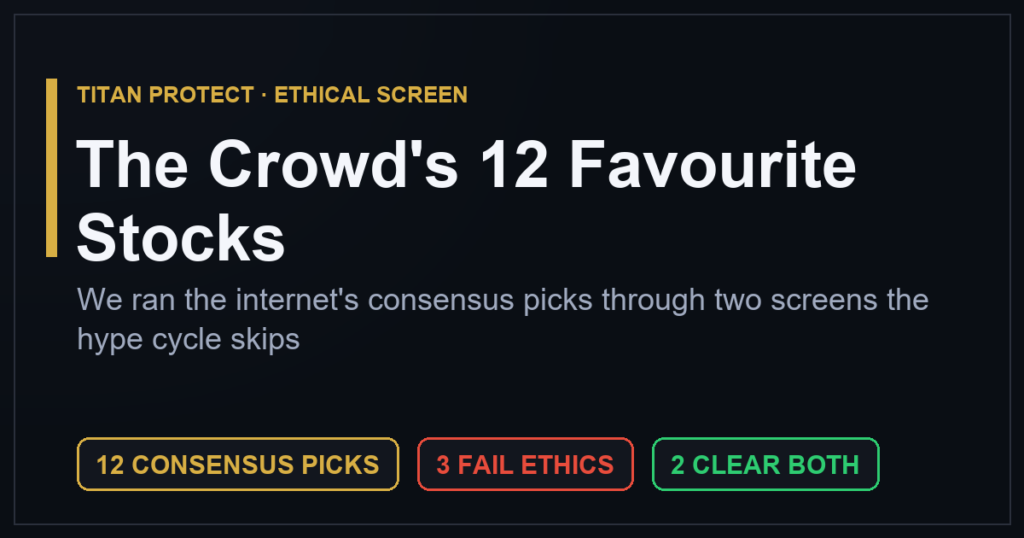
Someone spent a week watching dozens of the largest finance channels on YouTube and distilled every recommendation into twelve consensus stocks. We ran that consensus through the two screens the crowd almost never applies: ethical compliance, and honest value. A quarter of the list did not survive the first one.
Every week, the biggest voices in retail investing push hundreds of tickers. Aggregate the loudest of them, channels with audiences in the hundreds of thousands to millions, names like Meet Kevin, Joseph Carlson, Financial Education, Ticker Symbol You, Everything Money, Tom Nash, Invest with Henry and dozens more, and a shortlist emerges: the names the crowd agrees on.
That agreement feels like safety. It usually isn’t. Popularity measures attention, not quality, and it says nothing at all about whether a business is ethically sound or reasonably priced. So we took the crowd’s twelve favourite stocks and asked the two questions the hype cycle skips: Does it pass an ethical screen? And is it actually worth the price?
The headline: three of twelve are not ethically compliant
The most striking result is the simplest. Of the twelve most-recommended names, three fail our ethical screen outright, and a values-conscious investor following the crowd would have bought all three without ever being told:
- Palantir, fails on income from interest-bearing securities. Also, on our valuation read, trades at a steep premium to what the business is worth. Screen verdict: Avoid.
- Broadcom, fails on balance-sheet debt levels, a legacy of its acquisition spree. Strong business, but it trips a hard compliance threshold. Screen verdict: Avoid.
- Intuitive Machines, fails on core business activity, and sits in deeply speculative territory with a weak competitive moat. Screen verdict: Avoid.
None of these are obscure. Palantir and Broadcom in particular are among the crowd’s rising favourites, the names attention is flowing into right now. That is exactly the point. The louder a stock gets, the less likely anyone in the feed is checking whether it belongs in a values-conscious portfolio.
The full scorecard
Here is every one of the twelve, grouped the way the crowd grouped them, with our two verdicts alongside. Green passes the ethical screen; red fails it. The valuation read is our own, how the price compares to what the business is worth.
Where we agree with the crowd, and where we don’t
The crowd is not wrong about everything. On one name our screens agree emphatically. On another whole tier, we could not disagree more.
Biggest agreement: Adobe
The crowd filed Adobe under “everyone gave up on it.” Our screen has it as the single best value of the twelve, a strong-moat business trading at roughly nine times forward earnings, at a clear discount to what it is worth. The forgotten name is the one our numbers actually want to own. When the crowd loses interest in a quality business at a cheap price, that is often the signal, not the warning.
Biggest divergence: the “hyped” tier
The stocks attention is rushing into, Palantir and Broadcom, are precisely the two our screens tell you to avoid. One fails ethically and trades at a punishing premium; the other fails on debt. Rising popularity and rising quality are not the same thing, and here they point in opposite directions. Hype is a description of the crowd’s mood, not of the investment.
What clears both screens
Strip the list down to the names that pass the ethical screen and clear our valuation bar, compliant and reasonably priced, and twelve becomes two: Meta and Adobe. Everything else is either non-compliant, or compliant but priced at fair value or above. Nine of the crowd’s twelve are ethically sound; only two of those are also a value today. That is not a criticism of the crowd so much as a reminder of how much work is left after a stock becomes popular.
The takeaway
A recommendation tells you a stock is popular. It does not tell you the business is ethically sound, and it does not tell you the price is fair. Those are separate tests, and they are the two that actually protect a portfolio. Run the crowd’s consensus through both and the shortlist shrinks fast, three names fail on values alone, and only two survive as genuine value. Screening is not the exciting part of investing. It is the part that keeps you out of the names everyone else finds out about the hard way.
This is analysis, not financial advice, and not a recommendation to buy or sell any security. Ethical screening reflects our own methodology and criteria. Always do your own research and manage your risk.