Options Flow and Institutional Positioning
Options market sentiment stays firmly bullish as the put call ratio tightens to 0.586 from 0.873 the prior session. This shift reflects heavier call buying concentrated in six mega cap names, AAPL, NVDA, TSLA, META, MSFT and AMZN, with no offsetting bearish options prints visible across the surface. Building on yesterday’s view the risk on regime identified in Macro Pulse continues to underpin derivatives positioning, turning what looked like a modest bullish lean into a clearer institutional signal of accumulation rather than hedging. The absence of dark pool prints and whale block flow leaves the options book as the sole high conviction window into real money intent, and that window shows consistent long exposure through call strikes rather than protective puts. As our Positioning Pressure read notes, this call accumulation supports the broader tape yet sits at odds with the front week max pain configuration that now exerts downward mechanical pressure.
Max Pain and Dealer Gamma Setup
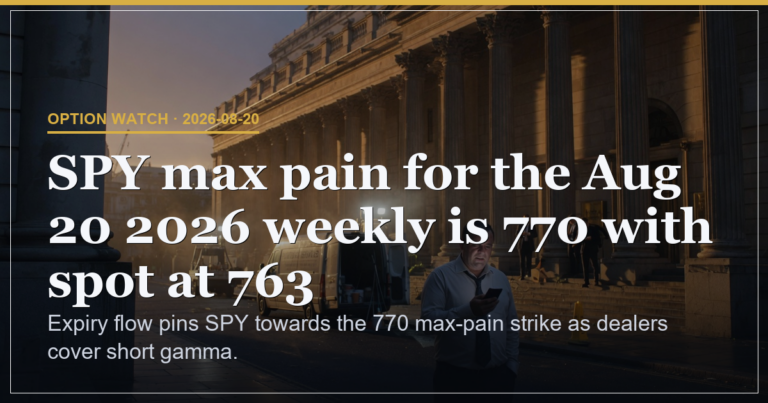
SPY closed at 777.97 against front week max pain of 772.00, widening the gap from yesterday’s 0.28 point proximity to a full 5.97 point cushion. The configuration reduces the mechanical pinning force that dominated the prior session and opens room for further upside into settlement. Next cluster resistance appears near 800, a strike that would require additional call buying to defend. Institutional Insight already flagged that price above max pain points to accumulation by big money, and the current six point cushion above the 770 level for the August 14 2026 expiry reinforces that dealers hold little incentive to defend either side aggressively.
Gamma Exposure Walls and Hedging Implications
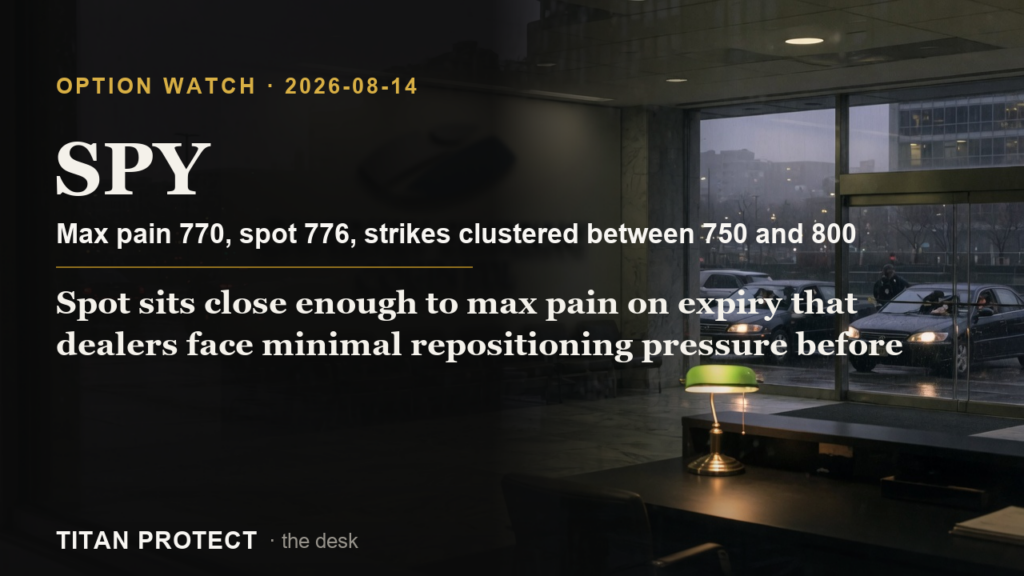
Strikes cluster between 750 and 800 with open interest walls offering scant support or resistance, so price can drift without forcing large gamma hedging flows. Dealers therefore face minimal repositioning pressure before settlement, allowing spot to wander within the narrow band around current levels. The absence of concentrated gamma at nearby strikes means any move higher would rely on fresh call buying rather than automatic dealer covering, while downside moves would encounter equally light put related hedging.
| Strike Zone | Open Interest Profile | Tactical Insight |
|---|---|---|
| 750-760 | Moderate put wall | Provides soft floor only if volume spikes, otherwise ignored into close |
| 770 | Max pain core | Dealer gamma flattens, minimal forced flows either way |
| 790-800 | Call heavy cluster | Requires sustained buying to activate upside gamma, else acts as cap |
Scenario Probabilities into Settlement
Drift toward 780 carries 45 percent probability given the institutional call flow and risk on backdrop. Pinning action near 775 holds 35 percent odds as the light gamma environment allows quiet drift without catalyst. A pull back toward 765 receives 20 percent weight should late selling emerge without dealer support.
| Scenario | Probability | Dealer Response |
|---|---|---|
| Drift to 780 | 45% | Light short covering only, no aggressive gamma chase |
| Pin near 775 | 35% | Passive book squaring, minimal flow impact |
| Pull to 765 | 20% | Soft put buying support, still insufficient for strong rebound |
Risk Assessment and Positioning Guidance
Risk sits at 25 percent driven by the low conviction around any single directional catalyst into expiry. The widened gap above max pain reduces pinning but also removes the mechanical support that previously kept volatility suppressed. Titan Tactics already flagged range trade the lead index with one percent risk sizing, and that approach remains appropriate here as flows stay selective rather than broad.
Experience Level Considerations
Beginner traders should focus on watching the 770 to 780 band and avoid size until a clear break occurs. Intermediate desks can use the light gamma setup to fade small extensions without expecting large follow through. Advanced participants monitor the six mega cap names for continued call flow as the primary signal that overrides the max pain read.
Spot sits close enough to max pain on expiry that dealers face minimal repositioning pressure before settlement.
This is analysis, not financial advice. Always manage your risk.