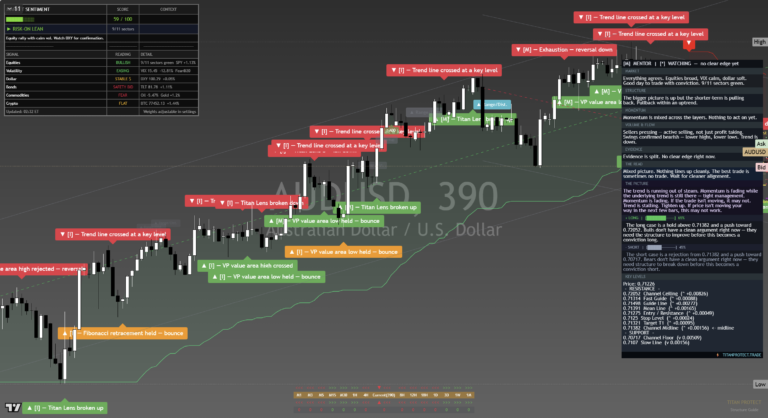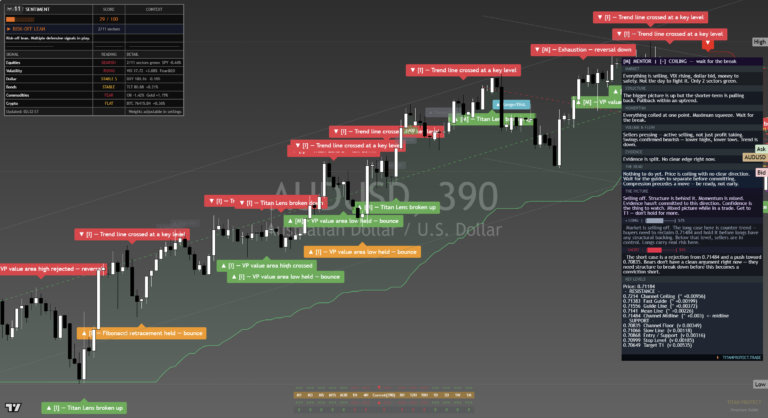
The AUDUSD Framework Journal for June 2026, newest read at the top. Each dated entry is our read on the close, kept as a living record so the framework can be judged over time. This is analysis, not financial advice.
Tuesday 30 Jun 2026
Aussie Dollar — Daily Framework Read
Tuesday 30 June 2026 • Titan Macro Desk
Saturday’s read was already showing weakness. The deterioration has accelerated. The framework panel now reads SHORT with multiple Titan Lens broken down signals. Structure is working against the Aussie, momentum is fighting the upside, and the framework sees this as a market where sellers are in control.
The analysis reads bearish. Structure is working against the Aussie, momentum is fighting, and multiple breakdown signals have fired. The bigger picture has not fully collapsed but the near-term direction is clear. Sellers are in control.
Framework Interpretation
Structure
Structure is working against the Aussie. The bigger picture is losing its grip. Momentum is fighting the upside, and every attempt to rally is being sold into. Multiple Titan Lens broken down signals have fired across the chart, which is the framework’s way of saying that the structural integrity is compromised. The trend line has been broken down, and the market is building lower below prior support levels.
Momentum
Momentum is aligned to the downside. Genuine demand is absent, and what buying appears is not sustained. The framework sees this as a market where sellers are stepping in on rallies with increasing conviction. The Aussie is fighting a headwind of dollar strength and commodity uncertainty that is making every rally a selling opportunity rather than a trend reversal.
Volume Profile
Value area has shifted lower. The market has repriced below prior value areas, and the acceptance at lower levels confirms the bearish thesis. The VP value area breakdown is significant because it tells us that the market consensus has moved lower. Buyers are stepping in but at lower and lower levels, which is the profile of a declining market.
The Call
The analysis reads bearish for AUD/USD. This is the cautious trade in the current environment. The framework panel is noting this may be a counter-trend move, so quick entries and quick exits are the approach. Rallies toward the 0.6480-0.6500 zone are the preferred selling area. This is not a market to hold overnight with size unless the structural breakdown extends further.
Key Levels
Risk Assessment
The direction is clear but the framework panel flags this may be a counter-trend move within a larger structure. That elevates the risk slightly because counter-trend trades require tighter management. The 35% reflects the bearish bias tempered by the possibility that this is a corrective pullback in a larger uptrend.
Scenario Analysis
20%
Reclaims 0.6500 and holds. Dollar reversal or commodity rally triggers a bounce.
25%
Consolidates between 0.6400-0.6500. Market searches for direction before next move.
50%
Continuation below 0.6400, targeting 0.6360. Dollar strength and commodity weakness drive extension.
5%
China stimulus surprise or RBA emergency action. Flash move in either direction.
Position Sizing Guidance
STANDARD
REDUCED
AVOID
Standard sizing. The direction is clear but the potential counter-trend nature means this should be treated as a tactical trade, not a positional hold. Quick entries and defined exits. Do not overstay the welcome.
Experience-Level Guidance
For Developing Traders
The Aussie is a commodity currency, which means it is sensitive to both dollar moves and commodity prices. When the dollar is strong and commodities are under pressure, the Aussie gets hit from both sides. This is what is happening now. If you are not comfortable with the speed of moves in this pair, it is better to watch than to participate. The framework is saying SHORT, but the tactical nature means it requires active management.
For Intermediate Traders
The sell-the-rally approach applies here. The 0.6480-0.6500 zone is where the framework sees the best risk-reward for short entries. Define risk above 0.6540 and target 0.6400 for the first take-profit level. The counter-trend flag from the framework panel means you should be taking profits aggressively rather than holding for an extended move.
For Advanced Traders
The AUD/USD weakness aligns with the broader DXY strength and the commodities complex under pressure. Cross-reference with copper and iron ore for commodity confirmation. If the China PMI data later this week disappoints, the Aussie could see accelerated selling. The 0.6360 extension target aligns with a prior structural level that could act as a bounce zone for profit-taking on shorts.
This content is for informational and educational purposes only. It does not constitute financial advice, a recommendation, or an offer to buy or sell any financial instrument. Trading foreign exchange carries a high level of risk and may not be suitable for all investors. Past performance is not indicative of future results. You should consider your financial situation, investment objectives, and risk tolerance before making any trading decisions. Always conduct your own research. Titan Protect and its contributors accept no liability for losses arising from the use of this material.
Sunday 28 Jun 2026
Aussie Dollar — Daily Framework Read
Sunday 28 June 2026 • Weekend Edition • Launch Read
This is the launch edition of our daily framework reads. No prior-day comparison is available. All readings reflect the current structural snapshot as of Friday’s close.
Framework Interpretation
Structure
The Aussie is under pressure. The analysis reads a market where the structure has rolled over and is now working against buyers. Channels that were supporting price have been broken to the downside. The transition from a range-bound to a declining environment is visible in how the value areas are shifting lower. This is a market that needs protection if you are long, not a market to be adding.
Momentum
Momentum is fighting but losing. There is no strong read either way on the momentum layers, but the balance is tilting to the downside. The framework sees momentum below its trending averages, which is consistent with a deteriorating environment. Buyers are not organised and each attempt to recover is met with selling. The momentum picture supports the bearish structure.
Volume Profile
Volume profile shows a market that is distributing rather than accumulating. The recent breakdown through support zones has been accompanied by acceptance at lower value areas. The analysis reads this as institutional repositioning to the downside. When value shifts lower and the market does not recover, it tells you that the selling is genuine.
The Call
The analysis reads bearishly for the Aussie heading into next week. Everything has turned against the bulls: structure, momentum, and volume are all pointing lower. The key question is not direction but timing. A rally into 0.6480-0.6500 would represent the framework’s preferred sell zone. Do not chase the downside at current levels. Get positioned on bounces and let the framework do the work. The first real support sits around 0.6400.
Key Levels
Risk Assessment
The 45% risk factor accounts for the Aussie’s high sensitivity to Asian session headlines, commodity prices, and China-related developments. The structural bias is clear but the exogenous risk is elevated. Weekend news from China or commodity markets could gap the Aussie in either direction on Sunday’s open. The directional edge is there but the gap risk must be respected.
Scenario Analysis
15%
Recovery above 0.6530 invalidates shorts. Would require positive China stimulus or commodity rally.
30%
Chop between 0.6400-0.6500. Market builds energy before the next directional leg.
48%
Break below 0.6400 triggers continuation toward 0.6360 and 0.6320. The base case.
7%
China financial shock or commodity flash crash. AUD is the G10 proxy for risk appetite.
Position Sizing Guidance
STANDARD
REDUCED
AVOID
Standard sizing is appropriate. The directional bias is clear and the framework supports the short thesis. However, sell into rallies toward 0.6480-0.6500 rather than pressing at current levels. Risk defined above 0.6530. The Aussie’s sensitivity to overnight headlines means you want defined risk, not open-ended exposure.
Experience-Level Guidance
For Developing Traders
The Aussie is a good pair to study because it reacts strongly to external factors like commodity prices and China news. The framework is reading a bearish structure, but notice how it still says to wait for a bounce before selling. Chasing a market that has already moved lower is how you get stopped out on the bounce. Let the market come to your level. Study the 0.6480-0.6500 zone as your entry area.
For Intermediate Traders
The structural breakdown is confirmed. The question is whether to position now or wait. The framework favours waiting for a retrace to 0.6480-0.6500 where broken support becomes resistance. Risk above 0.6530, target 0.6400 initially. Be aware that the Aussie gaps frequently on Sunday opens due to early Asian session liquidity. Consider scaling in rather than full position entry.
For Advanced Traders
The framework convergence on the bearish side is clear. The distribution profile, broken channels, and momentum shift all point lower. The optimal approach is a two-tranche short: first tranche on a bounce to 0.6480-0.6500, second on a confirmed break of 0.6400. Cross-reference with China PMI data due next week and iron ore pricing for additional confluence. The AUD is trading as a beta play on global risk appetite, so monitor equity markets for correlation.
This content is for informational and educational purposes only. It does not constitute financial advice, a recommendation, or an offer to buy or sell any financial instrument. Trading foreign exchange carries a high level of risk and may not be suitable for all investors. Past performance is not indicative of future results. You should consider your financial situation, investment objectives, and risk tolerance before making any trading decisions. Always conduct your own research. Titan Protect and its contributors accept no liability for losses arising from the use of this material.
Thursday 25 Jun 2026
Titan FX Desk · Daily Framework Read · Thursday 25 June 2026
AUD/USD: No Clear Edge as Mixed Signals Compete With DXY Weakness and Commodity Strength
Confidence: No Clear Edge
Yesterday vs Today
| Signal | Watching (Wednesday) | WATCHING (Thursday) |
| Shift | No change in signal. The chart shows trend line breaks and crosses at key levels in both directions. Value area has been tested and is acting as a pivot. Macro holds favour an AUD bid via commodity strength and DXY weakness but the technical structure is not confirming. Mixed picture persists. | |
Daily Read
AUD/USD continues in watching mode for the second consecutive session. The framework cannot find a clean directional edge. The chart shows a market caught between trend line breaks in both directions, with the value area acting as a magnet rather than a breakout level.
The macro environment should be supportive for the Aussie. Copper and Gold are both bouncing, DXY is weakening, and the Nikkei recovery reduces the risk-off tone that was pressuring commodity currencies. But the technical picture on AUD/USD itself is not reflecting these tailwinds with conviction.
This could be an AUD-specific issue. RBA rate expectations, Australian housing data, or China demand concerns may be offsetting the commodity tailwind. When the macro picture says buy and the chart says wait, the framework defaults to wait. The best trade is no trade until the structure confirms a direction.
Key Levels
| Level | Price | Significance |
|---|---|---|
| Resistance | 0.6680 | Trend line cross, breakout long trigger |
| Current Zone | 0.6600 – 0.6660 | No edge zone, watching |
| Support | 0.6540 | Value area low, breakdown trigger |
Risk Assessment
Around 50%
Average risk. The watching signal means the framework sees balanced probabilities. No directional commitment warranted until a breakout above 0.6680 or breakdown below 0.6540 resolves the compression pattern.
What to Watch Today
- Copper and iron ore prices as proxies for AUD fundamentals
- China economic data or policy signals affecting AUD sentiment
- DXY direction: sustained weakness should eventually lift AUD/USD
- RBA rate expectations from OIS market
This daily read is produced by the Titan FX Desk for educational and informational purposes only. It does not constitute financial advice or a recommendation to buy or sell any instrument. All levels and scenarios are analytical reference points, not trading instructions. Past performance of any level or scenario is not indicative of future results. Always apply your own risk management. Capital is at risk.
Wednesday 24 Jun 2026
Titan FX Desk · Daily Framework Read · Wednesday 24 June 2026
AUD/USD (Aussie): Worst Major at -1.26% as Risk-Off and Dollar Strength Collide
Yesterday vs Today
Monday 23 June: The Aussie was already showing signs of vulnerability as risk appetite deteriorated globally. The pair was trading above 0.6580, supported by the China recovery narrative and relative RBA hawkishness. However, the global equity selloff was beginning to weigh on commodity-linked currencies.
Wednesday 24 June: The vulnerability has materialised in spectacular fashion. A 1.26% single-session drop makes AUD/USD the worst-performing major pair. The framework shows every bearish signal firing: lanes broken down, value areas violated, active selling dominant. This is a capitulation-style move where multiple negatives have converged at once — dollar strength, risk-off sentiment, and commodity weakness all working against the Aussie simultaneously.
Daily Read
AUD/USD at 0.6497 has been the day’s clear casualty. A 1.26% decline is significant for any major pair, and it tells you exactly where the stress is concentrated in the FX market: high-beta, commodity-linked currencies. The Aussie sits at the intersection of everything going wrong today. The dollar is stronger, risk appetite is weaker, and the commodity complex is under pressure.
The daily read is unambiguous. Every layer of momentum is pointing lower. The lanes have broken down one after another, the value area has been violated comprehensively, and rallies are being met with immediate selling. This is not a market showing indecision. It has made its decision and it is executing relentlessly.
The 0.6500 psychological level is now the immediate focus. The pair is trading right on it, and whether it holds or breaks cleanly below will determine the character of the next move. A clean break opens the door to 0.6450 and potentially 0.6400. A hold and bounce would suggest the selling is exhausted and a short-covering rally could develop.
From a positioning perspective, the Aussie had built up a meaningful long position over recent weeks on the back of the China optimism trade and the RBA’s relatively hawkish stance. When those positions unwind, they unwind violently because the carry on AUD longs is modest and the stop-loss levels are typically clustered. What we are seeing today has the hallmarks of a position flush rather than a fundamental revaluation, but the distinction only matters for timing. The levels still need to be respected.
The Aussie’s correlation with risk appetite makes it a proxy for the broader market mood. If AUD/USD stabilises here, it suggests the worst of the risk-off move is priced. If it continues to fall, expect further pressure on equities and other risk assets. The pair is both a barometer and an amplifier of global sentiment right now.
Key Levels
| Level | Price | Significance |
|---|---|---|
| Resistance 2 | 0.6580 | Pre-selloff level, now distant overhead resistance |
| Resistance 1 | 0.6540 | Broken support, now flipped to resistance |
| Current Price | 0.6497 | Testing the 0.6500 psychological level |
| Support 1 | 0.6450 | Next structural floor, prior swing low zone |
| Support 2 | 0.6400 | Round number, deeper support from prior months |
| Major Support | 0.6350 | Major structural floor, would signal significant Aussie weakness |
Risk Assessment
Around 70%
High risk. A 1.26% single-session move in a major pair indicates genuine stress. The framework is heavily bearish with no signs of stabilisation yet. The primary risk is continuation selling toward 0.6450 if the dollar rally and risk-off conditions persist. The mitigating factor is that moves of this magnitude often exhaust themselves quickly, and short-covering bounces from oversold levels can be sharp.
Scenario Analysis
0.6500 holds as a floor. The selling exhausts itself and a short-covering rally develops toward 0.6540. Risk appetite stabilises in the US session, removing the primary headwind. The position flush proves to be a one-day event and the Aussie begins to recover as the oversold condition attracts bargain hunters.
0.6500 breaks cleanly. Dollar strength intensifies and risk-off deepens. The Aussie extends toward 0.6450 and potentially 0.6400 over coming sessions. China data disappoints, removing the last prop for the bull case. The pair enters a new bearish phase that unwinds much of the recovery gains from recent months.
AUD/USD consolidates between 0.6470 and 0.6530 as the market digests the sharp move. Volatility remains elevated but the directional momentum slows. The pair needs fresh catalysts to break out of the post-selloff range. Traders watch for China PMI data and US economic releases for the next directional signal.
This daily read is produced by the Titan FX Desk for educational and informational purposes only. It does not constitute financial advice or a recommendation to buy or sell any instrument. Capital is at risk.
Tuesday 23 Jun 2026
Titan Macro Desk · Daily Framework Read · 23 June 2026
AUD/USD: The Risk Proxy Is Reading the Selloff — Around 0.70 and Under Pressure
Framework Read
If you want to know what the global risk appetite picture looks like in a single FX pair, you watch AUD/USD. The Australian dollar is the market’s favourite risk proxy for a reason: Australia is a major exporter of commodities, it has deep trade ties with China, and its currency tends to move with global growth expectations. When the world is worried, AUD/USD falls. When confidence is high, it rises.
Today it is holding around 0.70, which is a level with significant psychological weight. It has been hovering near this point as global risk-off has intensified over the past two days. The pair is not collapsing, but it is not holding up with the relative resilience of GBP/USD or EUR/USD. That relative underperformance reflects the AUD’s dual vulnerability: it is a risk currency and it is a China-linked currency. Both of those exposures are headwinds today.
China’s housing data continuing to deteriorate is a direct negative for Australia. Chinese construction activity is one of the primary end markets for Australian iron ore — the country’s largest export. If Chinese property is weakening, demand for iron ore weakens, the price of iron ore falls, and Australia’s terms of trade deteriorate. That chain is well understood by currency traders and it shows up quickly in AUD/USD price action.
The Reserve Bank of Australia’s policy posture is also in play. If the RBA is more cautious about rate cuts than peers, that provides some support for the AUD through rate differentials. However, currency differentials tend to get overridden quickly by risk sentiment in times of global stress.
The 0.70 level is the line to watch. If it holds through today’s session, the pair is showing resilience despite the headwinds. If it breaks below 0.698 and then 0.695, you start looking at 0.685 as the next meaningful support level. A clean break of 0.70 on a closing basis would be a technically significant event given how long the pair has been testing this zone.
Key Levels
| Level | Price | Significance |
|---|---|---|
| Resistance 1 | 0.7050 | Recent session high region, immediate ceiling |
| Resistance 2 | 0.7120 | Prior week high zone, meaningful overhead resistance |
| Current Price | ~0.7000 | Psychological round number, key risk proxy level |
| Key Support | 0.6980 | Below this, the 0.70 break is confirmed |
| Support 2 | 0.6950 | Next structural support level below the round number |
| Deep Support | 0.6850 | Major support zone, would require an escalation in China or risk-off concerns |
Risk Assessment
Around 55%
Moderate to elevated risk. The dual headwind of global risk-off sentiment and China-linked commodity demand concerns puts AUD/USD in a vulnerable position at 0.70. The dollar’s stability is actually the only near-term protection the pair has — if the dollar were rallying as well, the downward pressure would be more severe. A 0.70 break and close below would be a material bearish signal.
Scenario Analysis
0.70 holds. US earnings stabilise global risk appetite overnight. China sentiment improves on any stimulus signal. AUD/USD bounces back toward 0.705 to 0.71. Iron ore prices stabilise and the commodity link works in the AUD’s favour. Wednesday’s Asia session sees AUD/USD recover.
0.70 breaks on a closing basis. VIX above 22 triggers broader risk-off. China housing data confirms further deterioration without policy response. AUD/USD moves toward 0.695 and then 0.685. The pair becomes a leading indicator of the broader risk-off acceleration and stops functioning as a simple range pair.
AUD/USD trades nervously around 0.698 to 0.703, testing but not cleanly breaking 0.70 today. The pair waits for the overnight US session and China’s policy response (or lack thereof) to determine the next directional move. No clean resolution today, low conviction from both sides.
This framework read is produced by the Titan Macro Desk for educational and informational purposes only. It does not constitute financial advice or a recommendation to buy or sell any instrument. Capital is at risk.
Monday 22 Jun 2026
22 June 2026 — Titan Macro Desk
AUD/USD — Dollar Pressure Tests Aussie at 0.70
Risk currencies are feeling the squeeze. Warsh’s hawkish signal, a firmer dollar and softening commodity demand are all converging on the Aussie at a level that actually matters.
What’s Happening
AUD/USD closed Monday at 0.7011 — down just four pips on the day, but that fraction hides a real story. The pair is sitting directly on the 0.70 psychological handle. That is not coincidence. That is where buyers and sellers fight the hardest, and right now the sellers have the better argument.
The macro setup is hostile for the Aussie. Kevin Warsh’s weekend commentary landed hard — he made clear that the Federal Reserve is not in a hurry to cut rates, and markets took notice. Dollar buying picked up across Asia and into the European session. The DXY gained ground. Commodity currencies — Australian dollar, New Zealand dollar, Canadian dollar — all came under pressure in that order.
What kept AUD/USD from falling harder was a quiet weekend from China. There was no fresh negative catalyst from Beijing, and iron ore futures held their tone going into Monday. That combination of global dollar strength meeting a stable-ish commodity story means the Aussie is treading water at 0.70 rather than already trading at 0.6950.
The Thursday-to-Monday slip is just three pips. The directional signal is bearish but the momentum is slow. The pair is coiling, not collapsing — which means the resolution, when it comes, could be sharp.
The Bigger Picture
The Australian dollar carries two distinct identities in the market: it is a commodity proxy and a risk sentiment barometer. Both identities are under pressure right now, just at different intensities.
On the commodity side, iron ore is the key input. China’s construction sector drives iron ore demand, and iron ore demand drives roughly a third of the price discovery in AUD/USD at the macro level. What we have seen over June is a China that is not delivering a strong demand pulse. Official stimulus announcements have been trickling through, but the real economy data from China — manufacturing PMI, property transactions, new construction starts — has been uninspiring. The Aussie has been living on hope that Beijing turns the taps on more forcefully. That hope is not yet matched by reality.
On the risk-sentiment side, the dynamic is clearer. When global equities are bid and traders are in a risk-on mood, they buy the Aussie. When credit spreads widen, equities wobble, or the Fed sounds hawkish, the Aussie suffers. Warsh’s weekend signal does exactly this — it tightens the expectation around how long the Fed keeps rates elevated, which strengthens the dollar and narrows the return differential that makes owning the Aussie attractive.
The Reserve Bank of Australia (RBA) has been threading a needle of its own. Domestic inflation has been stickier than the RBA wanted, which means they cannot easily cut rates even as the global environment calls for caution. That has provided some floor for AUD, but it is not a strong enough argument to drive the pair higher in the face of sustained dollar strength.
The net result: AUD/USD is caught between a currency that should be broadly firm on rate differentials (RBA not cutting) and a macro backdrop that is globally hostile to risk (USD strength, China demand missing). That tension explains why the pair is grinding sideways at 0.70 rather than trending clearly in either direction.
What the Pair Needs to Do Next
For the Aussie to turn this around and build a bullish case, it needs three things to shift simultaneously. First, the dollar has to stall — either Warsh’s hawkishness gets walked back, or incoming US data surprises to the downside and cuts the Fed’s credibility on the rate hold narrative. Second, China needs to show up with a real demand signal — not another announcement, but hard data: PMI expansion, credit growth, or property transaction volume ticking higher. Third, RBA commentary needs to stay away from any hint of a dovish pivot.
All three of those happening together in the near term is not the base case. Which means the path of least resistance is for AUD/USD to continue drifting below 0.70 — testing 0.6975 first, and then potentially 0.6930 if global risk sentiment deteriorates further.
The bear case is not a crash. It is a slow grind. The pair does not need to fall 300 pips in a day to confirm the trend. Small, consistent closes below 0.70 would be enough to bring in more systematic selling and flip the narrative from “testing support” to “confirmed breakdown.”
The bull case requires a catalyst. Absent that catalyst, the gravity is downward. Sitting at 0.7011 with dollar strength as the dominant macro theme is not a place where the Aussie historically thrives.
Risk Events to Watch
- Fed speakers (any Warsh follow-up)
- US PMI data Wednesday
- PCE revision signals
- DXY trend continuation above 105
- China PMI (second half week)
- Iron ore futures daily moves
- Australian retail sales (if due)
- RBA minutes / speaker tone
Strategy Tiers
The following represents analytical framing based on current conditions. This is not financial advice. All trading carries risk. Manage your own position sizing and risk parameters.
The bearish case has more structural support right now. Dollar strength with a hawkish Fed proxy in Warsh, commodity demand soft, and the pair sitting directly on a round number. A confirmed daily close below 0.7000 opens 0.6975 first, then 0.6930 as an extension target if the break accelerates.
If the pair holds 0.70 with multiple closes, a short-term range between 0.7000 and 0.7055 becomes the operative frame. In that scenario, the directional break resolves later in the week pending a catalyst from either Fed communications or China data.
A meaningful positive surprise from China — stronger PMI, a real stimulus delivery, or iron ore catching a sharp bid — combined with a softer tone from any Fed speaker this week could push the Aussie back toward 0.7055 and then 0.7100. This is the low-probability, high-impact scenario.
USD strength dominant, pair at fragile psychological support, commodity demand soft.
Every close matters at this handle. One firm close below 0.7000 changes the narrative.
Historical Context
The 0.70 level in AUD/USD has a long memory. The pair tested and rejected this zone multiple times over the 2022-2024 cycle as global rate expectations shifted. Each time the pair approached 0.70 from above during a dollar strength phase, it tended to spend several sessions chopping around the figure before one side won decisively.
What typically broke the range was a directional catalyst — either a US CPI print that changed the rate narrative, or a China announcement that fired up commodity demand. Watching for those catalysts this week is more productive than trying to predict the direction from price alone. The price is telling you it’s balanced. The catalyst will tell you where it goes.
Closing Read
AUD/USD at 0.7011 is not a position — it’s a question. The question is whether 0.70 holds or gives. The macro setup says give. The commodity story says maybe not yet. The answer comes this week from China data and Fed speaker tone.
The pair is coiling, not trending. That makes it tricky for short-term trades but clear for the medium-term bias: the dollar is the stronger currency in this environment, and the Aussie needs a lot to go right to hold above 0.70 with conviction.
This analysis is produced by the Titan Macro Desk for informational and educational purposes only. It does not constitute financial advice or a recommendation to buy or sell any financial instrument. All trading involves risk. Past conditions are not indicative of future price movements. Always conduct your own research and consult a qualified financial professional before making investment decisions.
Thursday 18 Jun 2026
Australian Dollar / US Dollar — Daily Framework Read | Thursday 18 June 2026
Daily Ticker Read | Thursday 18 June 2026
AUD/USD sits at 0.7014, down 0.73 percent on the day and now carrying two consecutive sessions of meaningful losses. The pair printed 0.7004 yesterday — a 0.97 percent decline — meaning the Aussie has shed close to 1.70 percent across two days against a resurgent dollar. FOMC hawkish hold is the driver. Dollar strength is broad and structured. Tomorrow is OpEx Friday, which typically compresses intraday range but can deliver sharp closing moves where positioning is clearest.
Where It Sits
AUD/USD at 0.7014 is sitting inside a well-defined bearish structure. The daily read on today’s chart shows the structural bias firmly short — the the framework panel reads mostly short and the panel notes that neither side has an edge quite yet, but the structure tells the cleaner story. Price is positioned below the key level architecture visible on the chart, and the directional drift across both sessions confirms sellers remain in control.
The pair has been pressing against the 0.7000 psychological barrier from above. That level carries weight beyond the chart — it is the line the market watches, and two sessions of selling have brought it within reach. The framework’s value area is visible on the chart sitting below current price, with a channel floor that has been broken up from below on prior sessions now acting as resistance overhead. The the structural lens annotation visible on today’s screenshot marks the lens broken down state clearly: structure is against longs, not with them.
Yesterday’s session at 0.7004 showed the pair briefly touching near the 0.70 figure before recovering marginally. Today it sits fractionally above that level. The channel structure and the framework annotations both point to a pair that has rolled over from a prior recovery attempt and is now pressing into a zone where a break would carry momentum implications. The daily read is: structure short, momentum confirming, nothing yet at a level that would force a reversal.
Yesterday vs Today
| Session | Close | Move | Daily Read |
|---|---|---|---|
| Wednesday 17 June | 0.7004 | -0.97% | Short bias confirmed. Structure broke down. Trend line crossed at key level. |
| Thursday 18 June | 0.7014 | -0.73% | Mostly short. Value area below price. Lens broken down. Sellers in control. |
The interesting dynamic between yesterday and today is that the pair is slightly higher today (0.7014 vs 0.7004) yet the structural read has not improved for bulls. What happened is that the FOMC reaction compression played out Wednesday with the sharper sell, and today’s session represents a mild consolidation just above the 0.70 figure rather than genuine recovery. The framework shows this clearly: yesterday’s lens broken down annotation remains active today. No structural repair has happened. The consolidation near 0.70 is the market deciding whether to break through or hold above it.
Yesterday’s chart shows the trend line crossed at a key level — that was the trigger for the 0.97 percent sell. Today’s chart confirms the aftermath: price is not recovering back above that broken level, it is drifting sideways to slightly higher within the new bearish range. This is a textbook structure-holds-as-resistance pattern. The resistance that breaks support typically flips to cap any recovery attempt. That is what the daily read is showing across both sessions.
Key Levels
Resistance: 0.7040 to 0.7055. The zone where the broken trend line and prior value area ceiling now sit. Any recovery attempt into this band that fails with a bearish close confirms the structure-as-resistance read and gives the short thesis a second entry opportunity. Through it on a daily close changes the bias back to neutral.
Decision: 0.7000. The psychological figure that has contained the pair for two sessions from below. A clean daily close below 0.7000 opens a measured move toward 0.6940 to 0.6960. A daily close back above 0.7020 with follow-through suggests the market has absorbed the FOMC selling pressure and a relief rally is developing.
Support: 0.6940 to 0.6960. The next structural zone below 0.7000, visible as the prior consolidation band on the weekly timeframe. This is the target for the extended short thesis if 0.70 breaks cleanly on volume.
Channel floor: 0.6880. The framework channel low visible on the chart. A sustained break below 0.6940 opens this as the next major magnet. Not the base case, but the framework’s downside extension if selling accelerates.
Short Bias Setup
Continuation Short: Sell The Drift Into 0.7030 to 0.7040
Risk score: around 55%
Entry: 0.7030 to 0.7040 on any intraday lift that fails at the broken level zone. Stop: 0.7065 (above the structural resistance band and any chance of genuine recovery). Target one: 0.6995 to 0.7000 (retest of figure). Target two: 0.6960 (next structural support). Risk to reward: roughly 1:1.5 to first target, 1:2.8 to second target.
Why it works: Dollar strength is structural post-FOMC. The daily read is short across both sessions. The broken level is now resistance. OpEx Friday tomorrow limits recovery capacity. AUD is a risk currency and risk appetite is suppressed by hawkish Fed messaging. Kill condition: daily close above 0.7065 with the daily read shifting to neutral or long.
Breakdown Short: Sell The Break Below 0.7000
Risk score: around 60%
Entry: Break and close below 0.6995 on a 4-hour or daily candle. Stop: 0.7025 (back above figure, trade is wrong if it reclaims). Target one: 0.6960. Target two: 0.6920. Risk to reward: roughly 1:1.7 to first target, 1:3.3 to second.
Why it works: The 0.70 figure is magnetic on two fronts — it is both psychological resistance for bulls and a level that, once broken, triggers fresh selling from funds that were neutral above it. The framework shows no structural support between 0.7000 and 0.6940. The breakdown trade needs the trigger; wait for the close, not the touch. Kill condition: Reclaim of 0.7020 within the same session the break triggered.
Long Bias Setup
Countertrend Long: Figure Bounce From 0.6980 to 0.7000
Risk score: around 70% — against the structural trend, requires confirmation
Entry: Only on a clear wick rejection candle at 0.6980 to 0.7000 with a bullish close above the figure. Stop: 0.6960 (below support). Target: 0.7035 to 0.7040 (back to broken level). Risk to reward: roughly 1:1.8. Tactical size only — this is a fade, not a trend trade.
Why it exists: Two sessions of consecutive selling into a round number creates a technical bounce setup even within a bearish trend. The long here is purely a figure bounce play, not a structural reversal call. The daily read must shift to at least neutral before adding size. Kill condition: Close below 0.6975.
Time Horizons
Intraday (zero to one day): OpEx Friday tomorrow means today’s close matters. AUD/USD likely stays within the 0.6980 to 0.7040 band today as the market consolidates near the figure. The directional break comes either at the US open or during the early London session if dollar data surprises. Watch the 0.7000 figure as the intraday pivot — above it, path of least resistance is 0.7030; below it, 0.6960 opens.
Swing (two to ten days): Post-FOMC dollar strength typically sustains for two to five sessions before a relief correction. If 0.7000 breaks and holds below, a swing short targeting 0.6920 to 0.6940 is the structural play. If the figure holds and the dollar cools post-OpEx, a recovery to 0.7060 to 0.7080 is the swing long opportunity. The framework needs a shift in read before the long case is active.
Positional (two to eight weeks): AUD/USD broke down through the 0.7040 to 0.7060 zone that was acting as mid-range support. A monthly close below 0.7000 would signal a positional shift back toward the 0.68 to 0.69 zone. A monthly close back above 0.7060 would reset the range. This timeframe belongs to the macro: Fed path, China data, and commodity pricing are the drivers.
Risk Score
AUD/USD risk score: around 65 percent.
- Plus 20 percent for the psychological 0.7000 figure test — round numbers create binary outcomes and binary outcomes mean elevated risk
- Plus 15 percent for OpEx Friday positioning tomorrow — gamma exposure compresses ranges but amplifies any break through a key level
- Plus 15 percent for two consecutive bearish sessions with no structural repair — momentum is clear but exhaustion risk grows with each leg
- Plus 10 percent for AUD being a risk proxy — if risk appetite stabilises, AUD recovers on correlation alone, not on its own fundamentals
- Minus 15 percent because the structural read is clearly bearish, so the direction of the risk is defined even if the timing is not
The biggest risk here is the 0.7000 binary: a clean break accelerates cleanly; a hold produces a sharp squeeze. Size to accommodate both outcomes rather than betting one way without a trigger.
Scenarios — Probabilities Sum to 100%
| Scenario | Trigger | Target | Probability |
|---|---|---|---|
| Break below 0.7000 | Daily close below 0.6995 | 0.6940 to 0.6960 | 40% |
| Consolidation at figure | Range between 0.6990 and 0.7040 | No directional break | 35% |
| Relief bounce | Close back above 0.7050 with dollar cooling | 0.7080 to 0.7100 | 25% |
Position Sizing
With the 0.7000 binary outcome in play, standard position sizing applies: use a third of normal size ahead of the figure test, add only after the direction is confirmed. If shorting the drift into 0.7030 to 0.7040, the stop at 0.7065 defines 30 to 35 pips of risk — straightforward. If trading the breakdown below 0.7000, wait for the candle close, not the tick through, and place the stop at 0.7025 (25 pip risk). The target at 0.6960 delivers roughly 40 pips at first target — modest but clean. OpEx Friday adds overnight gap risk, so avoid carrying large positions into tomorrow’s close without defined stops.
The daily read is short. The structure is bearish. The psychological figure is the gate. Let it decide before committing full size.
What The Framework Called Yesterday
Yesterday’s read on the chart showed a trend line crossover at a key level — that was the setup that preceded the 0.97 percent sell to 0.7004. The short bias was the correct call. The structural damage happened as expected once the level broke. Today’s read confirms the aftermath: sellers are still in the driving seat, and the prior broken support is now capping recovery attempts. Two sessions, two bearish closes, structure intact on the short side.
This is analysis, not financial advice. Always manage your risk.
Thursday 18 Jun 2026
Titan Macro Desk · Daily Framework Read
AUD/USD — Daily Framework Read
Thursday 18 June 2026 · Closing Data
Framework Read
The Australian dollar occupies a specific niche in the global FX framework: it is the G10 currency most sensitive to Chinese economic health and commodity prices simultaneously. Australia’s economy is structurally tied to China as its largest trading partner, and its most significant exports — iron ore, coal, liquefied natural gas, and agricultural products — all flow predominantly to Asian markets, with China absorbing the lion’s share.
Thursday’s Hang Seng -2.26% is therefore not just a Hong Kong equity story — it is a signal that feeds directly into the AUD/USD read. When China’s markets are underperforming and the structural weakness narrative is dominant, the commodity demand outlook from China deteriorates, iron ore prices soften, and the Australian dollar faces headwinds from both the commodity channel and the risk-sentiment channel simultaneously.
Add the dollar’s strength (DXY above 100.40) and you have a pair being pressured from both sides: the Australian dollar weakening on China concerns, and the US dollar strengthening on FOMC hawkish repricing. That is a classic double-whammy setup for AUD/USD downside. The question for the framework is how much of this is already priced in versus what incremental pressure remains.
The Reserve Bank of Australia’s policy context is secondary to the China/commodity/dollar trilogy for this pair. The RBA has been navigating its own rate cycle — balancing inflation management with housing affordability concerns. But in the current environment, the global macro forces (Fed versus RBA rate differential, China demand) are more impactful than domestic RBA decisions for the currency’s direction. AUD/USD is driven more by what happens in Beijing and Washington than in Canberra.
Wednesday vs Thursday — Pressure Points
| Factor | Direction | AUD/USD Impact |
|---|---|---|
| Dollar strength (DXY 100.40+) | USD up | AUD/USD down (denominator stronger) |
| Hang Seng -2.26% (China weak) | China weaker | Commodity demand concern → AUD down |
| NAS100 +2.33% (global risk-on) | Risk appetite up | Partial offset — AUD is risk-sensitive |
| Net | Negative | Dollar + China forces outweigh risk-on |
Key Levels
| Level | AUD/USD | Significance |
|---|---|---|
| Resistance 1 | 0.6550 | Near-term supply and recent range top |
| Resistance 2 | 0.6650 | Prior breakout level — significant if reclaimed |
| Support 1 | 0.6380 | Recent consolidation floor |
| Support 2 | 0.6250 | Structural support — break signals significant deterioration |
Bias & What to Watch
Bias: Bearish AUD — Dual Headwinds Active
Dollar strength and China weakness are both working against the Australian dollar simultaneously. The pair is under structural pressure. Any bounce is a selling opportunity unless one of those forces reverses.
The recovery catalyst for AUD/USD is either a dovish pivot from the Fed (reduces dollar strength) or positive Chinese economic data (supports commodity demand). Neither looks imminent given Thursday’s signals. Watch iron ore futures as the real-time China demand proxy — iron ore prices have a high correlation with AUD/USD because Australia’s iron ore exports to China are the single biggest driver of the trade relationship.
Any Chinese government stimulus announcement — infrastructure spending, property sector support, consumer demand packages — would be the fastest positive catalyst for AUD/USD. The Chinese government has historically deployed stimulus when markets become sufficiently stressed. The Hang Seng at -2.26% on a global risk-on day is the kind of signal that prompts policy attention in Beijing.
This framework read is produced by the Titan Macro Desk for informational and educational purposes only. It does not constitute financial advice, a personal recommendation, or an inducement to trade. Markets can move against any bias. Past performance and analytical frameworks are not guarantees of future results. Always apply your own risk management. Capital is at risk.
Wednesday 17 Jun 2026
Titan Macro Desk · Post-Close · Wednesday 17 June 2026
AUD/USD — FOMC Day Framework Read
The Aussie dollar — China proxy, commodity play, risk barometer. All three are pressured today.
Context: AUD/USD faces a triple compression today. First, dollar strength from FOMC hawkishness. Second, commodity weakness — gold down 1.68%, copper under pressure. Third, China growth concerns (AUD is effectively a proxy for Chinese industrial demand). All three of those are headwinds on the same day.
Our Framework Read
Bias
Bearish
Key Risk
China Stimulus
Support
0.6300 Critical
The AUD/USD is often the first currency to feel global growth anxiety. When the US tightens, when China slows, and when commodities fall — all three of which are happening today — the Australian dollar is usually the first to break. Today is a textbook example of that pattern in action.
Australia’s economy is uniquely tied to Chinese industrial activity. Iron ore, copper, lithium, coal — these are the exports that drive the terms of trade and ultimately the currency. When the Fed stays hawkish and Chinese stimulus is insufficient to offset the growth slowdown, the AUD feels it immediately.
The iron ore price is the variable our framework watches alongside AUD/USD. If iron ore continues to weaken, AUD has limited structural support regardless of what happens with the dollar side of the equation. The reverse is also true — a major Chinese stimulus announcement tomorrow would give AUD a meaningful bounce.
Our read: AUD/USD is in a corrective phase. The path of least resistance is lower unless China steps in with meaningful stimulus or commodities broadly recover. We would not look to position bullish on AUD until the commodity picture stabilises.
Key Levels
| Level | Price | Context |
|---|---|---|
| Support S1 | 0.6300 | Critical psychological support, high-volume demand |
| Support S2 | 0.6180 | Multi-month structural base, significant demand zone |
| Resistance R1 | 0.6450 | Pre-FOMC high, now overhead supply |
| Resistance R2 | 0.6600 | Requires both dollar reversal and China stimulus |
Risk Assessment
Around 65% risk
Elevated. Three headwinds on the same day is unusual. The only real catalyst to change the picture is China announcing meaningful fiscal or monetary stimulus — which remains possible given Beijing’s tendency to act in response to global tightening cycles.
This post is produced by the Titan Macro Desk for informational and educational purposes only. Nothing here constitutes financial advice. Capital is at risk.
Wednesday 17 Jun 2026
Titan Macro Desk · Post-Close · 16 June 2026
AUD/USD — Daily Framework Read
Tuesday 16 June 2026 | FOMC Eve
Session Summary
Risk Profile
Pro-Risk
China Link
Commodities
Framework
WATCHING
Framework Read
Bias
BEARISH LEAN
Framework State
WATCHING
Our Read
The Australian dollar is a classic risk-on, commodity-linked currency. When US equities sell off and risk appetite contracts, AUDUSD tends to fall. Today was no different — the NAS100 reversal and SPY weakness weighed on Aussie against the dollar.
The China connection is critical. Australia’s economy is deeply tied to Chinese demand for iron ore, coal, and LNG. When Chinese risk appetite fades — as it has in the face of property sector weakness and manufacturing slowdowns — the Aussie dollar is a transmission mechanism. AUD often moves as a China proxy in FX markets.
The Reserve Bank of Australia (RBA) has been cautious. With Australia’s housing market showing signs of strain under higher rates, the RBA has less room to tighten further. That gives AUD an additional structural headwind — lower rate differentials vs the USD if the Fed maintains its stance.
FOMC tomorrow is a binary for AUDUSD. A dovish Fed would lift risk sentiment, weaken the dollar, and allow AUDUSD to recover. A hawkish hold would push the pair lower, particularly damaging given the China growth concerns already weighing on the Aussie.
Framework: WATCHING. Risk-off mood prevails until FOMC clarity.
Key Levels
| Level | Rate | Significance |
|---|---|---|
| Resistance | 0.6600 | Key resistance level |
| Resistance | 0.6540 | Immediate overhead |
| Current Area | 0.6450–0.6490 | Range reference |
| Support | 0.6400 | First demand zone |
| Support | 0.6300 | Hawkish Fed downside target |
Risk Assessment
Around 65%
- Dual headwind: risk-off + China demand concerns
- Rate differential unfavourable if Fed holds hawkish
- Commodity prices mixed — copper and iron ore under pressure
- FOMC is primary driver — binary outcome likely
This framework read is produced by the Titan Macro Desk for analytical and educational purposes only. It does not constitute financial advice or a recommendation to buy or sell any instrument. All market analysis involves uncertainty. Past framework accuracy does not guarantee future performance. Conduct your own research and consult a qualified financial adviser before making investment decisions. Capital is at risk.
Tuesday 16 Jun 2026
Titan Macro Desk · Tuesday 16 June 2026
AUD/USD — Daily Framework Read
The Australian dollar sits at a natural crossroads between risk appetite, commodity cycles, and central bank divergence. With equities strong and the Iran deal potentially constructive for commodities, the Aussie has a supportive backdrop — the question is whether it can hold it.
Live Snapshot · 390-Minute Timeframe
Our Read
The Australian dollar is one of the market’s cleaner risk proxies. When equities are up, commodities are firm, and global growth expectations are reasonable, the Aussie tends to perform. Right now two of those three are in place — equities are strong (NAS100 +3.06%) and the Iran deal narrative adds a potentially constructive commodity angle. The missing piece is dollar direction, which will not be resolved until the FOMC speaks on Wednesday.
On the 390-minute chart, AUD/USD has been holding up relatively well compared to GBP/USD, which is underperforming today. The Aussie is not sprinting higher in this risk-on session, but it is not rolling over either. That kind of relative stability in a supportive macro environment usually means the pair is building a base, not topping out.
The commodity currency angle is important to understand. Australia’s economy is deeply tied to commodity exports — iron ore, coal, copper. When China’s economy is growing and commodity demand is firm, the Australian dollar benefits. The current environment has been mixed on the China front, but geopolitical de-escalation (Iran deal) tends to reduce the risk premium on global growth, which is marginally positive for the Aussie.
The Reserve Bank of Australia (RBA) has been cautious on rate cuts compared to other central banks. That positions AUD as having a decent carry component relative to currencies where rate cuts are already priced in aggressively. This is a mild structural tailwind for the pair.
The key decision point arrives Wednesday. A dovish FOMC weakens the dollar and AUD/USD should benefit as a risk currency, potentially making a meaningful move higher. A hawkish FOMC would test support levels and the pair’s ability to hold its recent gains. The pair is in a favourable position heading into that event, but it is not immune to a dollar-driven reversal if the Fed disappoints on the dovish side.
Key Levels
| Level | Price | Significance |
|---|---|---|
| Key Resistance | 0.6600 | Round-number psychological resistance. Needs a dovish Fed break to sustain above here. |
| Near Resistance | 0.6560 | Recent supply zone. Reclaiming this shifts the intraday tone constructive. |
| Current Zone | 0.6510-0.6540 | Approximate current trading zone. Holding in a consolidation ahead of FOMC. |
| Near Support | 0.6470 | First support on any pullback. Risk buyers typically step in around this zone. |
| Key Support | 0.6400 | Structural support. A break below here would signal a broader risk-off or dollar-strength move. |
| Major Support | 0.6300 | Significant demand zone. Only in play on a severe risk-off event or hawkish Fed surprise. |
Risk Assessment
Around 40% — Moderate-Low
The risk environment is broadly supportive for the Aussie today. The main risk is the binary FOMC event Wednesday. Pre-event, the pair is unlikely to make a decisive move. Post-event, the direction will be clear and potentially fast.
Key Downside Risks
- Hawkish FOMC — dollar strength
- China demand disappointment
- Commodity price weakness
- Risk-off episode (VIX spike)
Key Upside Drivers
- Dovish FOMC — dollar weakness
- Iran deal — commodity positive
- Risk-on environment sustained
- China stimulus acceleration
Cross-Reference
NZD/USD
NZD runs very similar dynamics to AUD — both commodity currencies, both Pacific, both rate-sensitive. NZD/AUD relative performance is a useful check on pair-specific factors.
Commodities
Iron ore and copper prices are the closest commodity proxies for AUD. A commodities rally supports the pair; a slide is a headwind regardless of broader FX moves.
AUD/USD and DXY move in opposite directions. A DXY break above 105.20 post-FOMC is directly bearish for AUD/USD — the transmission is almost immediate.
VIX
VIX at 16.2 is carry-trade and risk-currency friendly. A VIX spike above 20 would immediately pressure AUD/USD as carry unwinds and safe havens are bid.
Scenarios to Watch
Bullish Scenario — Risk-On Continues + Dovish Fed
FOMC delivers a dovish hold, risk appetite extends, dollar weakens. AUD/USD breaks through 0.6560, targets 0.6600 and potentially higher. Iran deal adds commodity support. This is the most favourable scenario for the Aussie this week.
Bearish Scenario — Dollar Firms on Hawkish FOMC
Fed signals higher for longer, dollar strengthens. AUD/USD tests 0.6470 initially. If support gives way, 0.6400 becomes the focus. Risk currencies as a group would underperform in this scenario — watch NZD for confirmation of broader weakness.
This post is produced by the Titan Macro Desk for informational and educational purposes only. It does not constitute financial advice. Framework reads represent our analytical view at the time of writing and may change without notice. All trading carries risk. Past performance is not indicative of future results. Please ensure you understand the risks involved before making any trading decisions.
Titan Macro Desk · Alpha Insights · 16 June 2026
Friday 12 Jun 2026
Daily Ticker Read | Friday 12 June 2026
Australian Dollar (AUD/USD) : Structure Locked In a Downtrend Despite Risk-On Tailwind
AUD/USD | Spot FX | Friday 12 June 2026
AUD/USD should be the biggest beneficiary of a risk-on environment. Iran de-escalation, equity market rallies, and commodity strength all traditionally lift the Aussie. But the chart is telling a different story. The analysis panel reads this as a downtrend with structure locked in. When a risk-sensitive currency cannot rally in a risk-on environment, that is a signal about relative weakness that matters more than the headline.
The Read
| Direction | BEARISH LEAN |
| Conviction | Medium |
| Risk Assessment | Around 55% — downtrend intact but risk-on could extend the bounce |
| Estimated Price | ~0.6420 |
| Bias | Bearish — the bigger picture is pulling back and structure is locked |
Yesterday vs Today
Thursday 11 June
Sentiment was mixed. Neither side had the edge, and the framework was waiting for clarity. The bigger picture pointed to a pullback within a downtrend, but short-term structure was choppy. Active selling was noted on any strength, with selling pressure building at the upper edge of the range. Titan Lane breakdowns were flagged at multiple points. The framework noted it was approaching a key level where a rejection would confirm the bearish read.
Friday 12 June
Everything aligns bearish. The analysis reads tightness with dollar holding the edge. The bigger picture confirms the downtrend is ongoing and the bounce was exactly that — a bounce. Momentum is grinding lower. Nothing firm is building on the buy side. The Titan Lane breakdown markers continue to stack. The pair tested upper resistance and got rejected, confirming the selling zone. The best trade is the pullback short.
What We See
Structure: The chart shows a downtrend with Titan Lane breakdowns stacking across the timeframe. The pair attempted a bounce into the value area resistance zone and was rejected. That rejection is the key structural signal. When a risk-sensitive currency gets rejected at resistance during a risk-on session, it tells you the underlying flow is distributing, not accumulating. Sellers are active and patient at the upper edge.
Momentum: Grinding lower with no reversal signals. The analysis reads pressure as persistent and building. The Iran relief has not translated into Aussie momentum the way you would expect from a traditional risk proxy. China slowdown concerns and the RBA’s cautious stance are weighing independently of the US dollar dynamic. AUD has its own problems beyond the DXY story.
Volume Flow: Nothing firm on the buy side. The framework is explicit about this. Sellers are active at the upper edge, and bounces lack follow-through. The volume profile supports the downtrend read, with distribution happening at resistance and absorption happening at support — which is exactly what you see in controlled institutional selloffs.
The Call: Bearish lean with medium conviction. The structure is clear, the momentum is aligned, and the failed bounce at resistance confirms the read. The risk-on environment has not changed the picture for AUD/USD. If you are looking for an FX short that benefits from both dollar strength and idiosyncratic weakness, AUD/USD is giving you that setup. Sell the bounces.
Key Levels
| Level | Price | Significance |
|---|---|---|
| Resistance 2 | 0.6520 | Prior breakdown origin — invalidation above here |
| Resistance 1 | 0.6470 | Value area high — confirmed sell zone after rejection |
| Current | ~0.6420 | Within downtrend after resistance rejection |
| Support 1 | 0.6370 | Recent low cluster — first downside target |
| Support 2 | 0.6300 | Weekly structural support — extended target |
Risk Assessment
Around 55% — The downtrend structure and the resistance rejection lower the directional risk for shorts. The elevated risk component comes from the risk-on environment which could produce another bounce attempt before the trend resumes. China sentiment shifts or a commodity spike could also create a temporary Aussie bid. The structure is your guide — as long as resistance holds, the trend is intact. Weekend gap risk applies, particularly given Asia opens first and any sentiment shift will hit AUD/USD before London and New York can respond.
Related Alpha Insights
Today’s FX Focus brief covers the AUD/USD structural analysis. The Sectors brief addresses commodity price dynamics relevant to the Aussie. See the NZD/USD read for the Antipodean comparison and the Dollar Index read for the DXY context.
This content is for informational and educational purposes only. It does not constitute financial advice, a recommendation, or an invitation to trade. All trading involves risk, including the potential loss of principal. Past performance does not guarantee future results. Always conduct your own research and consult a licensed financial adviser before making investment decisions. Alpha Insights is a research publication, not a regulated advisory service.
Friday 5 Jun 2026
AUD/USD — Daily Read | Friday 5 June 2026
Titan Protect Alpha Insights | Rates Repricing Day | analysis as of pre-market 5 June 2026
Market Context
AUD/USD fell sharply on Friday, caught in the twin headwinds of broad dollar strength following the hot US NFP print and the collapse in commodity prices that accompanied the global risk selloff. The Australian dollar is a commodity currency with particularly high sensitivity to both Chinese economic conditions and global growth expectations, making it one of the most exposed major pairs on a day where rates repriced, commodities fell, and risk appetite collapsed.
Gold fell 2.69% and copper declined materially, both of which are significant inputs to the Australian commodity export basket. Crude oil’s 3.06% decline added another layer of pressure. The confluence of commodity weakness and dollar strength is one of the most challenging environments for the Australian dollar.
The Reserve Bank of Australia’s own rate decisions have been cautious in the current cycle, keeping some support under the AUD from a yield perspective. However, the relative yield differential versus the Fed remains unfavourable, and Friday’s NFP reinforced that gap. The RBA is not in a position to respond to global macro shocks with the same firepower as larger central banks.
Commodity weakness plus dollar strength creates the worst possible environment for AUD/USD. Bias firmly lower. Chinese economic data next week is the most likely catalyst for any recovery.
Key Levels
| Level | Price | Significance |
|---|---|---|
| Resistance 2 | 0.6620 | Pre-NFP weekly high |
| Resistance 1 | 0.6540 | 20-day average and Friday rejection zone |
| Close / Pivot | 0.6470 | Friday settlement |
| Support 1 | 0.6400 | Key structural support — prior accumulation zone |
| Support 2 | 0.6320 | Major demand zone — breach targets sub-0.63 territory |
Weekend Setup
AUD/USD enters the weekend in a technically vulnerable position. Watch for any China economic data or stimulus signals over the weekend that could provide support through the commodity and risk sentiment channel. Monday’s Asian open will be an important test of whether the 0.6400 support level can hold.
The pair’s immediate direction depends heavily on whether the global commodity selloff stabilises. Copper and iron ore futures over the weekend are a useful proxy for likely AUD/USD behaviour at Monday’s open.
Risk Note: AUD/USD is highly sensitive to Chinese economic data, commodity price swings, and global risk sentiment shifts. All three drivers are in flux following Friday’s market moves. This creates binary gap risk on Monday morning that is difficult to hedge over the weekend.
This content is for informational and educational purposes only. It does not constitute financial advice, a personal recommendation, or a solicitation to buy or sell any financial instrument. Past performance is not a reliable indicator of future results. Trading involves significant risk of loss. Always conduct your own research and consult a qualified financial adviser before making investment decisions. Titan Protect Alpha Insights is not authorised or regulated by the Financial Conduct Authority.
Friday 5 Jun 2026
AUD/USD — Daily Read | Thursday 4 June 2026
Published: Thursday 4 June 2026 | Titan Protect Alpha Insights
AUD/USD faces a tug of war. The broad DXY weakness below 100 is a tailwind for the pair, but the 3% crude oil drop creates a headwind for Australia’s commodity-sensitive currency. Australia is a significant energy and commodity exporter, and when oil and base metals fall together, the Aussie dollar tends to underperform within the G10. The net result is a pair that is consolidating rather than trending clearly.
What the Analysis Shows
AUD/USD is being pulled in opposite directions. The dollar weakness story argues for a higher Australian dollar, while the commodity price pullback argues against it. Australia’s close economic ties to China add another layer of complexity: Hang Seng outflows and China demand concerns weigh on the AUD through the commodities channel.
The Reserve Bank of Australia has been more hawkish than markets expected, which provides modest rate support for the Aussie. But the fundamental case for AUD is ultimately tied to Chinese growth and commodity demand, and neither of those inputs is sending a strong positive signal right now.
Bias: Neutral to mildly bearish. The competing forces leave AUD/USD in a consolidation zone. A soft NFP that extends DXY weakness could push AUD/USD toward 0.6650. A crude stabilisation would help the pair. Until one of these inputs wins, expect range trading.
Key Levels
| Level | Price | Significance |
|---|---|---|
| Support 1 | 0.6550 | Near-term demand floor |
| Support 2 | 0.6480 | Broader base level |
| Resistance 1 | 0.6650 | Near-term ceiling |
| Resistance 2 | 0.6720 | Extended target |
Tomorrow’s Setup
Watch crude oil overnight and into Friday for direction clues on the Aussie. NFP drives the DXY side of the equation. If both crude stabilises and the dollar stays weak, AUD/USD can move higher. If crude continues lower alongside a strong NFP, the pair tests the lower end of its range at 0.6550.
Risk Note: AUD/USD is uniquely sensitive to both US and Chinese economic data. A simultaneous US beat and China disappointment would create compounding headwinds for the pair. Monitor both tracks before taking directional positions.
This analysis is for informational purposes only and does not constitute financial advice. Markets involve risk. Past performance is not indicative of future results. Always conduct your own due diligence before making any investment decisions.
Thursday 4 Jun 2026
Australian Dollar / US Dollar (AUD/USD)
Daily Read — Wednesday 3 June 2026
Current Price
0.6580
Session Tone
Under Pressure
What Happened Today
The Aussie dollar came under pressure as risk-off sentiment hit commodity-linked currencies hard. AUD/USD near 0.6580 reflects the dual pressure from dollar strength and softer global growth expectations following the ISM miss. Australia’s currency is highly sensitive to Chinese demand — any sign of slowing US growth typically feeds into expectations for weaker Chinese trade activity, which hits the Aussie.
Copper, a key Australian export product, held relatively flat at $6.66 (+0.11%), which prevented a sharper decline in the Aussie. If copper were to break down, AUD/USD would likely follow. The pair is sitting near support that has held multiple tests this month.
The Reserve Bank of Australia is in its own easing cycle, which limits the structural upside for AUD. Rate differentials are tilting toward the US dollar here.
Key Levels
| Level | Price | Significance |
|---|---|---|
| Resistance | 0.6680 | Recent swing high |
| Pivot | 0.6580 | Current level |
| Support 1 | 0.6520 | Weekly demand |
| Support 2 | 0.6440 | Monthly base |
Current Bias
Dollar strength, RBA easing cycle, and global growth uncertainty create a bearish setup. Copper stability is the one supporting factor.
What to Watch Tomorrow
- Copper price direction — key proxy for AUD demand
- China economic data or trade figures if released
- DXY direction post-US open
- 0.6520 support hold is critical
Risk Assessment
Elevated. Around 60% risk environment. Commodity and global growth sensitivity make this one of the more vulnerable pairs in the current environment.
This content is for informational purposes only and does not constitute financial advice. Past performance is not indicative of future results. Trading involves risk of loss. Always conduct your own research before making any investment decisions.
Tuesday 2 Jun 2026
EUR/USD — Daily Framework Read | Tuesday 2 June 2026
EUR/USD | Post Close Setup Daily Read | Data basis: 2026-06-02 close
Where It Sits
Structure
Structurally EUR/USD has pulled back into the session close. The broader trend remains intact on the daily timeframe but the shorter timeframe has softened. The structure is contested near the 1.1636 level.
Momentum
Momentum is neutral with internal readings near the centre of the range. That is the signature of a market digesting the prior move. The tape needs a fresh catalyst to commit to direction.
Volume & Flow
Volume data is limited for this session. The positioning read is neutral — no obvious skew in either direction. Watch for flow confirmation on the next session.
Key Levels
| Level | Type | Significance | Action Zone |
|---|---|---|---|
| 1.1699 | Resistance | Upper range target, prior supply zone | Take profits / fade if rejected |
| 1.1657 | Pivot | Mid-range continuation marker | Hold = constructive; lose = consolidation |
| 1.1636 | Session close | Reference anchor for next session | Above = continuation; below = mean revert |
| 1.1602 | Support | Recent range floor, demand zone | Buy zone with defined stop |
| 1.1560 | Major support | Prior breakout retest level | Stop-out below for longs |
Three Scenarios
Continuation
EUR/USD holds the session close at 1.1636 and pushes lower on continued positioning flow. The broader trend remains intact. Watch the dollar tape for confirmation.
Range
EUR/USD opens flat and ranges around 1.1636. Neither side has conviction without a fresh data catalyst. Range trade dominates.
Mean Reversion
EUR/USD breaks below support on a shift in dollar positioning. Mean reversion within the broader trend. Watch for a clean test of support before committing.
Risk Score
Risk sits at Around 45%
Risk sits around 45 per cent. Vix at 15.7 supports a measured risk posture. sentiment at 57 is neutral. Currency pairs carry intervention and data-release headline risk. Standard sizing with defined stops — discipline beats conviction.
How to Walk It
Entry / Stop / Target structure:
- Long 1.1602 pullback | Stop 1.1560 | Target 1.1657 | R:R 2:1
- Long 1.1657 breakout | Stop 1.1636 | Target 1.1699 | R:R 1.5:1
- Fade 1.1699 rejection | Stop above resistance | Target 1.1636 | R:R 2:1
Experience-level guidance:
Beginner: Reduce size to half your standard. Trade only the cleanest setup from the entries above. If the tape opens against your bias, do nothing — wait for the second hour, when the institutional flow has tipped its hand.
Intermediate: Use the levels table to define the trading range. Fade the extremes with defined stops, take profits before the round-number resistance levels.
Advanced: The vol regime supports defined-risk structures around the key pivot levels. Keep notional small relative to your book — asymmetric speculation, not core positioning.
Continue Reading
The macro frame driving this read is unpacked in the session briefs:
Check the latest session briefs on the site.
This analysis is for educational and informational purposes only. It does not constitute financial advice. Always manage your risk independently and in accordance with your own financial circumstances.