[TP] Sessions - Mentor
Example read, NAS100 14 minute, 29 Oct 2026 at 18:40 UTC (our design check)Down, strong. London stayed inside Asia's range, and New York has now closed under Asia's low at 29,324 for the last hour, so sellers have the upper hand this afternoon. The next test is New York's low at 29,247.
Wrong if: a 14-minute close back above 29,324 puts price back inside Asia and turns this to a sideways day.
Asia, London and New York, each on its own clock, drawn on your chart and read in plain words: which session took which level, whether it held, the next level to test and the close that would change the read.
Session boxes are easy to draw and easy to get wrong by an hour when the clocks change. This one builds each session on its own city's clock, keeps every high and low until a finished candle takes it, and writes the day's story on a card.
On TradingView from 18 Nov (members)
For members on TradingView from 18 Nov. Leave your email and we will tell you the day it is out.
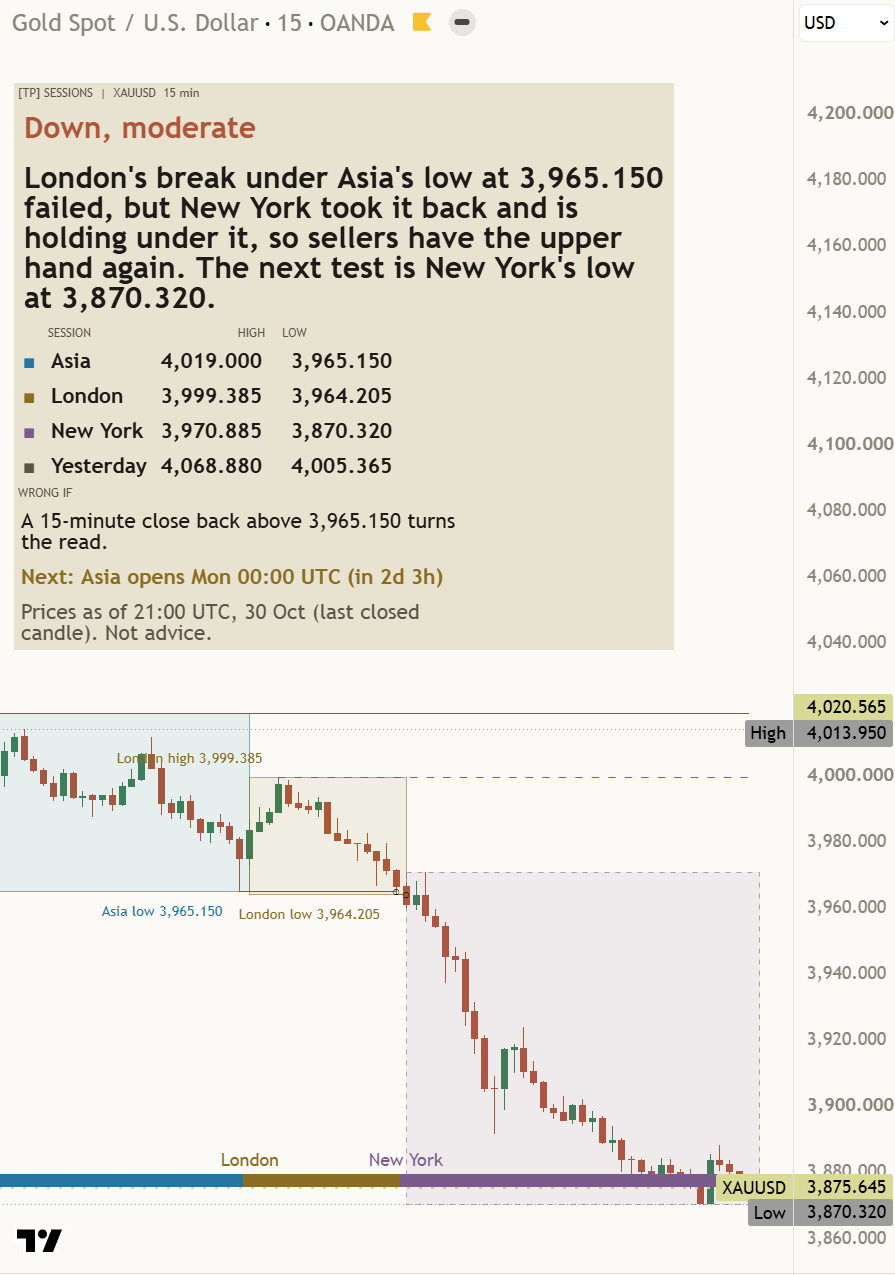
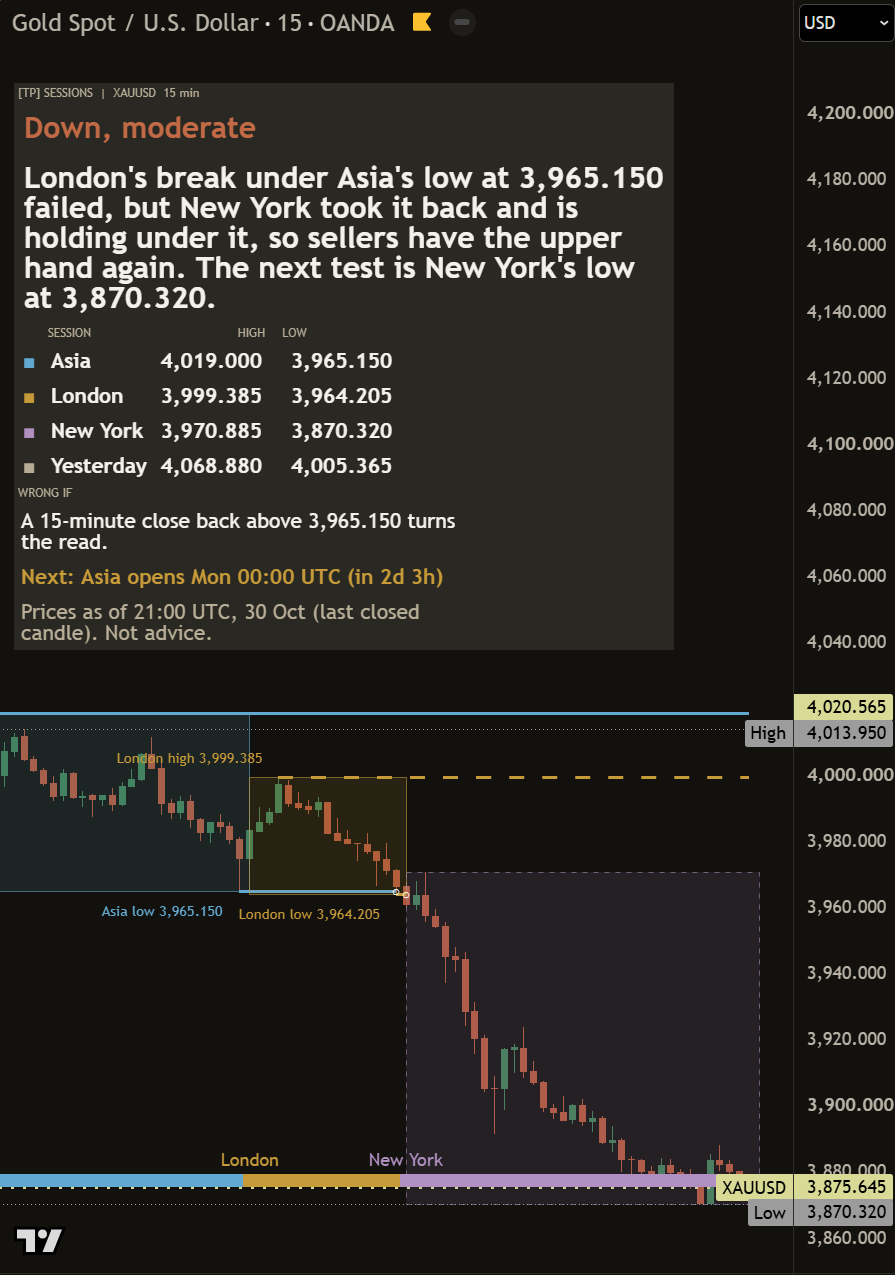
What you see on the chart
Every part of the indicator, in the order you will meet it.
- The readUp, Down or Sideways with a strength, at the top of the card. Within a session it changes only after two closes agree.
- The headlineThe session story in plain words: what London did with Asia's range, what New York did next, and the next level to watch.
- Session boxesA faint box for Asia, London and New York. The box is dashed while the session is still running.
- Session highs and lowsLines from the candle that made each high and low, running right until a finished candle trades through them.
- Taken ringsA ring on the candle where a level was taken, with the level, time and session on hover.
- Session tableHigh and low for Asia, London, New York and yesterday, each with a short status line.
- Session clockTime left in the running session, or when the next one opens. It knows weekends.
- Wrong ifThe close on your own timeframe that would prove the read wrong, always on the card.
What it is in 30 seconds
It marks the three trading sessions of the day on their own clocks and tells the day's story in plain words. It does not say where price goes next.
The right clocks
Asia runs 00:00 to 08:00 London time, London runs to the New York start, and New York runs 08:00 to 17:00 New York time. Summer time on both sides is handled for you.
What each session did
Whether London stayed inside Asia's range, took a side and held, took a side and failed, or took both, and what New York did next.
What would change it
Every read names a level and the close that would turn it, so you know what to watch.
How the read is made
The read follows the day's story. London is judged against Asia's range: inside, took the high and held, took the low and held, took a side and failed back inside, or took both. New York is then judged against both ranges and yesterday's high and low. Each story gives a direction and a strength, from slight to strong.
A level counts as taken only when a finished candle trades past it. Within a session the read waits for two closes before it changes; a new session can change it at once. While a change is pending, the headline says that one more close like the last would change it.
Honest about the data, honest about limits
Ranges, levels, rings and the read update on closed candles. The clock counts from the last closed candle.
A candle belongs to the session in which it opened. On 59 and 239 minute charts this makes the story coarser.
Yesterday's high and low are this chart's own session day, Asia open to New York close. They can differ from a broker's daily candle.
The clock knows weekends but not holidays. Daily and higher charts show a one-line note instead of drawings.
Settings
The defaults work out of the box. These are the ones worth knowing.
| Setting | What it does | Default |
|---|---|---|
| Asia / London ends / New York | Session times on their own clocks. Set New York to 0930-1600 for the stock market day. | 0000-0800; New York start; 0800-1700 |
| Session boxes / high and low lines / taken rings | The boxes, the level lines and the ring where a level was taken. | On; On; On |
| Session clock strip / midpoints / yesterday's lines | Coloured squares along the bottom, middle lines, and yesterday's high and low. | On; Off; Off |
| Past days drawn | How many earlier days stay on the chart, 0 to 5. | 0 |
| Panel detail / text size / position | Full or Compact card, four text sizes, nine positions. | Full; Small; Top Right |
| Theme / Line width | Auto follows the chart background (Paper or Ink); rows wrap at 44 characters for phones. | Auto; 44 |
| Alerts | Session opens, an Asia or London high or low taken, and a close back inside Asia's range. | On; On; On |
Every setting has a small (i) next to it that explains it in plain words on your chart. If candles draw over the card, right-click the indicator, then Visual order, then Bring to front.
Learn more
The opening range
The first minutes of a session on the right clock, and what price did with them. Free, with a quiz.
Open the lesson The Titan suiteOne angle here, the rest of the picture there
Every indicator page, the free Mentors and the member versions, in one place, each read in the same plain-English voice.
See all indicatorsQuestions
How do I get it?
It is for members on TradingView from 18 November 2026. Leave your email at the top of this page and we will tell you the day it is out.
Does it handle summer time?
Yes. Each session is built on its own clock, so the week when the UK and US change clocks on different dates is handled too.
Does it repaint?
No. Ranges, levels, rings and the read are set on finished candles and do not change afterwards.
Which markets does it work on?
Forex, index CFDs, futures and gold, on charts from 1 minute up to 4 hours. A stock or cash index with no candles in Asia hours gets a plain note.
How is it different from the Opening Range Mentor?
[TP] Opening Range - Mentor reads the first minutes of each session. Sessions reads the whole of each session and how the three hand over to each other.
Does it tell me when to act?
No. It tells you what each session did, the next level to test and the close that would change the read. Decisions stay with you.