The opening range: the first minutes, and what price did with them
Mark any session's opening range on the right clock, say in plain words whether price has broken it, and tell a Classic ORB from a break and retest and from a failed break.
By the end of this lesson you will be able to mark any session's opening range on the right clock, say in plain words whether price has broken it, and tell a Classic ORB from a break and retest and from a failed break. You will also be able to read a measured level as a distance, not a promise, and say what would change the read.
1. The idea in one sentence
Foundry lesson. Free, no gate. Page: /foundry/opening-range/. Educational interpretation only. Not financial advice.
How to use this lesson at your level
- Beginner: sections 1 to 5 and the traps in section 15. Get the habit of marking the range on the right clock and judging it on closes.
- Intermediate: add sections 6 to 9. Breaks, the count of closes, failed breaks.
- Advanced: sections 10 to 12. The three named plays and their measured levels.
- Expert: sections 13 and 14, plus the honest limit in every section. Reading one session against the others, and knowing what a pattern cannot tell you.
The opening range is the highest and lowest price of the first few minutes of a session, and many traders watch which side of it price closes beyond.
That is the whole idea. The first minutes after an open are often the busiest of the session, so the range they leave is a small, fresh map of where the day started.
Honest limit: the range describes the first minutes. It does not say what the rest of the session will do.
2. Each session has its own open
Markets that trade around the clock, like currencies, gold and index futures, still have busy opens: Tokyo at 09:00 Tokyo time, London at 08:00 London time, New York at 09:30 New York time. Each open can set its own range. A stock has one open: its exchange's first candle of the day.
Honest limit: some sessions matter more for some markets. A London range on a Japanese stock means little.
3. Use the city's clock, not an offset
London and New York change their clocks on different weekends. For a week or two each spring and autumn, the gap between their opens is an hour shorter than usual. A tool set to "London opens at 07:00 UTC" is right half the year and an hour off the other half. The fix is simple: read each session on its own city's local time.
Honest limit: a holiday with no candles in the window gives no range at all. That is correct, not a fault.
4. How many minutes?
The common choice is 15 minutes. Some traders use 5, 30 or 60. A shorter range sets sooner and is usually narrower, so it is broken more often. A longer one takes more of the session to form.
Honest limit: no length is the right one. Change it and every break, play and level changes with it.
5. The chart has to fit the range
A 15 minute range is the high and low of the candles that open inside those 15 minutes. On a 5 minute chart that is three candles. On a 4 minute chart the candles do not line up with the window, and on a 60 minute chart one candle covers the whole range and more. So the chart's candle length has to divide the range length evenly: 1, 3, 5 or 15 minutes for a 15 minute range.
Honest limit: on a daily chart there is no opening range to draw. You need an intraday chart.
6. Judge breaks on closes
A wick poking above the range is not a break. A break is a finished candle that closes beyond the high or the low. Waiting for the close keeps you from calling a break that was gone a minute later.
Honest limit: waiting for the close means you always see a break a little late. That is the price of not being fooled by wicks.
7. Count the closes beyond
One close beyond the edge is a start, not a fact about the session. A useful habit is to count: is this the first close above, the second, the third? On the Mentor's panel that reads, for example, "Above 2650.00 for 1 of 4 closes: early." (the form of the line).
Honest limit: four closes beyond the edge is a sensible count, not a magic one. A break can still come back later.
8. The failed break
Sometimes price closes beyond the range and then closes back inside within a few candles. That is a failed break. A common rule is three candles: back inside within 3 candles of the break. When that happens, the other edge of the range is the side in play.
Honest limit: a failed break is a fact about what happened, not a forecast that price will reach the other side.
9. Back inside after a longer break
If price stayed beyond the edge for longer than three candles and then came back inside, that is not called a failed break. It is simply back inside after a break, and the range is in play again on both sides.
Honest limit: the line between a failed break and a later return is a rule, not a law. Different traders use different counts.
10. The Classic ORB
The oldest opening range play: price closes beyond the range and stays beyond it. Toby Crabel wrote about it in 1990 and Mark Fisher built a whole method on it. Here it is named once the break has held 4 closes, the break candle included, without coming back to the edge. Why 4: a close back inside within 3 candles would be a failed break, so the 4th close is the first that can no longer fail that way.
On the panel: "Classic ORB long: held above 2650.00." or, mirrored, "Classic ORB short: held below 2637.50." (the form of the line).
Honest limit: a named play is a pattern, not a promise. Many Classic ORBs run out of room. The name tells you what happened, not what will.
11. Break and retest
After a break, price often comes back toward the edge it broke. If a later candle comes close to the broken edge and still closes beyond it, that is a break and retest. Mike Bellafiore calls it the second chance. Here "close to" means within about a third of a typical candle's size.
On the panel: "Break and retest: held above 2650.00." (the form of the line).
Honest limit: a retest that held once can still give way on the next candle. Every play comes with the close that would end it.
12. The measured level
For decades, traders have measured how far a break might travel using the range itself. Add the range's height beyond the broken edge: a 12.50 range broken at 2650.00 measures 2662.50. That is "a one-range move". Some also use 1.272 and 1.618 times the range, a Fibonacci habit.
On the panel: "A one-range move reaches 2662.50." For a failed break the level is the other edge: "Opposite side in play: 2637.50." (the form of both lines).
Honest limit: a measured move is a distance, not a goal. Price may turn before it, or go far beyond it.
13. Read one session against the others
A session does not start from nothing. New York opens with London's range already on the chart, and London with Tokyo's. Three simple questions help:
- Did this session break the earlier session's high or low, and is it still beyond it?
- Did it trade beyond an earlier high or low without a single close there, then come back inside? That is a sweep.
- Is it inside its own range from the day before, or beyond it?
The Mentor says these in one line each, for example "NY broke London's high: up side leads." or "London swept Tokyo's high, back inside."
Honest limit: these are facts about where price is against earlier ranges. When they point one way and the play points the other, both are still true.
14. Know what would change the read
Every read has an end. For a break above, a close back below the high. For a failed break, a close back beyond the edge it failed at. Saying it out loud keeps you honest. On the panel this is the "Changes if" line, for example "Changes if: a close back below 2650.00." (the form of the line).
Honest limit: the change line tells you when the read ends, not what comes after it.
15. Six common traps
- Using a fixed time offset, so the range is an hour off for part of the year.
- Drawing a 15 minute range on a chart whose candles do not fit it.
- Calling a break on a wick.
- Calling it held after one close.
- Reading a measured level as a place price must reach.
- Forgetting the earlier session's range when reading the next one.
16. Practise it
Pick a market you follow and one session. Before the open, write the time on that city's clock. When the range sets, write its high, low and size. Then, before each close beyond it, write what you expect: break, failed break, or a return to the edge. Afterwards, note which play it became and how far it went against one range height. After twenty sessions, your own notes will tell you more about that market than any rule of thumb.
Key takeaways
What to remember
- The opening range is the high and low of a session's first minutes, most often 15.
- Read each session on its own city's clock, and use a chart whose candles fit the range.
- Breaks are judged on closes. Count them: one close is early.
- Back inside within 3 candles is a failed break; the other edge is then in play.
- The Classic ORB held 4 closes; a break and retest came back to the edge and held.
- A measured level is a distance, not a goal, and every read has a close that would change it.
17. See it explained live: [TP] Opening Range - Mentor
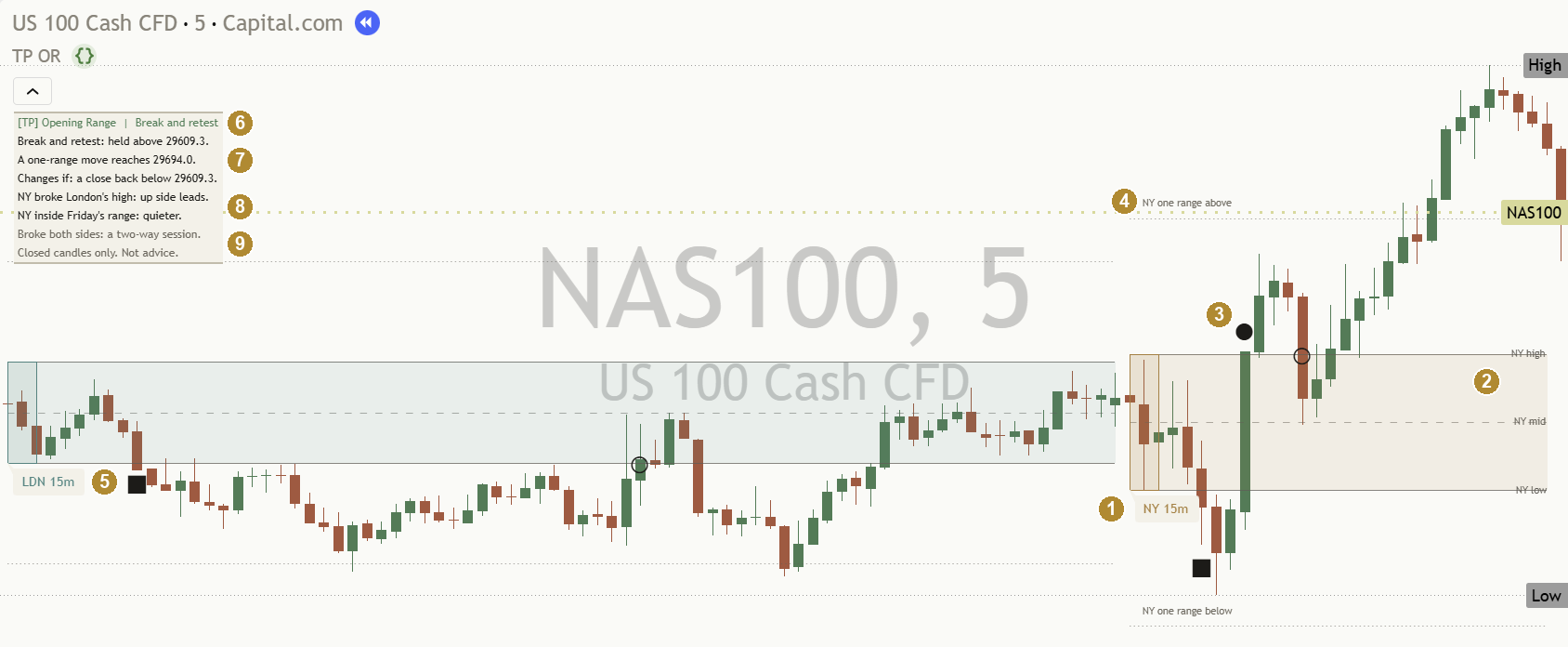
The free [TP] Opening Range - Mentor does all of this on your own chart, in plain words. It draws Tokyo, London and New York on their own clocks, marks the first close above, below and back inside, names the play while the session is open, and gives the level it measures and the close that would change it. It never says what to do.
On NAS100 five minutes, during the New York session on Monday 19 October 2026, its panel read:
- "[TP] Opening Range | Break and retest"
- "Break and retest: held above 29609.3."
- "A one-range move reaches 29694.0."
- "Changes if: a close back below 29609.3."
- "NY broke London's high: up side leads."
- "NY inside Friday's range: quieter."
Read it with this lesson: New York's range ran from 29524.6 to 29609.3, a size of 84.7. Price broke above, came back close to the high and still closed above it (section 11). One range height above the high is 29694.0 (section 12). New York was also beyond London's high and still inside Friday's range (section 13). And a close back below 29609.3 would end the read (section 14).
Test yourself
Take the 15-question quiz below to check what stuck.
Question 1 of 15 · Beginner
In plain words, what is the opening range?
Question 2 of 15 · Beginner
Why should each session be read on its own city's clock?
Question 3 of 15 · Beginner
Which chart fits a 15 minute opening range?
Question 4 of 15 · Beginner
A candle's wick pokes above the range high, but it closes inside. Is that a break?
Question 5 of 15 · Beginner
What does the midline of the range show?
Question 6 of 15 · Intermediate
Price closes above the range, then closes back inside two candles later. What is that called here?
Question 7 of 15 · Intermediate
After one close above the range, the panel reads "Above 2650.00 for 1 of 4 closes: early." What does it mean?
Question 8 of 15 · Intermediate
Why is a break named the Classic ORB only from the 4th close beyond the edge?
Question 9 of 15 · Intermediate
Price stayed above the range for ten candles, then closed back inside. Is that a failed break?
Question 10 of 15 · Advanced
A range runs from 2637.50 to 2650.00 and price breaks above. Where is the one-range move?
Question 11 of 15 · Advanced
What is a break and retest?
Question 12 of 15 · Advanced
The panel says "A one-range move reaches 29694.0." What is the honest way to read it?
Question 13 of 15 · Expert
London trades above Tokyo's high but never closes above it, then comes back inside. What is that?
Question 14 of 15 · Expert
The play reads one way and a context line reads the other way. How should you read that?
Question 15 of 15 · Expert
Why does the Mentor show no win rate or odds for its plays?
Educational interpretation only. Not financial advice.
Learn the idea here. Apply it with the desk.
Titan Protect turns lessons like this into a daily practice: live market research, the full framework, and the tools that put it to work. This lesson is free; the desk is where it compounds.