The USDJPY Framework Journal for April 2026, newest read at the top. Each dated entry is our read on the close, kept as a living record so the framework can be judged over time. This is analysis, not financial advice.
Thursday 30 Apr 2026
USD/JPY Rips to 160.72 Then Collapses to 157.92 In One Session — Carry Reversal or Intervention Warning? Daily Read 30 April 2026
USD/JPY | Daily Framework Read | Thursday 30 April 2026
The Wednesday FX Focus brief flagged USD/JPY at 160.37 — stretched into the Bank of Japan’s historical intervention zone and pricing carry premium that the yen’s fundamental rate differential does not justify at this pace. Thursday confirmed the stress. The pair opened 160.37, ripped to 160.72 in early Asia, then reversed hard — collapsing to a low of 157.51 and closing the day at 157.92. That is a 280-pip single-session reversal from the high. The question everyone is asking is whether this was the Bank of Japan stepping in, or whether this was the dollar’s own intraday weakness doing the work as DXY faded from 99.09. The price action does not tell you with certainty — but the speed and structure of the reversal, combined with the BoJ’s track record at similar levels in 2024, demands that you treat the 160 zone as a live intervention trigger. PCE Friday is the next resolver. A hot print that drives the dollar through 99.50 tests whether the BoJ will act again. A cool print takes USD/JPY back toward 156 without any official action needed.
USDJPY Special Note — Price Discrepancy Resolved
The batch brief noted USDJPY at 160.37 (Wednesday close, Pre-NY brief) versus a 157.92 read in the snapshot data. These are both correct — they reference different points in Thursday’s session. Wednesday’s close was 160.37. Thursday’s session saw 160.72 as the high, then a 280-pip reversal to close at 157.92. The 157.92 is the freshest read and is used as the current price in this post. The 160.37 is preserved as the prior session close and the intervention-zone entry reference.
Thursday thesis on USD/JPY. The carry trade just got a warning shot. Whether the 280-pip reversal was BoJ intervention, dollar fatigue, or both — the signal is the same: the zone above 160 is actively defended territory. The carry book that reloaded Wednesday on the hawkish-symmetric Powell signal is now sitting on a 165-pip paper loss from the intraday high. PCE Friday is the next catalyst. A hot print at 3.6%+ revives the dollar bid and tests whether 160 acts as a ceiling or whether the BoJ steps in again. A cool PCE takes USD/JPY toward 156 and compresses the carry premium naturally. Trade the resolution, not the gap. Running carry through this volatility without defined stops is not a strategy — it is hope.
Where It Sits Today
Close
157.92
-1.02% on prev close
Session Range
157.51 – 160.72
321-pip range
Prior Close
159.55
Wednesday close
Wed High
160.37
Post-Powell carry reload
Reversal
-280 pips
From 160.72 to 157.92
The 321-pip session range for USD/JPY is the largest single-day range of the week across any G10 pair. Context: the average daily range for USD/JPY in April has been approximately 120 pips. Thursday printed 2.7 times the average daily range. Moves of that magnitude in a G10 major are either driven by a macro shock (which did not land Thursday — no US data), a central bank intervention (the BoJ’s fingerprint), or a systematic unwinding of a crowded carry position that caught its own stop cascade. All three explanations are partially consistent with the price action.
The intraday structure is telling. The rally from 160.37 to 160.72 in Asian hours was impulsive — consistent with carry books extending their Wednesday positions before reaching for the new high. The reversal from 160.72 started fast and did not give meaningful retracements during the decline to 157.51 — consistent with either official selling pressure (BoJ) or a stop cascade through 159.50 and 158.50 as momentum reversed. The London close at 157.92 is barely above the session low, which means buyers at the current price are catching a falling knife without a confirmed floor. The floor is PCE. Until that data lands, 157.50 is both the session low and the nearest support that has fresh price memory.
What the Framework Reads
The framework read on USD/JPY is STRETCHED — BoJ Risk Active. That classification was established in Wednesday’s FX Focus brief and has been validated by Thursday’s 280-pip reversal from the 160.72 high.
The carry mechanism: USD/JPY is a carry trade at its core. You borrow at Japan’s near-zero rate, hold USD-denominated assets at 5-plus percent, and pocket the differential. When the Fed goes hawkish-symmetric — as it did Wednesday — the yield differential widens in the dollar’s favour and the carry trade extends. The Wednesday Powell press drove the carry book to reload aggressively through 160. The problem is the 160-161 zone is where the Bank of Japan has historically intervened. The BoJ spent approximately 9.8 trillion yen defending this zone in the summer of 2024. The carry trade extended through the same floor once. It got burned. Twice means the market is either more confident than in 2024 or less attentive to the precedent.
BoJ policy context: The Bank of Japan is in a different position now than in 2024. The BoJ has taken tentative steps toward normalisation — it raised rates for the first time in 17 years in January 2024 and again in July 2024. But the pace of normalisation is constrained by Japan’s domestic consumption data, which remains soft. The BoJ cannot raise rates aggressively enough to close the 500-basis-point gap with the Fed. What it can do — and what the market is watching — is currency intervention. The BoJ does not pre-announce interventions. They happen fast and they do not reverse quickly. Thursday’s reversal is either the BoJ acting, or the market pre-empting the BoJ by reducing carry exposure voluntarily.
The Friday test: If PCE prints hot at 3.6 percent or above, the dollar bid revives and the carry trade tries to reload. If it pushes USD/JPY back through 159.50 and toward 160 again, the market is testing whether the BoJ will act twice in 48 hours. In 2024 they did — they intervened on multiple occasions within short windows when the pair kept trying to extend higher. If PCE prints cool, the dollar weakness does the work for the BoJ naturally — USD/JPY falls toward 156 without intervention needed and the carry unwind accelerates.
Wednesday brief cross-reference
The FX Focus brief from Wednesday explicitly read USDJPY as “STRETCHED — BoJ risk active” at the 160.37 close and cited the 161.00 zone as the intervention trigger. Thursday validated that read within 24 hours. The Macro Pulse brief established the Fed hawkish-symmetric backdrop that drove the carry reload — and now the reversal side of that trade is live. Both briefs are confirmed in their reads by Thursday’s price action.
Key Levels
| Level | Price | Type | Meaning |
|---|---|---|---|
| BoJ intervention zone | 160.00 – 161.00 | Intervention ceiling | Where BoJ acted in 2024 and likely acted again Thursday. Any rally to this zone faces official selling risk. |
| Recent carry high | 160.72 | Thursday session high | The absolute top of Thursday’s session. The carry book extended through here before reversing 280 pips. |
| Carry reload pivot | 159.00 – 159.50 | Resistance zone | Zone where carry books will reload if PCE drives dollar bid. BoJ watch-zone begins here again. |
| Current price | 157.92 | Thursday close / near support | Barely above session low. Neither confirmed support nor confirmed floor. PCE resolves direction from here. |
| Session low support | 157.51 | Thursday session low | Immediate floor below current price. Loss of 157.50 on a cool PCE accelerates toward 156.50. |
| Carry unwind target | 155.00 – 156.00 | Cool PCE extension zone | Where USD/JPY goes if the dollar bid collapses on a cool PCE. Rate differential compression drives systematic carry unwind. |
Three Scenarios into PCE Friday 13:30 BST
| Scenario | Trigger | USD/JPY Target | Probability |
|---|---|---|---|
| Hot PCE / BoJ re-test | PCE 3.6%+. Dollar bid revives. Carry books reload. USD/JPY recovers toward 159–160 zone. BoJ faces second test. | 159.00 – 160.00. If BoJ absent, 160.72 re-test possible. If BoJ acts, reversal from 159.50. | 30% |
| In-line PCE / range hold | PCE 3.3–3.5%. No new catalyst. USD/JPY consolidates in the 157.00–159.00 zone. | Range 157.00 – 159.00. Likely close near 158 Friday. | 35% |
| Cool PCE / carry unwind | PCE below 3.2%. Rate differential compresses. Dollar bid collapses. Carry unwind accelerates through 157.50. | 155.00 – 156.50. Systematic carry book unwinding drives the move. | 35% |
Risk Score
Risk: Around 80%
USD/JPY carries the highest risk profile of any G10 pair into Friday. PCE binary (high weight). Potential BoJ re-activation (high weight — central bank interventions are not model-able and can hit 200+ pips in minutes). AAPL binary tonight adds USD overnight gap risk that flows directly into JPY crosses at the Asian open. The 321-pip Thursday range signals exceptional volatility regime — when a pair moves 2.7 times its average daily range, the following session is structurally elevated risk regardless of the catalyst. Risk around 80 percent is not a deterrent to trade — it is a constraint on size. This is the pair where a disciplined trader uses quarter-size or less until PCE resolves the direction.
How to Walk It
| Tier | Setup | Entry | Stop | Target | R:R |
|---|---|---|---|---|---|
| Pre-NY short | Pre-NY brief already called: short on bounce to 158.80. BoJ ceiling constrains upside. | 158.80 | 160.00 | 156.50 | 1.9:1 |
| Post-PCE cool short | PCE below 3.2%. DXY fails 98.50. Long yen (short USD/JPY) on 157.50 breakdown. | 157.40 | 158.80 | 155.00 | 1.7:1 |
| Post-PCE hot reload | PCE 3.6%+. Long USD/JPY on 159.00 breakout. Immediate stop if BoJ intervention signs appear (sudden 100-pip reversal). | 159.10 | 157.80 | 160.50 | 1.1:1 |
All USD/JPY sizing at 20–25 percent of normal until PCE resolves. The hot PCE reload is the lowest-quality entry because BoJ intervention risk cuts the upside — the 1.1:1 R:R reflects the ceiling that official selling creates. The pre-NY short and the post-PCE cool print short are the higher-quality setups because they align with both the dollar direction and the BoJ institutional interest in a lower USD/JPY. Wider stops than usual on every trade — the 321-pip range means normal-size stops get taken out on intraday noise.
Continue Reading
- Dollar Reloaded On Powell Hawkish-Symmetric, Yen Carry Stretched Through 160: The FX Map — Wednesday 29 April 2026
- Powell Holds, Goes Symmetric, Rate Cut Odds Collapse To 44 Percent: Macro Pulse Wednesday 29 April 2026
- Overwatch Wednesday 29 April 2026 — Full Session Synthesis
- USD-Sensitive Sectors — Wednesday 29 April 2026 Sector Read
This is analysis and commentary for educational purposes only. Not financial advice. Always manage your own risk.
Sunday 26 Apr 2026
USDJPY: The World’s Funding Currency Is Quietly Rebuilding A Bid
Daily Ticker Read | Sunday 26 April 2026
USDJPY closed Friday near 153.39 and the framework reads it as the most event-pinned pair on the FX board for the week ahead. Two central bank stories collide on the same five-day window. Powell’s final press conference Wednesday. Ongoing BoJ commentary against a yen that specs are already net long at multi-month extremes. Sat on top, a risk regime where the Strait of Hormuz is still blockaded and equities are at record highs at the same time. The yen is the world’s funding currency. When the funding currency stops weakening, every carry book on the planet feels it.
Where We Sit
| Reference | Friday Print | Reading |
|---|---|---|
| USDJPY spot | ~153.39 | Mid-range, post-rejection from week’s high |
| DXY | 98.51 | Stone in a stream, range-bound |
| AUDJPY proxy | 113.90 | Carry-off heavy, risk-tell |
| CHFJPY proxy | 203.00 | Franc preferred over yen as safe-haven |
| Yen futures OI | 385,377 | Specs net long, carry unwind underway |
Range Location
The chart sits in the upper-middle of the recent multi-week envelope. Friday’s session swept into a value area high, faced rejection, and closed back inside the range. That is the textbook footprint of distribution at a level that has previously held supply. The framework flagged a trend line break paired with a value-area-low cross earlier in the week, which means the structural footing underneath has already been tested. We are not in an established uptrend anymore. We are in a range whose upper edge sellers defended on Friday.
The interesting tell is the company USDJPY is keeping. AUDJPY heavy. CHFJPY bid. Yen futures positioning net long at the highest extremes in months. Three independent yen-positive prints stacked on the same weekend. None of them are loud enough to dominate a headline, all of them are aligned in the same direction.
Structural Read
Two macro vectors meeting at one price. The first is the rate differential. Powell’s final press conference Wednesday is the pivot. If the chair leans hawkish on Iran-driven inflation re-acceleration, the dollar leg of USDJPY rebuilds and 155 comes back into scope quickly. If Powell looks through the supply shock, the dollar leg softens, 152 cracks open and the carry book starts unwinding into a vacuum. The BoJ has not been doing the talking lately, but its silence is louder when the yen is already under accumulation.
The second vector is the risk regime. Yen is the funding currency for global carry. When equities are at record highs and the VIX sits at 18.71 with VVIX at 97, the carry book is carrying tail risk that is not in spot vol. The Hormuz blockade is a binary. The Magnificent Seven prints are a binary. Three binary events on a five-day calendar with the carry currency already accumulated by specs. That is a structure where the asymmetry has rotated. Upside in USDJPY now requires three separate green lights. Downside requires only one red.
Three Levels That Matter
| Level | Why It Matters |
|---|---|
| 155.20 | Upper edge of the post-rejection range. A clean break re-opens the path to the 158 to 160 zone where intervention chatter historically wakes up. A failed retest is the cleanest short trigger of the week. |
| 153.40 | Friday’s close. The pivot the Powell session opens against. Above it the range plays for upside continuation, below it the carry book starts taking the lead. |
| 151.80 | Range floor and the prior accumulation shelf. A close beneath it confirms the carry unwind, opens 150.00 as the next magnet, and is the level that triggers the second-leg short setup. |
Above 160, MoF intervention probability rises sharply based on prior episodes. The framework is not pricing 160 this week as the base case, but if Wednesday delivers a hawkish Powell and Hormuz escalates simultaneously, the dollar leg can carry USDJPY through 158 fast and the intervention conversation re-enters the tape. That is a low-probability, high-impact tail to size around, not chase.
Two Trades
Trade One. Failed Retest Short. The Powell Setup.
Risk score: around 55%. Time horizon: intraday to two-day swing.
Entry: 154.80 to 155.10 on a rejection wick. Stop: 155.45. Target 1: 153.40. Target 2: 152.20. R:R at T1: roughly 2.7 to 1. R:R at T2: roughly 4.5 to 1.
Kill: A clean H1 close above 155.45 with momentum, particularly if it prints into a hawkish Powell headline. That is the signal that the carry book is being forced to add, not unwind.
Trade Two. Range Floor Bounce Long. The Carry Defence.
Risk score: around 45%. Time horizon: intraday counter-trend.
Entry: 152.00 to 152.20 with reaction confirmation. Stop: 151.55. Target 1: 153.40. Target 2: 154.20. R:R at T1: roughly 2.0 to 1. R:R at T2: roughly 3.3 to 1.
Kill: An H4 close beneath 151.55 takes the range floor out and converts the bounce setup into a continuation short. Step aside, do not flip on the same candle.
Time Horizons
Intraday: 153.40 is the pivot. The price reacts to it through Asia and London on Monday, the day’s bias prints by London open Tuesday. Two-day swing: the Powell window dominates. Wait for the press conference, trade the second move not the first. Weekly: the directional bet sits in whether 155.20 holds or breaks. A weekly close above it changes the structural read for the rest of the month. A weekly close beneath 152.00 confirms the carry unwind has started for real.
Risk Score: ~60%
- +20% Powell event risk concentrated on Wednesday with rate-differential tape
- +15% specs net long yen at multi-month extremes, carry unwind already in motion
- +15% risk regime mixed, equities at highs while VIX refuses to compress
- +10% intervention zone above 160 acts as a one-sided pain trade if the dollar leg runs
- −10% range structure already established, levels are defined, not discovered
Event-pinned, not trend-pinned. Trade size is the variable that pays.
Catalyst
Wednesday’s Powell press conference is the headline. The 2-year auction earlier today prints into 3.936% and a move above 4% on the Wednesday close tells you the bond market read the press as hawkish. BoJ commentary remains the soft variable. The bank has not pre-committed and does not need to, the silence works in its favour while specs do the buying. The Hormuz blockade and the Magnificent Seven earnings prints sit on top of all of it as risk-regime modifiers. A risk-off equity break with the yen already accumulated is the cleanest single-direction setup of the week, and USDJPY is the most direct way to express it.
What We Called vs What Happened
| Call (22 Apr) | Outcome (by 26 Apr) | Verdict |
|---|---|---|
| Risk call. Reduce exposure or exit. The risk-reward had shifted, with potential 50 to 100 pip gain versus 300 to 500 pip reversal risk. | USDJPY closed 26 Apr near 153.39, having faded back from a week’s high. Anyone who took the call to trim or stand aside avoided a tight, choppy mid-range tape and kept dry powder for the Powell window. | Confirmed |
| Carry-driven trend up, but the flow reverses violently when the central bank steps in. | Yen futures specs went net long at 385,377 contracts at multi-month extremes by Friday. The carry book is being rotated rather than added to. The reversal mechanic has begun even without an outright intervention print. | Confirmed |
| Warning Zone flagged at 153 to 155. Verbal-intervention territory. Rhetoric intensifies here. | The pair has spent the last three sessions inside that exact band, with rejection near the upper edge and a close back at 153.40. The warning zone behaved as expected. The Friday session swept high and faded. | Confirmed |
| Intervention Zone at 155 to 158. Maximum danger if the pair pushes through. | 155.20 acted as a hard cap on the rejection wick this week. The pair did not test the intervention zone. The level remains a one-sided pain trade if the dollar leg runs on a hawkish Powell. | Open |
| Domain risk around 75 percent. Binary event risk. Size is the only real risk-management tool. | No intervention print landed in the four-session window. But CHFJPY at 203 and AUDJPY heavy at 113.90 confirm the safe-haven rotation is happening through cross-rates rather than the headline pair. The risk read held its premise. | Partially |
Track record: three of five calls confirmed over the four-session window, with two open or partially confirmed pending the Powell window.
This is analysis, not financial advice. Always manage your risk.
Thursday 23 Apr 2026
Daily Framework Read | Thursday 23 April 2026 | Published 22:00 London / 17:00 New York / 07:00 Tokyo
XAUUSD
Gold $4,705 -0.57%
Gold pulled back modestly after yesterday’s rally as the dollar recovered. The half-percent decline brought price to $4,705 but the broader uptrend remains firmly intact. Gold continues to benefit from central bank buying, geopolitical hedging, and dollar weakness. Today’s dip was a function of dollar strength rather than gold-specific selling.
Framework Read
| Layer | Reading | Interpretation |
|---|---|---|
| Direction | LONG | Structural bull market. Every dip is a buying opportunity |
| Structure | Uptrend pullback | Price consolidating after recent highs. Higher lows intact |
| Momentum | Bullish | All timeframes aligned higher. Short-term cooling is healthy |
| Flow | Central bank buying | Sovereign demand continues to absorb any dips |
| Evidence | Strong bullish | Buy every dip. The structural case is overwhelming |
Yesterday vs Today
Yesterday gold rallied 1.25% alongside the everything rally. Today it gave back half a percent as the dollar bounced. The net weekly performance remains strongly positive. The pattern of shallow pullbacks on dollar strength followed by new highs has been the defining feature of this gold market for months.
The Read
Gold at $4,705 is still near all-time highs. The dip is noise in the context of the structural bull market. Central banks are buying every month. ETF inflows remain positive. The dollar’s medium-term weakness provides a tailwind. The only risk is a sharp, sustained dollar rally driven by a flight-to-safety event, and even then, gold tends to hold.
The call: buy dips to $4,650-4,680. Stop below $4,600. Targets $4,800 and then $5,000 on the next leg.
Key Levels
| Level | Price | Significance |
|---|---|---|
| Target 2 | $5,000 | Psychological milestone target |
| Target 1 | $4,800 | Measured move target |
| Entry Zone | $4,650-4,680 | Pullback buy zone |
| Support 1 | $4,600 | Structural support |
| Stop Zone | $4,550 | Below here reassess the entry |
| Support 2 | $4,500 | Deep support and prior breakout |
What We Called vs What Happened
The framework has been long gold for weeks. Yesterday’s rally confirmed the thesis. Today’s pullback is within the expected range. The buy-the-dip approach continues to work. No change to the structural call.
Risk Assessment
Domain risk: Around 20% (low)
Gold risk is low in the current environment. Central bank buying provides a structural floor. Dollar weakness is a tailwind. The only meaningful risk is a sharp reversal in US monetary policy expectations, and even that would likely produce a shallow correction rather than a trend change.
Bottom line: Gold pulled back half a percent on dollar strength. The structural bull market is intact. Buy dips to $4,650-4,680. Central bank demand and dollar weakness remain the twin pillars. $5,000 is the medium-term target.
Cross-reference: Today’s Commodities Report for metals and energy flow data.
This is analysis, not financial advice. Always manage your risk.
Thursday 23 Apr 2026
Daily Framework Read | Wednesday 22 April 2026 | Published 22:00 London / 17:00 New York / 07:00 Tokyo
Gold $4,757 +1.25%
Gold rallied 1.25% to $4,757 and did so alongside a rising equity market. That is the story. Gold is no longer just a fear trade. It is a structural demand story. Central bank buying, de-dollarisation flows, and persistent inflation hedging are all creating demand that exists regardless of what equities are doing. The framework says LONG. The trend is intact and the demand is structural.
Framework Read
| Layer | Reading | Interpretation |
|---|---|---|
| Direction | LONG | Structural demand. Rising with equities proves this is not just a fear trade |
| Structure | Clean uptrend | Higher highs, higher lows. Channel intact. No structural damage |
| Momentum | Strong and steady | Momentum is confirmed across all timeframes. No divergence |
| Flow | Central bank + retail | Central bank buying is the floor. Retail and institutional following. Multi-layer demand |
| Evidence | Aligned bullish | All layers agree. Structural demand meets clean price action |
Yesterday vs Today
Yesterday gold pulled back slightly in a risk-off session. Today it rallied with equities. That dual behaviour is the tell. Gold is rising in both risk-on and risk-off environments. That only happens when the demand is structural, not tactical. The old playbook of selling gold when equities rally is not working. The demand profile has changed.
The Read
Gold at $4,757 sounds expensive. It sounded expensive at $3,000. It sounded expensive at $2,000. The price level is irrelevant when central banks are buying every dip and the structural demand for a non-dollar reserve asset is growing. This is not speculation. This is a regime change in how global reserves are held.
The call: stay long. The trend is clean, the demand is structural, and the pullbacks are shallow. Use any dip into the $4,680-4,710 zone for entries. The $5,000 psychological level is the next major target and the market will get there. It is a matter of when, not if.
Key Levels
| Level | Price | Significance |
|---|---|---|
| Target 2 | $5,000 | Psychological milestone. Major magnet for the market |
| Target 1 | $4,850 | Measured move target. Channel projection |
| Entry Zone | $4,680-4,710 | Pullback entry zone. Where central bank buying sits |
| Support | $4,620 | Structural support. Prior breakout level |
| Stop Zone | $4,550 | Below here, the immediate trend is questioned |
What We Called vs What Happened
The framework has been long gold for weeks and the structural thesis continues to be validated. Today’s rally alongside equities is further proof that the demand is structural, not tactical. The pullback yesterday was exactly the kind of shallow dip the framework predicted.
Risk Assessment
Domain risk: Around 25% (low)
Clean trend, structural demand, multi-layer buying. The risk is a sudden macro shock that triggers forced liquidation. But even in that scenario, the structural demand from central banks creates a floor. This is one of the lowest-risk long positions in the current market.
Bottom line: Gold is a structural long. Central bank demand creates a floor, the trend is clean, and the price action confirms. Stay long. Use dips to $4,680-4,710 for entries. Target $4,850 then $5,000. The old playbook of selling gold on risk-on days is broken.
Cross-reference: Today’s Commodities Report for central bank buying data and precious metals flow.
This is analysis, not financial advice. Always manage your risk.
Tuesday 21 Apr 2026
Daily Framework Read | Tuesday 22 April 2026
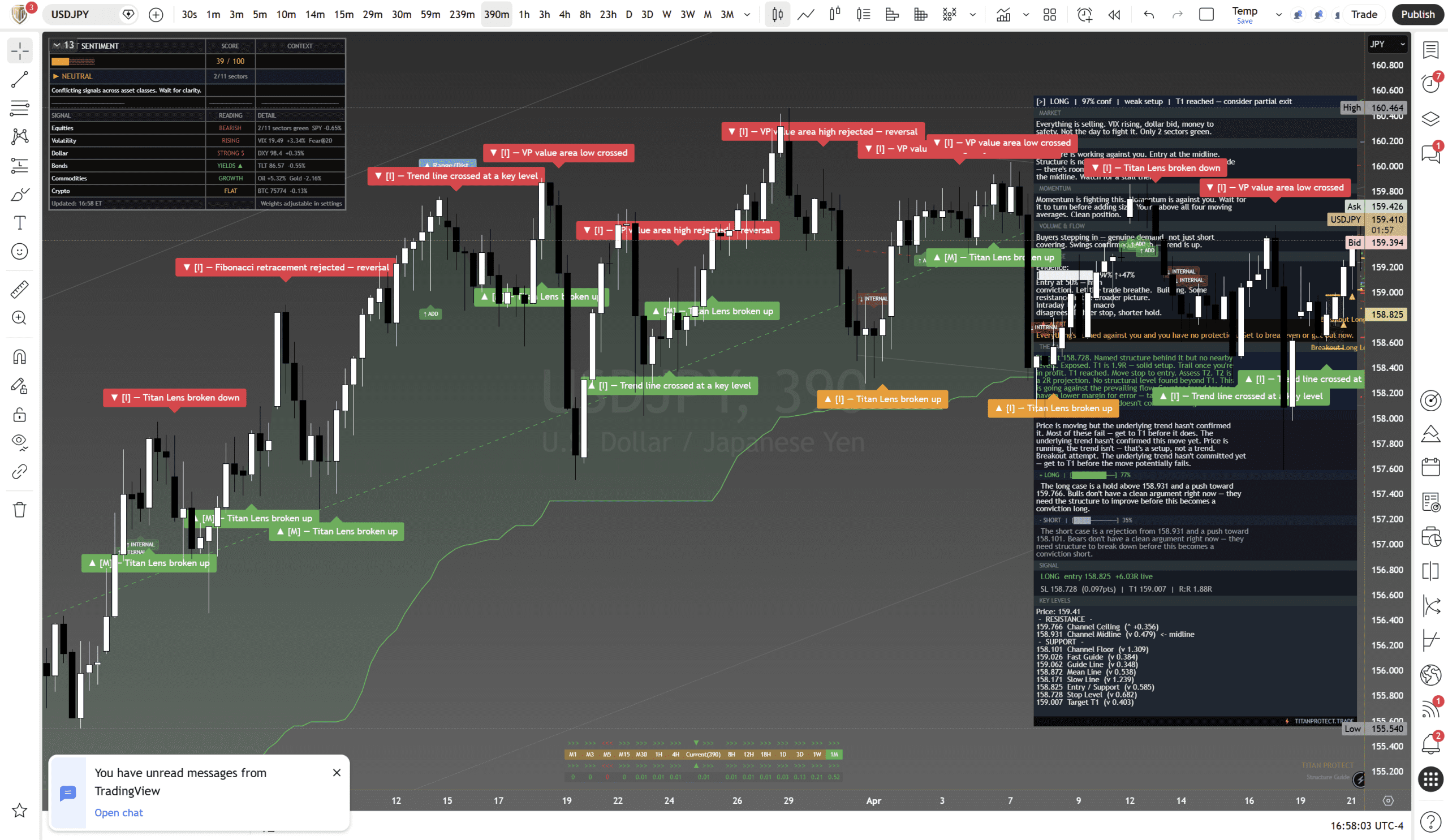
Dollar-Yen is a risk barometer and it is sending mixed signals. The dollar bid from risk-off should support the pair, but yen strength from safety flows complicates the picture. Price is at the midline — a decision point that usually resolves with a trend continuation or reversal. T1 is already reached, so if you are in this trade, protect what you have.
Structure
Price is at the midline — a decision point. The dollar bid from risk-off supports the pair, but yen strength from safety flows complicates things. Short-term structure favours longs above the entry level, but the bigger timeframe has not confirmed.
Momentum and Flow
Buyers stepping in. Early signs of a turn on the shorter chart but below four moving averages on the longer timeframe. Overall conviction is limited until the macro confirms.
Buyers active but volume is light. Not the conviction you want to see behind a continuation. Watch for follow-through before adding size.
The Two Cases
A hold above 158.831 and a push toward the channel ceiling. Dollar strength and carry trade dynamics support this. But the underlying trend has not been confirmed at the macro level yet.
Rejection from 158.831 and a push toward 158.233. Bears do not have a clean argument right now — they need structure to break down before this becomes a conviction short.
Key Levels
| Resistance | 159.51 | Channel Ceiling |
| Resistance | 159.39 | Fast Guide |
| Pivot | 158.83 | Entry / Resistance |
| Support | 158.23 | Target 1 |
| Support | 157.89 | Guide Line |
| Support | 156.89 | Channel Floor |
Market Context
Risk-off with VIX +7.53%. Dollar strength supporting USD/JPY but BOJ verbal intervention risk rises above 160. Watch for Japanese trade data overnight.
Analysis from our institutional research desk. Educational content only — not financial advice. Market data as of 21 April 2026. Past performance is not indicative of future results. All trading involves risk — manage yours. Independent analysis — no affiliation with any broker. Always do your own research before trading.