🛡️ SL/TP Intelligence Series — Article 2 of 10 | Video: 15 min
📋 What You’ll Learn:
- 🎯 Why risk-to-reward ratio is the math that matters
- 💡 How to calculate it (simple division — nothing fancy)
- ⚠️ Why 1:2 isn’t automatically better than 1:1
- 📊 The win rate you need for any ratio to work
- 🔢 Real examples with actual numbers
🎥 Video coming soon — Subscribe to @Titan_Protect for the full breakdown with live charts.
️ The Math That Separates Winners From Losers
Here’s a truth that surprises most new traders: you can be right less than half the time and still make money.
How? Risk-to-reward ratio. This one calculation determines whether your trading account grows or shrinks over time. Ignore it at your peril.
What Is Risk-to-Reward Ratio?
Simple version: How much you stand to gain versus how much you risk losing.
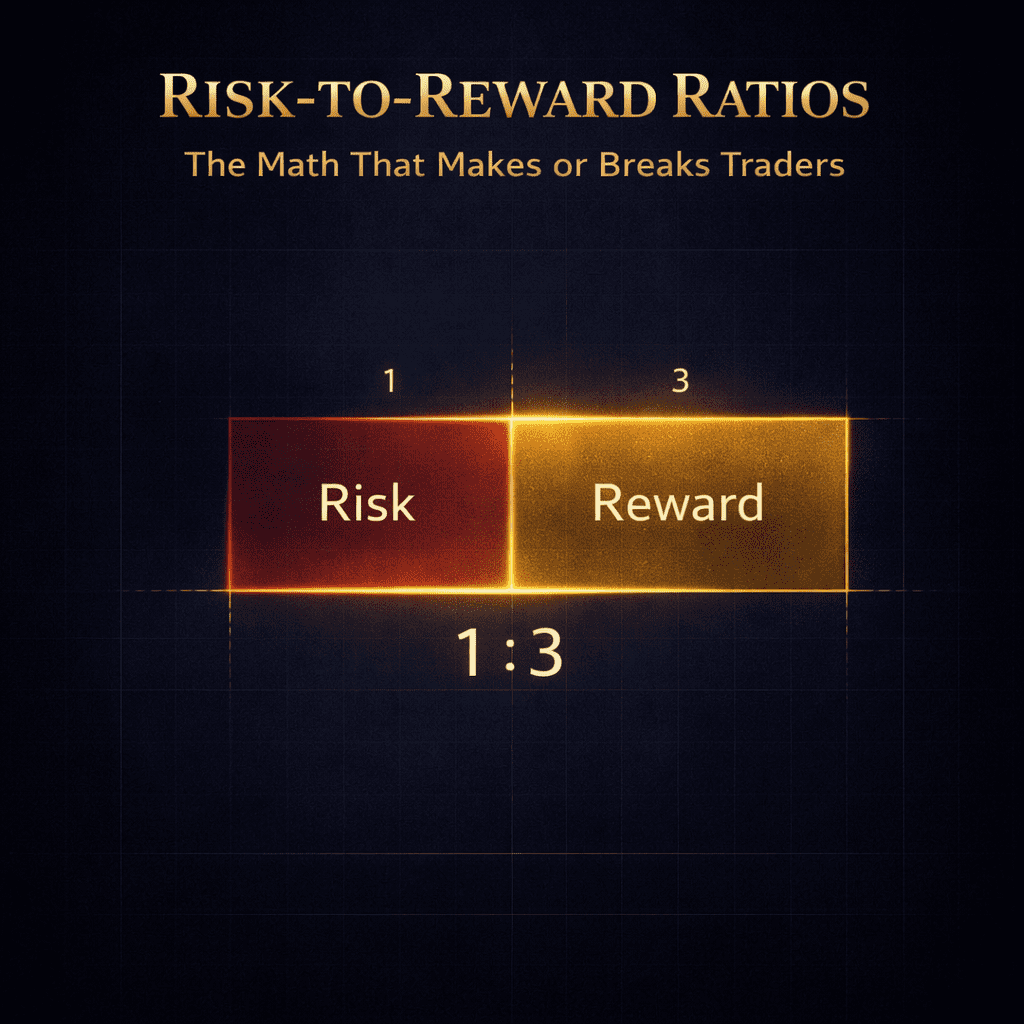
It’s written as 1:2, 1:3, 1:1, etc. The first number is what you risk. The second is what you hope to gain.
> Example: A 1:2 ratio means you risk $100 to make $200.
> Another example: A 1:1 ratio means you risk $100 to make $100.
Higher second number = better potential payoff. But (and this is crucial) higher isn’t always better. We’ll get to why.
How to Calculate It (Two Steps)
Step 1: Find Your Risk
Risk = Entry Price − Stop Loss Price
This is how much you’ll lose if the trade hits your stop. If you buy at $100 and your stop is at $95, your risk is $5 per share.
Step 2: Find Your Reward
Reward = Target Price − Entry Price
This is how much you’ll gain if the trade hits your target. If you buy at $100 and your target is $110, your reward is $10 per share.
Step 3: Divide
Reward ÷ Risk = Your Ratio
$10 reward ÷ $5 risk = 2 (or a 1:2 risk-to-reward ratio)
Why Win Rate Matters Too
Here’s what most “gurus” won’t tell you: your win rate and your risk-to-reward ratio are connected.
Win rate = how often you’re right. If you win 40 out of 100 trades, your win rate is 40%.
You can’t have a low win rate AND a low risk-to-reward ratio. That’s a recipe for bankruptcy. But you CAN have a low win rate with a high risk-to-reward ratio and still profit.
The Breakeven Win Rate
Breakeven = the point where you neither make nor lose money.
Here’s the math that matters:
| Your Risk-to-Reward | Win Rate Needed to Break Even |
|---|---|
| 1:1 | 50% |
| 1:2 | 33% |
| 1:3 | 25% |
| 1:4 | 20% |
See the pattern? With a 1:3 ratio, you only need to be right 25% of the time to break even. Be right 35% of the time and you’re profitable. That’s powerful.
️ Why 1:2 Isn’t Automatically Better
This is where traders mess up. They think “bigger ratio = better trade.” Not true.
A 1:4 ratio (risk $100 to make $400) sounds amazing. But if your target is so far away that price almost never reaches it, your actual win rate drops to nothing. You keep getting stopped out for $100 losses and never hit the $400 win.
The sweet spot depends on your strategy:
- Scalpers (quick trades): Often use 1:1 or 1:1.5 — higher win rate, smaller wins
- Swing traders (hold for days): Often use 1:2 or 1:3 — moderate win rate, bigger wins
- Trend followers (hold for weeks): Often use 1:4 or higher — lower win rate, home run wins
There’s no “best” ratio. There’s only the ratio that matches how you trade.
Real Example: Two Traders, Different Approaches
Trader A: High Win Rate, Lower Ratio
– Risk-to-reward: 1:1.5
– Win rate: 55%
– 100 trades: 55 wins, 45 losses
– Average win: $150
– Average loss: $100
Result: (55 × $150) − (45 × $100) = $8,250 − $4,500 = +$3,750 profit
Trader B: Lower Win Rate, Higher Ratio
– Risk-to-reward: 1:3
– Win rate: 35%
– 100 trades: 35 wins, 65 losses
– Average win: $300
– Average loss: $100
Result: (35 × $300) − (65 × $100) = $10,500 − $6,500 = +$4,000 profit
Both profitable. Different paths. The key is consistency, not chasing the “perfect” ratio.
Common Mistakes
Mistake #1: Ignoring Probability
A 1:10 ratio sounds incredible. But if price reaches that target 2% of the time, you’re just donating money to the market.
💡 Fix: Set targets where price actually goes based on your analysis, not where you wish it would go.
Mistake #2: Moving Targets
You plan for 1:3, but when price stalls at 1:1.5, you move your target higher to “give it room.” Price reverses, and you give back all your gains.
💡 Fix: Set your target before you enter. Stick to it unless market structure fundamentally changes.
Mistake #3: Unrealistic Expectations
“I’m only taking 1:4 setups from now on.” Great. Now you take no trades because they never meet your criteria.
💡 Fix: Know your strategy’s natural ratio. Don’t force trades to fit arbitrary rules.
Your Action Plan
- Calculate the ratio before every trade — no exceptions
- Know your breakeven — what’s your minimum win rate?
- Track your actual — are you hitting your targets or moving them?
- Match ratio to strategy — don’t force 1:3 on a scalping setup
What’s Next in This Series
This is article 2 of 10. Coming up:
- Volatility-Based Sizing → Adjusting size for market conditions
- Dynamic vs. Static Stops → When to move your stop (and when not to)
- Profit Target Strategies → Taking money off the table
A Thought to Take With You:
You don’t need to win every trade. You need your wins to outweigh your losses over time. That’s what risk-to-reward ratio ensures. Master this math, and you’ve mastered half of trading.
This week: Calculate the ratio on your next 5 trades before you enter. Don’t take any trade under 1:1.5. See how it changes your decision-making.
— Titan
Get the daily framework intelligence
Trade the framework, not the noise.
The principles in this article are how we read markets every day. Members get the live application: daily Pre-Asia, Pre-London, Pre-NY and Post-Close briefs across 20+ instruments, the indicator suite, the Foundry library, and live community.
Free Explorer tier · No card required · Upgrade when you’re ready