🛡️ SL/TP Intelligence Series — Article 4 of 10 | Video: 14 min
📋 What You’ll Learn:
- 🎯 The difference between static and dynamic stops
- 💡 When moving your stop makes sense (and when it doesn’t)
- ⚠️ The “breakeven stop” trap that kills profits
- 📊 Trailing stops explained simply
- 🔢 Rules for when to adjust, when to hold
🎥 Video coming soon — Subscribe to @Titan_Protect for the full breakdown with live charts.
️ To Move or Not to Move?
Here’s the debate that divides traders: Should you move your stop loss as the trade progresses, or set it and forget it?
The answer is annoying but true: it depends.
Some stops should never move. Others should move constantly. Knowing the difference separates professionals from gamblers.
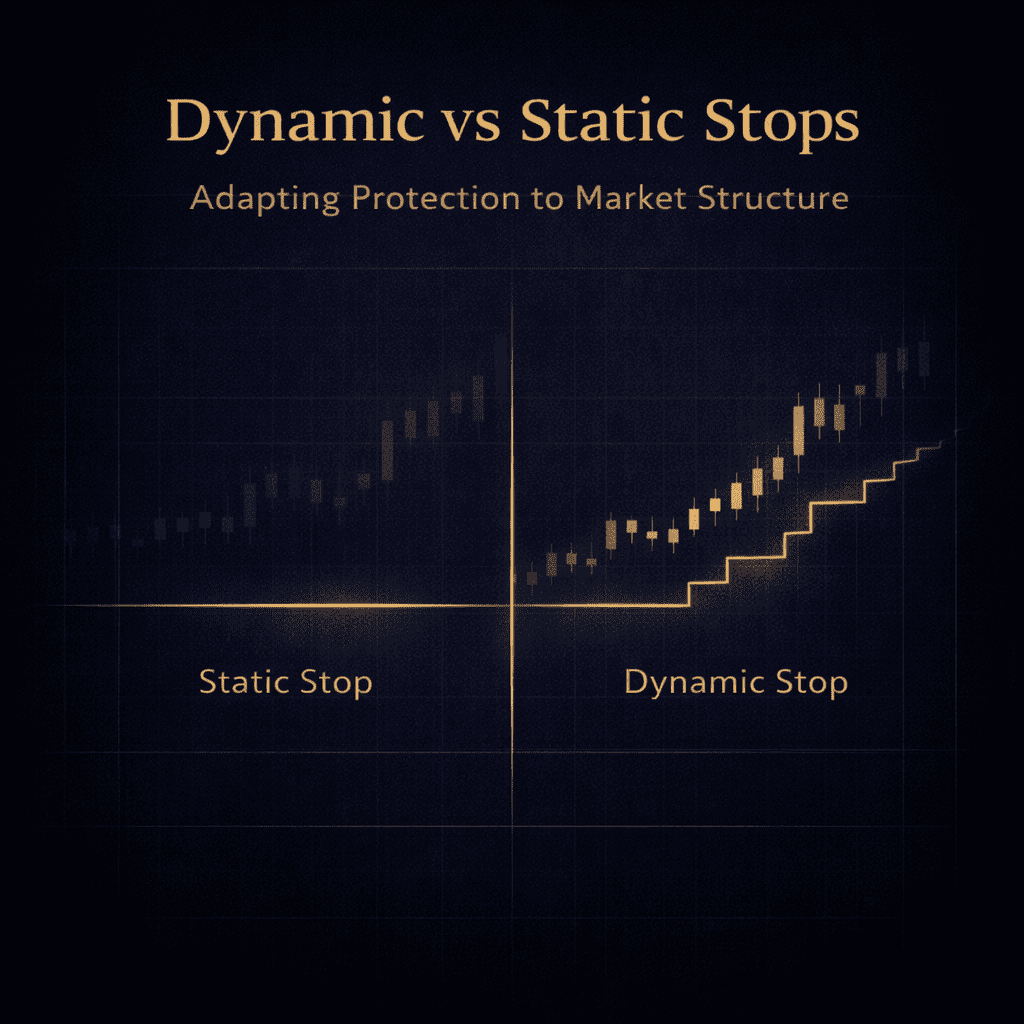
Static vs. Dynamic: What’s the Difference?
Static Stop (Set It and Forget It)
You place your stop at your “I’m wrong” price before entering. It stays there until the trade hits your stop or your target. Period.
Best for: New traders, strict rule-followers, strategies with fixed targets
Dynamic Stop (Adjust as You Go)
You start with an initial stop, then move it as the trade develops — usually to lock in profits or reduce risk.
Best for: Experienced traders, trend-following strategies, letting winners run
When to Move Your Stop (The Right Way)
Good Reason #1: Structure Changes
You bought at $100, stop at $95 (below support). Price rallies to $110, and now $105 is the new support level. Moving your stop to $104 makes sense — you’re protecting profits while respecting the new structure.
Good Reason #2: Trailing a Trend
A trailing stop moves with the price as it goes your way. It’s like a ratchet — it only moves in your favor, never against you.
Example: You set a trailing stop $5 below the highest price reached. Stock goes from $100 to $105 to $110. Your stop moves from $95 to $100 to $105. If price then drops to $108, your stop stays at $105. You locked in $5 of profit.
Trailing stops let you ride trends without giving back all your gains.
Good Reason #3: Partial Profits Taken
You sell half your position at your first target. Now you can afford to give the remaining half more room. Moving the stop to breakeven on the rest is logical.
️ When NOT to Move Your Stop
Bad Reason #1: Fear
Price is approaching your stop. You’re not ready to accept the loss. So you move the stop “just a little” to give it “more room.”
This isn’t risk management. It’s denial. You’re turning a planned $100 loss into an unplanned $200, $300, or worse loss.
💡 Remember: You set that stop when you were calm and objective. Trust your past self.
Bad Reason #2: The “Breakeven Stop” Obsession
As soon as a trade goes slightly profitable, traders rush to move their stop to breakeven (entry price). “Can’t lose now!” they think.
Here’s the problem: Breakeven stops often get hit by normal market wiggles. Price retraces to test support, knocks you out at breakeven, then continues to your original target without you.
You turned a winning trade into a scratch (no gain, no loss). That’s not protecting profits — that’s leaving money on the table.
💡 Better approach: Give the trade room to breathe. Move to breakeven only after price has moved significantly in your favor (at least 1:1 reward-to-risk).
Bad Reason #3: Tightening Into Profit
Trade moves from $100 to $105. You move stop from $95 to $104. “Locking in profit!” Then price pulls back to $104.50, stops you out, and continues to $110 without you.
You got stopped out by noise, not because your analysis was wrong.
💡 Rule: If you move your stop, give the trade enough room that normal fluctuations won’t knock you out.
The Professional Approach
Here’s how experienced traders handle stops:
- Start with a static stop at your “I’m wrong” price
- Let it breathe — don’t touch it in the early stages
- At 1:1 profit — consider moving to breakeven if structure supports it
- As trend develops — use trailing stops or move with structure
- Never widen — once set, stops only move toward profit, never away
Trailing Stop Strategies
Fixed Dollar Trailing Stop
Keep stop $X below the highest price reached. Simple, mechanical.
> Example: $5 trailing stop on a stock > – Buy at $100, stop at $95 > – Stock hits $110, stop moves to $105 > – Stock hits $120, stop moves to $115 > – Stock drops to $118, stop stays at $115 > – Stock drops to $114, you exit at $115 with $15 profitATR-Based Trailing Stop
Adjusts for volatility. In wild markets, you give more room. In calm markets, less.
> Example: 2× ATR trailing stop > – Stock ATR is $2, so stop is $4 below highs > – As volatility changes, your trailing distance changes > – More adaptable than fixed dollar amountsStructure-Based Trailing Stop
Move your stop below each new support level as it forms. Most discretionary approach, but requires skill to identify valid support.
The Golden Rules
- Stops only move one direction — toward profit, never away
- Have a reason — every move should be based on structure, not emotion
- Give room — tight stops get hit by noise
- Document it — know your rules before you trade
What’s Next in This Series
This is article 4 of 10. Coming up:
- Profit Target Strategies → When and how to take profits
- Psychology of Letting Winners Run → The mental game of holding
- Advanced Exit Strategies → Scaling, partials, and more
A Thought to Take With You:
The best stop strategy is the one you’ll actually follow. If moving stops triggers your emotional side, stick with static stops. If you can move them objectively based on structure, dynamic stops can improve your results. Know yourself. Trade accordingly.
This week: Pick one rule — either all static stops or structured dynamic stops. Apply it to every trade. No exceptions. See how it affects your decision-making.
— Titan
Get the daily framework intelligence
Trade the framework, not the noise.
The principles in this article are how we read markets every day. Members get the live application: daily Pre-Asia, Pre-London, Pre-NY and Post-Close briefs across 20+ instruments, the indicator suite, the Foundry library, and live community.
Free Explorer tier · No card required · Upgrade when you’re ready