🛡️ SL/TP Intelligence Series — Article 6 of 10 | Video: 16 min
📋 What You’ll Learn:
- 🎯 Why traders exit winning trades too early
- 💡 FOMO, fear, and greed — how emotions hijack exits
- ⚠️ The “retracement panic” that kills profits
- 📊 Mental frameworks for holding winners
- 🔢 Practical techniques to stay in winning trades
🎥 Video coming soon — Subscribe to @Titan_Protect for the full breakdown with live charts.
️ The Most Expensive Mistake in Trading
You’ve been there. The trade is working. You’re up 20%, 30%, maybe more. Your plan said to hold for a bigger target, but…
Price pulls back a little. Your profit shrinks. You start worrying. “What if this is the top? What if I give it all back?”
You hit sell. You lock in a decent profit. You feel relieved.
Then you watch in horror as price continues to your original target without you. You left 50% of the profit on the table because you couldn’t handle a normal pullback.
This is the psychology of early exits — and it’s costing you money.
Why We Exit Winners Too Early
Fear of Giving Back Profits
Once you have unrealized profits, they feel like YOUR money. Watching them shrink feels like losing. So you exit to “protect” them, even when your analysis says hold.
This is loss aversion — the psychological tendency to prefer avoiding losses over acquiring gains. It’s hardwired into us, but it’s deadly in trading.
Fear of Missing Out (FOMO)
Ironically, FOMO also causes early exits. You see other opportunities. “I should take this profit and get into that other trade that’s moving!” You chase the new shiny object and miss the move you’re already in.
Recency Bias
Your last few trades were winners that reversed into losses. So you assume THIS trade will do the same. You exit based on past trauma, not current conditions.
Understanding Normal Pullbacks
Here’s what most traders don’t understand: Prices don’t go straight up.
In an uptrend, price rises, then pulls back, then rises again. These pullbacks (also called retracements) are normal and healthy. They’re not a signal to exit — they’re part of the trend.
| Trend Type | Typical Pullback | What It Means |
|---|---|---|
| Strong trend | 23-38% of the move | Brief pause, trend continues |
| Normal trend | 38-50% of the move | Healthy correction, likely continues |
| Weak trend | 50-62% of the move | Trend may be ending |
If you panic every time price pulls back 30%, you’ll never catch a big move.
Mental Frameworks for Holding
The “House Money” Mindset
Once you’ve moved your stop to breakeven or taken partial profits, you’re playing with “house money” — the market’s money, not yours.
Reframe: “I’m not risking MY $500. I’m risking the market’s $500 that it gave me.” This makes it easier to let winners run.
Process Over Outcome
Don’t judge the trade by whether you kept every penny of profit. Judge it by whether you followed your plan.
If your plan said hold to $120 and you sold at $110 because you panicked, that’s a failure — even if you made money. If your plan said sell at $110 and you did, that’s a success — even if it went to $120 after.
Zoom Out
When you’re in a trade, you stare at every tick. Every 1-minute candle feels like a drama. Zoom out to the hourly or daily chart. Is the trend still intact? Then hold.
Intraday noise looks like catastrophe. Higher timeframe perspective shows it’s just normal movement.
️ When to ACTUALLY Exit Early
Sometimes exiting early IS the right call. Here’s how to tell:
Valid Reasons to Exit Early
- Market structure changes — support breaks, trendline fails
- News event — unexpected announcement changes the thesis
- Time stop — trade hasn’t worked in expected timeframe
- Better opportunity — only if your rules allow it
Invalid Reasons (Emotions)
- Fear of pullback — normal retracement, no structure change
- “It feels high” — feelings aren’t analysis
- Want to lock in profit — if it’s not at your target, it’s premature
- Boredom — “Nothing’s happening, I’ll find something else”
Practical Techniques to Hold Longer
1. Set Alerts, Not Stops
Set price alerts at key levels instead of watching the chart. When the alert fires, THEN assess. Don’t stare at every tick.
2. Trade from Higher Timeframes
If you trade the daily chart, check it once a day, not every 5 minutes. Less exposure to noise = fewer emotional exits.
3. Partial Profits Reduce Pressure
Scale out of part of your position at first target. Now the remaining position is “free” — you’ve already made money. Easier to hold the rest.
4. Pre-Commit to Your Plan
Write down: “I will hold until $X unless Y happens.” Y should be specific (support breaks, not “if it feels wrong”).
The Reality of Big Winners
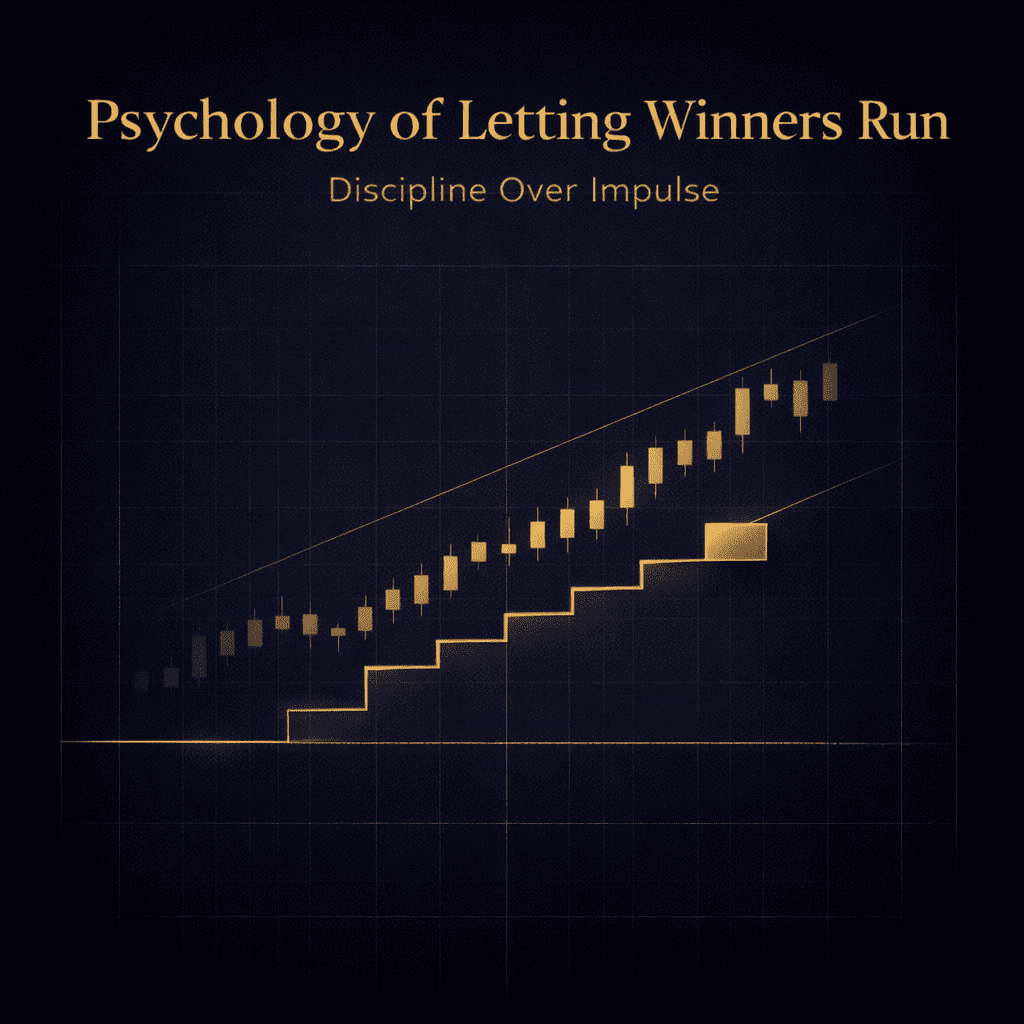
Here’s what big winning trades actually look like:
> – You enter. Price moves your way. Great!
> – Price pulls back 30%. You’re stressed but hold.
> – Price rallies to new highs. Relief!
> – Price pulls back 25%. Doubt creeps in.
> – Price rallies again. You’re up 50%.
> – Price pulls back 20%. You almost sell.
> – Price explodes to your target. You exit with a big win.
The path to big profits is never smooth. Expect discomfort. Embrace it.
Your Action Plan
- Define your exit before entering — price target, not feelings
- Set alerts, not watchlists — reduce screen time
- Understand normal pullbacks — 30-50% retracements are typical
- Use partial profits — scale out to reduce pressure
- Review after the trade — did you follow your plan?
What’s Next in This Series
This is article 6 of 10. Coming up:
- Advanced Exit Strategies → More techniques for maximizing profits
- The Pre-Trade Checklist → Putting it all together
- Post-Trade Analysis → Learning from every trade
A Thought to Take With You:
The traders who make the most money aren’t the ones with perfect entries. They’re the ones who can sit through discomfort and let winners run. Your psychology is the edge. Master it.
This week: Pick one trade where you’d normally exit early. Set your target. Set an alert. Walk away. Don’t look at it until the alert fires. See what happens when you remove yourself from the minute-by-minute drama.
— Titan
Get the daily framework intelligence
Trade the framework, not the noise.
The principles in this article are how we read markets every day. Members get the live application: daily Pre-Asia, Pre-London, Pre-NY and Post-Close briefs across 20+ instruments, the indicator suite, the Foundry library, and live community.
Free Explorer tier · No card required · Upgrade when you’re ready