🛡️ SL/TP Intelligence Series — Article 8 of 10 | Video: 12 min
📋 What You’ll Learn:
- 🎯 The 5-minute routine before every trade
- 💡 Why checklists prevent costly mistakes
- ⚠️ The questions you must answer before risking money
- 📊 How pros prepare vs. amateurs
- 🔢 Printable checklist included
🎥 Video coming soon — Subscribe to @Titan_Protect for the full breakdown with live charts.
️ The 5 Minutes That Save Your Account
Here’s what separates consistent traders from the crowd: they don’t wing it.
Before every trade, they run through a checklist. It takes 5 minutes. It prevents 90% of stupid mistakes. And it forces them to treat trading like a business, not a gamble.
This is that checklist.
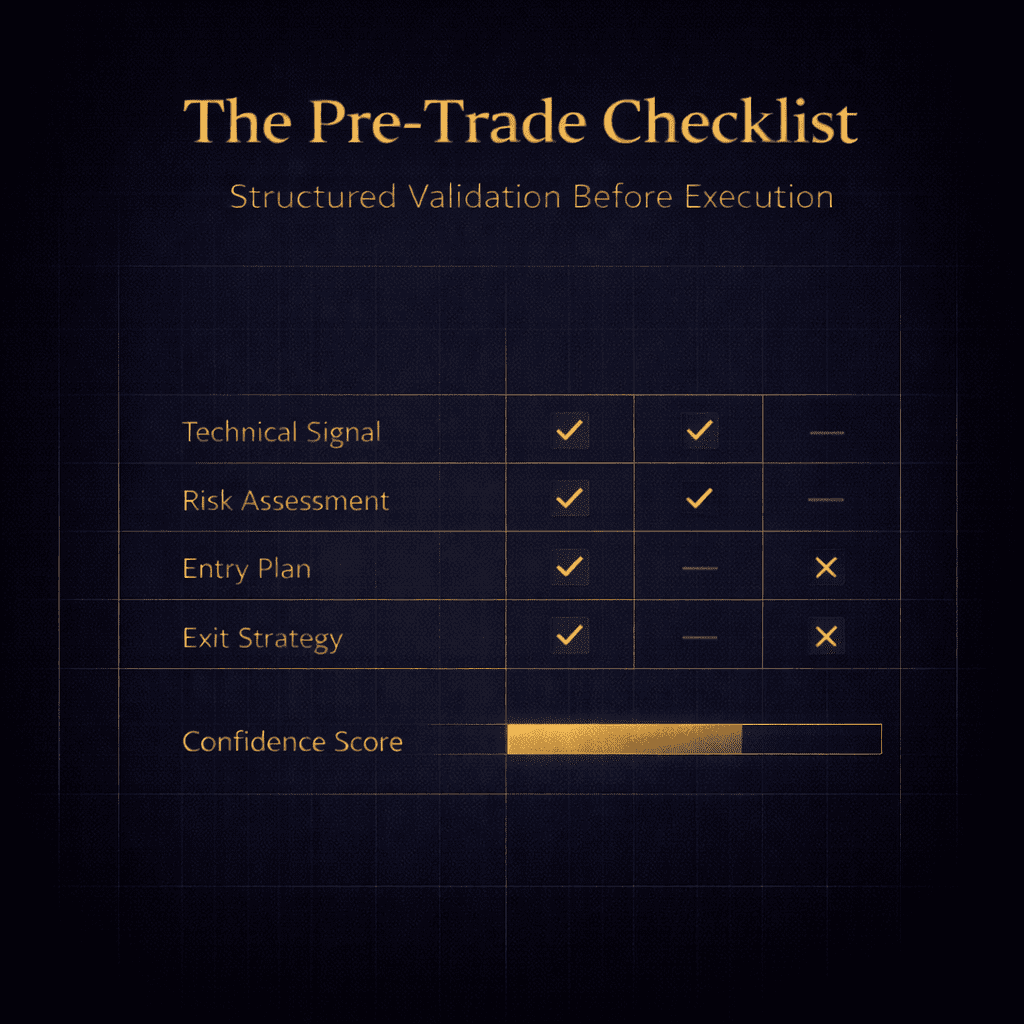
The Pre-Trade Checklist
Don’t skip items. Don’t rush. If you can’t answer every question confidently, don’t take the trade.
1. What’s My Setup?
Question: What pattern or condition am I trading?
Why it matters: If you can’t name your setup, you’re gambling. Every trade should fit a defined strategy — breakout, pullback, trend continuation, reversal, etc.
Examples: “Support bounce,” “Breakout above resistance,” “Trend continuation after pullback”
2. Where’s My Stop?
Question: At what price is my setup proven wrong?
Why it matters: This is your “I’m wrong” price. Not a percentage. Not a guess. The level where your analysis fails.
Example: “If price breaks below $45 support, my thesis is wrong. Stop at $44.50.”
3. Where’s My Target?
Question: Where will I take profits?
Why it matters: You need a destination. Targets should be based on structure — resistance levels, measured moves, previous highs.
Example: “First target at $55 resistance. Second target at $60 measured move.”
4. What’s My Risk-to-Reward?
Question: Is this trade worth taking?
Why it matters: Math doesn’t lie. Calculate: (Target − Entry) ÷ (Entry − Stop)
Rule: Minimum 1:1.5 for most strategies. Less than that? Skip the trade.
5. How Am I Sizing?
Question: How many shares/contracts based on my stop distance?
Why it matters: Position size should fit the stop, not the other way around. Formula: Dollar Risk ÷ Stop Distance = Position Size
Example: “Risking $200. Stop is $2 away. Position size = 100 shares.”
6. What’s the Market Context?
Question: What’s the broader market doing? Any news events?
Why it matters: You don’t trade in a vacuum. If the overall market is crashing, your individual stock setup matters less.
Check: Market trend, sector performance, economic calendar, earnings announcements
7. What’s My Exit Plan?
Question: How will I manage this trade once I’m in?
Why it matters: Exiting is harder than entering. Know your plan: static stops, trailing stops, scale out percentages, time stops.
Example: “Sell 40% at first target, move stop to breakeven. Trail remaining 60%.”
The Quick Version (60 Seconds)
Once you’ve done the full checklist 50 times, it becomes automatic. But even pros ask:
- What’s the setup?
- Where’s my stop?
- Where’s my target?
- What’s the ratio?
- Am I following my rules?
If you can’t answer in 60 seconds, don’t trade.
️ Red Flags — Don’t Take the Trade If:
- ❌ You can’t clearly define the setup
- ❌ You don’t know where your stop goes
- ❌ The risk-to-reward is under 1:1.5
- ❌ You’re trading because you’re bored
- ❌ You’re trying to “make back” a previous loss
- ❌ You haven’t checked the economic calendar
- ❌ Your position size doesn’t match your stop distance
Pro vs. Amateur
| Amateur | Professional |
|---|---|
| “This looks good, I’ll buy” | “Setup is support bounce, stop at $45, target at $55, 1:2 ratio, 100 shares based on $200 risk” |
| No plan, just hope | Every detail documented before entry |
| Trades 50 times a day | Trades 5 high-quality setups |
| Emotional decisions | Mechanical execution |
Your Action Plan
- Print this checklist — keep it visible at your trading desk
- Use it for every trade — no exceptions, not even “small” trades
- Write down your answers — don’t just think them
- Review after the trade — did you follow your checklist?
What’s Next in This Series
This is article 8 of 10. Coming up:
- Post-Trade Analysis → Learning from every trade
- Position Sizing Calculator → The math made simple
A Thought to Take With You:
Every trade is a business decision. You wouldn’t start a business without a plan. Don’t trade without one either. The checklist is your plan. Use it.
This week: Use this checklist for every single trade. Write down your answers. Don’t take any trade that doesn’t clear every item. See how your decision quality improves.
— Titan
Get the daily framework intelligence
Trade the framework, not the noise.
The principles in this article are how we read markets every day. Members get the live application: daily Pre-Asia, Pre-London, Pre-NY and Post-Close briefs across 20+ instruments, the indicator suite, the Foundry library, and live community.
Free Explorer tier · No card required · Upgrade when you’re ready