🛡️ SL/TP Intelligence Series — Article 7 of 10 | Video: 19 min
📋 What You’ll Learn:
- 🎯 Advanced stop management techniques
- 💡 Time-based exits explained simply
- ⚠️ Correlation exits for portfolio protection
- 📊 Multi-timeframe exit strategies
- 🔢 When to break your own rules
🎥 Video coming soon — Subscribe to @Titan_Protect for the full breakdown with live charts.
️ Beyond the Basics
You’ve mastered the fundamentals: stop losses, position sizing, taking profits. Now it’s time to explore advanced exit strategies that separate good traders from great ones.
These aren’t for beginners. Master the basics first. But when you’re ready, these techniques can significantly improve your edge.
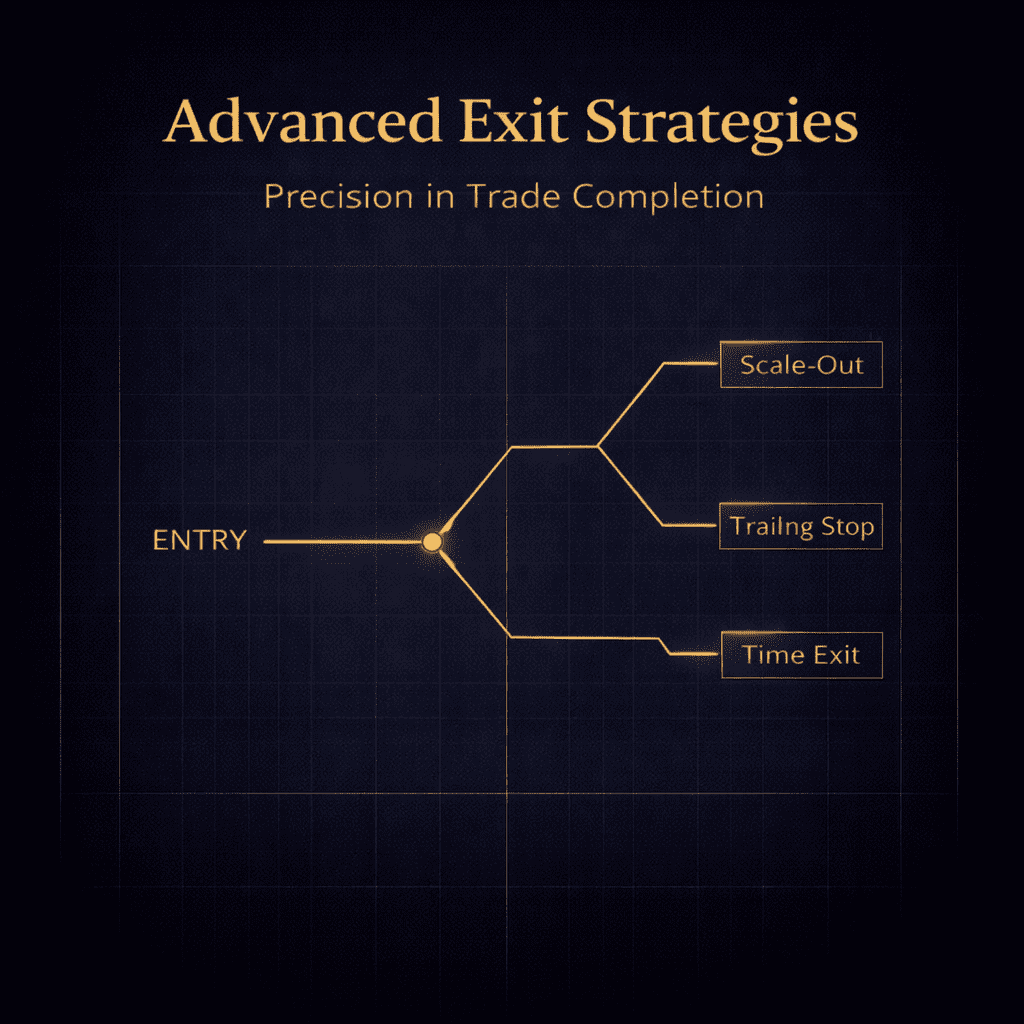
Time-Based Exits
Concept: If a trade hasn’t worked in a certain timeframe, exit — even if your stop hasn’t been hit.
Why? Because money tied up in a non-performing trade is money that can’t be used elsewhere. Plus, trades that don’t move as expected often reverse unexpectedly.
How It Works
Before entering, ask: “How long should this trade take to work?”
> – Day trade: If no move in 30 minutes, exit
> – Swing trade: If no move in 3-5 days, exit
> – Position trade: If no move in 2-3 weeks, exit
The exact timeframe depends on your strategy. The key is having a rule and following it.
Example
You buy a breakout expecting a quick move. Price just sits there, not going up or down. Three days pass. Your stop hasn’t been hit, but the trade isn’t working either.
Exit. Reallocate that capital to a better opportunity. Time is money.
Correlation Exits
Concept: If you have multiple positions that move together (correlated), reduce risk when they’re all moving against you at once.
Correlation means two things tend to move in the same direction. Tech stocks often move together. Oil stocks often move together.
The Risk
If you own 5 tech stocks and tech is crashing, you’re not diversified — you’re concentrated. A 5% market drop could mean 25% portfolio loss.
The Solution
When correlated positions move against you simultaneously, consider:
- Reducing position sizes across the correlated group
- Closing the weakest position in the group
- Hedging with an inverse position (short the index)
This is advanced portfolio management. Track your correlations. Don’t let “diversified” positions wipe you out together.
Multi-Timeframe Exits
Concept: Use different timeframes to manage the same trade. Longer timeframe for direction, shorter timeframe for execution.
Example Setup
> – Daily chart: Shows uptrend, you want to buy
> – 1-hour chart: Shows specific entry timing
> – 15-minute chart: Shows when to exit if the 1-hour setup fails
Your stop is on the 1-hour chart structure. But if the 15-minute chart shows momentum dying quickly, you might exit early to preserve capital.
This requires skill and experience. You’re essentially saying, “My original setup is invalidated by lower timeframe action.” Use cautiously.
Volatility-Based Exits
Concept: Adjust your exit strategy based on how volatile the market is.
High Volatility Exits
When markets are wild (earnings, news events, crashes):
- Take profits quicker — 1:1.5 instead of 1:3
- Use wider stops — normal stops get hit by noise
- Consider not trading — sometimes cash is the best position
Low Volatility Exits
When markets are quiet:
- Tighter stops work — less noise, cleaner moves
- Be patient — trends develop slowly but can run far
- Lower position size — less opportunity, don’t force trades
️ When to Break Your Rules
Advanced traders sometimes break their own rules. But they do it intentionally, not emotionally.
Valid Rule-Breaking
- Widening a stop — only if new information justifies it (not fear)
- Moving target higher — only if structure clearly supports more upside
- Exiting early — only if thesis is invalidated, not because you’re scared
Invalid Rule-Breaking
- Widening stops on losers — you’re just avoiding the loss
- Taking profits early — greed or fear, not plan
- Moving targets because “it feels right” — feelings aren’t analysis
Golden rule: You can break rules, but you must have a written, logical reason BEFORE you do it. “I’m scared” doesn’t count.
The Advanced Exit Checklist
Before every trade, consider:
- What’s my timeframe? — Day, swing, or position?
- What’s my time stop? — How long should this take?
- What’s my correlation exposure? — Am I overexposed to one sector?
- What’s the volatility? — Should I adjust my strategy?
- Under what conditions would I break my rules? — Define them in advance
Putting It All Together
Advanced exits aren’t about complexity. They’re about:
- Context awareness — What’s happening in the broader market?
- Portfolio thinking — How does this trade affect my total risk?
- Time efficiency — Is my capital working or waiting?
- Flexibility — Can I adapt when conditions change?
Master the basics first. Then layer on these advanced techniques one at a time.
What’s Next in This Series
This is article 7 of 10. Coming up:
- The Pre-Trade Checklist → Putting everything together
- Post-Trade Analysis → Learning from every trade
- Position Sizing Calculator → The math made simple
A Thought to Take With You:
Advanced techniques amplify whatever you already do. If your foundation is solid, they make you better. If your foundation is weak, they make you worse. Master the basics. Then build on them.
This week: Pick ONE advanced technique — time stops, correlation management, or volatility adjustment. Apply it to your next 5 trades. See how it changes your decision-making.
— Titan
Get the daily framework intelligence
Trade the framework, not the noise.
The principles in this article are how we read markets every day. Members get the live application: daily Pre-Asia, Pre-London, Pre-NY and Post-Close briefs across 20+ instruments, the indicator suite, the Foundry library, and live community.
Free Explorer tier · No card required · Upgrade when you’re ready