3 July 2026
PayPal at $41: The Fallen Fintech Giant Nobody Wants to Catch
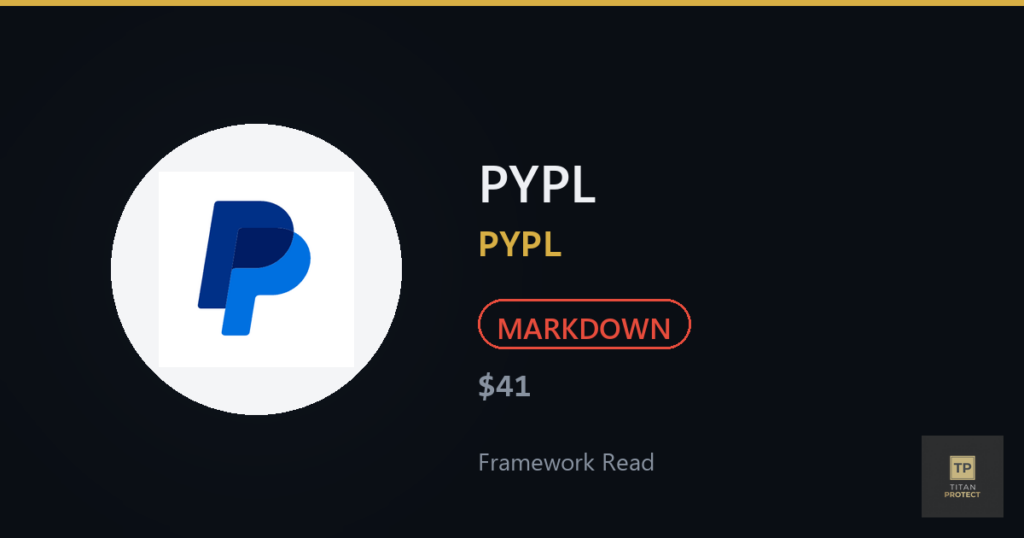
PYPL is in a confirmed markdown regime. The stock that once traded above $300 now sits below $41, and the regime data says the bleeding is not over.
Regime Classification: Markdown
| Metric | Reading | Implication |
|---|---|---|
| Current Price | $41 | Down 86% from ATH ($310) |
| Regime | Markdown | Institutional distribution complete, price discovery lower |
| Sector | Financials | Fintech subsector under persistent pressure |
| Volume Profile | Declining on rallies | No institutional re-accumulation yet |
What the Regime Data Actually Says
PayPal is the poster child for what happens when a pandemic darling meets reality. The stock surged to $310 in 2021 as every analyst on the planet projected a cashless future arriving by Tuesday. It did not arrive by Tuesday. And the markdown regime that followed has been relentless.
At $41, retail traders keep asking the same question: “Is this cheap enough?” The regime data answers clearly: not yet. Markdown means institutional players have already completed their distribution. They sold their positions at higher prices, and what remains is a stock searching for a floor that keeps moving lower.
The Bull Case Everyone Clings To
The bull argument writes itself. PayPal processes over $1.5 trillion in payment volume annually. The Venmo platform has over 80 million users. Revenue still grows, albeit slowly. At 10x forward earnings, the stock looks statistically cheap compared to payment peers like Visa and Mastercard trading at 25-30x.
But “cheap” and “markdown” are not contradictions. Stocks in markdown regimes get cheaper. That is literally what the regime describes. The question is not whether PayPal is a good business. It is whether institutional capital is ready to step back in. The regime says no.
The Real Problem
PayPal faces a structural challenge that a low P/E ratio cannot solve. Apple Pay, Google Pay, and buy-now-pay-later competitors have eroded its moat. The checkout button that once dominated e-commerce is now one of six options at the bottom of every payment page. Braintree, its merchant processing arm, grows but at razor-thin margins.
CEO Alex Chriss has pivoted toward advertising and AI-driven commerce features. These are interesting ideas. They are also the kind of strategic pivots that take years to bear fruit, and markdown regimes do not wait for management to execute.
What Would Change the Regime
For PayPal to shift from markdown to accumulation, we would need to see:
- Volume expansion on down days drying up completely
- A period of tight, sideways price action lasting several months
- Institutional accumulation visible in the positioning data
- A clear catalyst that redefines the competitive narrative
None of these conditions exist today. The stock rallies on earnings beats, then fades within weeks. That pattern is textbook markdown behaviour.
Context Within Fintech Markdown
PayPal is not alone. This markdown regime extends across former fintech darlings. Coinbase, Airbnb, and Palantir all share similar regime classifications. When an entire cohort marks down together, it tells you this is not company-specific. It is a sector-wide institutional rotation away from the growth-at-any-price trade that defined 2020-2021.
The convergence of multiple fintech names in markdown simultaneously suggests the cycle has further to run. Regime transitions typically require a period of quiet accumulation before any sustained recovery, and most of these names have not even begun that process.
What Retail Traders Get Wrong
The most common mistake with a stock like PayPal at $41 is anchoring to the old high. “$310 to $41 means it must bounce” is not analysis. It is hope dressed up as a thesis. Markdown regimes exist precisely because institutional participants decided the prior valuation was wrong, and they are still in the process of repricing it.
The second mistake is buying on earnings beats. PayPal has beaten earnings estimates in multiple quarters during this markdown. The stock still trends lower. Beating a lowered bar does not change the regime.
Strategy Considerations by Tier
| Approach | Consideration |
|---|---|
| Position Building | Regime does not support new long positions. Wait for accumulation signals. |
| Existing Holders | Evaluate whether cost basis and time horizon justify continued exposure during markdown. |
| Tactical | Short-term rallies toward resistance offer poor risk-reward in a markdown regime. |
The Bottom Line
PayPal at $41 is a good business in a bad regime. That distinction matters enormously. Good businesses can stay in markdown for years when the structural competitive picture shifts against them. The regime data does not care about your P/E ratio or your nostalgia for the 2021 highs. It measures what institutional capital is actually doing, and right now, it is not buying PayPal.
When the regime shifts to accumulation, that will be the signal to reassess. Until then, catching this falling knife remains a low-probability trade regardless of how “cheap” the fundamentals appear.