The NZDUSD Framework Journal for June 2026, newest read at the top. Each dated entry is our read on the close, kept as a living record so the framework can be judged over time. This is analysis, not financial advice.
Tuesday 30 Jun 2026
Kiwi Dollar — Daily Framework Read
Tuesday 30 June 2026 • Titan Macro Desk
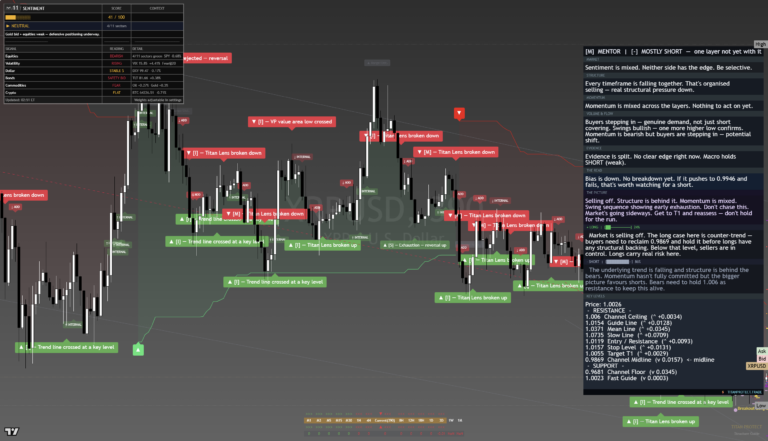
Saturday’s read was showing early weakness. The framework panel has now shifted to MOSTLY SHORT. The bigger picture is still technically up, but the shorter-term structure is pulling back hard. Pullbacks within the uptrend are accelerating, and multiple Titan Lens broken down signals have fired. The framework is no longer neutral on this. The near-term direction is lower.
The analysis reads MOSTLY SHORT. One layer has not yet fully confirmed, but the bias is clear. The bigger picture is up but the shorter-term pullback is becoming the dominant theme. Buyers are stepping in but not with enough conviction to arrest the decline.
Framework Interpretation
Structure
The bigger picture remains technically upward, but the shorter-term is pulling back with increasing urgency. This is the conflict. The daily structure is not broken, but the intraday and multi-day structure is deteriorating. Multiple Titan Lens broken down signals have fired, trend lines have been crossed to the downside, and the market is accepting lower levels. The framework is reading this as a correction within a larger trend rather than a trend reversal. But the correction is not done yet.
Momentum
Momentum is mixed. The bigger picture says buyers are still present, but the shorter-term is clearly bearish. Genuine demand is not yet short-lived, which means the pullback has further to go. Confidence is split between the timeframes, and the framework is giving more weight to the near-term momentum which is clearly working lower. The Kiwi is no close edge right now between the conflicting signals.
Volume Profile
The value area has shifted. Price has moved below the prior value area and is being accepted at lower levels. The breakdown signals are confirmed by the volume profile, which shows sellers overwhelming buyers at prior support levels. The market is repricing and the profile says the new value area is forming lower than where we were on Saturday.
The Call
The analysis reads MOSTLY SHORT for NZD/USD. This is a correction trade within a larger uptrend, which means it requires tactical execution. The 0.5670 level is the near-term target, with a push toward 0.5620 if the broader support fails. Rallies back toward 0.5720-0.5740 are the selling zone. This is not a positional short. It is a tactical trade that should be managed actively.
Key Levels
Risk Assessment
Risk is elevated because this is a counter-trend trade. The bigger picture remains technically bullish, which means the correction could reverse at any time. The 48% reflects this conflicting signal environment. The near-term is bearish but the structural foundation has not been destroyed. Active management and tight stops are essential.
Scenario Analysis
25%
Correction ends, reclaims 0.5740 and resumes the broader uptrend. Dollar reversal required.
25%
Consolidates between 0.5670-0.5740. Market searches for the correction floor.
45%
Correction deepens through 0.5670, targeting 0.5620. Dollar strength accelerates the pullback.
5%
RBNZ emergency action or NZ-specific shock. Flash move to 0.5580 or below.
Position Sizing Guidance
STANDARD
REDUCED
AVOID
Reduced sizing. Counter-trend trades within a larger uptrend require smaller positions and tighter stops. The near-term direction is clear but the trade could reverse quickly when the correction completes. Do not size this as if it were a trend-following trade.
Experience-Level Guidance
For Developing Traders
Counter-trend trades are among the most difficult to execute well. The framework is saying SHORT near-term, but the bigger picture is still technically bullish. For developing traders, the best approach is to wait for the correction to complete and then look for a bullish re-entry when the framework flips back to LONG. Trading against the larger trend requires experience and precision that takes time to develop.
For Intermediate Traders
If you take this trade, treat it as tactical. Rally into 0.5720-0.5740, sell with a stop above 0.5780, target 0.5670. The reward-to-risk is approximately 1.5:1 from the optimal entry. Take profits aggressively. Do not hold through signs of reversal. The moment the framework panel starts showing mixed signals again, that is your cue to exit.
For Advanced Traders
The NZD/USD correction mirrors the AUD/USD weakness and both are expressions of the same dollar strength theme. The Kiwi is slightly more vulnerable due to its lower liquidity and the RBNZ’s relatively dovish stance. If the 0.5670 support breaks, the move toward 0.5620 could be rapid because of the liquidity gap below. The broader uptrend remains intact above 0.5580, so any positional shorts should be closed before that level.
This content is for informational and educational purposes only. It does not constitute financial advice, a recommendation, or an offer to buy or sell any financial instrument. Trading foreign exchange carries a high level of risk and may not be suitable for all investors. Past performance is not indicative of future results. You should consider your financial situation, investment objectives, and risk tolerance before making any trading decisions. Always conduct your own research. Titan Protect and its contributors accept no liability for losses arising from the use of this material.
Tuesday 30 Jun 2026
Kiwi Dollar — Daily Framework Read
Monday 29 June 2026 • Q3 Day 1 • Daily Read
SHORT
• Launch Edition
SHORT
• Conf: LOW-MODERATE • Risk: 4.8
Bias held but conviction low. Fighting conditions. No strong read.
The framework panel reads NZD/USD as short but with low confidence and the bias not yet fully declared. Structure is working against the Kiwi but momentum is fighting. The framework sees a bearish lean but this is not the clean setup that AUD/USD presents. The bigger picture is bearish but the near-term is messy and the framework warns against aggressive positioning.
Framework Interpretation
Structure
Structure is working against the Kiwi but with less conviction than AUD/USD. The chart shows multiple Titan Lens breaks downward and the market has dropped back into a range after failing at the value area high. The trend line has crossed at a key level but the analysis reads this as a weak signal rather than a strong one. The structure says lower but the confidence behind that read is not high enough to call it a clean setup.
Momentum
Momentum is fighting. Slow and confirmed bearish candles but not the kind of aggressive selling that the framework needs to see for a high-conviction call. The force behind the move is present but it lacks urgency. This is the kind of environment where the trade works but takes longer than expected, testing patience and stop-loss placement. Not ideal for traders who need quick resolution.
Volume Profile
The value area high was rejected with a reversal signal, which the analysis reads as distribution at elevated levels. However, the volume at lower prices is thin, suggesting the market could find support quickly if selling pressure pauses. The long-term lens is pointing toward a potential break below the range but the framework needs to see a breakdown and acceptance below current support to confirm.
The Call
The analysis reads NZD/USD as bearish-leaning but not actionable at high conviction. This is similar to the AUD/USD story but with less structural clarity. The Kiwi dollar is caught between dollar weakness supporting it and domestic/regional weakness dragging it lower. The short bias is maintained from Saturday but the framework acknowledges that this is a low-conviction read. Wait for a break below current support or a rally into the sell zone before committing.
Key Levels
Risk Assessment
Risk is moderate because the framework has a directional lean but insufficient conviction to call it a clean setup. When momentum is fighting the structural read, the probability of false signals increases. The 48% factor reflects the messy near-term conditions and the lack of a clean trigger for new entries. The framework prefers to be honest about the quality of the edge rather than force a high-conviction call.
Scenario Analysis
35%
Break below 0.5670 triggers acceleration toward 0.5640-0.5600. Domestic weakness dominates dollar narrative.
35%
Range between 0.5670-0.5730. Market remains indecisive. Most likely scenario given the mixed signals.
25%
Dollar weakness catches up. NZD/USD recovers above 0.5730 toward 0.5760. Would invalidate the short thesis.
5%
RBNZ emergency action or major dairy price shock. Tail risk always accounted for.
Position Sizing Guidance
STANDARD
REDUCED
AVOID
Reduced sizing. The framework has a bearish lean but the conviction is low-moderate. This is not the setup for standard or maximum sizing. If you want Antipodean short exposure, AUD/USD offers a cleaner read. Use NZD/USD as a secondary expression with reduced risk allocation.
Experience-Level Guidance
For Developing Traders
Compare this read with AUD/USD. Both Antipodean currencies are reading bearish but AUD/USD has moderate-high confidence while NZD/USD has low-moderate. That difference matters. The framework is telling you that AUD/USD is the cleaner trade and NZD/USD is the messier one. When two similar setups exist, always choose the one with higher confidence. That is how you improve your hit rate.
For Intermediate Traders
The breakdown trigger at 0.5670 is the key level. A clean break and acceptance below this level would upgrade the framework’s confidence to moderate or higher. Until that happens, the setup is tentative. Consider alert-based trading here: set an alert at 0.5670 and only engage if and when it triggers. The Q3 open could provide the catalyst for the break.
For Advanced Traders
AUD/NZD may be a cleaner expression of the relative Antipodean story than both AUD/USD and NZD/USD individually. If you believe AUD is weaker than NZD (which the framework confidence differential suggests), then AUD/NZD short captures that divergence without the complication of the dollar narrative. Check the AUD/NZD chart for structural confirmation before executing.
This content is for informational and educational purposes only. It does not constitute financial advice, a recommendation, or an offer to buy or sell any financial instrument. Trading foreign exchange carries a high level of risk and may not be suitable for all investors. Past performance is not indicative of future results. You should consider your financial situation, investment objectives, and risk tolerance before making any trading decisions. Always conduct your own research. Titan Protect and its contributors accept no liability for losses arising from the use of this material.
Sunday 28 Jun 2026
Kiwi Dollar — Daily Framework Read
Sunday 28 June 2026 • Weekend Edition • Launch Read
This is the launch edition of our daily framework reads. No prior-day comparison is available. All readings reflect the current structural snapshot as of Friday’s close.
Framework Interpretation
Structure
The Kiwi is working structurally lower. The framework sees a market where the structure is working against buyers across timeframes. The bigger picture is bearish and the shorter timeframes are confirming. Multiple breakdowns through key levels have occurred, and the market is not recovering. When a market breaks and stays broken, the analysis reads that as genuine selling, not a shakeout.
Momentum
Momentum is aligned with the bearish structure. The analysis reads downside momentum that is building, not exhausting. Everything is aligned but the direction is against longs. Sellers are in control and the momentum layers confirm it. This is the kind of environment where bounces are sold, not bought.
Volume Profile
The value area high rejection and reversal signal is the key reading. The market attempted to reclaim higher value and was firmly rejected. This tells us that the selling pressure is coming from above, which is characteristic of institutional distribution. The analysis reads this as a market where smart money is selling into strength, and price is repricing lower as a result.
The Call
The analysis reads bearishly for the Kiwi with moderate-to-high confidence. The structure, momentum, and volume profile are all telling the same story: lower. This is one of the more aligned bearish reads across the FX board this weekend. Rallies into 0.5760-0.5780 are the framework’s preferred sell zone. The first downside target sits at 0.5690. The risk is defined and the direction is clear. Everything turned against the bulls, and the analysis says to get positioned on protection or get out.
Key Levels
Risk Assessment
The 35% risk factor is relatively low because the framework alignment is clean. Structure, momentum, and volume all agree on direction. The risk comes from the Kiwi’s thin liquidity during Asian sessions, which can create spiky price action, and from weekend gap exposure. The directional edge is one of the clearest across today’s reads.
Scenario Analysis
10%
Recovery above 0.5810 invalidates shorts. Would require significant risk-on shift or NZD-specific catalyst.
25%
Range between 0.5690-0.5780 before next directional move.
58%
Break below 0.5690 confirms continuation toward 0.5650 and 0.5600. The base case with highest probability.
7%
NZD flash crash on thin Sunday liquidity or major antipodean risk event. NZD’s thin market makes this slightly more likely.
Position Sizing Guidance
STANDARD
REDUCED
AVOID
Standard sizing. The framework alignment is strong and the direction is clear. Sell into rallies toward 0.5760-0.5780 with risk defined above 0.5810. The Kiwi’s thin liquidity means wider stops may be needed to accommodate the spiky price action. Account for that in your position sizing calculation.
Experience-Level Guidance
For Developing Traders
The Kiwi is a lower-liquidity pair, which means it can move sharply in both directions, even within a clear trend. The analysis reads bearishly and the alignment is strong, but be aware that NZD can spike on thin volume during Asian hours. Use wider stops than you would on EUR/USD or GBP/USD. The lesson here is that strong conviction on direction must be balanced with respect for the pair’s volatility characteristics.
For Intermediate Traders
This is one of the cleaner bearish setups on the board. The value area high rejection and reversal is the key signal. Consider selling into any bounce toward 0.5760-0.5780 with risk above 0.5810. Target 0.5690 initially. The framework convergence supports the trade, but scale in to manage the liquidity risk. Watch AUD/USD as a correlated pair for confirmation.
For Advanced Traders
The 58% bearish continuation probability is the highest conviction directional scenario across today’s reads. The framework alignment is clean: structure, momentum, and volume profile all confirm. Consider pairing NZD/USD shorts with AUD/USD shorts for an antipodean basket approach. The NZD typically leads AUD in these moves due to its higher beta. Risk above 0.5810, target 0.5600 on a medium-term horizon. Cross-reference with dairy auction prices and RBNZ rate expectations for additional context.
This content is for informational and educational purposes only. It does not constitute financial advice, a recommendation, or an offer to buy or sell any financial instrument. Trading foreign exchange carries a high level of risk and may not be suitable for all investors. Past performance is not indicative of future results. You should consider your financial situation, investment objectives, and risk tolerance before making any trading decisions. Always conduct your own research. Titan Protect and its contributors accept no liability for losses arising from the use of this material.
Thursday 25 Jun 2026
Titan FX Desk · Daily Framework Read · Thursday 25 June 2026
NZD/USD: Short Signal at 56% With 11 Conditions as Kiwi Diverges From Commodity Recovery
Confidence: Around 56%
Partial Exit Zone
Yesterday vs Today
| Signal | Short (Wednesday) | SHORT (Thursday) |
| Shift | Short signal maintained. The chart shows cascading trend line breaks to the downside, exhaustion labels at recovery attempts, and a clear series of lower highs. 11 conditions matched. However, partial exit territory is flagged as the selling is mature. The kiwi is diverging from its commodity peers, suggesting NZD-specific factors are at work. | |
Daily Read
NZD/USD is maintaining its short signal at 56% confidence with 11 conditions matched and partial exit territory flagged. The chart tells a clear story of structural deterioration. Multiple trend line breaks to the downside have been confirmed, exhaustion labels at bounce attempts show sellers defending the overhead, and the series of lower highs is intact.
The divergence from the commodity recovery is notable. AUD/USD is in watching mode, but NZD/USD has a confirmed short signal. This suggests NZD-specific weakness rather than a broad commodity currency story. RBNZ rate cut expectations, dairy price softness, or New Zealand housing concerns may be contributing factors that the framework captures through the price structure even if it does not speculate on fundamentals.
Partial exit territory means the short is mature. The selling has been going on long enough that the easy gains are behind. Any fresh short entry at these levels carries a worse risk-reward than earlier in the move. The framework is advising management of existing positions, not new entries.
Key Levels
| Level | Price | Significance |
|---|---|---|
| Resistance | 0.6280 | Trend line break zone, short invalidation |
| Current Zone | 0.6180 – 0.6240 | Active short zone, partial exit flagged |
| Support | 0.6120 | Downside target, channel floor |
Risk Assessment
Around 60%
Moderate-to-elevated. The short signal is clear but the move is mature. DXY weakness is a headwind for new shorts. Partial exit territory means reduced sizing and tighter stops. A dead-cat bounce toward 0.6280 is possible and would trap late shorts.
What to Watch Today
- NZD-specific data or RBNZ commentary
- Dairy auction prices for NZD fundamental direction
- AUD/NZD cross for relative Antipodean strength
- Whether DXY weakness eventually lifts the kiwi despite the short signal
This daily read is produced by the Titan FX Desk for educational and informational purposes only. It does not constitute financial advice or a recommendation to buy or sell any instrument. All levels and scenarios are analytical reference points, not trading instructions. Past performance of any level or scenario is not indicative of future results. Always apply your own risk management. Capital is at risk.
Wednesday 24 Jun 2026
Titan FX Desk · Daily Framework Read · Wednesday 24 June 2026
NZD/USD (Kiwi): Caught in the Crossfire as Commodity Currencies Sold Across the Board
Yesterday vs Today
Monday 23 June: NZD/USD was trading above 0.5770, holding up reasonably well in the broader risk-off environment. The Kiwi was benefiting from a relatively dovish RBNZ outlook and stable dairy commodity prices. However, the global risk-off theme was beginning to create headwinds for the pair.
Wednesday 24 June: The headwinds have turned into a gale. NZD/USD has sold off sharply, tracking its close cousin AUDUSD lower. The framework shows multiple lane breakdowns, broken structures, and selling pressure that is both broad and sustained. The Kiwi has been caught in the wider commodity-currency liquidation and is trading near 0.5717, well below the 0.5770 level that was providing support.
Daily Read
NZD/USD at 0.5717 is caught in the same storm that has battered AUDUSD. The commodity currency complex is being sold across the board, and the Kiwi, with its smaller liquidity pool and higher beta characteristics, is suffering proportionally. When the Aussie drops 1.26%, the Kiwi follows — it almost always does, because the two economies share similar trade exposures and risk sensitivities.
The framework is firmly bearish. Lanes have broken down at multiple levels, the structure has been violated, and the selling is broad-based. What stands out is the speed of the deterioration. Just two sessions ago, the Kiwi was holding its technical levels and looking stable. Now the analysis reads as though the market has shifted into a different regime entirely.
The RBNZ factor adds a layer of vulnerability. Unlike the RBA, which has maintained a relatively hawkish stance, the RBNZ has been more openly dovish. That means the Kiwi does not have the interest rate differential prop that other currencies enjoy. When risk appetite deteriorates and the dollar strengthens simultaneously, currencies without yield support are the most vulnerable, and NZD fits that description.
Dairy prices are the other watchpoint. New Zealand’s economy is heavily dependent on dairy exports, and any weakness in global commodity prices feeds directly into the NZD outlook. The current risk-off environment tends to weigh on commodity prices broadly, which creates a secondary headwind for the Kiwi beyond the direct FX impact.
The 0.5700 level is the immediate focus. It is the next round-number support and a level the market will be watching for signs of stabilisation. If it fails, the pair has room to fall toward 0.5650 and potentially 0.5600, which would represent a significant deterioration from the recent recovery highs.
Key Levels
| Level | Price | Significance |
|---|---|---|
| Resistance 2 | 0.5780 | Pre-selloff level, now distant overhead |
| Resistance 1 | 0.5745 | Broken lane support, now flipped to resistance |
| Current Price | 0.5717 | Below broken structure, approaching 0.5700 |
| Support 1 | 0.5700 | Round number, first meaningful buyer zone |
| Support 2 | 0.5650 | Prior swing low, deeper structural support |
| Major Support | 0.5600 | Major psychological level, multi-month floor |
Risk Assessment
Around 65%
Elevated risk. The Kiwi is tracking the broader commodity currency selloff and lacks the yield support to defend itself. The framework is heavily bearish with no signs of stabilisation. The primary risk is continuation selling toward 0.5650 if risk-off conditions persist. RBNZ dovishness removes a potential floor. The mitigating factor is that commodity currency selloffs of this speed tend to produce sharp short-covering bounces.
Scenario Analysis
0.5700 holds. Risk appetite stabilises and commodity currencies bounce. NZD/USD recovers toward 0.5745 on short-covering. Dairy auction results are positive, providing a fundamental prop. The selloff proves to be a positioning flush rather than the start of a new trend.
0.5700 breaks on follow-through selling. Dollar strength broadens further and risk-off deepens. NZD/USD extends toward 0.5650 and potentially 0.5600. The RBNZ provides no support through hawkish rhetoric, leaving the Kiwi defenceless against the dollar rally. Dairy prices weaken, adding commodity pressure.
NZD/USD consolidates between 0.569 and 0.574. The market digests the selloff and waits for directional clarity from the broader dollar complex. Volatility remains elevated but the momentum slows. The pair trades in sympathy with AUDUSD and takes its cue from the global risk appetite picture rather than NZ-specific factors.
This daily read is produced by the Titan FX Desk for educational and informational purposes only. It does not constitute financial advice or a recommendation to buy or sell any instrument. Capital is at risk.
Monday 22 Jun 2026
22 June 2026 — Titan Macro Desk
NZD/USD — The Hardest Hit Risk Currency Today
The kiwi fell 0.32% — more than three times the Aussie’s move on the same session. When dollar strength hits the risk FX complex, the New Zealand dollar tends to go furthest. Today proved that pattern again.
NZD/USD fell -0.32% on Monday — the largest session decline of the four FX reads. For context, AUD/USD fell -0.04% on the same session. The kiwi’s amplified reaction to USD strength is a consistent pattern worth understanding.
What’s Happening
NZD/USD closed Monday at 0.5734, dropping 18 pips from Thursday’s 0.5752 close. That is a 0.32% move — significant for a session where the primary driver was Fed-proxy hawkishness rather than a direct New Zealand data catalyst. The kiwi did not need a reason specific to New Zealand to sell off. The dollar strengthening was enough.
The comparison with the Aussie is instructive. AUD/USD fell 0.04% on the same session. NZD/USD fell 0.32% — eight times the move. Both are commodity-linked, risk-sensitive currencies in the Pacific region. Both trade with sensitivity to China. But the kiwi consistently shows higher beta to USD moves, especially to the downside. It is a smaller economy, a smaller FX market, and carries less structural support from commodity export volumes. When the tide goes out, the kiwi goes lower faster.
The 0.5734 level is not far from the lower end of the range the kiwi has been trading in during the June period. The Thursday reference at 0.5752 was already near recent lows. Monday’s move has pushed the pair toward territory where the question becomes whether this is a dip within a range or the beginning of a more sustained move toward 0.57 and below.
The Reserve Bank of New Zealand (RBNZ) has been cutting rates actively in 2025-2026. That dovish lean means the NZD does not have a yield advantage working in its favour — unlike AUD, where the RBA has been more reluctant to cut. A dovish RBNZ plus a hawkish Fed is a classic recipe for NZD/USD weakness.
Why the Kiwi Falls Harder
New Zealand is a small open economy. Its primary exports are agricultural — dairy, meat, wine, wood products. These are not price-inelastic commodities like iron ore or oil. Dairy prices, in particular, fluctuate with global supply and demand in ways that do not always correlate with broader risk sentiment. When the world is worried, dairy prices do not get a flight-to-safety bid. They just fall.
The RBNZ started cutting rates before most major central banks. That dovish cycle, combined with a New Zealand economy that has been facing challenges — slowing consumer spending, a housing market correction, falling business confidence — means there is not a structural rate advantage drawing capital into the NZD. Quite the opposite. Capital has been leaving to find higher returns elsewhere, including in the USD, which is now offering competitive yields again.
The other reason NZD/USD moves more than AUD/USD in dollar-strength sessions is pure market structure. The kiwi is one of the least liquid of the G10 currencies. Less liquidity means larger price moves for the same order flow. When institutional money de-risks from Pacific exposure, it is easier to move NZD/USD 30 pips than it is to move AUD/USD 30 pips, because the kiwi market is thinner.
This is not necessarily a sign that New Zealand is in worse shape fundamentally than Australia on any given day. It is simply the structure of how these currency markets work. The kiwi amplifies whatever signal the broader risk environment is sending. Right now that signal is: risk off, dollar up, sell the high-beta FX.
RBNZ: The Rate Headwind
The Reserve Bank of New Zealand entered its cutting cycle earlier than its peers. That decision was driven by a New Zealand economy that was cooling faster than anticipated — GDP growth slowed, consumer confidence dropped, and the housing market corrected from a post-COVID surge. The RBNZ read the room early and acted.
The consequence for NZD/USD is a structural headwind. As the RBNZ cuts and the Fed holds (or even signals higher for longer as Warsh did this weekend), the interest rate differential between the two countries narrows — and then reverses in favour of the USD. Carry traders who were holding NZD to earn the higher yield start to unwind those positions when the yield advantage disappears.
This is the deep structural reason why the kiwi is vulnerable right now. It is not just about Monday’s session or Warsh’s comments in isolation. The underlying architecture of NZD/USD has been shifting toward USD advantage for months. Monday’s move is the daily expression of that multi-month structural shift.
For the kiwi to genuinely recover and sustain a move higher, the RBNZ would need to pause its cutting cycle — signalling that New Zealand’s economy has stabilised enough to hold rates — or the Fed would need to shift meaningfully toward cuts. Right now, both of those conditions are working against NZD/USD.
Strategy Tiers
Analytical framing only. Not financial advice. All trading carries risk.
The structural backdrop — RBNZ cutting vs Fed on hold — is bearish. Monday’s momentum confirms it. If USD strength continues through this week (Fed speakers, US PMI), NZD/USD tests 0.5700 next, with 0.5650 as the extension if the round number breaks with conviction.
A bounce back to 0.5752 is possible if global risk sentiment improves — equity markets stabilise, China posts a positive data point, or a Fed speaker softens the Warsh narrative. This is a recovery within the bearish trend, not a reversal.
Highest of the four reads today. RBNZ dovish + Fed hawkish + thin liquidity = high downside vulnerability.
Any RBNZ communication suggesting the cutting cycle is pausing would be the highest-impact bullish catalyst for the kiwi.
Risk Events This Week
- RBNZ communications (any)
- New Zealand trade balance
- Dairy price auction (GDT)
- China demand data (key proxy)
- Fed speaker calendar
- US PMI flash prints
- DXY momentum follow-through
- Global risk sentiment (equities)
Closing Read
NZD/USD is the most exposed of the four FX reads today. The 0.32% fall versus AUD/USD’s 0.04% tells you something important: this pair is carrying the most weight from the combination of USD strength, RBNZ cuts, and thin market liquidity.
At 0.5734, the pair is not at a structural catastrophe — but the bias is clear, the momentum is down, and the rate differential is working against the kiwi. Unless there is a genuine catalyst from RBNZ, New Zealand trade data, or China demand this week, 0.5700 is the next test. A clean break of 0.5700 opens 0.5650.
This analysis is produced by the Titan Macro Desk for informational and educational purposes only. It does not constitute financial advice or a recommendation to buy or sell any financial instrument. All trading involves risk. Past conditions are not indicative of future price movements. Always conduct your own research and consult a qualified financial professional before making investment decisions.
Thursday 18 Jun 2026
New Zealand Dollar / US Dollar — Daily Framework Read | Thursday 18 June 2026
Daily Ticker Read | Thursday 18 June 2026
NZD/USD at 0.5752, down 1.36 percent today and 1.19 percent yesterday. The Kiwi is the weakest major FX performer across both sessions, shedding more ground than AUD in percentage terms and sitting significantly below 0.58 — a level that has acted as a psychological floor for the pair in recent weeks. FOMC hawkish hold hit the Kiwi hardest because New Zealand carries a dovish RBNZ backdrop, making the policy divergence against the Fed sharper than any other G10 pair today.
Where It Sits
NZD/USD at 0.5752 is the hardest-hit risk currency in this dollar-strength cycle. The pair has broken below multiple structural zones across two sessions and the daily read is unambiguously bearish. The chart shows the structural lens annotations marking broken down structure throughout — multiple instances where the structural lens has rolled over and new lows have followed. Price is tracking below the channel midline, below the value area, and approaching a zone on the chart that previously held as support but is now being tested from above.
The framework’s the framework panel on today’s chart is explicit: mostly short, structure is broken, sellers are active, not just profit-taking — active selling with conviction. The panel notes the case for a short is strong at current levels, the bigger picture is pointing lower, and the breakdown sequence is consistent with institutional distribution rather than retail stop-running.
Yesterday’s chart tells the setup story — the framework had already flagged the lean-down signal sessions ago, and the FOMC catalyst confirmed the direction. The value area pivot broke on the downside, the trend line crossed at a key level to the downside, and the the structural lens broke down cleanly. That was the framework’s sell signal. The 1.19 percent move yesterday and the further 1.36 percent today are the consequence.
Yesterday vs Today
| Session | Close | Move | Daily Read |
|---|---|---|---|
| Wednesday 17 June | 0.5759 | -1.19% | the structural lens broken down. Value area pivot broken. Trend line crossed at key level. Short confirmed. |
| Thursday 18 June | 0.5752 | -1.36% | Extension of short. Multiple lens-broken-down annotations. Mostly short. Sellers in control. New lows probing. |
Two sessions, minus 2.55 percent combined. This is significant for a currency pair in a normal low-volatility environment. The Kiwi is being sold on a macro thesis — the Fed hawkish hold has widened the rate differential meaningfully, and the RBNZ is on a cutting trajectory. When yield differentials move sharply, FX pairs move sharply. The framework captured the structural deterioration before the FOMC catalyst confirmed it.
The interesting observation between yesterday and today is that the selling pace actually accelerated: yesterday’s session was 1.19 percent, today’s is 1.36 percent. Acceleration into a move, rather than deceleration, suggests the sellers are not done. There is no structural support between 0.5752 and the next visible level on the framework chart, which is in the 0.5680 to 0.5700 zone.
Key Levels
Resistance: 0.5800 to 0.5820. The zone the pair has now broken below across two sessions. This is the ceiling for any recovery attempt. The 0.58 figure is now resistance, not support. Any intraday bounce that fails at 0.5800 to 0.5815 and closes back lower confirms the structural rollover.
Decision: 0.5750. Current price. The pair is sitting on this level and the direction of the close today matters. A close below 0.5745 signals the next leg has begun. A close back above 0.5780 suggests short-term exhaustion and a consolidation phase is starting.
Support: 0.5700 to 0.5720. The next visible structural level on the chart, corresponding to a prior consolidation zone. This is the target for the continuation short thesis if 0.5750 fails.
Extended target: 0.5650 to 0.5680. The channel floor visible on the framework chart. An extended dollar-strength episode with continued RBNZ dovishness could reach this zone over the coming one to two weeks. Not the immediate target but the measured move if the breakdown accelerates.
Short Bias Setup
Continuation Short: Sell Any Bounce Into 0.5790 to 0.5810
Risk score: around 50%
Entry: Any intraday recovery to 0.5790 to 0.5810 that produces a bearish close or rejection wick. Stop: 0.5835 (above the structural resistance and above any chance of genuine recovery). Target one: 0.5720. Target two: 0.5680. Risk to reward: roughly 1:1.7 to first target, 1:3.0 to second target.
Why it works: Framework is firmly short. Structure has broken across multiple annotations on the chart. Dollar strength is macro-driven and sustained. RBNZ-Fed divergence widens every time the Fed holds and RBNZ cuts. The bounce entry gives a better risk-to-reward than chasing the current low. Kill condition: Daily close above 0.5840.
Breakdown Short: Sell The Close Below 0.5745
Risk score: around 55%
Entry: 4-hour close below 0.5745. Stop: 0.5775. Target one: 0.5700. Target two: 0.5660. Risk to reward: roughly 1:1.5 to first target, 1:3.8 to second.
Why it works: The pair is pressing 0.5750 and the selling pace is accelerating. A close through that level removes the last nearby structural support and opens a clean move to the next zone. The breakdown entry is lower risk-to-reward at the first target but cleaner in terms of confirmation. Kill condition: Reclaim of 0.5775 within the same session.
Long Bias Setup
Exhaustion Long: Reversal At 0.5680 to 0.5700 Support Zone
Risk score: around 75% — deeply against the structural trend. Lower-timeframe only.
Entry: Only on a clear bullish engulfing or hammer candle at 0.5680 to 0.5700 with a close back above 0.5710. Stop: 0.5655. Target: 0.5790 (prior support zone now resistance). Risk to reward: roughly 1:2.5.
Why it exists: Two-and-a-half percent in two sessions qualifies as short-term oversold for NZD/USD. A technical bounce from the next structural support is plausible. This is a lower-timeframe scalp against the trend, not a reversal call. Framework must show the read shifting toward neutral before considering it. Kill condition: Close below 0.5660.
Time Horizons
Intraday (zero to one day): NZD/USD is pressing 0.5750 with acceleration in the selling. The intraday path is: hold above 0.5745 for consolidation, break below for the next leg to 0.5700. Intraday resistance is 0.5780 to 0.5800 — bounces into that zone with rejection are short entries. OpEx Friday tomorrow may temporarily slow the pace but won’t change the structural read.
Swing (two to ten days): Post-FOMC dollar moves in FX typically sustain for three to seven sessions. If dollar strength holds through next week, NZD/USD has a swing path to 0.5650 to 0.5680. The pair needs a macro catalyst shift — either a surprise RBNZ hawkish signal or a softer Fed speaker — to change the swing direction. Neither looks imminent.
Positional (two to eight weeks): The rate differential trade between NZD and USD is the positional driver. RBNZ cutting while Fed holds or implies further tightening is the most bearish positional scenario for NZD/USD. A monthly close below 0.5700 would confirm a multi-week positional short with a measured target toward 0.5500. This is not the immediate base case but it is the framework-implied downside if the macro trajectory continues.
Risk Score
NZD/USD risk score: around 60 percent.
- Plus 20 percent for accelerating momentum — two-session moves that accelerate (not decelerate) carry exhaustion risk even within a trend
- Plus 15 percent for OpEx Friday tomorrow — sharp intraday reversals are possible in compressed liquidity
- Plus 15 percent for New Zealand data sensitivity — any surprise economic print can produce outsized moves
- Minus 15 percent because the structural framework is clearly and consistently bearish across both sessions
- Plus 25 percent base for being a risk proxy currency in a risk-off environment — this is the highest-risk classification in FX
The direction is the clearest of the four pairs today. The risk is in the size and timing — do not overcrowd the short into an accelerating move without a defined entry trigger. The bounce-sell approach manages this better than chasing the low.
Scenarios — Probabilities Sum to 100%
| Scenario | Trigger | Target | Probability |
|---|---|---|---|
| Continuation lower | Close below 0.5745 | 0.5680 to 0.5700 | 45% |
| Consolidation at lows | Range between 0.5745 and 0.5790 | Digestion before next leg | 35% |
| Technical bounce | Dollar cooling + wick reversal | 0.5820 to 0.5840 | 20% |
Position Sizing
NZD/USD carries more daily volatility than EUR/GBP but less than the stock indices. The continuation short from 0.5790 to 0.5810 with a stop at 0.5835 defines 25 to 45 pip risk depending on exact entry. Target at 0.5720 delivers 70 to 90 pips — a meaningful reward relative to the risk. Standard position sizing applies. The bounce entry is always preferable to chasing momentum after a two-session 2.5 percent move: the risk-to-reward deteriorates sharply when you buy or sell extended moves without a trigger.
If the breakdown below 0.5745 triggers today, the stop at 0.5775 is 23 to 30 pip risk with 45 to 50 pips to the first target. Acceptable but tight — manage it actively and don’t let a clean short become a loss by being too relaxed with the stop.
What The Framework Called Yesterday
Yesterday’s chart showed the structural lens broken down at a key level, value area pivot broken, and the trend line crossing to the downside. That was the short signal. The 1.19 percent sell to 0.5759 delivered exactly as the framework structure implied. Today’s follow-through of 1.36 percent confirms the continuation read. Two sessions of framework alignment, two sessions of directional delivery. The structure has not changed — it has reinforced.
This is analysis, not financial advice. Always manage your risk.
Thursday 18 Jun 2026
Titan Macro Desk · Daily Framework Read
NZD/USD — Daily Framework Read
Thursday 18 June 2026 · Closing Data
Framework Read
The New Zealand dollar is the framework’s most risk-sensitive G10 currency. The “kiwi” moves with global risk appetite in a way that few other major currencies match — when investors are feeling confident, they reach for yield and higher-beta assets, which includes NZD. When fear returns, NZD is typically among the first to sell off as those positions are unwound. With the Fear & Greed index sitting at 37.1 (firmly in fear territory), the NZD/USD backdrop is structurally challenged.
The dynamic on Thursday is instructive. The NAS100 rallied +2.33%, which would normally be a positive for NZD/USD — risk on, carry trades favoured, commodity currencies supported. But the dollar strengthened simultaneously (DXY 100.40+) and China showed structural weakness (Hang Seng -2.26%). New Zealand’s economy is similarly tied to China — dairy, meat, and agricultural exports flow predominantly to Asian markets. The China demand concern acts on NZD similarly to how it acts on AUD.
The Reserve Bank of New Zealand has been on a cutting cycle — responding to softer domestic economic conditions. The RBNZ cutting while the Fed holds means the USD-NZD interest rate differential widens in favour of the dollar, which is a fundamental headwind for NZD/USD. Carry traders who borrow in lower-yielding currencies and invest in NZD find the opportunity less compelling when the differential narrows, and they actively unwind their positions when it moves against them.
The NZD is also smaller and less liquid than AUD — which means it is more volatile and moves more sharply on risk-sentiment changes. The same forces that create headwinds for AUD create amplified headwinds for NZD. This is a consistent pattern across cycles: in risk-off environments, NZD underperforms AUD; in risk-on environments with China strength, NZD can outperform. The current environment does not favour NZD on either dimension.
Wednesday vs Thursday
| Metric | Wednesday | Thursday | NZD Impact |
|---|---|---|---|
| Risk sentiment | Risk-off (FOMC) | Partial risk-on | Slightly supportive |
| Dollar | Strengthening | 100.40+ (strong) | Headwind |
| China (Hang Seng) | — | -2.26% | Demand concern |
| F&G | ~32 est. | 37.1 | Still fear — cautious |
Key Levels
| Level | NZD/USD | Significance |
|---|---|---|
| Resistance 1 | 0.6050 | Near-term ceiling — prior range top |
| Resistance 2 | 0.6150 | Structural resistance — needs significant risk-on to reach |
| Support 1 | 0.5880 | Near-term floor — watch for break |
| Support 2 | 0.5750 | Structural support — multi-year floor zone |
Bias & What to Watch
Bias: Bearish NZD — Risk-Sensitive in Fear Environment
F&G at 37.1 (fear), dollar strong, China weak. All three NZD risk factors pointing in the same direction. The partial risk-on recovery from the US equity bounce provides limited support given the scale of the structural headwinds.
The recovery catalyst for NZD/USD is a combination of F&G moving above 50 (risk appetite genuinely returning), dollar reversing (Fed pivot signal), and China stabilising (commodity demand supported). All three together would create a powerful NZD recovery. Right now, none of the three is confirmed — making this a pair to monitor rather than position aggressively in either direction.
Friday’s OpEx in the US could temporarily lift risk appetite and provide a brief NZD/USD bounce. But treat any bounce as a retest of resistance rather than a directional shift until the macro signals above change.
This framework read is produced by the Titan Macro Desk for informational and educational purposes only. It does not constitute financial advice, a personal recommendation, or an inducement to trade. Markets can move against any bias. Past performance and analytical frameworks are not guarantees of future results. Always apply your own risk management. Capital is at risk.
Wednesday 17 Jun 2026
Titan Macro Desk · Post-Close · Wednesday 17 June 2026
NZD/USD — FOMC Day Framework Read
The Kiwi — smallest of the G10, most sensitive to global risk appetite. Under pressure today.
Context: NZD/USD typically follows AUD/USD with a lag and slightly more volatility. The same headwinds apply — hawkish Fed, weak commodities, global risk-off. New Zealand’s economy adds a domestic layer: RBNZ has been cutting rates, which widens the rate differential with the US further. The Kiwi is doubly pressured.
Our Framework Read
The NZD/USD is the clearest risk-on/risk-off barometer in the G10 after AUD. When global sentiment turns fearful — as it has today with F&G at 34.7 and VIX at 17.99 — the Kiwi tends to be sold quickly. It carries less liquidity than AUD or the majors, which means moves tend to overshoot in either direction.
The RBNZ has been on an easing path while the Fed has held firm. That rate differential story is not new, but the FOMC today confirmed it will persist. For NZD/USD, that means the fundamental case for buying dips is limited until either the Fed pivots or New Zealand’s economic data surprises significantly to the upside.
Our read: track AUD/USD as the leading indicator. If AUD breaks 0.6300 to the downside, NZD is likely to follow with an even sharper percentage move. The 0.5800 level on NZD/USD is the key structural reference for our framework below current levels.
Key Levels
| Level | Price | Context |
|---|---|---|
| Support S1 | 0.5800 | Key structural level, significant demand |
| Support S2 | 0.5680 | Multi-month lows, extreme risk-off level |
| Resistance R1 | 0.5980 | Pre-FOMC base, now overhead supply |
| Resistance R2 | 0.6100 | Requires full risk-on reversal |
Risk Assessment
Around 67% risk
High risk for the Kiwi. RBNZ easing combined with Fed hawkishness creates the maximum rate differential headwind. Risk-off sentiment amplifies the weakness. The only offsetting catalyst is a strong China stimulus or Iran deal risk-on reversal.
This post is produced by the Titan Macro Desk for informational and educational purposes only. Nothing here constitutes financial advice. Capital is at risk.
Wednesday 17 Jun 2026
Titan Macro Desk · Post-Close · 16 June 2026
NZD/USD — Daily Framework Read
Tuesday 16 June 2026 | FOMC Eve
Session Summary
Risk Profile
High Beta
RBNZ Stance
Cautious
Framework
WATCHING
Framework Read
Bias
BEARISH LEAN
Framework State
WATCHING
Our Read
NZD/USD is the highest-beta major FX pair in the risk spectrum. When equities sell off and risk appetite contracts, Kiwi tends to fall harder and faster than most. Today’s NAS100 reversal and SPY weakness created exactly that environment.
The Reserve Bank of New Zealand (RBNZ) has been more openly dovish than other central banks. New Zealand’s economy has been slowing — housing market soft, consumer confidence weak, labour market cooling. That fundamentally undermines NZD versus a still-relatively-hawkish Fed. Rate differentials are unfavourable for Kiwi.
The China connection also weighs on NZD, though less directly than AUD. New Zealand’s dairy exports to China are significant, and when Chinese growth cools, commodity demand — including agricultural products — falls. That adds a commodity-linked bearish overlay to the already unfavourable rate differential story.
FOMC tomorrow is the catalyst. A hawkish outcome would be a double blow for NZD: stronger dollar + weaker risk appetite. A dovish surprise would relieve pressure and allow NZDUSD to recover, but the structural headwinds (RBNZ dovishness, China slowdown) mean any recovery would be sold into by longer-term positioning.
Framework: WATCHING with a bearish lean bias. The risk-reward for new long positions here is not compelling.
Key Levels
| Level | Rate | Significance |
|---|---|---|
| Resistance | 0.6200 | Significant overhead |
| Current Area | 0.5980–0.6020 | Range reference |
| Support | 0.5920 | Near-term support |
| Support | 0.5800 | Hawkish scenario downside |
Risk Assessment
Around 68%
- Highest-beta major pair — amplified risk-off moves
- RBNZ dovishness compounds rate differential headwind
- China demand slowdown weighs on agricultural exports
- Any recovery likely to be sold into by structural bearish positioning
This framework read is produced by the Titan Macro Desk for analytical and educational purposes only. It does not constitute financial advice or a recommendation to buy or sell any instrument. All market analysis involves uncertainty. Past framework accuracy does not guarantee future performance. Conduct your own research and consult a qualified financial adviser before making investment decisions. Capital is at risk.
Tuesday 16 Jun 2026
Titan Macro Desk · Tuesday 16 June 2026
NZD/USD — Daily Framework Read
The New Zealand dollar is a smaller, higher-beta version of the commodity FX story. What applies to AUD/USD applies here, often with more amplitude. Risk-on supports it; FOMC direction determines the week’s move.
Live Snapshot · 390-Minute Timeframe
Character
High-Beta FX
Risk Backdrop
Constructive
Timeframe
390m
RBNZ Stance
Easing Cycle
Our Read
The kiwi dollar is AUD/USD’s smaller, more volatile cousin. They share most of the same macro drivers — risk appetite, commodity cycles, China demand, dollar direction — but NZD/USD tends to move with greater amplitude in both directions. When risk is on, NZD can outperform even AUD. When risk turns, NZD tends to suffer more.
Today’s backdrop — NAS100 up over 3%, VIX at 16.2, Iran deal narrative adding a commodity support angle — is supportive for NZD/USD. The pair is holding in a constructive zone on the 390-minute chart without a clear directional push, which is consistent with the broader market pattern of pre-FOMC compression.
There is one important domestic difference between AUD and NZD: the Reserve Bank of New Zealand (RBNZ) is further along in its easing cycle than the RBA. The RBNZ has already cut rates multiple times in this cycle, which means the carry advantage of the New Zealand dollar versus the US dollar is narrowing. That is a mild structural headwind relative to AUD. All else being equal, a currency where rates are being cut underperforms one where rates are on hold.
The New Zealand economy is also more concentrated than Australia’s — it is heavily exposed to dairy and agricultural exports, tourism, and a deep economic relationship with Australia itself. When the global growth picture is constructive and commodity demand is firm, those exposures are positives. When global growth sours, they work against the kiwi.
For this week: NZD/USD is in a wait-and-see mode with the FOMC as the binary event. A dovish Fed unlocks the risk-on trade and NZD could be one of the stronger performers among commodity currencies. A hawkish Fed reverses the trade quickly — and with NZD’s high beta, the move could be more pronounced than in AUD/USD. Watch AUD/NZD as a relative signal; if that cross starts moving, it tells you whether the commodity FX sell-off is broad (both weaker) or selective (NZD specifically).
Key Levels
| Level | Price | Significance |
|---|---|---|
| Key Resistance | 0.6100 | Major psychological level. Needs a clear dovish Fed and strong risk-on to reach here. |
| Near Resistance | 0.6050 | Supply zone from recent sessions. Initial upside target on risk-on continuation. |
| Current Zone | 0.5980-0.6010 | Approximate current area. Holding near round number, pre-FOMC consolidation. |
| Near Support | 0.5940 | First support on pullback. Buyers typically emerge here in a broadly supportive environment. |
| Key Support | 0.5880 | Structural support. Hawkish Fed or risk-off would test this quickly given NZD’s high beta. |
| Major Support | 0.5800 | Significant demand zone. Only on severe risk-off or fundamental NZ deterioration. |
Risk Assessment
Around 50% — Moderate
NZD carries slightly more risk than AUD in similar conditions due to its higher beta and the RBNZ being further into its easing cycle. The pair is sensitive to both dollar moves and broader risk sentiment shifts — two variables resolving on Wednesday.
Key Downside Risks
- Hawkish FOMC — high beta amplifies
- RBNZ cutting further than expected
- China slowdown signal
- Dairy / agriculture price weakness
Key Upside Drivers
- Dovish FOMC — high beta amplifies up
- Risk-on extension (NAS momentum)
- Iran deal supports commodities
- NZ data beat
Cross-Reference
AUD/USD
The closest comparator. Watch AUD/NZD to see if divergences emerge — if AUD is outperforming, NZ-specific factors are the driver rather than the commodity FX trend.
NZD/USD and DXY are inversely correlated. FOMC-driven DXY moves will drive NZD directly and often with more violence than in EUR/USD or GBP/USD.
VIX
Low VIX at 16.2 is the friend of high-beta FX. If VIX spikes post-FOMC, NZD typically sells off harder than most G10 peers. It is a useful risk barometer for the pair.
China Activity
New Zealand is heavily reliant on China as an export destination. Chinese PMI and demand data have an outsized impact on NZD compared to most G10 currencies.
Scenarios to Watch
Bullish NZD — Risk-On + Dovish FOMC
Fed delivers a dovish hold, equities extend higher, VIX stays suppressed. NZD/USD is one of the main beneficiaries as a high-beta risk currency. Breaks above 0.6050 target 0.6100. NZD typically outperforms AUD in strong risk-on moves.
Bearish NZD — Hawkish Fed + Carry Unwind
Hawkish FOMC triggers dollar strength and risk aversion. NZD/USD falls through 0.5940 toward 0.5880. The RBNZ’s easing cycle means NZD has less carry support than AUD — so in a dollar-strength environment, NZD tends to underperform its commodity FX peers. Watch AUD/NZD moving lower as a confirmation of this.
This post is produced by the Titan Macro Desk for informational and educational purposes only. It does not constitute financial advice. Framework reads represent our analytical view at the time of writing and may change without notice. All trading carries risk. Past performance is not indicative of future results. Please ensure you understand the risks involved before making any trading decisions.
Titan Macro Desk · Alpha Insights · 16 June 2026
Friday 12 Jun 2026
Daily Ticker Read | Friday 12 June 2026
New Zealand Dollar (NZD/USD) : Downtrend Confirmed With Sellers Defending Every Bounce
NZD/USD | Spot FX | Friday 12 June 2026
NZD/USD is tracking the broader Antipodean weakness against the dollar, but with its own idiosyncratic layer. The RBNZ has been cutting rates aggressively compared to the Fed, which creates a widening rate gap that structurally weighs on the kiwi. The Iran de-escalation has not produced any meaningful bid for NZD, which confirms that the pair’s weakness is structural rather than sentiment-driven. The analysis panel reads this as a confirmed downtrend with sellers defending every bounce.
The Read
| Direction | BEARISH |
| Conviction | Medium |
| Risk Assessment | Around 50% — trend is clear but pace is grinding, not impulsive |
| Estimated Price | ~0.5740 |
| Bias | Bearish — downtrend confirmed, sell the bounces |
Yesterday vs Today
Thursday 11 June
Sentiment was mixed. Neither side had the edge, but the framework noted the bigger picture was a confirmed bearish cycle. Structure was softly lower with momentum pointing downward. The pair had tested the sell zone and was holding below prior support levels. Titan Lane breakdowns were logged. The read was moving towards bearish with standard confirmation pending from Friday’s session.
Friday 12 June
Everything aligns bearish. The analysis reads tightness across layers with dollar holding the edge. Momentum is grinding lower and the bigger picture is confirmed down. Titan Lane breakdowns continue to stack. The pair attempted a bounce that was sold at resistance. The analysis panel notes the trend has been locked for a while and the recent price action just confirms what was already building. Sellers are defending every recovery attempt.
What We See
Structure: The chart shows a persistent downtrend with multiple Titan Lane breakdown markers. Each bounce attempt is met with selling at well-defined resistance zones. The value area is migrating lower session by session, which is the institutional fingerprint of controlled distribution. The structure is not choppy or uncertain — it is methodically moving price lower.
Momentum: Grinding lower with consistency. The framework does not see any reversal signals or momentum divergence. The pace is slow but persistent, which can be frustrating for traders who want fast moves but is actually the highest-probability pattern. Slow grinds tend to extend further than fast moves because they reflect institutional rebalancing rather than panic.
Relative Weakness: NZD is underperforming AUD in the Antipodean space, which tells you the kiwi has its own structural weakness beyond the dollar story. The RBNZ’s more aggressive cutting cycle means the rate differential is widening against NZD faster than against AUD. For cross-rate traders, long AUD/NZD is the expression of this relative weakness.
The Call: Bearish with medium conviction. The downtrend is confirmed across timeframes and the framework is aligned. The pace is grinding rather than impulsive, so patience on entries is important. Wait for bounces to the sell zone rather than chasing the move lower. The rate divergence underpins the structural case.
Key Levels
| Level | Price | Significance |
|---|---|---|
| Resistance 2 | 0.5850 | Prior breakdown origin — invalidation zone |
| Resistance 1 | 0.5790 | Value area high — primary sell zone on bounces |
| Current | ~0.5740 | Within confirmed downtrend |
| Support 1 | 0.5700 | Recent session low — first downside target |
| Support 2 | 0.5640 | Multi-month structural support — extended target |
Risk Assessment
Around 50% — The trend is confirmed and the framework is aligned, which provides clarity on direction. The risk is in timing and pace — grinding trends can pause and bounce before continuing, which tests patience. NZD is a smaller, less liquid currency pair than EUR/USD or GBP/USD, which means weekend gaps can be more pronounced. The RBNZ cutting cycle provides structural support for the short thesis, but any surprise hold or hawkish pivot would trigger a sharp short squeeze. Size appropriately for the lower liquidity profile.
Related Alpha Insights
Today’s FX Focus brief covers the Antipodean weakness thesis. See the AUD/USD read for the comparison view and the Dollar Index read for the DXY context. The Pre-Asia brief is particularly relevant for NZD given New Zealand opens the global FX day.
This content is for informational and educational purposes only. It does not constitute financial advice, a recommendation, or an invitation to trade. All trading involves risk, including the potential loss of principal. Past performance does not guarantee future results. Always conduct your own research and consult a licensed financial adviser before making investment decisions. Alpha Insights is a research publication, not a regulated advisory service.
Friday 5 Jun 2026
NZD/USD (Kiwi) — Daily Read | Friday 5 June 2026
Titan Protect Alpha Insights | Rates Repricing Day | analysis as of pre-market 5 June 2026
Market Context
NZD/USD fell sharply on Friday in lockstep with AUD/USD, reflecting the New Zealand dollar’s high sensitivity to both global risk appetite and commodity prices. The hot US NFP reading strengthened the dollar and simultaneously weakened global growth expectations, creating a perfect storm for the commodity-linked Kiwi.
The Reserve Bank of New Zealand has been in an easing cycle, cutting rates progressively over recent months to support the domestic economy. This reduces the yield support for NZD relative to a Fed that is holding rates higher for longer. The interest rate differential against the dollar has been a persistent headwind, and Friday’s NFP print has widened that gap further.
New Zealand’s dairy export prices — the country’s primary commodity export — are sensitive to Chinese demand, and any deterioration in the China growth outlook compounds the NZD weakness. The pair is often treated as a higher-beta version of AUD/USD given the smaller economy and thinner liquidity profile.
RBNZ easing cycle plus dollar strength plus commodity weakness creates a structurally negative outlook for NZD/USD. Targeting the 0.5880 support level next.
Key Levels
| Level | Price | Significance |
|---|---|---|
| Resistance 2 | 0.6120 | Pre-NFP weekly high |
| Resistance 1 | 0.6040 | 20-day average zone |
| Close / Pivot | 0.5960 | Friday settlement |
| Support 1 | 0.5880 | Structural support and May low area |
| Support 2 | 0.5790 | Major demand zone — breach would signal significant NZD weakness |
Weekend Setup
NZD/USD follows AUD/USD very closely, and the weekend setup is essentially identical: watch commodity prices and Chinese economic signals as the primary catalysts. Any stimulus announcement from Beijing could provide meaningful support to both antipodean currencies. Absent that, the bias remains lower.
The RBNZ meeting calendar for next week is the other variable. Any signal of further cuts would add to the negative NZD outlook and could see the pair test 0.5880 early in the new week.
Risk Note: NZD/USD is a thinner market than AUD/USD, meaning gaps and slippage are more common, particularly at the Asian market open on Monday. Use limit orders and maintain tighter risk controls than you would for the more liquid major pairs.
This content is for informational and educational purposes only. It does not constitute financial advice, a personal recommendation, or a solicitation to buy or sell any financial instrument. Past performance is not a reliable indicator of future results. Trading involves significant risk of loss. Always conduct your own research and consult a qualified financial adviser before making investment decisions. Titan Protect Alpha Insights is not authorised or regulated by the Financial Conduct Authority.
Friday 5 Jun 2026
NZD/USD — Daily Read | Thursday 4 June 2026
Published: Thursday 4 June 2026 | Titan Protect Alpha Insights
The New Zealand dollar is one of the most risk-sensitive currencies in G10. When global risk appetite is healthy, the Kiwi performs well. When risk is being repriced lower, NZD/USD tends to fall faster than most major pairs. The current backdrop is mixed: VIX has fallen which supports risk appetite, but AVBO’s after-hours miss and the Hang Seng outflow story introduce uncertainty that NZD/USD cannot ignore.
What the Analysis Shows
NZD/USD moves with the broad risk-on / risk-off tide more than most pairs. The DXY weakness below 100 is the key support for the pair right now, as a weaker dollar directly lifts NZD/USD mechanically. The Reserve Bank of New Zealand has been cutting rates, which reduces the interest rate support for the Kiwi and makes it more reliant on risk appetite and dollar direction.
China is New Zealand’s largest trading partner, and the record Hang Seng outflows and ongoing Chinese demand uncertainty are a background headwind. If Chinese economic data continues to disappoint, the commodities (dairy, meat, forestry) that drive New Zealand’s trade account will see demand pressures, which flows through to the currency.
Bias: Neutral, with downside risk if risk appetite deteriorates. The pair is supported by dollar weakness but capped by China uncertainty and RBNZ easing. NFP is the key catalyst for Friday, with risk skewed to the downside if the print is strong.
Key Levels
| Level | Price | Significance |
|---|---|---|
| Support 1 | 0.5980 | Near-term demand level |
| Support 2 | 0.5920 | Broader base support |
| Resistance 1 | 0.6060 | Near-term supply area |
| Resistance 2 | 0.6120 | Extended resistance |
Tomorrow’s Setup
NFP is the event driver. Risk-on continuation post-soft NFP targets 0.6060. A strong print or deteriorating risk appetite from AVBO contagion puts 0.5980 support under immediate pressure. The pair’s sensitivity to risk makes it a good barometer of broader market mood on Friday.
Risk Note: NZD/USD can move sharply on both US and Chinese data surprises. The pair has two macro risk triggers, not one. Keep position sizes modest around NFP given the binary potential.
This analysis is for informational purposes only and does not constitute financial advice. Markets involve risk. Past performance is not indicative of future results. Always conduct your own due diligence before making any investment decisions.
Thursday 4 Jun 2026
New Zealand Dollar / US Dollar (NZD/USD)
Daily Read — Wednesday 3 June 2026
Current Price
0.5980
Session Tone
Soft
What Happened Today
The kiwi dollar is hovering near 0.5980, a level that represents a key test. NZD/USD is one of the most risk-sensitive major currency pairs and the combination of DXY strength and global growth concerns has kept it under pressure. The 0.60 psychological level was tested earlier in the week and rejected.
New Zealand’s economy is closely tied to Chinese demand and agricultural commodity prices. With Chinese stimulus providing some support to the growth outlook, the kiwi has not collapsed — but neither has it been able to sustain breaks above 0.60. The RBNZ is also in an easing cycle, which limits the structural support for the currency.
The 0.5950 level is a meaningful support zone. A close below there opens the door to 0.5880. A recovery through 0.60 would improve the picture materially.
Key Levels
| Level | Price | Significance |
|---|---|---|
| Resistance | 0.6080 | Recent swing high |
| Pivot | 0.5980 | Current level |
| Support 1 | 0.5950 | Demand zone |
| Support 2 | 0.5880 | Monthly base |
Current Bias
Dollar strength, RBNZ easing, and risk-off tone create a headwind. The 0.60 rejection is technically significant.
What to Watch Tomorrow
- 0.5950 support hold or breach
- China trade data or PBOC activity as proxy for kiwi demand
- DXY direction post-US open
- Risk appetite across equities
Risk Assessment
Elevated. Around 62% risk environment. Small currency, high sensitivity to global macro shifts, and sitting near key support.
This content is for informational purposes only and does not constitute financial advice. Past performance is not indicative of future results. Trading involves risk of loss. Always conduct your own research before making any investment decisions.
Tuesday 2 Jun 2026
NZD/USD — Daily Framework Read | Tuesday 2 June 2026
NZD/USD | Post Close Setup Daily Read | Data basis: 2026-06-02 close
Where It Sits
Structure
Structurally NZD/USD has pulled back into the session close. The broader trend remains intact on the daily timeframe but the shorter timeframe has softened. The structure is contested near the 0.5926 level.
Momentum
Momentum is positive but measured. The advance has been orderly without stretching the range. Internal readings are constructive without flagging exhaustion — supportive of continuation.
Volume & Flow
Volume data is limited for this session. The positioning read is neutral — no obvious skew in either direction. Watch for flow confirmation on the next session.
Key Levels
| Level | Type | Significance | Action Zone |
|---|---|---|---|
| 0.60 | Resistance | Upper range target, prior supply zone | Take profits / fade if rejected |
| 0.59 | Pivot | Mid-range continuation marker | Hold = constructive; lose = consolidation |
| 0.59 | Session close | Reference anchor for next session | Above = continuation; below = mean revert |
| 0.59 | Support | Recent range floor, demand zone | Buy zone with defined stop |
| 0.59 | Major support | Prior breakout retest level | Stop-out below for longs |
Three Scenarios
Continuation
NZD/USD holds the session close at 0.5926 and pushes lower on continued positioning flow. The broader trend remains intact. Watch the dollar tape for confirmation.
Range
NZD/USD opens flat and ranges around 0.5926. Neither side has conviction without a fresh data catalyst. Range trade dominates.
Mean Reversion
NZD/USD breaks below support on a shift in dollar positioning. Mean reversion within the broader trend. Watch for a clean test of support before committing.
Risk Score
Risk sits at Around 45%
Risk sits around 45 per cent. Vix at 15.7 supports a measured risk posture. sentiment at 57 is neutral. Currency pairs carry intervention and data-release headline risk. Standard sizing with defined stops — discipline beats conviction.
How to Walk It
Entry / Stop / Target structure:
- Long 0.59 pullback | Stop 0.59 | Target 0.59 | R:R 2:1
- Long 0.59 breakout | Stop 0.59 | Target 0.60 | R:R 1.5:1
- Fade 0.60 rejection | Stop above resistance | Target 0.59 | R:R 2:1
Experience-level guidance:
Beginner: Reduce size to half your standard. Trade only the cleanest setup from the entries above. If the tape opens against your bias, do nothing — wait for the second hour, when the institutional flow has tipped its hand.
Intermediate: Use the levels table to define the trading range. Fade the extremes with defined stops, take profits before the round-number resistance levels.
Advanced: The vol regime supports defined-risk structures around the key pivot levels. Keep notional small relative to your book — asymmetric speculation, not core positioning.
Continue Reading
The macro frame driving this read is unpacked in the session briefs:
Check the latest session briefs on the site.
This analysis is for educational and informational purposes only. It does not constitute financial advice. Always manage your risk independently and in accordance with your own financial circumstances.