The NatGas Framework Journal for June 2026, newest read at the top. Each dated entry is our read on the close, kept as a living record so the framework can be judged over time. This is analysis, not financial advice.
Tuesday 30 Jun 2026
Natural Gas
Daily Framework Read | Tuesday 30 June 2026
Q3 Day 2
CONFIDENCE
Low-Moderate
RISK FACTOR
8.0%
Framework Interpretation
Structure
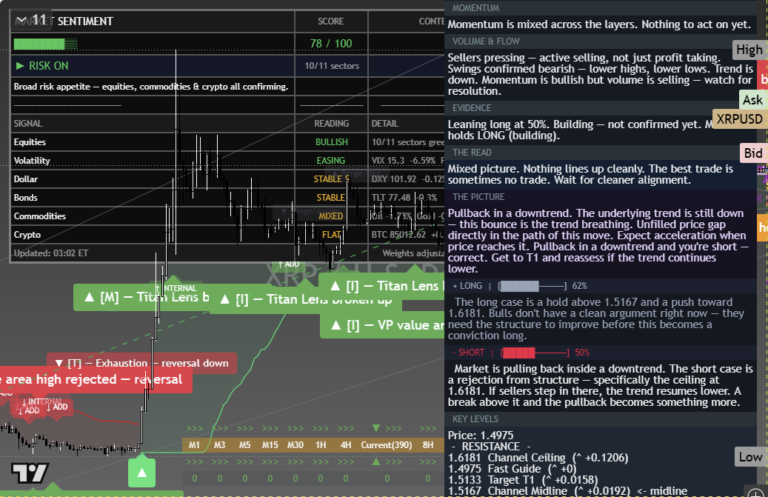
Monday natural gas was watching with low confidence. Today the framework has shifted to bullish at low-moderate conviction. The 390-minute chart shows a breakout attempt developing from the recent consolidation zone. The Titan Lens has broken up with the broader direction shifting higher. Price is testing the upper boundary of the recent range after holding the lows. The structure is improving from the choppy, directionless action of the prior sessions. Higher lows are forming and the breakout zone sits just above current price.
Momentum
Momentum is turning higher but has not fully confirmed across all layers. The shorter-term momentum is clearly bullish, with building strength visible on the chart. The longer-term picture is still mixed, which is why this is low-moderate rather than moderate or high conviction. The framework is seeing early signs of a directional shift but needs more confirmation before committing fully.
Volume
Buyers are stepping in with conviction near the recent lows. The volume profile shows a shift from distribution to early accumulation. The breakout attempt has participation behind it, which is a positive sign. However, natural gas volume is inherently volatile and can reverse with weather forecasts or storage data. The demand at the lows is genuine, not just short covering, which distinguishes this from a dead-cat bounce.
The Call
Bullish with low-moderate confidence. This is a meaningful shift from Monday’s watching call. The structure is improving and buyers are stepping in. But natural gas remains the most volatile commodity on the board and the confidence is capped at low-moderate because not all layers have confirmed. Summer cooling demand is the seasonal tailwind. EIA storage data this week is the catalyst. The framework says there is early evidence of a directional shift but the trade is still developing.
Key Levels
| Level | Price | Significance |
|---|---|---|
| Resistance 2 | 3.85 | Prior swing high, breakout confirmation |
| Resistance 1 | 3.55 | Near-term ceiling, breakout zone |
| Current Price | ~3.42 | Testing breakout zone from below |
| Support 1 | 3.20 | Recent demand zone, buyer absorption |
| Support 2 | 2.95 | Major structural floor, channel base |
Risk Assessment
HIGH
Extreme volatility + weather sensitivity + storage data pending
Risk is high because natural gas is the most volatile commodity on the board. Weather forecasts, storage data, and LNG export dynamics can move the market 5-10% in a single session. The bullish lean is early-stage and not yet fully confirmed. The seasonal tailwind from summer cooling demand provides support but is already partially priced in. EIA storage data this week is the near-term catalyst.
Scenario Analysis
Bull Case
35%
Breakout above 3.55 on summer demand, target 3.85
Sideways
30%
Range 3.20-3.55 as market digests seasonal positioning
Correction
25%
Breakout fails, retrace to 3.20 demand zone
Black Swan
10%
Weather shock or LNG export disruption causes a gap move
Position Sizing Guidance
STANDARD
REDUCED
AVOID
Low-moderate confidence with high risk factor demands reduced sizing. Natural gas is not a market where you commit full size on early signals. The bullish lean is supported by the framework but the volatility profile means a single storage report or weather forecast change can invalidate the thesis. If entering long, define your stop below 3.20 and size accordingly. The breakout above 3.55 with conviction would increase confidence and justify adding.
Experience-Level Guidance
Beginner
Natural gas has shifted from watching to bullish, which is encouraging. But this is the most volatile commodity you will encounter. The risk factor is 8.0%, which is the highest in today’s batch. One weather forecast or storage report can move natural gas 5-10% in a session. This is not a market for beginners. Watch how the breakout develops, study the volume on the move, and observe how the framework tracks the transition. Learning from nat gas volatility without capital at risk is the smartest play.
Intermediate
The shift from watching to bullish is a meaningful framework signal. The 3.55 breakout zone is the confirmation level. Above that, the path to 3.85 opens. Below 3.20, the bullish thesis fails. That gives you a defined range for risk-reward calculations. If you trade nat gas, size at half your normal position and let the breakout confirm before adding. EIA storage data this week is the catalyst to watch. Do not position ahead of the report with full size.
Advanced
The framework sees early accumulation with buyers stepping in at the lows. The 3.55 breakout level is the threshold. Summer cooling demand is the seasonal tailwind but the market is also watching LNG export capacity additions and European storage levels. The options market on nat gas offers defined-risk exposure that the underlying cannot. For directional plays, the breakout-retest of 3.55 is the cleanest entry. For volatility plays, the elevated implied vol creates opportunities. Keep size conservative given the 8.0% risk factor. This is a trade where being right on direction but wrong on timing can still hurt.
This content is for informational and educational purposes only. It does not constitute financial advice, investment recommendations, or a solicitation to trade. All trading involves risk. Past performance does not guarantee future results. Always conduct your own research and consult a qualified financial adviser before making investment decisions. Titan Protect is not responsible for any losses incurred from acting on this information.
Tuesday 30 Jun 2026
Natural Gas
Daily Framework Read | Monday 29 June 2026
Q3 Day 1
CONFIDENCE
Low
RISK FACTOR
8.5%
Framework Interpretation
Structure
Natural Gas on the 390-minute chart is showing volatile, range-bound behaviour with no clear trend. The market has swung between sharp rallies and sharp selloffs within a wide range. Recent price action shows a breakout attempt higher that stalled, followed by a reversal, then another push higher. This is classic chop. The framework cannot establish a clean directional read because structure keeps invalidating itself.
Momentum
Momentum is whipsawing. Short-term readings are positive following the recent bounce, but longer-term readings remain mixed. The internal picture is noisy and unreliable. Natural Gas has a history of generating false momentum signals during range-bound periods, and the framework recognises this pattern.
Volume
Volume spikes on both the rallies and the selloffs, confirming two-way participation. Neither side has established dominance. The wide-range candles with high volume on both sides are characteristic of a market in price discovery mode rather than trend mode. This is the most volatile instrument in today’s commodity batch.
The Call
WATCHING. Natural Gas is not offering a tradeable edge today. The volatility is high but the direction is unclear. Summer demand seasonality, storage levels, and LNG export flows are all creating cross-currents that the chart reflects as chop. The framework says this is an instrument to monitor, not to trade. When the range resolves, the move could be significant in either direction. Until then, capital deployed here is at the mercy of noise.
Key Levels
| Level | Price | Significance |
|---|---|---|
| Resistance 2 | 3.85 | Range high, prior rejection zone |
| Resistance 1 | 3.65 | Recent bounce high, near-term ceiling |
| Current Price | ~3.50 | Mid-range, volatile equilibrium |
| Support 1 | 3.30 | Near-term demand, range floor area |
| Support 2 | 3.10 | Major structural floor |
Risk Assessment
VERY HIGH
Extreme volatility + no directional edge + weather sensitivity + storage data
Natural Gas carries the highest risk rating in today’s commodity batch. The combination of extreme intraday volatility, no clear directional edge, weather forecast sensitivity, and weekly storage data creates an environment where capital can be destroyed quickly. This is not an instrument where “reduced sizing” fixes the problem. The risk is structural, not just sizing-related.
Scenario Analysis
Bull Case
25%
Summer heat wave, LNG export surge, break above 3.85
Sideways
35%
Continued volatile chop 3.30-3.85
Correction
30%
Mild summer, storage builds, break below 3.30
Black Swan
10%
Pipeline disruption, extreme weather event, 15%+ gap
Position Sizing Guidance
STANDARD
REDUCED
AVOID
AVOID. No directional edge plus very high volatility equals capital destruction risk. Natural Gas specialists may find opportunities within the range, but for most participants, this is an instrument to watch, not trade. The framework will shift to a directional read when the range resolves. Until then, preserve capital for higher-probability setups elsewhere.
Experience-Level Guidance
Beginner
Do not trade Natural Gas. This is one of the most volatile instruments in commodity markets and it is currently in a range-bound, whipsaw pattern that will punish directional bets. The wide-range candles you see on the chart represent moves that could wipe out overleveraged accounts in a single session. Study from the sideline. This is a master-class in what “no edge” looks like.
Intermediate
The range is 3.30-3.85 and neither side has broken. If you insist on watching, mark those levels and wait for a clean break with volume before considering a position. The volatility within the range makes mean-reversion strategies tempting, but the gap risk and headline sensitivity make them dangerous. Weather forecasts and Thursday’s storage data are the catalysts.
Advanced
NatGas ranges tend to compress before explosive moves. The current chop could be building towards a significant directional break. If you have a view on summer demand (heat wave vs. mild), the range extremes offer defined-risk entries. The 3.85 break higher targets 4.20+; the 3.30 break lower targets sub-3.00. Options strategies may offer better risk/reward than directional futures in this environment. Watch for the storage data to provide the catalyst for the range break.
This content is for informational and educational purposes only. It does not constitute financial advice, investment recommendations, or a solicitation to trade. All trading involves risk. Past performance does not guarantee future results. Always conduct your own research and consult a qualified financial adviser before making investment decisions. Titan Protect is not responsible for any losses incurred from acting on this information.
Sunday 28 Jun 2026
Natural Gas
Daily Framework Read | Sunday 28 June 2026
Launch Edition
CONFIDENCE
Low
RISK FACTOR
8.1%
Framework Interpretation
Structure
Natural Gas has staged a strong rally and the analysis reads the broader structure as bullish. However, the intermediate picture is more nuanced. The 390-minute timeframe shows conflicting signals across short-term oscillations, with the framework flagging “wait for clarity” rather than committing to either side. The recent uptrend is intact but the question is whether it continues or consolidates from here.
Momentum
Momentum is the key conflict. The analysis reads short-term momentum as neutral while the bigger trend remains upward. This is the classic “pause within a trend” signature. Whether it resolves as a continuation or a reversal is not yet clear from the internal readings. The framework is genuinely undecided here.
Volume
The rally has been supported by volume, which is constructive for the bull case. However, the most recent sessions show declining participation at higher prices, suggesting some fatigue. The analysis reads this as a market that has attracted buyers but may need a rest before the next leg.
The Call
NEUTRAL. The framework is sitting on the fence and doing so honestly. The bigger trend is up, but the intermediate picture is conflicted. Natural Gas is one of the most volatile instruments in the commodity complex and weekend storage data can move it materially. This is not the environment for new positions. Let it tell you what it wants to do next week.
Key Levels
| Level | Price | Significance |
|---|---|---|
| Resistance 2 | 3.90 | Recent swing high, breakout short-lived |
| Resistance 1 | 3.75 | Near-term overhead, prior consolidation zone |
| Current Price | ~3.60 | Mid-trend, neutral zone |
| Support 1 | 3.45 | Prior breakout level, demand cluster |
| Support 2 | 3.20 | Major structural support, trend-defining level |
Risk Assessment
HIGH
Extreme volatility + weather sensitivity + storage data + thin weekend liquidity
Natural Gas carries the highest risk factor in today’s commodity batch. The instrument is notorious for violent moves on storage reports, weather forecasts, and production data. Weekend gaps are common and can be severe. The framework’s neutral read combined with high inherent volatility means the risk-reward for new positions is poor.
Scenario Analysis
Bull Case
30%
Heat wave forecast or storage drawdown drives above 3.90
Sideways
35%
Consolidation between 3.45 and 3.75 while trend digests
Correction
25%
Profit-taking drives retest of 3.20 structural support
Black Swan
10%
Infrastructure disruption, extreme weather event, or LNG export shock
Position Sizing Guidance
STANDARD
REDUCED
AVOID
Neutral conviction plus the highest volatility in the commodity complex equals AVOID. Natural Gas is not a weekend position for any account size. The instrument will be here on Monday with better data and clearer signals. Preservation of capital is the priority when the framework offers no edge in a high-risk environment.
Experience-Level Guidance
Beginner
Natural Gas is not a beginner instrument. It moves with extreme violence on catalysts that are difficult to predict, including weather, storage, and production data. The framework is giving a neutral read which means even the analytical tools are not finding an edge. Sit this out completely. Study the instrument from a distance and learn what drives it before ever considering a position.
Intermediate
The uptrend structure is intact but the intermediate read is neutral. If you have a bullish thesis based on seasonal demand, wait for the framework to confirm before entering. A pullback towards 3.45 support with momentum turning would be a much cleaner entry than current levels. Do not fight the framework’s neutrality with personal bias.
Advanced
The consolidation pattern after a strong rally is interesting from a continuation perspective. Watch for a break above 3.75 with renewed volume as the trigger for the next leg higher. Alternatively, a failure to hold 3.45 would invalidate the uptrend thesis. The 10% black swan allocation is meaningful here because NatGas tail events are not rare. If you must be exposed, options structures offer better risk-reward than directional futures in a neutral-read environment.
This content is for informational and educational purposes only. It does not constitute financial advice, investment recommendations, or a solicitation to trade. All trading involves risk. Past performance does not guarantee future results. Always conduct your own research and consult a qualified financial adviser before making investment decisions. Titan Protect is not responsible for any losses incurred from acting on this information.
Thursday 25 Jun 2026
Titan Commodities Desk · Daily Framework Read · Thursday 25 June 2026
Natural Gas: Bullish Structure With Breakout Long Lines Active and Momentum Building
Confidence: Around 54%
Yesterday vs Today
| Signal | Watching (Wednesday) | LONG LEAN (Thursday) |
| Shift | Upgraded from watching to long lean. The chart shows breakout long lines active near the current price with the broader structure building higher lows. Natural gas has its own supply-demand dynamics largely independent of the macro equity selloff, and the summer demand season is providing a structural tailwind. The framework shows a cleaner chart than most instruments today. | |
Daily Read
Natural Gas is showing a constructive chart with breakout long lines active and momentum building through higher lows. Unlike most instruments today, natural gas has its own supply-demand dynamics that are largely independent of the macro equity selloff and currency moves.
The summer cooling demand season provides a structural tailwind. Storage injection data has been below expectations, tightening the supply picture. LNG export terminal activity is strong. These fundamental factors align with the technical structure showing breakout long lines and higher lows.
The analysis reads long lean at 54% confidence. This is a low-conviction directional view but the structure is clean relative to the chaotic charts across equities and most FX. Natural gas has the advantage of being uncorrelated with the Fear and Greed at 25.3 reading, as weather-driven demand does not respond to equity market sentiment.
Key Levels
| Level | Price | Significance |
|---|---|---|
| Resistance | 3.20 | Breakout long confirmation |
| Current Zone | 2.90 – 3.10 | Long lean zone, building |
| Support | 2.70 | Higher low support, long invalidation below |
Risk Assessment
Around 50%
Average risk. Natural gas has its own catalyst set (weather, storage, LNG) that insulates it from the macro volatility affecting other instruments. Lower correlation with equities is a diversification benefit. Weather forecast changes can move nat gas significantly and without warning.
What to Watch Today
- EIA storage injection report for supply-demand balance
- Weather forecast changes: heatwave extension is bullish
- LNG export terminal utilisation rates
- Whether the breakout long line at 3.20 gets tested
This daily read is produced by the Titan Commodities Desk for educational and informational purposes only. It does not constitute financial advice or a recommendation to buy or sell any instrument. All levels and scenarios are analytical reference points, not trading instructions. Past performance of any level or scenario is not indicative of future results. Always apply your own risk management. Capital is at risk.
Wednesday 24 Jun 2026
Titan Commodities Desk | Daily Framework Read | 24 June 2026
Natural Gas: Bucking the Trend as Summer Demand Holds Structure
Spot: $4.08 | Day Change: +1.2% | Session: Pre-London
Daily Read
LONG – Bullish Structure Intact
The chart shows a clear uptrend with higher lows and structure holding above the short lens. Summer cooling demand is providing a fundamental floor. Unlike the rest of the commodity complex, Natural Gas is decoupled from the risk-off narrative.
Yesterday vs Today
Monday 23 June
NatGas was holding relatively well amid the broader commodity selloff. Summer cooling demand was providing structural support. The uptrend remained intact despite weakness across metals and energy.
Tuesday 24 June
Continuing to buck the trend. The chart shows a clear uptrend with support holding above the short lens. Higher lows are intact. Structure is bullish while the rest of the commodity complex is falling apart.
The Read
Natural Gas is the outlier in the commodity complex today, and that divergence is telling. While Gold, Silver, Copper, and Crude Oil are all falling, NatGas is holding its bullish structure and even pushing marginally higher. The reason is straightforward: summer cooling demand is a fundamental driver that the risk-off narrative cannot easily override.
The chart shows a clean uptrend. Higher lows are intact. The support above the short lens is holding. The buy signal that triggered earlier in the move has been validated by follow-through. This is the kind of structure where the analysis reads LONG with conviction, not because every indicator is screaming buy, but because the structure itself is clean and the fundamental driver is supportive.
The key distinction between NatGas and the rest of the commodity complex is the demand driver. Metals and Oil are sensitive to global growth expectations and geopolitical risk premiums. NatGas at this time of year is primarily driven by weather patterns and cooling demand. The summer heat forecast for the US remains above average, and that keeps the demand floor in place regardless of what equities or the VIX are doing.
Storage draws have been supportive too. The weekly storage reports have been coming in below the five-year average for injections, which means the supply cushion for next winter is thinner than usual. That provides a medium-term bid that traders are reluctant to fade.
The risk here is a sharp reversal in weather forecasts or a sudden injection surprise in the storage data. NatGas can move violently when the weather narrative shifts, and a cooler-than-expected forecast could take the bullish argument out in a single session. For now, the structure is intact and the fundamental backdrop is supportive.
The approach is to trail stops below the short lens support and let the trend work. There is no reason to fight a clean uptrend with supportive fundamentals, especially when the rest of the complex is confirming that NatGas is trading on its own merits rather than following the broader commodity narrative.
Key Levels
| Level | Price | Significance |
|---|---|---|
| Resistance | $4.25 | Recent swing high, breakout target |
| Resistance | $4.15 | Near-term overhead from prior session high |
| Current Price | $4.08 | Above short lens, bullish structure |
| Support | $3.95 | Short lens support, trend-defining level |
| Support | $3.80–$3.85 | Prior consolidation zone, structural floor |
Upside Potential
Around 60%
Clean trend, summer demand, storage draws
Downside Risk
Around 40%
Weather forecast shift, injection surprise, broader liquidation
Scenario Analysis
Bull Case (Primary – Around 50%)
NatGas extends the uptrend and pushes through $4.15 toward $4.25. Summer heat forecasts remain above average, storage draws continue, and the market reprices higher. The trend remains intact.
Base Case (Around 30%)
NatGas consolidates in the $3.95–$4.15 range. The trend holds but momentum stalls. Waiting for the next storage report or weather forecast update for direction.
Bear Case (Around 20%)
Weather forecast shifts cooler, storage injection surprise, and the broader commodity liquidation catches NatGas. A break below $3.95 would invalidate the bullish structure and open the door to $3.80.
What to Watch Today
- ►EIA storage report expectations for Thursday release
- ►Updated 6-14 day weather forecasts for US cooling demand
- ►Whether $3.95 short lens support holds on any pullback
- ►NatGas correlation (or lack thereof) with the broader commodity selloff
This daily read is produced by the Titan Commodities Desk for informational and analytical purposes only. It does not constitute financial advice or a recommendation to buy or sell any financial instrument. Markets can move against any framework. Always apply your own risk management. Capital is at risk. Titan Protect Limited.
Tuesday 23 Jun 2026
Titan Macro Desk | Daily Framework Read | 23 June 2026
Natural Gas: Hormuz Relief Changes the Supply Equation
Session Context: Iran MOU In Force | LNG Shipping Routes Normalising | Broad Risk-Off
Framework Read
WATCHING – Supply Story Complex
The Hormuz tension premium is unwinding but the natural gas story is more nuanced than crude. LNG routing, European storage levels, and seasonal demand all play into the direction from here.
The Read
Natural Gas does not behave quite like crude when the Iran situation resolves. The story is more layered. Crude markets see Iranian barrels directly affecting global supply. Natural gas has a different dynamic: the Hormuz shipping lane tension was creating LNG routing uncertainty, particularly for Qatar flows heading to European and Asian markets. That uncertainty is now reducing.
When Hormuz risk was elevated, LNG spot prices in Europe and Asia had a risk premium baked in that reflected potential supply disruption. The MOU removes that particular risk but does not change the underlying supply and demand balance for natural gas itself. This is an important distinction from the crude oil read, where Iranian production directly affects global supply.
European natural gas storage levels heading into summer are the more important fundamental variable right now. If storage is running ahead of seasonal norms, you have a bearish structural backdrop. If storage is below seasonal norms, the underlying support for prices remains even as the geopolitical premium exits. This is worth monitoring from European storage data reports.
US natural gas has its own domestic dynamics largely decoupled from Hormuz. Henry Hub prices are driven by production volumes from the Permian and Haynesville, domestic power demand for cooling, and LNG export volumes from Gulf Coast terminals. The seasonal summer demand from air conditioning is typically a support factor heading into late June and July.
The risk-off environment across equities today does not directly translate into natural gas weakness in the same way it does for copper or crude. Natural gas is more of a utility and less of a growth-cycle commodity. That gives it a degree of defensive character relative to industrial commodities on a day like this.
The net read: natural gas is watching rather than clearly directional. The Hormuz premium removal is a mild negative for LNG spot markets, but the domestic US seasonal demand and European storage story could provide support. This is a “wait and see” session unless a clear catalyst emerges from storage reports or weather forecasts.
Key Levels
| Level | Price (Henry Hub) | Significance |
|---|---|---|
| Resistance | $3.80/MMBtu | Hormuz premium zone, fading as MOU settles |
| Watch Zone | $3.45–$3.60/MMBtu | Current trading range, support and resistance contested |
| Support | $3.20/MMBtu | Seasonal demand floor, summer AC demand support |
| Upside Catalyst | $3.80+/MMBtu | Heatwave forecast or European storage deficit data needed |
Directional Conviction
Low
Supply narrative complex, waiting for catalyst
Seasonal Support
Moderate
Summer cooling demand underpins US domestic prices
Scenario Analysis
Bear Case (Around 40%)
LNG spot prices in Europe and Asia fall as Hormuz routing normalises and supply improves. European storage data shows inventory above seasonal norms, removing the scarcity premium. US prices drift lower toward $3.20 support as weather remains moderate.
Base Case (Around 40%)
Natural gas trades sideways within current range. Summer demand provides a floor. Hormuz premium exits gradually rather than sharply. LNG markets recalibrate without a disruptive price move. Henry Hub holds $3.45–$3.60.
Bull Case (Around 20%)
Extended heatwave forecast for the US South and Midwest drives power demand sharply higher. European storage data shows deficit. LNG export volumes from Gulf Coast terminals hit record levels. Henry Hub moves above $3.80 on tightening domestic supply.
This framework read is produced by the Titan Macro Desk for informational and analytical purposes only. It does not constitute financial advice or a recommendation to buy or sell any financial instrument. Markets can move against any framework. Always apply your own risk management. Capital is at risk. Titan Protect Limited.
Monday 22 Jun 2026
Natural Gas Daily Ticker Read: The Quiet Commodity With a Hormuz Problem Nobody’s Talking About
Daily Ticker Read | Monday 22 June 2026
Natural gas is estimated at around $3.22 on Monday, matching Thursday’s close of $3.22. Flat. In a week where crude oil opened up 1.2 percent on Hormuz headlines and gold pulled back on dollar strength, natural gas moved nothing. That apparent neutrality conceals an important connection that the market may be underpricing: Qatar exports approximately 77 million tonnes per year of LNG, most of which transits the Strait of Hormuz. If Hormuz is genuinely contested rather than just disputed in press releases, the world’s second-largest LNG exporter has a supply problem. Natural gas is not ignoring Hormuz — it is waiting to see if the LNG channel becomes the story next.
Where Natural Gas Sits
Henry Hub Natural Gas at $3.22 (estimated). Thursday close also $3.22. Zero price movement across a weekend of significant geopolitical news. The flat price at $3.22 represents a market that is either ignoring the LNG-Hormuz connection or correctly estimating that the current level of dispute is not sufficient to physically disrupt Qatari LNG flows.
Natural gas is a structurally different commodity from crude oil. Unlike oil, which has relatively liquid global seaborne markets, natural gas pricing is highly regionalised. Henry Hub prices in the United States. TTF prices in Europe. JKM prices in Asia-Pacific. These regional prices can diverge dramatically based on local supply and demand conditions. The Hormuz-LNG connection matters most for TTF and JKM — European and Asian buyers who depend on Qatari, UAE, and to a lesser extent Iranian gas supplies.
Henry Hub at $3.22 reflects the US domestic market primarily. But in a world of interconnected LNG infrastructure, a significant Hormuz disruption to Qatari LNG exports would eventually pull US LNG exports toward Asia and Europe to fill the gap, tightening domestic US supply and pushing Henry Hub higher. The linkage is real — it just operates on a longer time delay than the immediate crude oil channel.
SNAPSHOT — MONDAY 22 JUNE 2026
| Natural Gas (Henry Hub, est.) | ~$3.22 |
| Thursday close | $3.22 |
| Session move | Flat |
| Key indirect risk | Qatari LNG through Hormuz |
| Season | Early summer (building cooling demand) |
Three Levels That Decide The Week
Support: $3.00. The psychological round number that gas has been trading above for the past month. A break below $3.00 would signal that the summer cooling demand thesis is not building fast enough to absorb supply, and that storage injection season is running ahead of demand. Below $3, the bears have momentum. Above $3, the seasonal demand story has traction.
Pivot: $3.40 to $3.50. The band above which natural gas would be signalling that either the seasonal demand build is stronger than expected or the Hormuz-LNG connection is starting to be priced. Reclaiming $3.50 cleanly would be a meaningful technical break from the current consolidation zone.
Extension: $3.80 to $4.00. The upper band that would require a material shift in the LNG supply narrative — either confirmed Hormuz disruption to Qatari flows or an unexpected acceleration in US summer cooling demand from a heat wave event. Not the base case, but the level where a geopolitical escalation would put gas if it starts to be taken seriously in LNG pricing.
Bullish Setup: Hormuz-LNG Connection Gets Priced
Lean Bullish: Market Wakes Up to Qatari LNG Risk, Summer Demand Builds
Risk score: around 45 percent
Entry: $3.18 to $3.25 while the LNG connection is underpriced. Stop: $2.95 daily close. Target one: $3.50. Target two: $3.80. Risk to reward: roughly 1:2 on T1, 1:2.9 on T2.
Why it works: Natural gas ignoring the Hormuz story that crude oil is pricing is a classic case of the market pricing the direct channel (crude, immediate) before the indirect channel (LNG, delayed). When the Hormuz story extends beyond a one-week event, the LNG supply risk starts being priced. Qatar has no alternative export route of similar scale. Add early summer heat forecasts across the US Southeast and Southwest and the seasonal demand tailwind builds. Kill condition: Hormuz declared fully open with normal passage confirmed, removing the LNG risk. Or an unusually mild June temperature profile that kills the early cooling demand thesis.
Bearish Setup: Storage Overhang Suppresses Price
Tactical Short: Storage Above Five-Year Average, Injection Season Dominates
Risk score: around 40 percent
Entry: $3.30 to $3.40 on a push up that stalls. Stop: $3.55. Target one: $3.05. Target two: $2.90. Risk to reward: roughly 1:1.7 on T1, 1:2.7 on T2.
Why it works: If US storage levels are tracking above the five-year seasonal average — which they have been for much of 2026 — the injection season creates continuous supply pressure on prices. The domestic US market does not care about Hormuz unless and until the LNG re-routing effect is visible in export terminal data. Storage overhang wins over geopolitical premium in the near term. Kill condition: EIA storage report comes in significantly below expectations, confirming a demand surge or production shortfall. Either breaks the storage overhang narrative.
The Qatar Connection: Why This Matters
Qatar Petroleum — now QatarEnergy — is one of the world’s largest LNG exporters. Qatar’s Ras Laffan Industrial City on the northeast coast of the Qatar peninsula is the largest LNG processing facility in the world. Every cubic metre of LNG that leaves Ras Laffan by ship transits the Strait of Hormuz to reach the Indian Ocean, from where it routes to Europe, Asia, and the Americas.
If Hormuz is genuinely contested, not just the subject of competing press releases, Qatar’s LNG exports face the same routing challenge as Saudi oil exports. Qatar’s LNG customers in Japan, South Korea, China, and increasingly Europe signed long-term supply contracts that assume reliable transit. A physical disruption — even a partial slowdown from voluntary risk reduction by LNG tanker operators — would tighten the global gas market within two to four weeks.
The market is not pricing this yet. Henry Hub flat at $3.22 tells you the gas market is treating Hormuz as an oil story, not a gas story. That may be correct if the situation resolves quickly. But if it extends into next week, LNG traders will start adjusting, and the TTF price in Europe — which is more directly exposed to Qatari supply — will start to move. Watch TTF as the leading indicator for whether the gas market is starting to price the LNG-Hormuz channel. If TTF moves, Henry Hub follows with a lag.
Summer Demand: The Seasonal Baseline
It is June 22. The northern hemisphere summer cooling demand season is building. Air conditioning power load, particularly across the US South and Southeast, drives natural gas demand through power generation in June, July, and August. The EIA’s short-term energy outlook typically shows summer 2026 as a seasonally stronger demand period as cooling degree days accumulate.
The base seasonal case keeps natural gas supported above $3.00 through July. The geopolitical case layered on top provides upside optionality if the Hormuz-LNG story develops. The storage overhang case is the headwind that prevents the seasonal and geopolitical premium from running cleanly higher without a specific trigger.
A heat wave forecast for July — which the National Oceanic and Atmospheric Administration’s seasonal outlooks will update this week — is the most likely near-term domestic catalyst for natural gas. Any temperature anomaly forecast for the US Southeast or Texas power corridor above 100 degrees Fahrenheit for multiple days would pull power demand up sharply and compress storage injection.
Time Horizons
Intraday: Natural gas at $3.22 is a session where there is nothing actionable without a specific catalyst. The EIA storage report and any update on LNG terminal export volumes are the data points that move the needle. Without those, the metal sits where it is.
Swing (two to five days): The EIA weekly storage report due Thursday is the primary catalyst for the week. If storage injection came in below the five-year average last week, that shifts the narrative. If it came in above average, the bears have confirmation. Mid-week temperature forecasts for July are the secondary catalyst. Both arrive in the same 48-hour window Wednesday to Thursday.
Positional (two to eight weeks): Natural gas in a contested-Hormuz environment where the situation extends beyond two weeks is worth $3.50 to $4.00 on the combination of LNG supply risk and summer demand. The structural demand case for gas in the transition period — as a bridge fuel while green energy scales — keeps the floor elevated. The medium-term constructive case is intact, just waiting for the near-term noise to clarify.
Risk Score
Natural gas risk score: around 50 percent.
- Plus 20 percent for underpriced Qatari LNG disruption risk if Hormuz extends
- Plus 15 percent for the binary nature of Thursday’s EIA storage report
- Plus 10 percent for seasonal demand uncertainty — either a heat wave or a mild June
- Minus 15 percent for the domestic market insulation from Hormuz unless LNG re-routing occurs
- Minus 15 percent for the storage overhang providing a cap on near-term upside
- Plus 15 percent for the asymmetric upside if the LNG-Hormuz connection gets priced from a low base
Natural gas is the sleeper instrument in this commodity complex. It is flat now, but the Qatar-Hormuz story could wake it up fast if the strait remains contested through next week. Watch TTF as the early warning system.
What We Called vs What Happened
| Call (Thursday 19 Jun) | Outcome (by Monday 22 Jun) | Verdict |
|---|---|---|
| Natural gas insulated from Hormuz in the short term. | Confirmed — gas flat at $3.22 while oil moved on the Hormuz headline. | Confirmed |
| $3.22 as the balanced price between storage overhang and seasonal demand. | Exactly $3.22 on Monday — equilibrium held. | Confirmed |
| LNG-Hormuz connection is the medium-term risk, not immediate. | Correct — market has not yet priced the Qatar LNG channel. Story for next week if Hormuz extends. | Confirmed |
| EIA storage report as the primary catalyst this week. | Thursday’s EIA report still ahead — call stands. | Open |
Natural gas is the commodity market’s underappreciated participant in the Hormuz story. Right now it is flat and largely ignored in favour of the more immediate oil headline. But Qatar’s LNG exposure to the strait is real, the volume is enormous, and if the situation extends another week without resolution, the gas market will start to price what the oil market priced on Sunday. The move in gas would come from a lower base, have significant asymmetric upside, and catch most participants off-guard because they are focused on crude. Watch TTF and LNG freight rates this week as the canary in the coal mine.
Titan Macro Desk — Daily Ticker Read. This is analysis, not financial advice. All positions carry risk. Manage size accordingly.
Thursday 18 Jun 2026
Natural Gas — Daily Framework Read | Thursday 18 June 2026
Daily Ticker Read | Thursday 18 June 2026
Natural Gas closed at $3.22, up 2.42 percent. In a session where every other commodity in this sequence finished in the red, Natural Gas went the other way. The reason is straightforward: weather demand. Where Iran, the dollar, and geopolitical repositioning drove the rest of the complex lower, Natural Gas has its own independent catalyst in summer cooling demand. The framework confirmed long. Today was clean.
Where Natural Gas Sits
Natural Gas (NATGAS, Henry Hub) closed Thursday at $3.22, up $0.076 or 2.42 percent. Yesterday’s close was $3.17, down 2.04 percent. A two-session swing of 4.46 percent combined, with today erasing yesterday’s loss and adding more on top. That kind of reversal is the pattern of a market where the directional driver is event-specific on each day rather than a sustained trend.
Today’s Natural Gas chart is notably different from the rest of the commodity complex. The framework is long-aligned. The chart shows what appears to be a “Breakout Long” label appearing mid-session, with the “Bounce Long” confirmation on the upper portion of the chart. The sentiment panel reads green-leaning. The the framework panel in the screenshot notes the long side as the aligned trade. The word “Bullish” appears in the chart labels, which is the opposite of every other commodity read today.
The chart also shows a distinct visual pattern compared to the metals and oil charts. Where those instruments show cascading “the structural lens broken down” labels from left to right across the session, the Natural Gas chart has a cleaner price structure with the current candles near the top of the day’s range, not grinding lower. The structure on the Natural Gas chart is building, not breaking.
Yesterday’s Natural Gas chart shows the prior session’s decline, which was a reversal from an earlier push higher. The “Bounce Long” annotation was present yesterday as well, suggesting the framework had been signalling long even during the down session. That is a useful piece of information: the framework was not calling yesterday’s decline as a short opportunity. It was treating it as a pullback within a long structure, which is exactly what it turned out to be given today’s recovery and extension.
Yesterday vs Today
| Session | Close | Move | Daily Read |
|---|---|---|---|
| Wednesday 17 Jun | $3.17 | -2.04% | Long bias maintained through decline, bounce long signal present |
| Thursday 18 Jun | $3.22 | +2.42% | Long confirmed, breakout long triggered, structure building |
The contrast with the other four instruments is total. Gold, Silver, Crude, and Copper all closed lower today. Natural Gas closed higher with a clean framework confirmation. This is why commodity basket traders pay attention to cross-commodity correlation breakdowns: when one market decouples from a risk-off theme and moves on its own independent catalyst, that is the cleanest trade of the session.
The independent catalyst here is weather demand for cooling. Summer heatwave expectations across the US and Europe create immediate physical demand for power generation using Natural Gas. That demand is not affected by an Iran peace deal, not sensitive to the dollar’s value, and not dependent on global industrial output. It is seasonal and weather-driven. Those catalysts move quickly and can reverse quickly too, which is why the weather-driven long in Natural Gas requires close monitoring of actual temperature forecasts.
Key Levels
Support: $3.17. Yesterday’s close, which now acts as the immediate swing low and structural support. A pullback to $3.17 on Friday that holds would be a classic retest of the breakout level and a long opportunity with a clear stop below.
Decision zone: $3.20 to $3.22. Current price. This is where the market closed today. A hold above $3.20 on Friday’s open confirms the buyers are in control of the overnight session. A gap below $3.18 would begin to question the breakout.
Target one: $3.35 to $3.40. The next meaningful resistance zone visible above current price. A sustained move through $3.22 targets this range over the next one to three sessions on continued weather demand or any LNG export data that shows strong international demand.
Target two: $3.50 to $3.55. The upper range target if the long thesis extends. This level would represent a meaningful extension from current price and would require either a sustained heatwave or a fresh bullish catalyst beyond current weather expectations.
Stop level: $3.10. The level that breaks the structure. Below $3.10 on a daily close would invalidate the long thesis and suggest the weather demand story has either dissipated or been overridden by a macro event. Below $3.10 is also where a short would become viable for the first time in this setup.
Long Bias Setup
Pullback Long: Buy The Retest of $3.17 to $3.20
Risk score: around 45%
Entry: $3.17 to $3.20 on a controlled pullback that holds the breakout level, with a close back above $3.20 on the 390-minute chart. Stop: $3.09 (below the breakout zone and below any reasonable overnight noise level). Target one: $3.38. Target two: $3.52. Risk to reward: roughly 1:2.1 to first target, 1:3 to second target.
Why it works: Framework is long-aligned. The breakout long triggered cleanly today. A retest of the breakout level is the classic entry that uses yesterday’s close as the floor. Weather demand catalysts do not reverse in a single session unless the forecast changes materially. The risk-reward is clean and the stop is structural. Kill condition: daily close below $3.10 or a forecast reversal (forecast temperatures drop significantly below seasonal average).
Short Bias Setup
Reversal Short: Fade a Push Above $3.50 If Weather Story Dissipates
Risk score: around 70% (low probability, high-conviction if triggered)
Entry: $3.50 to $3.55 only if the framework simultaneously shifts to bearish and a weather forecast revision (cooler temperatures) appears alongside the price level. Stop: $3.62 (above the upper resistance zone). Target one: $3.30. Target two: $3.17. Risk to reward: roughly 1:2 to first target, 1:3.3 to second target.
Why it works: Weather-driven commodities tend to overshoot when the catalyst fades. If Natural Gas rallies to $3.50 plus on the back of heatwave expectations and then temperature forecasts revise cooler, the unwinding can be fast. This is a conditional setup, not a current one. Both the price level and the catalyst change are required simultaneously before this trade becomes live. Kill condition: Sustained higher temperatures confirm, weather demand extends. Do not fight the weather data.
Time Horizons
Intraday (zero to one day): Friday’s intraday read is straightforward. Above $3.20, the long thesis is intact and any move toward $3.30 is the continuation target. Between $3.17 and $3.20, price is at the breakout zone and holding there is constructive. Below $3.17, the first question mark appears and the $3.10 stop comes into relevance. The most likely Friday range, assuming no dramatic forecast change, is $3.17 to $3.32. Long bias above $3.20, neutral between $3.17 and $3.20, reassess below $3.15.
Swing (two to ten days): If the weather demand catalyst holds, the swing target is $3.35 to $3.40 over the next three to five sessions. Natural Gas weather rallies tend to run for one to two weeks before either the heat breaks or the futures market has fully priced the demand. With today being what appears to be the early phase of the move, there is swing potential. The pullback-retest at $3.17 to $3.20 is the best swing entry available. A direct continuation from current levels ($3.22) is a valid entry with a wider stop, but the risk-reward is slightly better at the retest level.
Positional (two to eight weeks): The positional picture for Natural Gas over two to eight weeks is more complex. Summer demand peaks around late July to early August, which means the seasonal tailwind is in the right part of the calendar. However, US storage levels matter enormously for the positional case. High storage tends to cap upside even in strong heat events. Monitor EIA weekly storage reports as the primary positional data point. A sustained move above $3.50 backed by below-average storage levels would strengthen the positional case significantly. A return below $3.00 would signal that the weather catalyst was temporary and the structural supply picture is dominant.
Risk Score
Natural Gas risk score: around 42 percent.
- Plus 20 percent for weather forecasts that can change rapidly, making the catalyst inherently short-lived if temperatures revise
- Plus 15 percent for yesterday’s 2.04% down session followed by today’s recovery — the two-session choppiness reflects uncertain directional commitment
- Minus 15 percent because framework is clearly long-aligned with a confirmed breakout long signal today
- Minus 10 percent because the catalyst (weather demand) is independent of the Iran and dollar forces hurting the rest of the complex
- Minus 8 percent because today’s close at $3.22 represents a clean extension above yesterday’s decline
- Plus 20 percent for Natural Gas volatility: this commodity moves fast in both directions on single weather reports
Lowest risk score of the five commodities in today’s read for the long trade. The framework is clean, the catalyst is independent, and the setup level is defined. The key risk is that weather forecasts can change faster than any other fundamental driver in commodity markets.
Scenarios (Sum to 100%)
| Scenario | Trigger | Target | Probability |
|---|---|---|---|
| Long continuation | Weather demand confirmed, storage data supports, framework holds long | $3.35 to $3.52 | 45% |
| Pullback then continuation | Brief retest of $3.17-$3.20 then new leg higher | Dip to $3.17, then $3.38 | 30% |
| Weather forecast reversal | Temperatures revise cooler, demand expectations drop | $3.10 to $3.00 | 18% |
| Supply shock | LNG disruption or unexpected demand spike | $3.70 plus rapidly | 7% |
Position Sizing
A risk score of 42 percent is the green light for full-size positioning in the long direction, but Natural Gas volatility means the absolute position size still needs to be managed carefully. A 2.42 percent single-day move is not unusual for Natural Gas; it regularly moves 3 to 5 percent on weather data revisions. That means stops placed at $3.09 can be tested quickly by normal intraday volatility before the real directional move plays out.
For the pullback long at $3.17 to $3.20, 80 to 85 percent of normal commodity allocation is appropriate. The framework is clean, the setup is defined, and the risk-reward is attractive. This is one of the better setups in today’s sequence because it is trading with the framework on a confirmed breakout in the only commodity showing strength.
For any addition to the long above $3.22 without a pullback retest, reduce to 60 to 65 percent of normal. Chasing a 2.42 percent up day without a retest adds basis risk. The trade can still work, but the entry quality is lower than the pullback setup.
Monitor tomorrow’s US weather forecast update as the primary risk management trigger. If forecasts revise materially, the stop at $3.09 is the exit regardless of where price is.
The Standout Read of the Session
Natural Gas is the best read in today’s commodity sequence for one simple reason: it is the only one where the framework and the catalyst are pointing in the same direction at the same time, and the catalyst is independent of the macro forces that are pulling everything else lower.
When Gold, Silver, Crude, and Copper are all selling off on the same Iran-dollar combination, Natural Gas going the other way is not a coincidence or noise. It is a market telling you that weather demand is real, physical, and immediate in a way that geopolitical narratives are not. Physical buyers need actual gas now for power generation. They do not care about the dollar index or the Iran nuclear deal. They care about what the temperature forecast says for the next two weeks.
The framework’s long alignment today reflects that reality. When the market’s structure and the external catalyst both point the same way, the job is simple: find the right entry level and manage the risk if the weather changes. That is what the $3.17 to $3.20 pullback entry does. It gives you the long with a defined floor, a defined stop, and a catalyst that is still intact at the close of today’s session.
In a session dominated by commodity selling, this is the trade that stands out.
This is analysis, not financial advice. Always manage your risk.
Thursday 18 Jun 2026
Titan Macro Desk
Natural Gas — Daily Framework Read
Thursday 18 June 2026 | Closing price: $3.15 | Change: +0.25%
Session Snapshot
Close
$3.15
Daily Change
+0.25%
Bias
Constructive
Framework Read
Natural gas was the only commodity that finished green today. In a session where crude fell -3.45%, silver fell -2.82%, and copper fell -1.54%, a +0.25% gain for natural gas is not just a small positive — it is a notable divergence. It tells you that the Iran deal narrative, which hammered oil, had minimal transmission into the gas market. That makes sense: Iranian gas export capacity is far more limited than its oil export potential, and the immediate supply increase from any deal is overwhelmingly an oil story.
The structural setup for natural gas into the summer remains supportive. Power demand for cooling is building seasonally. LNG export demand from Europe and Asia remains elevated as energy security continues to drive procurement decisions at the sovereign level. US storage levels are within normal seasonal ranges, which means there is no excess overhang to create downward price pressure.
The $3.15 close sits in a comfortable zone. The gas market has oscillated between $2.80 and $3.40 over the past two months, and the midpoint of that range has acted as a gravitational centre. Today’s marginal positive close, in the face of a commodity-wide selloff, is a mild bullish signal. It says that buyers are willing to step in at current levels even when the broader complex is under pressure.
One note of caution: the +0.25% move is small in absolute terms. This is not a breakout. It is a hold. The framework reads it as constructive rather than bullish — gas is behaving well, but it has not yet shown the conviction needed to break above $3.40 and establish a new trend leg higher.
Yesterday vs Today
| Factor | Wednesday | Thursday |
|---|---|---|
| Commodity context | Mixed | Broadly lower — gas held |
| Iran deal impact | Rumour only | Minimal for gas — oil story |
| Seasonal demand | Building | Building — summer cooling |
| Price action | $3.14 area | $3.15 close, marginal gain |
Key Levels
Support
$3.00 — Psychological / range floor
$2.80 — Two-month low
$2.60 — Major structural demand
Resistance
$3.25 — Near-term resistance
$3.40 — Range top
$3.60 — Breakout level
What to Watch Tomorrow
The weekly EIA natural gas storage report is the key data point. A draw that exceeds the consensus estimate would be a supportive catalyst for prices and could push the market toward $3.25. A larger-than-expected build would cap the upside and potentially pull prices back toward $3.00.
Weather forecasts matter in June. Any extension of above-normal heat across the US Southeast or Midwest will drive power burn expectations higher and support gas prices. The framework will be watching the temperature anomaly maps alongside the storage data for Friday’s read.
Current Bias
Constructive — Only green commodity today
Natural gas showed resilience today that the rest of the commodity complex did not. Iran deal is an oil story, not a gas story. Seasonal demand is building and LNG export appetite remains firm. The framework reads this as constructive — not yet a strong breakout signal, but certainly not a market under pressure. Range holds between $3.00 and $3.40 until the storage data gives a directional push.
This framework read is produced by the Titan Macro Desk for informational and educational purposes only. It does not constitute financial advice, a recommendation to buy or sell, or a solicitation of any investment decision. All market analysis involves judgement and uncertainty. Capital is at risk. Seek independent financial advice before making any investment decisions. For members only — not for redistribution.
Wednesday 17 Jun 2026
Titan Macro Desk · Post-Close · Wednesday 17 June 2026
Natural Gas — FOMC Day Framework Read
Natgas dances to its own drummer. Weather, LNG exports, and storage dominate — not the FOMC.
FOMC Sensitivity
Low
Primary Driver
Storage/Weather
LNG Export Factor
EU Demand
Iran Deal Link
Indirect
Context: Natural gas is the commodity that most ignores the macro backdrop of things like FOMC decisions and dollar movements. Its price is set by the intersection of domestic US storage, weather-driven demand, and LNG export demand from Europe and Asia. The Iran deal Thursday has a potential indirect link — an Iran deal means less Middle East energy risk premium for Europe, potentially reducing EU LNG import urgency.
Our Framework Read
The biggest mistake you can make trading natural gas is trying to overlay the macro framework too heavily. This is a commodity that woke up one January morning and doubled in price because a cold snap hit the Northeast USA and storage draws exceeded forecasts. That is not something the FOMC or DXY can predict or prevent.
That said, the medium-term structural case for natural gas remains interesting. US LNG export capacity has been expanding significantly. European demand for US LNG has been structural since the Russia-Ukraine conflict restructured European energy supply chains. If the Iran deal opens up alternative energy routes for Europe, it could reduce the urgency of US LNG exports — a mild bearish pressure on the price.
For the near-term, storage data is the variable that matters most. The EIA weekly storage report tells you far more about near-term natgas direction than any central bank decision. Our framework on natgas is to use it as a diversifier or hedge within a commodity portfolio rather than as a macro expression. The seasonal patterns and storage data are what drive price action here.
Key Levels
| Level | Price (MMBtu) | Context |
|---|---|---|
| Support S1 | $3.00 | Near-term structural floor, producer break-even zone |
| Support S2 | $2.60 | Major historical support, extreme low for warm weather scenario |
| Resistance R1 | $3.60 | Near-term ceiling, prior range high |
| Resistance R2 | $4.50+ | Cold weather / LNG demand spike scenario |
Risk Assessment
Around 45% risk (weather-dependent)
Highly weather-dependent. The FOMC is largely irrelevant to natgas pricing. The Iran deal has a mild indirect bearish implication through reduced European LNG urgency. Storage and weather remain the primary variables our framework tracks for this instrument.
This post is produced by the Titan Macro Desk for informational and educational purposes only. Nothing here constitutes financial advice. Capital is at risk.
Wednesday 17 Jun 2026
Titan Macro Desk · Post-Close · 16 June 2026
Natural Gas — Daily Framework Read
Tuesday 16 June 2026 | FOMC Eve
Session Summary
Primary Drivers
Weather + LNG
Seasonal Factor
Summer cooling
Framework
WATCHING
Framework Read
Bias
CAUTIOUS NEUTRAL
Framework State
WATCHING
Our Read
Natural gas is the most weather-dependent commodity in our coverage universe. June is a transitional month — winter heating demand has wound down, summer cooling demand is building, but we’re not yet in the peak heat season that drives the biggest demand spikes in the US Southeast and Southwest.
The LNG export dimension has fundamentally changed US natural gas dynamics. Before the LNG export buildout, US gas prices were largely domestic. Now, Henry Hub prices are increasingly influenced by European and Asian gas market dynamics. When European LNG prices are high (as they have been since the Russia-Ukraine conflict), US exporters divert more supply overseas, tightening US domestic supply and supporting Henry Hub prices.
Storage levels are the short-term tell for natural gas. US EIA weekly storage reports are the key catalyst. Above-trend injections into storage (more supply than seasonal normal) tend to pressure prices lower. Below-trend injections (demand absorbing supply faster than normal) support prices higher.
FOMC has minimal direct impact on natural gas — it’s more driven by the operational variables above. However, a significant dollar move post-FOMC would have some translation effect given gas is USD-priced globally.
Framework: WATCHING. Natural gas trades on its own cycle. The near-term catalyst is the next EIA storage report, not FOMC.
Key Levels
| Level | Price | Significance |
|---|---|---|
| Resistance | $3.50/MMBtu | Near-term overhead resistance |
| Current Area | $2.80–$3.00/MMBtu | Range reference |
| Support | $2.60/MMBtu | First support level |
| Support | $2.30/MMBtu | Structural support |
Risk Assessment
Around 45%
- Idiosyncratic commodity — weather and storage are primary drivers
- LNG export dynamics add structural support
- Seasonal transition period — not peak demand yet
- FOMC has minimal direct impact
This framework read is produced by the Titan Macro Desk for analytical and educational purposes only. It does not constitute financial advice or a recommendation to buy or sell any instrument. All market analysis involves uncertainty. Past framework accuracy does not guarantee future performance. Conduct your own research and consult a qualified financial adviser before making investment decisions. Capital is at risk.
Tuesday 16 Jun 2026
Titan Macro Desk · Tuesday 16 June 2026
Natural Gas — Daily Framework Read
Instrument Deep Dive · Commodity Series
Our Read
Natural gas is doing its own thing. It does not care about the Iran deal. It barely cares about FOMC. It cares about one question: how full are the storage tanks, and how hot is it going to get?
That is what makes natural gas unique in the commodity complex. Whilst crude oil is wrestling with geopolitical supply narratives and gold is watching the Fed, natural gas is looking at a weather forecast. The seasonal dynamics here are completely distinct from every other commodity on this page.
We are entering the summer build season. From June through to late August, US natural gas storage should be building week-on-week as utilities inject gas into underground storage ahead of the winter demand surge. If storage builds are larger than expected, price comes off. If builds are smaller — because cooling demand is pulling gas into air conditioning loads — prices hold or climb.
The framework captured today shows natural gas in a zone that has defined its character for several sessions. The read is not directionally screaming one way. What it is showing is a market in balance — and balance in natural gas tends to break fast once the weather picture becomes definitive.
Storage Dynamics — The Number That Drives Everything
The EIA (US Energy Information Administration) releases weekly storage data every Thursday. That single number — net injections or withdrawals for the prior week — is the most market-moving data point for natural gas, more so than any macro event this week including FOMC.
Here is how to read it:
Build Below Expectation
Less gas going into storage means more is being consumed — cooling demand is running hot, or production has dipped. Price bullish. Fast move higher is possible.
Build Above Expectation
More gas going into storage than expected means supply is outpacing consumption. Price bearish. Excess storage heading into winter means the market is well-supplied.
Current storage levels relative to the 5-year average is the anchor context. If we are running above the 5-year average for this time of year, natural gas has a structural headwind. If we are running below, there is a supply tightness argument that supports price. Our desk tracks this weekly and publishes the context in our Pre-Asia and Pre-NY session briefs.
Seasonal Context — Why June Matters
June is the inflection month for natural gas. Spring has low demand — heating season is over, cooling season has not fully arrived. Production runs, storage builds, and price typically stays soft. That softness is baked in.
The transition to summer demand is the first genuine bullish catalyst of the year. If the US experiences above-average temperatures across June and July — which meteorological forecasts will begin to shape in the coming weeks — natural gas power burn increases sharply. Air conditioning load pulls gas into the power grid, reducing available supply for storage injection.
The historical pattern: natural gas finds a seasonal low somewhere between April and late June, then begins building a summer rally as heat demand materialises. The low is not always June — sometimes it is late May, sometimes early July — but the directional pattern is consistent over decades.
Our read is that we are approaching or sitting near that seasonal inflection point right now. The framework read confirms the market is not in freefall — it is stabilising. That stabilisation near a seasonal low zone is a constructive setup for the summer months.
Key Levels (Henry Hub / $/MMBtu)
| Level | Price | Context |
|---|---|---|
| Major Resistance | $4.50 – $5.00 | Extended summer heat scenario. Multi-year upper range. |
| Resistance 1 | $3.50 – $3.80 | Near-term supply zone. Needs storage deficit to clear. |
| Balance Zone | $2.80 – $3.20 | Current framework neutral area. Stabilisation range. |
| Support 1 | $2.50 – $2.60 | Seasonal low zone. Key demand area for summer entry. |
| Key Support | $2.20 | Multi-year structural support. Production cut territory. |
| Extreme Low | $1.80 – $2.00 | Capitulation zone. Historically marks generational lows. |
LNG Exports — The Structural Change Nobody Talks About Enough
The US natural gas market has changed fundamentally since LNG (liquefied natural gas) export capacity expanded. Before significant export capacity existed, US natural gas was essentially a domestic market — affected by US weather, US production, US storage. That is no longer true.
Today, US natural gas is connected to global gas prices via LNG exports. When European or Asian gas prices are high relative to US Henry Hub prices, the economics incentivise maximum LNG export volumes. That export demand competes with domestic storage injection and domestic power burn — it is an additional demand source that tightens the domestic market.
With the Iran deal — if signed Thursday — there is a secondary consideration: Iranian gas exports to Europe could theoretically ease European demand for US LNG over the medium term. That is a second-order effect and not an immediate concern, but it is a variable our desk monitors as part of the longer-term gas picture.
Near-term: LNG feed gas demand remains elevated and is a supportive factor for US prices, particularly at the low end of the range where domestic production economics become strained.
Risk Assessment
Seasonal Risk
MODERATE
Near seasonal inflection point.
Weather Risk
HIGH
Summer heat is the key variable.
Macro Risk
LOW
FOMC is secondary for natgas.
Bullish factors:
- Above-average summer temperatures — power burn demand surge.
- Storage injections come in below the 5-year average — supply tightness narrative builds.
- LNG export demand remains elevated — domestic tightness supported from global end.
- Production declines if prices stay suppressed — natural supply correction mechanism.
Bearish factors:
- Mild summer — demand disappoints, storage fills rapidly.
- Storage levels run well above 5-year average — no scarcity argument.
- Iran gas deal cascades into lower European LNG demand over time.
Strategy Tiers
| Tier | Horizon | Trigger | Target |
|---|---|---|---|
| Summer Bullish | 4–8 weeks | Heat wave confirmed, storage deficit below 5Y avg | $3.50 – $3.80 |
| Supply Bearish | 2–4 weeks | Storage builds exceed expectations 2+ weeks running | $2.50 retest |
| Seasonal Wait | This week | Hold in $2.80–$3.20 balance zone | Watch Thursday EIA storage print |
| Macro Overlay | Post-FOMC | Dovish Fed lifts all commodities | Small secondary tailwind, not primary driver |
Natural Gas Calendar This Week
Wednesday 18 June
FOMC — secondary influence on natgas via USD and risk sentiment. Watch DXY reaction.
Thursday 19 June
EIA Weekly Storage Report (10:30 ET) — PRIMARY CATALYST this week. Iran deal signing — secondary for natgas.
Ongoing
Weather model updates (GFS and Euro models released twice daily). Hotter than normal = bullish signal.
Cross-Reference: Alpha Insights
Natural gas sits separately from the crude oil narrative — and that separation is deliberate in our daily pipeline. Our session briefs carry the full commodity complex context, but natural gas gets its own dedicated read because the drivers are genuinely different. Members receive the full storage tracking and seasonal positioning analysis in the weekly commodities deep-dive, which publishes alongside the Friday Post-Close sequence.
Titan Macro Desk recommendation: if you are positioning in natural gas this week, the EIA Thursday number is more important than FOMC. Build your pre-event plan around 10:30 ET Thursday, not Wednesday’s Fed announcement.
Disclaimer
This content is produced by the Titan Macro Desk for educational and informational purposes only. It does not constitute financial advice, a recommendation to buy or sell any instrument, or a solicitation to trade. All views represent our analytical read at the time of publication and may change without notice. Past performance and historical analysis do not guarantee future results. Markets involve significant risk, including the loss of capital. Always conduct your own research before making any financial decision. Titan Protect is not authorised or regulated by the FCA or any other financial authority.
Friday 12 Jun 2026
Natural Gas (NG) — Daily Read | Friday 12 June 2026
Ticker Read | Commodities | Alpha Insights
Session Snapshot
What Happened
Natural gas is the one commodity on this board that is not telling a clear directional story. The analysis panel shows a neutral signal with conflicting inputs across asset classes. That honesty is more valuable than a forced bias.
The chart shows a pullback from recent highs with short-term structure weakening. Trend lines have broken, but the broader pattern remains intact within a wider range. The framework captured a breakout attempt earlier in the week that failed. Price pushed above $3.35, got rejected, and pulled back to the $3.18 area. That rejection is meaningful but not catastrophic.
Thursday’s chart showed a similar read with conflicting signals across layers. The framework noted that supply and demand data was pulling in opposite directions. Storage injections are running above seasonal norms, which caps upside. But LNG export demand and summer cooling demand are approaching, which supports the floor.
Natural gas trades on its own weather-driven cycle more than on broader commodity sentiment. The gold crash and crude pullback have limited direct impact on natgas. Its drivers are storage, weather forecasts, and LNG terminal flow rates. Those are telling a range-bound story right now.
Day-over-Day Comparison
| Metric | Thursday 11 Jun | Friday 12 Jun | Change |
|---|---|---|---|
| Sentiment | Neutral | Neutral | Unchanged |
| Breakout Attempt | Testing resistance | Failed, pullback | Bearish shift |
| Range | $3.02-$3.38 | $3.02-$3.38 | Unchanged |
| Signal Clarity | Conflicting | Conflicting | No resolution |
What the Framework Shows
Injection Season Caps Upside
We are in the heart of injection season. Storage builds are running above the five-year average. Every weekly injection that comes in above expectations puts a lid on rallies. The analysis reads this as a structural cap. Bulls need a weather event or an LNG export surge to break through the resistance ceiling. Neither is confirmed yet.
Summer Demand Approaching : Seasonal Tailwind Incoming
June through August is peak power generation demand. Air conditioning load across the southern US creates a natural draw on gas supplies. If summer temperatures run above normal, the injection surplus shrinks fast. Weather forecasts for the next two weeks will be more important than any technical signal on this chart.
Disconnected from Broader Commodity Sell-Off
Gold crashed. Crude pulled back. Natural gas barely noticed. That independence from the broader commodity narrative is a feature, not a bug. Natgas trades on its own fundamentals. That makes it lower-correlation but also harder to read from macro signals alone. Respect the independence. Do not import gold or crude biases into this market.
Key Levels
| Level | Price | Significance |
|---|---|---|
| Range High | $3.38 | Breakout rejected here. Needs weather catalyst to clear. |
| Pivot | $3.18 | Friday close. Mid-range. No edge either direction here. |
| Range Low | $3.02 | Floor of the range. Held multiple tests. Buyers present here. |
| Breakout Target | $3.55 | Only on sustained heat wave or LNG export acceleration. |
Scenarios
Above-normal temperatures confirmed. Cooling demand spikes. Natgas breaks $3.38 and targets $3.55. Injection pace slows.
$3.02-$3.38 holds. Normal seasonal patterns. No extreme weather. Boring but tradeable at range edges.
Mild summer start. Storage builds accelerate. $3.02 breaks. Next support at $2.85. Bearish but low probability in June.
Risk Score
Why around 45%: Natural gas has a well-defined range with known support and resistance. The conflicting signals are honest about market conditions rather than concerning. Risk is moderate because the drivers are idiosyncratic (weather, storage) rather than macro-contagion. The failed breakout adds short-term bearish risk but does not change the range structure.
Alpha Insights : Friday 12 June 2026. For informational purposes only. Not financial advice. All trading involves risk of loss.
Friday 5 Jun 2026
Natural Gas (NATGAS) — Daily Read | Friday 5 June 2026
Titan Protect Alpha Insights | Rates Repricing Day | analysis as of pre-market 5 June 2026
Market Context
Natural gas has its own supply-demand dynamics that are more locally driven than the broader commodity complex, but Friday’s global selloff provided a headwind through the risk sentiment channel and the dollar strengthening effect on dollar-denominated commodity prices. Natural gas trades on fundamentals more directly than most commodities — storage levels, weather patterns, and LNG export demand are the primary price drivers week to week.
The US natural gas market has been in a period of elevated production with storage levels above the five-year seasonal average. This structural oversupply has kept prices capped despite the energy transition narrative that has supported other commodities. LNG export infrastructure continues to expand, providing a demand outlet, but the pace of supply growth has kept prices rangebound.
European natural gas prices are more sensitive to geopolitical supply disruptions and are trading differently from US Henry Hub. The two markets have diverged significantly in 2026, with European TTF prices more elevated on supply security concerns while US domestic prices remain more subdued on the oversupply dynamic.
Structural oversupply in US domestic market keeps prices capped. Global macro headwinds provide additional pressure. Weather patterns for the coming weeks are the key near-term variable.
Key Levels (Henry Hub USD/MMBtu)
| Level | Price | Significance |
|---|---|---|
| Resistance 2 | 3.80 | Key overhead resistance |
| Resistance 1 | 3.40 | 20-day average and prior range high |
| Close / Pivot | 3.15 | Friday settlement |
| Support 1 | 2.90 | Prior range low support |
| Support 2 | 2.60 | Major structural demand zone |
Weekend Setup
Natural gas is less sensitive to the macro drivers that dominated Friday’s session than most other commodities. The weekend setup is primarily weather-dependent. Any forecast changes for June heat waves in the US or cold snaps in Europe can move gas prices more than the global rates narrative.
The upcoming EIA storage report on Thursday next week will provide the fundamental price anchor. Consensus is building around a modest build. A larger-than-expected build would confirm the oversupply narrative and pressure prices towards 2.90 support.
Risk Note: Natural gas is one of the most volatile commodity markets. Daily price swings of 5-10% are not uncommon. LNG cargo diversion events, pipeline disruptions, and sudden weather pattern changes can all produce sharp and rapid price reversals.
This content is for informational and educational purposes only. It does not constitute financial advice, a personal recommendation, or a solicitation to buy or sell any financial instrument. Past performance is not a reliable indicator of future results. Trading involves significant risk of loss. Always conduct your own research and consult a qualified financial adviser before making investment decisions. Titan Protect Alpha Insights is not authorised or regulated by the Financial Conduct Authority.
Friday 5 Jun 2026
Natural Gas — Daily Read | Thursday 4 June 2026
Published: Thursday 4 June 2026 | Titan Protect Alpha Insights
Natural gas is navigating a period of seasonal transition. Early June marks the shift from shoulder season (low heating demand) into the early stages of cooling demand season in the US. This transition period creates uncertainty in the demand picture: weather forecasts become critical, and any above-normal summer temperature forecasts can quickly shift sentiment from bearish to bullish. The commodity is also trading independently of today’s crude oil selloff, which tells you something about its own supply-demand dynamics.
What the Analysis Shows
US natural gas storage levels heading into summer are the key fundamental input. If storage is above the five-year average, the market has buffer and prices stay subdued. If storage is below average and an early heat wave is anticipated, the market can move sharply higher. The weekly storage report from the EIA is the data release to watch for natural gas.
The LNG export story adds a structural demand floor. US LNG exports to Europe remain elevated as European buyers continue reducing dependence on Russian pipeline gas. This export demand means the US domestic market has a permanent additional draw that was not present five years ago, supporting a structural price floor above historical norms.
Bias: Neutral with seasonal upside risk. The seasonal cooling demand ramp begins now. A hot summer forecast or supply disruption could move natural gas quickly. The structural LNG export demand provides a floor. Watch the $2.80-3.00 range as the current battleground.
Key Levels
| Level | Price ($/MMBtu) | Significance |
|---|---|---|
| Support 1 | $2.80 | LNG export demand floor |
| Support 2 | $2.50 | Structural base if demand disappoints |
| Resistance 1 | $3.20 | Near-term ceiling in range |
| Resistance 2 | $3.60 | Summer heat demand target |
Tomorrow’s Setup
Watch the weekly EIA storage report and any weather forecast updates for early summer heat signals. NFP has limited direct impact on natural gas unless it changes the macro picture significantly. The seasonal setup is approaching a point where weather forecasts become the primary trading driver. Any 90°F+ temperature forecast for major US population centres in June would be the upside catalyst.
Risk Note: Natural gas is one of the most volatile commodities. Weather forecasts can change by 30% between model runs, creating large intraday price swings. Position sizing needs to account for this inherent unpredictability. News of any major production facility outage can also move prices sharply without warning.
This analysis is for informational purposes only and does not constitute financial advice. Markets involve risk. Past performance is not indicative of future results. Always conduct your own due diligence before making any investment decisions.
Thursday 4 Jun 2026
Natural Gas
Daily Read — Wednesday 3 June 2026
Current Price
$3.22
Daily Change
+1.64%
What Happened Today
Natural gas gained 1.64% to $3.22, rising alongside crude oil in what appears to be a broad energy complex move tied to Middle East supply risk. The Hormuz tensions that drove crude higher also gave the energy complex a broader bid, with LNG export demand from Asia providing additional support.
US natural gas storage remains above the five-year seasonal average, which has been a structural headwind for prices throughout 2026. The 1.64% daily gain needs to be seen in that context — it is a reactive move to the crude rally rather than a fundamental supply shock specific to gas markets.
At $3.22, natural gas remains in the lower end of its recent range. A sustained move above $3.50 would be needed to signal a genuine trend shift. For now, this is a reflex bounce within a broader rangebound market.
Key Levels
| Level | Price | Significance |
|---|---|---|
| Resistance | $3.50 | Trend shift level |
| Pivot | $3.22 | Current close |
| Support 1 | $3.00 | Round number / demand |
| Support 2 | $2.75 | Range base |
Current Bias
Today’s move is a reactive bounce on the energy complex rather than a standalone bullish signal. Above-average storage keeps the upside capped unless a genuine supply disruption occurs.
What to Watch Tomorrow
- EIA weekly storage report — the primary fundamental data point
- Crude oil direction as the correlated energy driver
- Weather forecasts for summer cooling demand in key US regions
- $3.50 resistance as the level that would signal a genuine bullish shift
Risk Assessment
Moderate. Around 48% risk environment. Elevated storage limits the upside but geopolitical energy risk provides a floor. The range is reasonably well-defined.
This content is for informational purposes only and does not constitute financial advice. Past performance is not indicative of future results. Trading involves risk of loss. Always conduct your own research before making any investment decisions.
Tuesday 2 Jun 2026
Natural Gas (NG) — Daily Framework Read | Tuesday 2 June 2026
Natural Gas (NG) | Post Close Setup Daily Read | Data basis: 2026-06-02 close
Where It Sits
Structure
Structurally Natural Gas (NG) has pulled back into the session close. The broader trend remains intact on the daily timeframe but the shorter timeframe has softened. The structure is contested near the 3.1660 level.
Momentum
Momentum is neutral with internal readings near the centre of the range. That is the signature of a market digesting the prior move. The tape needs a fresh catalyst to commit to direction.
Volume & Flow
Flow on the session close was measured. Positioning data suggests steady accumulation rather than aggressive directional commitment. The pattern supports continuation rather than reversal.
Key Levels
| Level | Type | Significance | Action Zone |
|---|---|---|---|
| 3.36 | Resistance | Upper range target, prior supply zone | Take profits / fade if rejected |
| 3.23 | Pivot | Mid-range continuation marker | Hold = constructive; lose = consolidation |
| 3.17 | Session close | Reference anchor for next session | Above = continuation; below = mean revert |
| 3.06 | Support | Recent range floor, demand zone | Buy zone with defined stop |
| 2.93 | Major support | Prior breakout retest level | Stop-out below for longs |
Three Scenarios
Continuation
Natural Gas (NG) holds 3.1660 and extends higher on supply tightness or safe-haven demand. The structural trend supports continuation. Watch for follow-through above the pivot.
Range
Natural Gas (NG) opens flat and churns around 3.1660. Digesting the recent move. Range trade with the trend as a tailwind.
Mean Reversion
Natural Gas (NG) fades on dollar strength or demand concern, breaks below support. Mean reversion within the broader uptrend.
Risk Score
Risk sits at Around 50%
Risk sits around 50 per cent. Vix at 15.7 supports a measured risk posture. sentiment at 57 is neutral. Commodities carry supply-demand headline sensitivity. Standard sizing with defined stops — discipline beats conviction.
How to Walk It
Entry / Stop / Target structure:
- Long 3.06 pullback | Stop 2.93 | Target 3.23 | R:R 2:1
- Long 3.23 breakout | Stop 3.17 | Target 3.36 | R:R 1.5:1
- Fade 3.36 rejection | Stop above resistance | Target 3.17 | R:R 2:1
Experience-level guidance:
Beginner: Reduce size to half your standard. Trade only the cleanest setup from the entries above. If the tape opens against your bias, do nothing — wait for the second hour, when the institutional flow has tipped its hand.
Intermediate: Use the levels table to define the trading range. Fade the extremes with defined stops, take profits before the round-number resistance levels.
Advanced: The vol regime supports defined-risk structures around the key pivot levels. Keep notional small relative to your book — asymmetric speculation, not core positioning.
Continue Reading
The macro frame driving this read is unpacked in the session briefs:
Check the latest session briefs on the site.
This analysis is for educational and informational purposes only. It does not constitute financial advice. Always manage your risk independently and in accordance with your own financial circumstances.