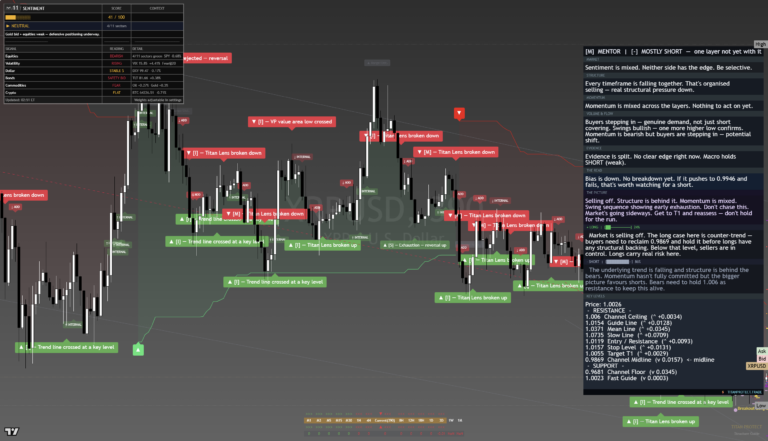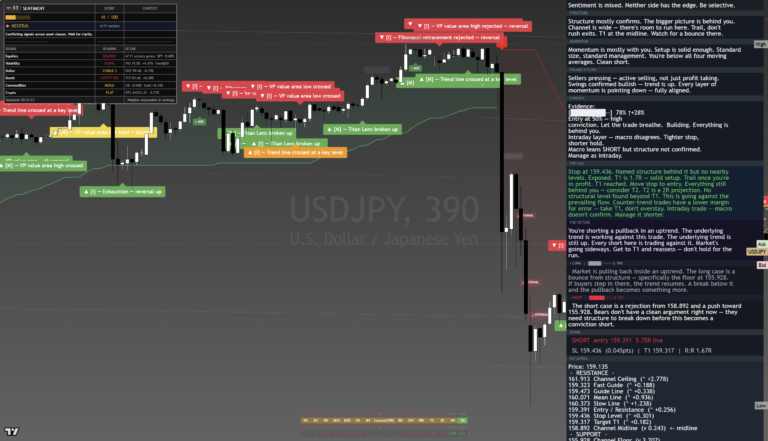
The GBPUSD Framework Journal for June 2026, newest read at the top. Each dated entry is our read on the close, kept as a living record so the framework can be judged over time. This is analysis, not financial advice.
Tuesday 30 Jun 2026
Sterling Dollar — Daily Framework Read
Tuesday 30 June 2026 • Titan Macro Desk
Saturday’s read was LONG with moderate-high confidence. The framework has shifted. Cable pulled back from the 1.2700 area and is now sitting in a contested zone. The clean structural alignment from the weekend has deteriorated. The framework panel reads no clear edge, and confidence is split across the layers. This is a material change from the weekend’s directional conviction.
The framework sees no clear edge. Structure is mixed, momentum is conflicted, and the framework panel is not aligned. This is a wait-and-watch environment until one side takes control.
Framework Interpretation
Structure
Cable has pulled back from the weekend highs and is now sitting in a structural no-man’s land. The Titan Lens has broken down on the near-term view, but the broader picture has not fully reversed. Value area high resistance is capping upside, and the trend line has turned sideways at a key level. The market is not trending cleanly in either direction right now. Momentum is mixed across the layers, and nothing is set up for a clean directional commitment.
Momentum
Confidence is split. The framework sees buyers and sellers fighting for control, and neither side has won yet. The bounce from the recent lows shows some demand, but the inability to reclaim value area highs tells us that sellers are defending overhead levels. This is classic chop territory where the framework advises patience over participation.
Volume Profile
Volume profile is showing a battleground. The value area high from recent sessions is acting as resistance, while support from the value area low is holding below. Price is sandwiched between these two reference points. Until one breaks with conviction, the profile is telling us that the market has not decided on a direction. The trend line crossing at the current level adds to the indecision.
The Call
No clear edge. The framework is not aligned, and the framework panel confirms the split. This is not a market to force a view on. Wait for a clean break above the value area high for a bullish re-engagement, or a break below recent support for a bearish shift. The worst thing you can do in a split environment is pick a side without confirmation. Let the market tell you.
Key Levels
Risk Assessment
Risk has increased materially from the weekend read. The framework is split, which means any directional bet carries higher-than-normal risk. The 58% factor reflects the lack of alignment, the contested value area, and the potential for headline-driven moves heading into month-end. Position sizing should reflect this uncertainty.
Scenario Analysis
30%
Reclaims 1.2700 value area high, buyers re-engage and push toward 1.2740. Requires dollar weakness to materialise.
40%
Chops between 1.2620-1.2700 range. Month-end flows dominate without clear direction.
25%
Breaks 1.2620 support, sellers take control, targets 1.2570 channel floor. Dollar strength resumes.
5%
BoE emergency intervention or geopolitical shock drives a gap move. Low probability but always accounted for.
Position Sizing Guidance
STANDARD
REDUCED
AVOID
Reduced sizing only. The framework is not aligned and forcing a directional bet here is poor process regardless of outcome. If you must participate, keep size small and define risk tightly. The better play is to wait for resolution.
Experience-Level Guidance
For Developing Traders
This is exactly the kind of environment where new traders get chopped up. The framework is telling you there is no edge, and the best trade is no trade. Learn to recognise this pattern. When the framework panel is split and confidence is low, the market is telling you to sit on your hands. Preservation of capital is a skill.
For Intermediate Traders
If you had a long position from the weekend read, the framework shift warrants re-evaluation. The structural alignment that supported the LONG bias has broken down. Consider tightening stops or reducing exposure. The 1.2620 level is the key inflection point. A close below it would shift the read bearish. A reclaim of 1.2700 would restore the prior bullish thesis.
For Advanced Traders
Month-end flows could create temporary dislocations that look like breakouts but reverse quickly. The DXY is showing strength, which is a headwind for Cable. If you are looking for an asymmetric setup, watch the 1.2620 level. A failure there with the dollar bid would open a clean path toward 1.2570. Alternatively, a sharp rejection of dollar strength with Cable reclaiming 1.2700 would be a counter-trend opportunity worth considering.
This content is for informational and educational purposes only. It does not constitute financial advice, a recommendation, or an offer to buy or sell any financial instrument. Trading foreign exchange carries a high level of risk and may not be suitable for all investors. Past performance is not indicative of future results. You should consider your financial situation, investment objectives, and risk tolerance before making any trading decisions. Always conduct your own research. Titan Protect and its contributors accept no liability for losses arising from the use of this material.
Sunday 28 Jun 2026
Sterling Dollar — Daily Framework Read
Sunday 28 June 2026 • Weekend Edition • Launch Read
This is the launch edition of our daily framework reads. No prior-day comparison is available. All readings reflect the current structural snapshot as of Friday’s close.
Framework Interpretation
Structure
Cable is working structurally higher. The framework identifies an upward working environment with multiple confirmation signals firing across timeframes. Price has broken above value area highs and is holding. The bigger picture is building, not decaying. Buyers have been stepping in on pullbacks with increasing conviction, and the structure reads as a market that wants higher prices into next week.
Momentum
Momentum is aligned with the structural read. The framework sees upside demand building, not just short-covering. Internal readings suggest genuine accumulation rather than a squeeze-driven move. Halfback levels are acting as a doorstep for continuation, which is typically a sign of sustained buying interest rather than reactive positioning.
Volume Profile
Volume profile confirms the directional bias. Value area highs have been crossed and retested. The acceptance above prior value areas is significant because it tells us that the market is repricing higher, not just visiting. The trend line has crossed at a key structural level, adding weight to the upside thesis.
The Call
The analysis reads structurally higher for GBP/USD heading into next week. This is not a chase, it is a structural read that says the path of least resistance is upward. The risk is defined, the direction is clear, and the alignment across timeframes supports the bias. Pullbacks into the 1.2640-1.2660 zone would represent the kind of entry the framework favours, not panic selling.
Key Levels
Risk Assessment
Risk is contained because the structural read is clean and directional. The 32% factor reflects weekend gap exposure and the proximity to value area highs where profit-taking could emerge early in the Asian session on Monday. The framework does not see reversal risk at current levels.
Scenario Analysis
45%
Continuation above 1.2740, targeting 1.2780+. Buyers remain in control, momentum carries into London open.
30%
Consolidation between 1.2660-1.2740. Market digests the move before next directional push.
20%
Pullback through 1.2660 support toward 1.2610. Would require a shift in dollar sentiment or risk-off catalyst.
5%
Weekend geopolitical shock or emergency central bank action drives a gap below 1.2570. Low probability but always accounted for.
Position Sizing Guidance
STANDARD
REDUCED
AVOID
The framework supports standard position sizing. The structural alignment is clear but not at the extreme confidence level required for maximum allocation. Weekend gap risk and proximity to resistance prevent a full-conviction call. Standard sizing with defined risk below 1.2610 is the appropriate approach.
Experience-Level Guidance
For Developing Traders
This is a clean structural read and a good example of what aligned conditions look like. The framework is not conflicted here. If you are learning to read markets, notice how the structure, momentum, and volume profile are all telling the same story. That alignment is what you want to see before committing capital. If the market pulls back to 1.2660 and holds, that is the kind of entry the framework supports. Do not chase at current levels. Wait for the market to come to your level.
For Intermediate Traders
The value area acceptance above prior highs is the key signal here. The framework is reading this as genuine repricing, not just a liquidity grab. Consider scaling into the position on a pullback to the 1.2660 zone with risk defined below the value area low at 1.2610. The reward-to-risk profile improves significantly on a dip. Weekend gap risk means you may want to wait for Sunday’s open before committing fully.
For Advanced Traders
The multi-timeframe alignment here is noteworthy. The framework sees this as a trending environment where the halfback is acting as continuation support rather than mean-reversion. The structural read suggests that any gap-down on Sunday’s open into the 1.2660-1.2680 zone would represent an asymmetric opportunity. The invalidation at 1.2610 is clean and defined. Consider the broader dollar picture, particularly the DXY read, for confluence.
This content is for informational and educational purposes only. It does not constitute financial advice, a recommendation, or an offer to buy or sell any financial instrument. Trading foreign exchange carries a high level of risk and may not be suitable for all investors. Past performance is not indicative of future results. You should consider your financial situation, investment objectives, and risk tolerance before making any trading decisions. Always conduct your own research. Titan Protect and its contributors accept no liability for losses arising from the use of this material.
Thursday 25 Jun 2026
Titan FX Desk · Daily Framework Read · Thursday 25 June 2026
GBP/USD (Cable): Short Signal Holds With 11 Conditions Matched as DXY Weakness Creates a Contradiction
Confidence: Around 56%
11 Conditions
Yesterday vs Today
| Signal | Short (Wednesday) | SHORT (Thursday) |
| Confidence | Around 55% | Around 56% |
| Shift | Short signal maintained with slightly higher confidence. The chart shows multiple trend line breaks to the downside, exhaustion at the reversal zone, and a value area high that was crossed and rejected. However, DXY weakness despite hot PCE is a fundamental contradiction: if the dollar is weakening, cable should be strengthening, yet the analysis reads short on GBP structure. | |
Daily Read
Cable presents one of the more interesting contradictions in today’s read. The framework is reading short at 56% confidence with 11 conditions matched, including multiple trend line breaks to the downside, a rejected value area high, and deteriorating momentum. But the macro backdrop says the dollar is weakening, which should be bullish for GBP/USD.
The chart shows a clear downtrend on the 390-minute timeframe. Price attempted to reclaim the value area high and was rejected, producing a reversal candle. Trend lines were crossed at key levels and exhaustion labels appeared at the bounce attempt. The structure is telling us that sterling-specific weakness is dominating the pair, not dollar direction.
This could be linked to UK-specific factors. BOE rate expectations, UK economic data, or gilt market dynamics may be weighing on sterling independently of the dollar. When a pair moves against the dominant dollar trend, it usually means the non-dollar leg has its own catalyst. The framework does not speculate on fundamentals, but the structure is unambiguous: sellers are in control of cable.
The risk is that DXY weakness eventually overwhelms GBP-specific headwinds. If the dollar continues to weaken post-PCE, cable shorts will face increasing macro headwind even if the technical structure is bearish. This is a position that needs active management and a tight invalidation level above the rejected value area high.
Key Levels
| Level | Price | Significance |
|---|---|---|
| Resistance 2 | 1.2780 | Prior swing high, signal invalidation |
| Resistance 1 | 1.2720 | Value area high rejection zone |
| Current Zone | 1.2650 – 1.2700 | Active short zone, 11 conditions matched |
| Support 1 | 1.2580 | Trend line target from the breakdown |
| Support 2 | 1.2500 | Major psychological and structural support |
Risk Assessment
Around 65%
Elevated risk due to the structural-versus-macro contradiction. The analysis reads short but DXY weakness is a headwind for that view. This divergence increases the probability of a sharp reversal if the macro theme overwhelms the technical structure. Tight risk management is essential.
What to Watch Today
- DXY direction: continued weakness makes cable shorts harder to hold
- UK-specific data or BOE commentary that could explain GBP underperformance
- Value area high at 1.2720: a clean reclaim above this invalidates the short
- EUR/GBP cross for sterling-specific weakness confirmation
This daily read is produced by the Titan FX Desk for educational and informational purposes only. It does not constitute financial advice or a recommendation to buy or sell any instrument. All levels and scenarios are analytical reference points, not trading instructions. Past performance of any level or scenario is not indicative of future results. Always apply your own risk management. Capital is at risk.
Wednesday 24 Jun 2026
Titan FX Desk · Daily Framework Read · Wednesday 24 June 2026
GBP/USD (Cable): Sterling Loses 1.340 as Dollar Reasserts Control
Yesterday vs Today
Monday 23 June: Cable was holding 1.3400 and looking resilient. We noted the pound was refusing to weaken despite a global equity selloff, suggesting sterling had genuine underlying support. The market was treating 1.340 as a key pivot, and the DXY at 101.2 was not finding the safe-haven bid you would expect in a risk-off environment.
Wednesday 24 June: That picture has shifted. The dollar has found its footing, DXY rallying 0.36% to 101.39, and cable has broken below the 1.340 reference level. The framework is now showing multiple lane breakdowns on the downside. Momentum has turned bearish and every structural layer is pointing lower. The resilience we flagged yesterday has cracked.
Daily Read
Cable at 1.3390 has failed the test we set yesterday. The 1.340 level that the market was treating as a line of demarcation has been breached to the downside, and the manner of the break matters. This was not a clean stop-run followed by a recovery. The framework is showing sustained selling pressure, with lane after lane breaking down. The structure has shifted from “holding” to “selling into”, and that is a meaningful change in character.
The driver is straightforward: the dollar is moving. DXY at 101.39 represents the dollar reassertion we flagged as the key risk scenario yesterday. The move is measured rather than panicked, gaining 0.36% in a session, which suggests this is a grinding revaluation rather than a fear-driven spike. For cable, grinding dollar strength is actually worse than a spike because spikes reverse, whereas grinding moves tend to persist and build momentum.
The value area has been violated. The framework is showing price pushing through the lower value zone, and the high that was printed early in the session was immediately sold. This is the hallmark of a market where rallies are being treated as selling opportunities rather than continuation signals. Active selling and profit-taking are the dominant behaviours at present.
From a broader perspective, this move in cable is consistent with the wider FX theme today. AUDUSD dropped 1.26% yesterday, EURUSD fell 0.71%, and USDJPY pushed higher. The dollar is gaining across the board, and sterling is not being spared. The UK-specific factors that were providing support have been overwhelmed by the broader dollar theme.
The question now is whether 1.335 holds as the next meaningful support. If it does, this could be a healthy pullback within the broader sterling uptrend. If it does not, the door opens to a deeper retracement toward 1.328 and potentially 1.320, which would represent a significant unwinding of recent pound gains.
Key Levels
| Level | Price | Significance |
|---|---|---|
| Resistance 2 | 1.3450 | Prior session high, now distant resistance |
| Resistance 1 | 1.3400 | Former pivot, now flipped to resistance on the break |
| Current Price | 1.3390 | Below the pivot, bearish posture confirmed |
| Support 1 | 1.3350 | Near-term floor, intraday low zone from recent sessions |
| Support 2 | 1.3280 | Prior consolidation base, structural support |
| Major Support | 1.3200 | Deep support, would require sustained dollar rally |
Risk Assessment
Around 55%
Risk has elevated from yesterday’s 35% reading. The break below 1.340 is a structural shift, not just noise. The dollar is moving with purpose across all major pairs. The primary risk is continuation of dollar strength forcing cable toward 1.328. The mitigating factor is that the dollar move remains measured rather than panicked, which leaves room for stabilisation if data disappoints.
Scenario Analysis
Dollar rally stalls near 101.5 on DXY. Cable finds a floor at 1.335 and begins to recover toward 1.340. The break proves to be a false one, with buyers stepping in on the dip. UK data or a shift in Fed rhetoric provides a catalyst for sterling to reclaim the pivot. Probability: lower than yesterday given the structural damage.
Dollar strength continues to build. DXY pushes through 101.5 toward 102. Cable fails to hold 1.335 and extends the selloff toward 1.328. The multi-week sterling uptrend begins to unwind in earnest. FedEx and Micron earnings from last night add to risk-off sentiment, further boosting the dollar as a haven.
Cable consolidates between 1.335 and 1.340. The market digests the break below the pivot and waits for fresh catalysts. Dollar strength is present but not accelerating. The session is characterised by range-bound trading with a mild bearish lean, and traders wait for Thursday’s data for the next directional move.
This daily read is produced by the Titan FX Desk for educational and informational purposes only. It does not constitute financial advice or a recommendation to buy or sell any instrument. Capital is at risk.
Tuesday 23 Jun 2026
Titan Macro Desk · Daily Framework Read · 23 June 2026
GBP/USD (Cable): Sterling Holds 1.340 as Dollar Stability Meets UK Resilience
Framework Read
Cable at 1.3400 is holding firm. That is the headline and it is worth thinking about carefully. In the middle of a global equity selloff, with VIX at 19.9 and risk assets taking a beating across the board, the pound is not weakening against the dollar. That tells you something: either the dollar is not finding the safe-haven flows it normally would in this type of environment, or sterling has genuine underlying support at current levels, or both.
The DXY at 101.2 is the clue. The dollar index is stable, not rallying. In a classic risk-off episode, you would expect the dollar to gain ground as capital flows to safety. The fact that it is not doing so suggests the current selloff is more of a rotation and valuation adjustment story than a genuine flight-to-safety event. That is a nuanced distinction but it matters for GBP/USD because it means the pair is not fighting a strong dollar headwind today.
The 1.340 level has now become a clear reference point. It is round, it has featured as both support and resistance in recent sessions, and the market is treating it as the line of demarcation. Above it, the recent trend of sterling appreciation remains intact. Below it, you start questioning whether the move is reversing.
For the FTSE, cable’s firmness creates a mild headwind for the multinational earners as discussed in the FTSE read. But for the broader macro picture, a stable or slightly stronger pound reflects market confidence in the UK’s relative position — which is a positive signal about the Bank of England’s credibility and the UK’s economic trajectory.
The risk to this picture comes if the global selloff intensifies and forces a broader dollar move. If VIX crosses above 22 and there is genuine panic in equities, the dollar historically reasserts itself as the global safe haven and cable would come under pressure regardless of UK domestic fundamentals.
Key Levels
| Level | Price | Significance |
|---|---|---|
| Resistance 1 | 1.3450 | Recent high zone, sellers likely active here |
| Resistance 2 | 1.3500 | Psychological round number, major overhead resistance |
| Current Price | 1.3400 | Key reference level, market treating as pivot |
| Support 1 | 1.3350 | Near-term floor, prior intraday low region |
| Support 2 | 1.3280 | Prior consolidation base, structural support zone |
| Major Support | 1.3200 | Deeper support, would require significant dollar strength to reach |
Risk Assessment
Around 35%
Lower risk environment for GBP/USD. The pair is holding a key level during a period of global stress, which is a constructive signal. The primary risk is dollar reassertion if the global selloff intensifies beyond the current rotation narrative. The US earnings triple header tonight is the next binary event to watch for dollar direction.
Scenario Analysis
1.340 holds and cable pushes toward 1.345. US earnings night is mixed to positive, reducing safe-haven dollar demand. The UK economic calendar shows no negative surprises. Cable extends toward 1.350 over the following sessions as the trend of mild sterling strength continues.
US earnings disappoint and VIX spikes above 22. The dollar reasserts itself as the global safe haven. Cable breaks below 1.340 and tests 1.328. The FTSE’s afternoon session is further pressured as sterling strength (which would be normal in non-risk-off periods) inverts into weakness that catches market participants off guard.
Cable trades in a tight 1.337 to 1.343 range through the session. Dollar stays stable at DXY 101.2. No breakout in either direction until the US session and earnings clarify the dollar’s next move. The pair drifts gently through the London afternoon with low volatility.
This framework read is produced by the Titan Macro Desk for educational and informational purposes only. It does not constitute financial advice or a recommendation to buy or sell any instrument. Capital is at risk.
Monday 22 Jun 2026
British Pound / US Dollar (GBP/USD)
Daily Read — Monday 22 June 2026
Current Price
1.3222
Daily Change
+0.20%
Thursday Close
1.3196
Session Tone
Cautious Recovery
Risk Score
Around 65%
Bias
Bearish Lean
Week Range
1.3196 – 1.3240
London Open: 08:00 BST
Tokyo Open: 09:00 JST
What Happened
Cable is trading at 1.3222 on Monday, up 0.20 percent from Thursday’s close of 1.3196. The small gain disguises a pair under genuine structural pressure. The Bank of England held rates on Thursday but the vote was 6-3, with three members of the Monetary Policy Committee voting to cut. That dissent count matters. Markets heard it as a committee that is one bad inflation print away from cutting, and sterling found no buyers willing to hold size above 1.32 into the weekend.
Warsh at the Federal Reserve reinforced a hawkish posture in the United States on Friday, which strengthened the DXY and compressed the rate differential argument that had previously supported cable. The pound needs the interest rate spread to work in its favour. Right now it is narrowing. The Bank of England’s dovish dissenters combined with a hawkish Fed is the worst possible combination for GBP/USD directional traders who were long from the 1.30 breakout in March.
Switzerland trade talks stalled over the weekend, adding a layer of European uncertainty that typically spills into sterling. When European risk sentiment deteriorates, the pound tends to underperform the euro but gets hit by the same macro headwinds. Cable’s Monday recovery to 1.3222 looks more like a positioning unwind and less like genuine bullish interest.
Macro Context: The Three Forces on Cable This Week
Three separate macro forces are pushing against sterling simultaneously this week, and understanding their relative weight is the job before placing any position.
Force one: BOE dovish shift. The 6-3 vote on Thursday confirmed that the Bank of England’s dissenters are not fringe voices. Three MPC members wanted a rate cut. That is a meaningful signal. If UK data softens even slightly through June, the 6-3 vote becomes 5-4, and 5-4 becomes 4-5 and a cut. Markets price the direction of travel, not the current level. The direction of travel for UK rates is now clearly down. Sterling cannot sustain a structural bid when its domestic central bank is moving toward easing while the Fed is not.
Force two: Warsh hawkishness. The Federal Reserve’s hawkish tone, driven by Warsh’s commentary on Friday, sent the DXY higher and reset rate expectations at the short end of the US curve. When US short rates stay elevated and UK short rates are being guided lower, the mechanically correct trade is to sell sterling against the dollar. That is not a complicated analysis. It is a rate differential play, and right now the differential is working against cable.
Force three: European uncertainty. The stalled Switzerland trade talks are a European story, but sterling is not fully insulated from European risk off. The UK’s trade relationship with Europe remains its largest economic anchor. Any sense that European political or trade cohesion is fraying tends to hit sterling harder than it hits the euro. Cable traders need to track EUR/USD alongside the pair because the correlation remains significant.
Key Levels
| Level | Price | Significance |
|---|---|---|
| Resistance 2 | 1.3320 | May swing high, bear thesis invalidation |
| Resistance 1 | 1.3280 | Monday intraday ceiling, first sellers emerge |
| Pivot | 1.3222 | Current level, hold or break decides direction |
| Support 1 | 1.3196 | Thursday close, first demand zone |
| Support 2 | 1.3140 | Weekly structure, break opens 1.30 revisit |
| Bear Target | 1.3050 | Measured move from head-and-shoulders neckline |
Strategy Tiers
| Tier | Direction | Entry | Stop | Target | R:R |
|---|---|---|---|---|---|
| Scalp | Bearish | Fade 1.3270–1.3280 | 1.3295 | 1.3210 / 1.3196 | 1:3 |
| Intraday | Bearish | Break below 1.3196 on volume | 1.3225 | 1.3140 / 1.3100 | 1:2.1 |
| Swing | Bearish | Daily close below 1.3196 | 1.3285 | 1.3050 | 1:1.6 |
| Positional | Avoid | Too much two-way central bank noise for positional trades this week | |||
Scenario Analysis
| Scenario | Probability | Trigger | Target |
|---|---|---|---|
| Bear | 45% | Daily close below 1.3196, DXY holds above 101 | 1.3050 |
| Sideways | 35% | Consolidation between 1.3196 and 1.3280 for 3–4 sessions | Range trade |
| Bull | 15% | Soft US data, DXY reversal, break above 1.3280 | 1.3320 |
| Black Swan | 5% | UK inflation shock or emergency BOE communication | 1.2900 or 1.3450 |
Position Sizing
Max
AVOID
Too directional this week
Standard
REDUCED
50% of normal size
Scalp
STANDARD
Short-duration only
Bull Case
A softer-than-expected US data print this week reverses the Warsh hawkish narrative. DXY gives back recent gains. Cable reclaims 1.3280 and the path to 1.3320 reopens. The BOE dissenters become a non-story if UK inflation stays sticky.
Bear Case
The 6-3 BOE split combines with another hawkish Fed speaker to accelerate the rate differential trade. Cable breaks 1.3196, finds no demand at 1.3140, and the next structural support is the 1.3050 zone that defined the March base. That is a 170-pip move from current levels.
Experience Level Guidance
Beginner
Cable is not the right pair to trade this week if you are still building your framework. Two central banks moving in opposite directions creates false moves and whipsaws that frustrate directional entries. Sit this one out or watch how the 1.3196 level behaves on the first test. That interaction is a textbook example of how key support works: does price bounce cleanly, consolidate, or slice through? Observe the mechanics and note the volume on each candle.
Intermediate
The intraday setup is a break-and-retest below 1.3196. Wait for a decisive hourly close below the level, watch for a return to the underside of 1.3196 as new resistance, and enter there with the stop above 1.3225. Your target is 1.3140 for the initial leg. Do not chase the break. The retest is where the trade lives. If the retest does not come and price just slides, stay out. The best setups do not require you to chase.
Advanced
The structural edge is the three-way compression: BOE dovish lean, Fed hawkish lean, European political risk. Watch the daily close carefully. A daily close below 1.3196 with DXY above 101 is a convergence signal. Size the swing entry at 50 percent, add the second 50 percent on the first pullback toward 1.3170, stop the position above 1.3240. Target the measured move at 1.3050. Hedge with an option spread at 1.3000 to capture any acceleration below structure. The BOE vote split is the tail risk catalyst if dissenters become the majority view faster than scheduled MPC dates imply.
What to Watch This Week
- UK inflation data (CPI) — if it surprises lower, the three BOE dissenters become five and cable breaks
- Fed speakers following Warsh — any pushback from doves changes the rate differential picture
- DXY behaviour above the 101 level — if DXY stalls here, cable relief rally has fuel
- 1.3196 on a daily close basis — this is the line between consolidation and a genuine trend break
- EUR/USD direction as a proxy for European sentiment and cable correlation
- Switzerland-EU trade headline risk — negative developments weigh on all European currencies
Risk Assessment
Elevated. Around 65% risk environment. The BOE vote split is the primary source of uncertainty. A 6-3 MPC result that shifts to 5-4 on the next meeting could come with significant volatility in sterling across all pairs. Add the Warsh hawkish tone at the Fed and the Switzerland European uncertainty, and there are three separate tail risks all pointing against pound longs. Keep size small, keep stops hard, and respect the key levels.
Titan Macro Desk — FX Coverage
This content is for informational purposes only and does not constitute financial advice. Past performance is not indicative of future results. Trading involves risk of loss. Always conduct your own research before making any investment decisions.
Thursday 18 Jun 2026
GBP/USD (Cable) — Daily Framework Read | Thursday 18 June 2026
Titan Macro Desk | Daily Framework Read
Cable closed Thursday at 1.3196, down 1.72 percent. The Bank of England held rates as expected but the guidance was dovish enough to detonate the pound. Yesterday’s FOMC hawkish hold added fuel to the dollar side. Two central bank decisions in 48 hours, both dollar-positive. Tomorrow is OpEx Friday. This is not a quiet end to the week.
Where It Sits
GBP/USD (Cable) is the most-traded sterling pair in the world, reflecting the exchange rate between the British pound and the US dollar. It is sensitive to UK macro data, Bank of England policy, and the broader dollar index. When risk appetite falls and the dollar firms simultaneously, cable gets hit from both sides at once. That is exactly what happened across Wednesday and Thursday this week.
Thursday’s close at 1.3196 represents a clean two-day sell-off of approximately 240 pips from Tuesday’s reading near 1.3415. The structure on the chart shows price working lower through multiple layers, with selling pressure concentrated and consistent. There has been no meaningful bounce attempt. The analysis reads bearish. Structure is behind price, not supporting it.
The chart on both today and yesterday shows the framework registering consistent downside signals. Multiple trend line crossings to the downside were flagged. Value area levels were broken. The shorter time frame was selling, the broader lens confirmed. Everything pointed the same direction: lower.
Yesterday vs Today: Two Sessions, One Direction
Wednesday 17 June: Cable closed at 1.3271, down 1.08 percent on the day. The FOMC delivered a hawkish hold, keeping rates steady but signalling no urgency to cut. Powell’s tone reinforced the view that the Fed is comfortable waiting. Dollar bulls took the greenlight. Cable fell roughly 145 pips on the session. The chart from Wednesday showed the framework beginning to align bearish, with trend line breaks appearing across the structure and value areas starting to lose support.
Thursday 18 June: The Bank of England held rates at its scheduled meeting. On the surface that sounds neutral. But the MPC vote split and the statement language carried a softer tone than the market had priced in. Several members voted for a cut. Governor Bailey’s communication leaned dovish. The market heard “cuts are coming.” Sterling got sold immediately and decisively. Cable dropped a further 1.72 percent to 1.3196 on the session. The chart from today shows full structural breakdown, with the framework now completely aligned to the downside across all visible lenses. Multiple sell signals registered simultaneously. There was no ambiguity in the read.
Combining the two sessions: Cable has shed approximately 2.8 percent from its recent highs in under 48 hours. That is a significant move for a major FX pair and reflects coordinated fundamental pressure rather than a technical sell-off that fades quickly.
| Session | Close | Move | Driver |
|---|---|---|---|
| Wednesday 17 Jun | 1.3271 | -1.08% | FOMC hawkish hold, dollar bid |
| Thursday 18 Jun | 1.3196 | -1.72% | BOE dovish hold, cable crushed |
| Two-day combined | 1.3196 | -2.80% approx | Twin central bank divergence |
Key Levels
Resistance: 1.3271 to 1.3290. Wednesday’s close and the area where the sell-off accelerated on Thursday. Any bounce that fails here confirms the bearish continuation. This zone now acts as supply. A daily close back above 1.3300 would challenge the short bias but would need a fundamental catalyst to achieve it.
Pivot: 1.3200. The round number that cable just breached on Thursday’s close. Thursday’s close at 1.3196 is barely below it. Holding below 1.3200 into Friday confirms the breakdown. A reclaim of 1.3200 on volume would suggest some short-covering into OpEx Friday, but not a reversal of the trend.
Support: 1.3100 to 1.3120. The next meaningful level below current price. This is where the prior consolidation base sits and where longer-term structural buyers would be expected. A move to this zone on Friday or early next week is the base case for the continuation trade.
Deeper support: 1.2980 to 1.3000. The round number below that and where the structural floor from the prior multi-week range sits. A break below 1.3100 opens this zone for a measured move target over the following week.
Long Bias Setup
Counter-Trend Long: Structural Support Bounce From 1.3100 to 1.3120
Risk score: around 75%. This is a counter-trend trade against the dominant bias.
Entry: 1.3100 to 1.3120 on a wick rejection with a reversal candle showing. Stop: 1.3060 (below structural support and the prior base). Target one: 1.3200. Target two: 1.3270. Risk to reward: roughly 1:2 to first target, 1:3.4 to second target.
Why it could work: After a two-day 280-pip sell-off, a short-covering bounce into a recognised structural level is technically valid. OpEx Friday can produce mechanical flows that temporarily reverse intraday direction. The trade only works as a bounce play, not a trend reversal. Kill condition: daily close below 1.3060. That opens the door to 1.2980 without any structural floor.
Short Bias Setup
Continuation Short: Sell the Bounce Into 1.3200 to 1.3270
Risk score: around 55%. This is the base case trade that aligns with the structural read.
Entry: 1.3200 to 1.3270 on any intraday bounce that rolls over. Look for a rejection candle at the supply zone, ideally with a wick into the zone and a close back below. Stop: 1.3310 (above the supply cluster and above Wednesday’s close). Target one: 1.3100. Target two: 1.2980. Risk to reward: roughly 1:1.8 to first target, 1:3.5 to second target.
Why it works: The framework is fully aligned bearish. Central bank divergence is the dominant narrative and it does not resolve in one or two sessions. The Fed is holding tight. The BOE is signalling cuts. That spread widens dollar strength against sterling over days and weeks, not hours. Every bounce into resistance is a gift to the continuation trade. Kill condition: two consecutive daily closes above 1.3310 on genuine buying volume.
Time Horizons
Intraday (zero to one day): Friday is OpEx. That introduces mechanical flows and can produce sharp intraday reversals that mean nothing structurally. The 1.3200 pivot dominates Friday’s session. A European open above 1.3200 keeps short-covering alive into London fix. Below 1.3200 on the Asian open puts 1.3140 then 1.3100 in play before New York arrives. Do not hold overnight positions through OpEx without a clear structural read on the new candle.
Swing (two to ten days): The bearish case is the base case. Central bank divergence takes weeks to fully price into a currency pair, not hours. The route lower toward 1.3000 to 1.3100 plays out over the next one to three weeks if the macro environment holds. Any UK data that reinforces the BOE’s dovish lean accelerates it. Any US data that weakens the dollar case buys cable time but does not change the structural direction.
Positional (two to eight weeks): The BOE cutting cycle has begun in spirit, even if the formal cut has not yet landed. If the next MPC meeting delivers an actual rate reduction, cable faces a further leg down. The positional bearish case targets the 1.2800 to 1.2900 range on a sustained divergence trade. A monthly close above 1.3400 would be required to invalidate the positional bearish read.
Risk Score
Cable risk score: around 70 percent.
- Plus 25 percent for OpEx Friday: mechanical flows introduce unpredictability. Gamma unwind and options expiry can spike cable in either direction without any macro reason.
- Plus 20 percent for two consecutive central bank events in 48 hours, both dollar-positive. The speed of the move creates elevated short-term volatility even within a clear directional trend.
- Plus 15 percent for the 1.3200 level: cable closed barely below it at 1.3196. A break back above or a hold below is the binary decision that opens the next 100-pip move.
- Plus 10 percent for residual BOE communication risk if any MPC member speaks on Friday and contradicts Bailey’s dovish lean.
- Minus 10 percent because the structural framework is fully aligned. There is no ambiguity in the direction. The risk is timing and execution, not the call itself.
OpEx Friday is the wildcard. Respect the levels. Let price confirm before committing.
Scenarios for Friday and Next Week
| Scenario | Trigger | Target | Probability |
|---|---|---|---|
| Continuation lower | Hold below 1.3200. OpEx Friday quiet. Dollar holds firm. | 1.3100 then 1.2980 | 45% |
| OpEx bounce then resume | Friday short-covering to 1.3240 to 1.3270. Supply holds. Sell-off resumes Monday. | Bounce fades, 1.3100 next week | 35% |
| Reversal recovery | Strong UK data or dollar reversal. Cable reclaims 1.3300 with volume. | 1.3350 to 1.3400 | 20% |
Position Sizing
Cable is moving in large daily ranges right now. The 170-pip Thursday session alone is material for standard sizing. On the continuation short from 1.3240 with a stop at 1.3310, the stop distance is 70 pips. For a one percent account risk, size so that 70 pips equals one percent of capital. On a ten thousand dollar account that means position size allows for a maximum loss of one hundred dollars on a 70-pip stop, which translates to roughly 0.14 lots. Scale down further for OpEx Friday where the bid-ask spread widens and slippage is more common around the fix.
For the counter-trend bounce from 1.3100, half sizing only. Counter-trend trades into a bearish structural read carry higher inherent risk. The setup only makes sense if the structural level produces a confirmed reversal candle with clear rejection. If in doubt, pass. The continuation short is the higher-probability trade.
The Macro Context That Owns This Pair Right Now
The BOE and the Fed have diverged. That is the sentence that runs this trade for the next four to eight weeks. The Fed is holding rates at restrictive levels and signalling patience. The BOE has a split MPC and a governor who sounds like cuts are a matter of when, not if. Rate differentials drive FX pairs over time. When one central bank is hawkish and one is leaning dovish, the hawkish currency wins. The dollar wins this argument right now.
The recovery day context makes this more interesting. Equities are bouncing and the dollar is strengthening simultaneously. That is not the usual combination. Normally a stronger dollar goes with risk-off and equity weakness. When you get dollar strength alongside equity recovery, it reflects genuine confidence in the US rate path rather than a flight to safety. That is a more sustained dollar bid than a panic-driven one.
Cable trades at 1.3196. The next act depends on whether OpEx Friday produces a real bounce or just a blip. Either way, the structural direction is clear. Sell bounces. Respect the kill conditions. Let the framework confirm before sizing up.
This is analysis, not financial advice. Always manage your risk.
Thursday 18 Jun 2026
Titan Macro Desk · Daily Framework Read
GBP/USD — Daily Framework Read
Thursday 18 June 2026 · Closing Data
Framework Read
GBP/USD dropped 0.83% to 1.3315 after the Bank of England held rates at 3.75%. That is a significant one-day move for a G10 currency pair, and it tells you the market had been positioned for — or at least speculating about — a dovish shift that did not materialise. When a central bank holds and the currency falls, it means the market was pricing in either a cut or a significantly more dovish tone in the forward guidance. Neither came.
The BOE’s hold at 3.75% is not a surprise in isolation — it was the consensus expectation. What moves currency markets is the tone around the decision: the split in the MPC vote, the language around future meetings, and the projections for inflation and growth. A narrow vote to hold (say 5-4 rather than 8-1) with dovish language is very different from a decisive hold with hawkish forward guidance. The 0.83% sterling decline suggests the communication leaned more hawkish or the market had been leaning on a dovish surprise that was not delivered.
The dollar side of the equation also matters. The DXY is above 100.40 — a notable level that represents dollar strength broadly. GBP/USD’s decline is partly sterling weakness and partly dollar strength operating simultaneously. When both forces push in the same direction, the move is amplified. The FOMC’s hawkish hold on Wednesday has repriced the interest rate differential between USD and GBP — and that differential now favours holding dollars over sterling at the margin.
The interest rate differential is the fundamental anchor for GBP/USD. With the Fed holding at a higher terminal rate than previously expected and the BOE holding at 3.75%, the spread between US and UK rates is the key variable. If the market comes to believe the Fed will cut before the BOE — or that the BOE will cut more aggressively — sterling would regain ground. For now, the held-rate environment provides no catalyst for sterling appreciation.
Wednesday vs Thursday
| Metric | Wednesday | Thursday | Read |
|---|---|---|---|
| GBP/USD | ~1.342 est. | 1.3315 | -0.83% |
| BOE event | Pre-decision | Held 3.75% | Dovish hope dashed |
| DXY | ~99.8 est. | 100.40+ | Dollar strength adding pressure |
| USD rate outlook | Hold | Higher for longer | GBP headwind |
Key Levels
| Level | GBP/USD | Significance |
|---|---|---|
| Resistance 1 | 1.3400 | Pre-BOE level — now supply overhead |
| Resistance 2 | 1.3480 | Range high — needs fundamental shift to reclaim |
| Current Close | 1.3315 | Post-BOE hold settlement |
| Support 1 | 1.3250 | Near-term floor — watch for stabilisation |
| Support 2 | 1.3100 | Structural support — break signals GBP deterioration |
Bias & What to Watch
Bias: Bearish Sterling Short-Term
BOE held and did not provide the dovish signal market participants were leaning on. Dollar strength adds to the headwind. The 1.3300 level is the immediate test — a break below opens 1.3100 as the next meaningful support.
The next catalyst for GBP/USD is UK inflation data and labour market figures. If UK CPI continues to fall towards the BOE’s 2% target, the market will start pricing a July or August cut — and sterling could find support on that repricing. Conversely, any upside inflation surprise would push rate cut expectations further out, extending the current sterling weakness.
The broader risk: if global risk sentiment deteriorates — VIX spikes again, equities sell off — GBP/USD will come under additional pressure as dollar safe-haven demand kicks in. Sterling is not a safe-haven currency in the way that USD, JPY, or CHF are. In risk-off environments, GBP tends to underperform. With VIX at 16.73 (improving but not fully benign), watch for any renewed equity stress as the trigger for sterling to test lower.
This framework read is produced by the Titan Macro Desk for informational and educational purposes only. It does not constitute financial advice, a personal recommendation, or an inducement to trade. Markets can move against any bias. Past performance and analytical frameworks are not guarantees of future results. Always apply your own risk management. Capital is at risk.
Wednesday 17 Jun 2026
Titan Macro Desk · Post-Close · Wednesday 17 June 2026
GBP/USD — FOMC Day Framework Read
Cable took a 1.08% hit today. BOE tomorrow is the defining moment.
Context: GBP/USD (Cable) saw its largest single-day drop since early 2026 today, down 1.08% to 1.3300. The driver is almost entirely the dollar side — the FOMC hawkish hold pushed DXY to 100.40. Sterling’s own fundamentals did not deteriorate today. That distinction matters for how we position into the BOE decision.
Our Framework Read
Bias
Bearish Short-Term
Primary Driver
USD Strength
Pivot Risk
BOE Hawkish
When Cable drops 1.08% in a session, the first question is: is this a sterling problem or a dollar problem? Today it was almost entirely a dollar problem. US data is not giving the Fed room to pivot. The market knows it. Dollar bought up across the board.
Sterling at 1.3300 is at an important psychological level. The 1.32 zone is a meaningful multi-month support area. If the BOE tomorrow delivers a hawkish hold or surprise — either matching or exceeding the Fed’s tone — sterling could recover some ground. The interest rate differential between GBP and USD would compress, which is a mild positive for Cable.
Conversely, if the BOE cuts tomorrow, or signals a more dovish path than the Fed, that rate differential widens in the dollar’s favour. Cable would likely accelerate lower, potentially testing 1.29 or 1.30 before finding genuine support.
The 1.3300 level tonight is not one to treat as support until the BOE verdict is in. The pre-announcement period is a dangerous time to be positioned in either direction without conviction on the BOE outcome. Our framework keeps us cautious and neutral ahead of the decision.
Key Levels
| Level | Price | Context |
|---|---|---|
| Support S1 | 1.3200 | Key psychological level, prior structural base |
| Support S2 | 1.3050 | Major multi-month support, high-volume zone |
| Resistance R1 | 1.3450 | Pre-FOMC high, now overhead supply |
| Resistance R2 | 1.3600 | Would require DXY reversal and hawkish BOE |
BOE Scenarios for GBP/USD
BOE Holds / Hawkish — Cable could recover to 1.34+
Rate differential stays compressed. Sterling gets relief. 1.3300 becomes support again.
BOE Cuts — Cable tests 1.30
Differential widens, dollar wins the cross. Acceleration lower likely. 1.3050 becomes the key test.
Risk Assessment
Around 58% risk
Elevated heading into the BOE. The dollar backdrop is bearish for Cable. BOE decision tomorrow is the critical variable. Two-way risk around the announcement — which means asymmetric opportunity if you can read the BOE outcome in advance of the market.
This post is produced by the Titan Macro Desk for informational and educational purposes only. Nothing here constitutes financial advice. Capital is at risk.
Wednesday 17 Jun 2026
Titan Macro Desk · Post-Close · 16 June 2026
GBP/USD — Daily Framework Read
Tuesday 16 June 2026 | FOMC Eve
Session Summary
Current Rate
1.3399
Character
GBP SOFT
Framework
WATCHING
Framework Read
Bias
BEARISH GBP
Framework State
WATCHING
Key Catalyst
FOMC TOMORROW
BOE Stance
CAUTIOUS DOVISH
Our Read
GBPUSD at 1.3399 tells a simple story: sterling is soft. It’s not collapsing, but it is drifting lower. The pound has been unable to hold above 1.35 despite dollar weakness in recent weeks, which suggests the selling is partly GBP-specific rather than purely dollar-driven.
The Bank of England is in a difficult position. UK inflation has been stickier than desired, but growth is weak. The BoE is caught between a labour market that has cooled and services inflation that hasn’t. That ambiguity is not bullish for sterling — markets like clarity, and the BoE is currently offering the opposite.
The FOMC decision tomorrow is the dominant driver. A hawkish Fed would strengthen the dollar across the board, pushing GBPUSD lower from 1.3399 toward 1.3300 or potentially 1.3200. A dovish surprise would relieve dollar pressure and allow cable to recover toward 1.3500. The range for tomorrow’s move is likely 100-150 pips in either direction.
Watch the 1.3350 level as the immediate support. If that cracks on a hawkish Fed, the next meaningful level is 1.3200. On the upside, 1.3450 is the first hurdle, then 1.3500 is the key level that would signal a bullish reversal of the current softness.
Our framework is WATCHING. GBPUSD is a clean FOMC derivative trade with clear levels in both directions.
Key Levels
| Level | Rate | Significance |
|---|---|---|
| Resistance | 1.3500 | Key resistance — bullish reversal target |
| Resistance | 1.3450 | First overhead hurdle |
| Current | 1.3399 | Session close — GBP soft |
| Support | 1.3350 | Immediate support — watch on hawkish Fed |
| Support | 1.3200 | Deeper support if 1.3350 breaks |
Post-FOMC Scenarios
Dovish Fed (GBP Bullish)
Dollar sells off. GBPUSD recovers toward 1.3450-1.3500. Relief for cable bulls. Watch BoE commentary for follow-through.
Hawkish Fed (GBP Bearish)
Dollar strengthens. GBPUSD breaks 1.3350 and tests 1.3200. BoE dovish lean compounds sterling weakness.
Risk Assessment
Around 60%
- FOMC binary creates 100-150 pip potential move
- GBP already soft — downside asymmetry on hawkish surprise
- BoE ambiguity compounds currency weakness
- UK growth data remains sluggish
This framework read is produced by the Titan Macro Desk for analytical and educational purposes only. It does not constitute financial advice or a recommendation to buy or sell any instrument. All market analysis involves uncertainty. Past framework accuracy does not guarantee future performance. Conduct your own research and consult a qualified financial adviser before making investment decisions. Capital is at risk.
Tuesday 16 Jun 2026
Titan Macro Desk · Tuesday 16 June 2026
GBP/USD — Daily Framework Read
Sterling under quiet pressure as the dollar firms ahead of Wednesday’s FOMC decision. The pair is soft despite a reasonably constructive global risk backdrop — that divergence is the story today.
Live Snapshot · 390-Minute Timeframe
Last Price
1.3399
Session Change
-0.38%
Timeframe
390m
Bias
Cautious
Our Read
Sterling is doing something a little odd today. Global equities are firm — NAS100 is up over 3% — and that sort of risk environment usually puts a bid under cable. Instead, GBP/USD has drifted lower by nearly 0.4%. That tells you the weakness is pound-specific, not just a dollar story.
On the 390-minute view, the pair has been grinding within a compression zone roughly between 1.3340 and 1.3480 for the past several sessions. The current print at 1.3399 puts us in the lower half of that range. There is no clean directional momentum here — what we have is a market waiting for a catalyst, and that catalyst arrives Wednesday afternoon with the FOMC decision.
The pound has its own domestic pressures. UK wage growth remains sticky and the Bank of England is in no rush, but markets are watching whether the BOE can hold the line as global central banks navigate very different paths. The Fed is expected to hold on Wednesday, but the language around the path of cuts — or lack of them — will drive DXY, and DXY drives cable more than anything else in the near term.
If the Fed signals patience and the dollar firms into Thursday, the 1.3340 zone becomes the key level to watch. A clean break there opens the door to 1.3280. On the upside, 1.3480 has been the ceiling — it would take a dovish Fed surprise or a strong UK data beat to push through.
The Iran deal narrative is worth noting as a cross-asset read. If Thursday’s Iran headlines turn constructive, risk broadly improves, which could give cable a modest tailwind — but that is a secondary driver, not the primary one. FOMC direction is the event that matters this week.
Key Levels
| Level | Price | Significance |
|---|---|---|
| Upper Range | 1.3480 | Compression ceiling — multiple rejections. Breakout needs a catalyst. |
| Near Resistance | 1.3440 | Intraday supply zone. Sellers appeared here in the last two sessions. |
| Current Price | 1.3399 | Mid-range, biased lower. No momentum confirmation in either direction. |
| Near Support | 1.3340 | Lower range boundary. Failure here accelerates the move lower. |
| Downside Target | 1.3280 | Next structural support if 1.3340 gives way. FOMC hawkish scenario. |
| Extended Downside | 1.3200 | Major support zone. Would require significant dollar strength to reach. |
Risk Assessment
Around 55% — Moderate
Risk is elevated but not extreme. The primary driver is FOMC uncertainty — markets are not fully priced for either a hawkish or dovish outcome, which keeps the pair in suspension.
Factors Weighing Down
- Pre-FOMC dollar firmness
- Pound underperforming peers
- Range compression — breakout risk
Factors Supporting
- Global risk-on backdrop
- Structural 1.3340 support intact
- No UK-specific negative catalyst
Cross-Reference
DXY (Dollar Index)
DXY is range-bound but holding its footing ahead of FOMC. Any upside surprise there feeds directly into cable weakness.
EUR/GBP
EUR/GBP is edging higher — the euro is holding better than sterling, which confirms this is a pound-specific softness today.
NAS100
NAS +3.06% is the context. Risk is clearly on, which makes cable’s softness more notable — this is a relative pound story.
VIX at 16.2 confirms a low-fear environment. Cable weakness is not a macro panic — it is pre-event positioning ahead of Wednesday.
Scenarios to Watch
Bullish Scenario — Dovish Fed Wednesday
Fed signals openness to cuts. DXY retreats. Cable recovers through 1.3440 and targets 1.3480 and beyond. Risk appetite adds momentum. Monitor the press conference language closely.
Bearish Scenario — Hawkish Fed / Higher for Longer
Fed doubles down on patience. Dollar firms. Cable breaks 1.3340 and tests 1.3280. If UK data disappoints simultaneously, the move extends to 1.3200. A clean break of the range low is the tell.
This post is produced by the Titan Macro Desk for informational and educational purposes only. It does not constitute financial advice. Framework reads represent our analytical view at the time of writing and may change without notice. All trading carries risk. Past performance is not indicative of future results. Please ensure you understand the risks involved before making any trading decisions.
Titan Macro Desk · Alpha Insights · 16 June 2026
Friday 12 Jun 2026
Daily Ticker Read | Friday 12 June 2026
Sterling (GBP/USD) : Pullback in a Downtrend, and the Trend Is Not Done
GBP/USD | Spot FX | Friday 12 June 2026
The Iran de-escalation has been the dominant macro theme this week, driving risk-on flows and pressuring the dollar across the board. GBP/USD has been a beneficiary of that weaker-dollar environment, but the bounce is running into structural resistance. The CPI print at 4.2% has complicated the rate picture, and the analysis panel is telling us this is a pullback in a downtrend rather than a genuine reversal.
The Read
| Direction | BEARISH LEAN |
| Conviction | Medium |
| Risk Assessment | Around 55% — downtrend structure intact, but risk-on is providing counterflow |
| Estimated Price | ~1.2590 |
| Bias | Bearish — pullback is a selling opportunity, not a trend change |
Yesterday vs Today
Thursday 11 June
Sentiment was mixed. The bigger picture pointed to pullback within a broader selloff, but short-term momentum was probing to the upside. The framework flagged active selling and profit-taking into any strength. Multiple Titan Lane breakdowns were confirmed, with structure behaving in a predictable downtrend pattern. Price was bouncing but without conviction.
Friday 12 June
Everything aligns to the downside. The analysis reads tightness across layers with the dollar still holding an edge despite risk-on flows. Momentum is grinding lower, not impulsively but persistently. The bigger picture remains down, and the short-term bounce has stalled at resistance. Titan Lane breakdowns continue to stack on the chart. The best trade is to sell the bounce, not chase the dip.
What We See
Structure: The chart shows a clear downtrend with multiple Titan Lane breakdown markers stacking across the timeframe. The pattern is consistent with a controlled selloff rather than a panic move. Price is pulling back into an area where prior support has become resistance, and the framework identifies this as a high-probability selling zone. Value area highs are being respected as ceilings.
Momentum: Pressure is genuinely to the downside. The framework is reading momentum as grinding lower with nothing to suggest a reversal. The risk-on environment from Iran de-escalation has slowed the pace of the decline but has not changed its direction. That is an important distinction. Slower bearish is still bearish.
Volume Flow: Nothing firm is building on the buy side. The analysis panel notes that the best trade is to sell the bounce. When the framework tells you that rallies are selling opportunities rather than trend changes, that is a clear read on where the smart flow is sitting. Sellers are active at the upper edge of the range.
The Call: Bearish lean with medium conviction. The pullback is a downtrend feature, not a breakout signal. The Iran de-escalation rally in equities has given sterling a temporary bid, but the structural picture has not changed. If you are looking for a short entry, this bounce toward resistance is giving you one. The framework is clear: sell the pullback.
Key Levels
| Level | Price | Significance |
|---|---|---|
| Resistance 2 | 1.2680 | Prior breakdown origin — thesis invalidation on close above |
| Resistance 1 | 1.2640 | Value area high — primary sell zone on bounces |
| Current | ~1.2590 | Mid-range pullback within downtrend |
| Support 1 | 1.2530 | Recent session low — first downside target |
| Support 2 | 1.2450 | Weekly structural floor — extended target |
Risk Assessment
Around 55% — The downtrend structure is intact and the framework is clear on direction, but the risk-on environment from Iran de-escalation is providing counterflow that could extend the bounce before the trend resumes. BoE rate expectations and the 4.2% CPI add complexity. The risk is not that the trend changes — it is that the bounce extends further before sellers reassert. Weekend positioning risk adds to the caution. The short thesis is valid but timing requires patience.
Related Alpha Insights
Today’s FX Focus brief covers the full GBP structural analysis alongside the DXY pressure from risk-on flows. The Positioning brief tracks institutional flow across major FX pairs. See the Dollar Index read for the inverse view on dollar weakness driving this pair.
This content is for informational and educational purposes only. It does not constitute financial advice, a recommendation, or an invitation to trade. All trading involves risk, including the potential loss of principal. Past performance does not guarantee future results. Always conduct your own research and consult a licensed financial adviser before making investment decisions. Alpha Insights is a research publication, not a regulated advisory service.
Friday 5 Jun 2026
GBP/USD (Cable) — Daily Read | Friday 5 June 2026
Titan Protect Alpha Insights | Rates Repricing Day | analysis as of pre-market 5 June 2026
Market Context
Cable experienced a sharp decline on Friday as the hot US Non-Farm Payrolls print reignited dollar demand across the board. GBP/USD fell decisively as the market repriced Federal Reserve rate-cut expectations significantly lower, driving the DXY higher and pushing all dollar pairs in favour of the greenback.
The Bank of England’s own policy trajectory adds a layer of complexity. The BOE has been more cautious than the ECB in signalling rate cuts, and UK inflation data has been stickier than hoped. This dual-hawk dynamic between the Fed and BOE creates a tighter convergence in monetary policy outlooks than the market had been pricing, which limits the magnitude of GBP weakness relative to other pairs. However, the direction is firmly dollar-positive for now.
UK risk appetite also deteriorated in sympathy with global equities, which adds a mild additional headwind to sterling as a risk-correlated currency. The pair’s reaction to the US jobs data was immediate and sustained, with only a partial retracement into the close.
Dollar demand is the dominant driver. Cable likely to remain under pressure until Fed rate-cut expectations recover or UK data surprises to the upside.
Key Levels
| Level | Price | Significance |
|---|---|---|
| Resistance 2 | 1.2920 | Pre-NFP high and prior weekly resistance |
| Resistance 1 | 1.2810 | Intraday recovery ceiling and 20-day average |
| Close / Pivot | 1.2720 | Friday settlement |
| Support 1 | 1.2640 | May structural support |
| Support 2 | 1.2530 | Major demand zone — breach opens path to 1.24 handle |
Weekend Setup
Cable closes the week in a technically fragile position, sitting near important support at 1.2640. A break below this level on Monday would confirm that the NFP-driven dollar strength is extending and target the 1.2530 zone. Absent any weekend commentary from BOE officials or US Fed speakers, the pair is likely to open close to Friday’s close.
UK economic data next week — particularly any inflation or labour market reads — will be critical for determining whether sterling can stabilise. A softer UK reading on top of the dollar strength story would amplify the downside.
Risk Note: FX weekend gaps in major pairs are typically small but can be larger following significant macro events. The NFP story may continue to drive positioning adjustments when Asian markets open Sunday evening. Liquidity in cable is thinner in Asian hours.
This content is for informational and educational purposes only. It does not constitute financial advice, a personal recommendation, or a solicitation to buy or sell any financial instrument. Past performance is not a reliable indicator of future results. Trading involves significant risk of loss. Always conduct your own research and consult a qualified financial adviser before making investment decisions. Titan Protect Alpha Insights is not authorised or regulated by the Financial Conduct Authority.
Friday 5 Jun 2026
GBP/USD — Daily Read | Thursday 4 June 2026
Published: Thursday 4 June 2026 | Titan Protect Alpha Insights
Sterling is holding constructively above the 1.34 level, supported by a broadly weak US dollar. The DXY has fallen below 100, which provides a structural tailwind for GBP/USD. The pair has been in a recovery mode from last year’s lows and is now testing whether it can sustain gains above 1.34 ahead of a potentially volatile NFP release.
What the Analysis Shows
GBP/USD above 1.34 is a meaningful level. The Bank of England has been more cautious than the Federal Reserve in signalling rate cuts, which keeps UK yields relatively attractive compared to US equivalents in the current environment. When dollar weakness combines with a credible UK rate story, sterling tends to find support.
The pair’s structure looks constructive. Support has held on recent dips and the broader dollar weakness trend is the dominant force in the background. UK economic data has been mixed but not dire, which is enough to keep the BoE on hold longer than the Fed in market pricing.
Bias: Bullish while above 1.34. The near-term trend favours the upside as long as dollar weakness persists. NFP tomorrow is the risk event. A strong jobs print would strengthen the dollar and could quickly push GBP/USD back toward 1.33 support.
Key Levels
| Level | Price | Significance |
|---|---|---|
| Support 1 | 1.3400 | Key psychological and technical level |
| Support 2 | 1.3340 | Prior consolidation base |
| Resistance 1 | 1.3480 | Near-term supply zone |
| Resistance 2 | 1.3550 | Medium-term target on continuation |
Tomorrow’s Setup
NFP is everything for GBP/USD on Friday. A soft number extends the dollar weakness trade and keeps GBP/USD constructive above 1.34. A strong beat risks a sharp reversal. The 1.3400 level is the line in the sand: hold above it and the bullish case remains intact.
Risk Note: NFP creates genuine binary risk for GBP/USD. The pair can move 80-120 pips in the immediate aftermath of a major jobs surprise. Position sizing around NFP releases warrants careful risk management.
This analysis is for informational purposes only and does not constitute financial advice. Markets involve risk. Past performance is not indicative of future results. Always conduct your own due diligence before making any investment decisions.
Thursday 4 Jun 2026
British Pound / US Dollar (GBP/USD)
Daily Read — Wednesday 3 June 2026
Current Price
1.3400
Daily Change
-0.30%
What Happened Today
Sterling gave back ground against the dollar as the DXY found its footing following the ISM-triggered market moves. Cable dropped 0.30% to trade at 1.3400, a level that represents a meaningful psychological support zone. The move was orderly rather than aggressive, reflecting the DXY bid rather than any specific sterling weakness.
The Bank of England remains on hold and the UK data calendar is light this week, meaning GBP/USD is almost entirely a dollar story right now. The DXY’s 0.31% gain pulled cable lower in a near-mechanical fashion. The 1.34 handle has held on the daily close, which is meaningful for the near-term technical picture.
Friday’s NFP will be the decisive event. A strong US jobs number reinforces dollar strength and threatens the 1.3400 support. A weak number could see cable recover towards 1.35+.
Key Levels
| Level | Price | Significance |
|---|---|---|
| Resistance | 1.3520 | Recent swing high |
| Pivot | 1.3400 | Current close / round number |
| Support 1 | 1.3340 | Weekly demand zone |
| Support 2 | 1.3240 | Monthly base |
Current Bias
Dollar demand is the dominant driver. As long as the DXY holds its bid, cable faces headwinds. Watch 1.3340 as the next meaningful downside level.
What to Watch Tomorrow
- DXY direction is the primary driver — cable is essentially inverse DXY right now
- Any UK economic data releases
- 1.3400 hold is critical for near-term structure
- Friday NFP is the week-defining event for this pair
Risk Assessment
Moderate to elevated. Around 55% risk environment. NFP positioning risk increases through Thursday.
This content is for informational purposes only and does not constitute financial advice. Past performance is not indicative of future results. Trading involves risk of loss. Always conduct your own research before making any investment decisions.
Tuesday 2 Jun 2026
Ethereum (ETH/USD) — Daily Framework Read | Tuesday 2 June 2026
Ethereum (ETH/USD) | Post Close Setup Daily Read | Data basis: 2026-06-02 close
Where It Sits
Structure
Structurally Ethereum (ETH/USD) has pulled back into the session close. The broader trend remains intact on the daily timeframe but the shorter timeframe has softened. The structure is contested near the 1,896.20 level.
Momentum
Momentum is firm with the daily timeframe showing clear acceleration. Internal readings sit in the upper portion of the range. The risk is not that momentum fails but that it stalls at round-number resistance and triggers profit-taking.
Volume & Flow
Flow on the session close was measured. Positioning data suggests steady accumulation rather than aggressive directional commitment. The pattern supports continuation rather than reversal.
Key Levels
| Level | Type | Significance | Action Zone |
|---|---|---|---|
| 2,071 | Resistance | Upper range target, prior supply zone | Take profits / fade if rejected |
| 1,954 | Pivot | Mid-range continuation marker | Hold = constructive; lose = consolidation |
| 1,896 | Session close | Reference anchor for next session | Above = continuation; below = mean revert |
| 1,803 | Support | Recent range floor, demand zone | Buy zone with defined stop |
| 1,687 | Major support | Prior breakout retest level | Stop-out below for longs |
Three Scenarios
Continuation
Ethereum (ETH/USD) holds 1,896.20 and pushes higher on continued institutional flow and positive macro mood. The 24/7 tape supports trending moves when traditional markets are risk-on.
Range
Ethereum (ETH/USD) churns around 1,896.20. Range-bound without a fresh catalyst. Weekend liquidity dynamics can create noise.
Mean Reversion
Ethereum (ETH/USD) fades on a risk-off shift or specific headline, breaks support. Crypto gives back faster than it gains — size discipline essential.
Risk Score
Risk sits at Around 60%
Risk sits around 60 per cent. Vix at 15.7 supports a measured risk posture. sentiment at 57 is neutral. Crypto carries 24/7 liquidity risk and higher-beta positioning. Standard sizing with defined stops — discipline beats conviction.
How to Walk It
Entry / Stop / Target structure:
- Long 1,803 pullback | Stop 1,687 | Target 1,954 | R:R 2:1
- Long 1,954 breakout | Stop 1,896 | Target 2,071 | R:R 1.5:1
- Fade 2,071 rejection | Stop above resistance | Target 1,896 | R:R 2:1
Experience-level guidance:
Beginner: Reduce size to half your standard. Trade only the cleanest setup from the entries above. If the tape opens against your bias, do nothing — wait for the second hour, when the institutional flow has tipped its hand.
Intermediate: Use the levels table to define the trading range. Fade the extremes with defined stops, take profits before the round-number resistance levels.
Advanced: The vol regime supports defined-risk structures around the key pivot levels. Keep notional small relative to your book — asymmetric speculation, not core positioning.
Continue Reading
The macro frame driving this read is unpacked in the session briefs:
Check the latest session briefs on the site.
This analysis is for educational and informational purposes only. It does not constitute financial advice. Always manage your risk independently and in accordance with your own financial circumstances.