
Three Calls, Three Hits — The Day the Data Said the Fear Was Fake
Date: Monday 8 June 2026
Session: Post-Close Recap | US Market Close
Published: 21:00 BST / 16:00 EDT / 05:00 JST (Tue)
“The put wall at 740 decides what happens next.” Gap-and-reverse scenario: 30% probability.
“29,400 NAS by close is the test.” Bounce extends scenario (Scenario A): 45% probability.
“VIX falling but insiders not buying.” We flagged this as the reason to trade the bounce, not marry it.
Three session briefs. Three correct directional calls. One persistent contradiction that kept sizing honest. This is the framework working as designed — not predicting the future, but identifying the scenarios that matter and putting probabilities on them before the market opens. When you do that consistently, you do not need to be right every time. You need to be positioned correctly most of the time.
21.51 — elevated fear
$94.51 — war premium active
0.895 — hedging heavy
42.1 — fear
~70% — reduced sizing
18.92 — fear unwound
$91.29 — war premium faded
0.792 — bullish shift
42.1 — unchanged (lagging)
~50% — standard sizing
The shift is unmistakable. Every fear indicator improved between morning and close except the Fear and Greed Index, which is a lagging analysis that will likely catch up tomorrow. VIX dropped 2.6 points. Crude lost $3.22 of its war premium. The gex-max-pain-and-putcall-ratios/” style=”color:#D8AF44;text-decoration:underline” title=”What is Options Intelligence?”>put/call ratio fell from hedging territory to outright bullish. Risk assessment improved 20 percentage points. The market went from pricing in escalation to pricing in containment — in a single session. That is not normal. It tells you the Friday selloff was an emotional overreaction to a hot jobs number, and the Iran strike simply accelerated the bounce by giving institutions a cheaper entry than they expected.
| Instrument | Close | Change | Closing Read |
|---|---|---|---|
| S&P 500 (SPY) | $739.22 | +0.23% | Recovered from $737.55 Friday close — held above 740 put wall |
| Nasdaq 100 (QQQ) | $716.07 | +1.56% | Led the recovery — tech outperformed broad market 7:1 |
| S&P 500 Futures (ES) | 7,412 | +0.16% | Modest gain — 7,500 remains unreclaimed |
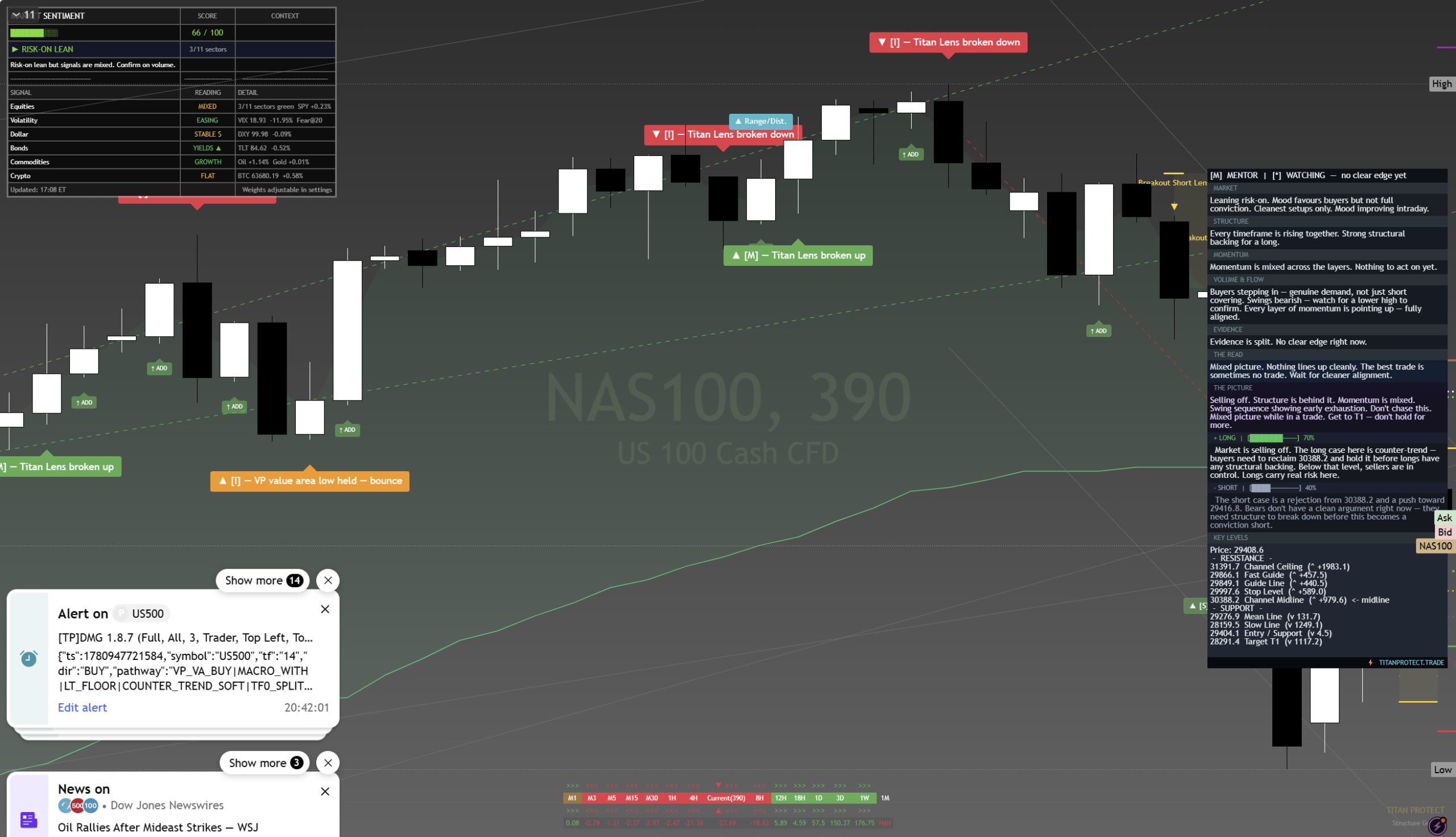
| Nasdaq 100 Futures (NQ) | 29,440 | +1.42% | Closed 40pts above 29,400 — the exact level we flagged |
| VIX (Volatility Index) | 18.92 | -12.04% | Massive one-day crush — systematic buying triggered |
| Gold (XAUUSD) | $4,354 | +0.39% | Mild safe-haven bid persists — structural support intact |
| Crude Oil (WTI) | $91.29 | +0.83% | Iran premium faded from +4.4% to under 1% — containment priced |
| Bitcoin (BTC) | $63,613 | +0.59% | Quiet recovery — not leading, not lagging |
| Options Put/Call Ratio | 0.792 | down from 0.895 | Bullish — call buying replaced Friday’s hedging panic |
| Fear & Greed Index | 42.1 | unchanged | Still fear — lagging indicator, expect catch-up Tuesday |
The setup was about as ugly as it gets. Friday closed with the Nasdaq down 5.44% on a scorching NFP print that killed the rate-cut narrative. Then Sunday night, IRGC missiles hit Ramat David Air Base in Israel. Every weekend warrior was convinced Monday would be a bloodbath.
It was not. Not even close.
Asia opened soft, tested lower, and found buyers immediately. London confirmed — the VIX started collapsing the moment European desks came online, and it never stopped. By the time New York opened, the question had already shifted from “how bad will it get” to “is it too late to buy.” The fear trade — crude, gold, volatility — all unwound in sequence. Crude’s war premium went from $4+ to under $1. VIX went from 21.5 to 18.9. The put/call ratio dropped from 0.895 to 0.792.
NQ futures closed at 29,440. We said this morning that 29,400 was the line between a real recovery and a dead cat bounce. It closed 40 points above it. Not with conviction — with 40 points of margin. That matters. It is technically a reclaim. It is not a statement.
Trump urged no retaliation on Iran. The market treated that as de-escalation. Crude’s response confirmed it — when oil cannot hold its gains on a literal missile strike, the geopolitical fear bid is dead for now.
Everything bounced. Nobody with real skin in the game bought it.
We flagged this contradiction in the Pre-NY brief and it remained true through the close. Across 12,000+ tickers refreshed today, insider activity is overwhelmingly neutral. The executives, the founders, the board members — the people who actually know the state of their businesses — looked at the biggest single-day dip in months and said: pass.
The regime data reinforces this. The quantitative universe shows 45% sideways, 26% bearish, and only 21% bullish states. Death crosses (912) still outnumber golden crosses (860). Markup phases (4,235) lead the Wyckoff distribution, but markdown + distribution combined (4,955) outnumber them. This is a market where the headline indices recovered but the underlying breadth did not.
What this means: today’s bounce was driven by mechanical flows — vol-control rebalancing, short-covering, options dealer hedging. Those flows have an expiry date. If insiders do not start buying into this dip by mid-week, the bounce loses its fuel. Watch for Form 4 filings Wednesday and Thursday.
4,235 (34%)
3,283 (26%)
2,681 (22%)
2,274 (18%)
5,548 (45%)
3,259 (26%)
2,676 (21%)
989 (8%)
Golden Crosses: 860
The quant snapshot is unchanged from the Pre-NY reading because the refresh captured the full session. The numbers did not move because one day of bouncing does not change trend structure across 12,000 names. Death crosses take weeks to form and weeks to repair. The regime tilt is constructive (markup + accumulation at 60%) but the trend-following indicators are still in repair mode. It will take at least two to three sessions of follow-through before the technical picture confirms what the price action suggested today.
Here is where the market stands on Iran after today. IRGC fired missiles at Ramat David Air Base. Trump urged no Israeli retaliation. Markets digested the entire event in under 12 hours. Crude closed at $91.29, barely above Friday’s close — which means the market has priced this as a one-off, not the first shot of a wider conflict.
That is the base case, and it is probably correct. But “probably correct” and “definitely correct” are different things, and the difference is what your stops are for. The overnight session between now and Tuesday’s open is the highest-risk window for a headline surprise — either Israeli retaliation or a second IRGC statement. If you are carrying positions into tomorrow, your stops need to reflect the possibility that the containment narrative breaks. It probably will not. But you are not being paid to assume.
Tuesday is a follow-through day. The bounce either sticks or it does not, and you will know by the first hour. If NQ holds above 29,400 on the opening pullback and pushes toward 29,800, that is a continuation signal and Monday’s close was a genuine inflection point. If NQ drops back below 29,400 early, Monday was just short-covering and the real direction is still lower. The fact that NQ closed only 40 points above the critical level — rather than 200 or 300 — tells you the market is not yet committed. Tuesday decides.
40% Probability
NQ holds 29,400 on the opening dip, pushes through 29,800 by mid-session. VIX continues lower toward 17.5. Fear and Greed finally ticks up. The mechanical buying that drove Monday extends into Tuesday as more short-sellers capitulate. ORCL pre-earnings positioning starts to lift tech sentiment. ES reclaims 7,450+. This is the scenario where you wish you had added to Monday’s bounce. Risk: overconfidence. Two green days after a 5.44% crash does not erase the damage to the rate-cut narrative.
40% Probability
NQ oscillates between 29,200 and 29,600 without committing. VIX stabilises at 18-19 and stops falling. The market waits for ORCL Wednesday and ADBE Thursday before making its next move. Volume declines. Breadth narrows. The 45% sideways signal in the quant universe was the accurate read all along — this market lacks conviction in either direction. Tuesday becomes a day to observe, not act. Existing positions hold; new entries find no edge.
20% Probability
NQ gaps down below 29,400 on overnight weakness — either Iran escalation, a hawkish Fed speaker, or simply exhausted buying flows. The insider absence proves prescient. Monday’s entire recovery is retraced by Wednesday. VIX rebounds above 20. This is the scenario the insiders are waiting for — they know something the algorithms do not, and they are waiting for cheaper prices. The 912 death crosses were the signal. The bounce was just a pause.
If you caught Monday’s bounce, trail your stops to breakeven and let Tuesday tell you the story. NQ holding above 29,400 on the first test is your reason to stay. Below 29,200 is your exit signal — do not give back the recovery waiting for a bounce that may not come. Gold longs remain valid — the structural bid above $4,300 is persistent even as the geopolitical premium fades, which tells you central bank buying is the real driver, not Iran fear. Crude oil longs should be trimmed aggressively — the war premium is gone and there is no catalyst to rebuild it unless Israel retaliates. ORCL Wednesday creates event risk for tech-heavy positions — size accordingly.
Position sizing remains at STANDARD — VIX below 19 means the vol regime supports normal conviction. The opening 30 minutes decide everything. NQ above 29,400 after the first pullback: buy toward 29,800 with stops below 29,300. NQ below 29,400 early: fade the gap-up, target 29,100, stop above 29,550. The afternoon session will be more important than the morning — wait for the 2:00 PM window before adding to winners. Tuesday after a Monday bounce is historically one of the highest-variance sessions of the week. Respect that by keeping your stops tight and your first position small.
Today was a textbook lesson in the difference between headlines and price. Missiles hit Israel. The market went up. Your job as a developing trader is not to predict headlines — it is to understand positioning. Here is the exercise: go back and read the Pre-Asia brief from last night. Then read the Pre-London brief. Then read the Pre-NY brief. Notice how each one built on the last, how the probabilities shifted as new information arrived, and how the framework adapted without contradicting itself. That process — scenario identification, probability assignment, level-setting, then reaction — is the entire skill. If you only write down one thing from today, write this: the market prices the future, not the news. By the time you read the headline, it is already in the price.
Risk dropped another 5 points from the Pre-NY assessment. Three factors drove improvement: VIX confirmed below 19 at the close (not just in pre-market), NQ reclaimed 29,400 (the test we set this morning), and crude’s war premium is functionally gone.
Three factors keep us at 50% rather than lower: insider absence persists across 12,000+ tickers, the Fear and Greed Index has not budged (the broader sentiment analysis has not confirmed the bounce), and ORCL/ADBE earnings this week create binary event risk for the sector that led today’s recovery. Tech bounced the hardest today — tech also has the most to lose Wednesday and Thursday.
Net assessment: the market earned the right to be traded, not the right to be trusted. Standard sizing is appropriate. Aggressive sizing is not.
We said the put wall at 740 decides what happens. SPY held above it. We said London decides if Iran is priced. VIX confirmed it was. We said 29,400 NAS by close is the test. NQ closed at 29,440. Three briefs, three calls, three confirmed outcomes. That is not luck. That is a framework doing what it is supposed to do — identifying the levels that matter, assigning probabilities that reflect reality, and adapting as new information arrives.
But accountability works both directions. We also said insiders were not buying, and they still are not. We said the bounce was mechanical, and it was — 40 points above 29,400 is not conviction, it is survival. We said the 45% sideways universe meant the broader market was not confirming the headline bounce, and that has not changed either. The framework got the direction right. It also got the caveat right. Both matter.
Carry this into Tuesday: the bounce is alive but it is on life support from mechanical flows, not fundamental conviction. It survives as long as nothing breaks the containment narrative (Iran), nothing spooks the earnings outlook (ORCL/ADBE), and nothing gives the insiders a reason to keep waiting. That is a lot of conditions. Standard sizing. Tight stops. Let the market prove it deserves more.
This recap builds on three session briefs published earlier today. Read them in sequence for the full picture.
Disclaimer: This content is for informational and educational purposes only and does not constitute financial advice, investment advice, or a recommendation to buy or sell any financial instrument. All trading involves risk, and you should consult with a qualified financial advisor before making any investment decisions. Past performance is not indicative of future results. Titan Protect and its authors are not responsible for any losses incurred as a result of acting on the information provided in this brief.
Deepen Your Understanding
Related articles from the Titan Protect Foundry: