3 July 2026
SoFi at $17: The Digital Bank in Markup That Nobody Saw Coming
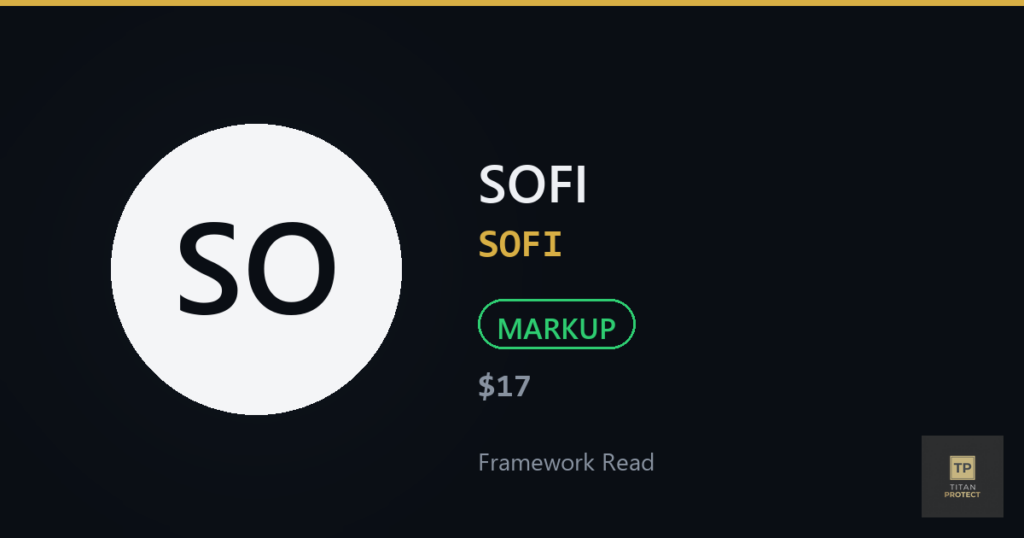
SOFI is in a confirmed markup regime at $17. The fintech that everyone left for dead after the student loan moratorium has quietly become a real bank, and institutional capital noticed.
Regime Classification: Markup
| Metric | Reading | Implication |
|---|---|---|
| Current Price | $17 | Recovered from $4 lows, sustained uptrend |
| Regime | Markup | Institutional buying driving price higher |
| Sector | Financials | Digital banking, lending, brokerage |
| Bank Charter | Active since Jan 2022 | Deposit-funded lending dramatically lowers cost of capital |
What the Regime Data Actually Says
SoFi’s markup regime is one of the strongest vindication stories in fintech. At its nadir below $5, the consensus was that SoFi was a failed SPAC destined to join the graveyard of overvalued fintechs. The regime data tells a different story. Institutional capital began accumulating quietly at the lows, and the markup that followed is sustained, volume-confirmed, and backed by genuinely improving fundamentals.
At $17, SoFi has more than tripled from those lows. The markup is not driven by hype or meme energy. It is driven by the simple reality that SoFi obtained a national bank charter and used it to build a deposit-funded lending business that generates real, growing revenue.
The Bank Charter Was the Inflection Point
Everything changed when SoFi became a bank. Before the charter, SoFi originated loans and sold them, taking a fee. After the charter, SoFi holds deposits and funds loans with those deposits, earning the spread. This is the oldest, most proven business model in financial services, and SoFi is executing it with digital efficiency.
Deposits have grown to over $25 billion. Net interest margin is expanding. The lending business now has a cost of funding advantage that non-bank fintech competitors simply cannot match. This is the structural moat that institutional buyers are pricing in.
Beyond Lending
SoFi’s Galileo and Technisys platforms provide banking-as-a-service infrastructure to other fintechs and financial institutions. This B2B segment generates high-margin, recurring revenue that diversifies SoFi beyond consumer lending. Over 150 million accounts run on Galileo’s infrastructure.
The investment platform, while smaller than Robinhood’s, adds another revenue stream and deepens user engagement. The “financial super-app” vision that sounded like marketing fluff in 2021 is increasingly backed by actual products and actual revenue.
What Separates SoFi from PYPL
The contrast with PayPal is instructive. Both are fintechs. PayPal sits in markdown while SoFi sits in markup. The difference is competitive positioning. PayPal faces intensifying competition from Apple Pay, Google Pay, and BNPL providers, with its moat eroding. SoFi’s bank charter gives it a structural advantage that grows more valuable over time as deposits accumulate.
This divergence within the same sector confirms that regime analysis is company-specific, not sector-driven. The market differentiates between fintechs that have found durable models and those still searching.
Risks to the Markup
SoFi is not without risks that could end the current markup:
- Credit quality deterioration in a recession would pressure the loan portfolio
- Student loan exposure, while diversified, remains a headline risk
- Valuation at $17 is no longer the extreme bargain it was at $5
- Anthony Noto’s execution has been excellent, but management concentration risk exists
Strategy Considerations by Tier
| Approach | Consideration |
|---|---|
| Trend Following | Markup regime supports trend participation. The institutional trend is up with fundamental backing. |
| Banking Sector | SoFi offers digital banking exposure without the legacy cost structure of traditional banks. |
| Risk Management | Credit cycle risk warrants attention. Size positions for the possibility that loan losses spike. |
The Bottom Line
SoFi at $17 in markup is the fintech that actually earned its valuation recovery. The bank charter, deposit growth, and diversification into B2B infrastructure have transformed the thesis from speculative to structural. Institutional capital confirms this with sustained buying. The risk is credit quality in a downturn, but the regime data says that risk is currently priced and accepted by sophisticated buyers.