3 July 2026
JD.com at $29: China’s Logistics Giant in Distribution
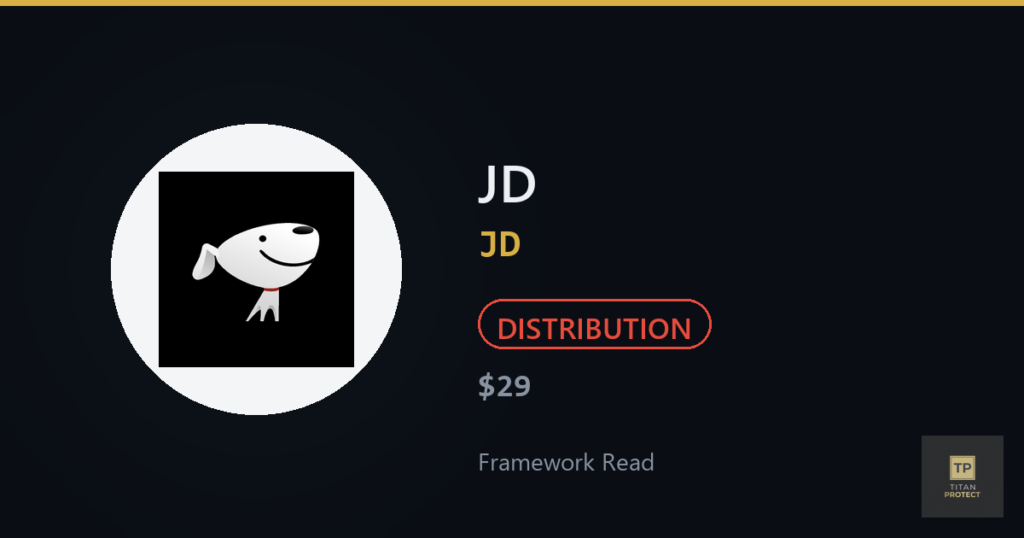
JD trades at $29 in a distribution regime. The company that built China’s most efficient logistics network watches institutional capital rotate out alongside its larger rival Alibaba.
Regime Classification: Distribution
| Metric | Reading | Implication |
|---|---|---|
| Current Price | $29 | Well below $100+ highs, recovery stalled |
| Regime | Distribution | Institutional selling into China recovery narrative |
| Sector | Consumer Cyclical | Chinese e-commerce and logistics |
| Competitive Edge | First-party logistics | 90% same/next-day delivery, fully owned network |
What the Regime Data Actually Says
JD.com’s distribution regime mirrors Alibaba’s and confirms a sector-wide institutional rotation away from Chinese e-commerce. When both of China’s largest online retailers share the same regime, the signal is clear: this is not about JD specifically. It is about institutional appetite for Chinese consumer exposure, and that appetite is diminishing.
At $29, JD trades at roughly 7x forward earnings with a logistics infrastructure valued at near zero by the market. That is the kind of valuation that attracts deep-value buyers. The regime data shows those buyers exist but are being overwhelmed by sellers. Distribution means more capital is leaving than arriving.
The Logistics Moat
JD’s competitive advantage is its logistics network. Unlike Alibaba’s marketplace model, JD owns warehouses, vehicles, and delivery staff. This enables 90%+ same-day or next-day delivery across China, a service level that marketplace models cannot match. In a market where delivery speed drives purchasing decisions, this infrastructure is genuinely valuable.
JD Logistics also serves third-party merchants and external clients, turning a cost centre into a revenue generator. The logistics division is now profitable on a standalone basis and processes billions of orders annually.
The PDD/Temu Threat
The emergence of PDD Holdings (Pinduoduo/Temu) as a major competitor has disrupted both JD and Alibaba. PDD’s ultra-low-price model and gamified shopping experience have captured price-sensitive Chinese consumers. JD, positioned as the premium, reliable e-commerce platform, has had to respond with its own low-price initiatives, which compress margins.
This competitive pressure is a key reason institutional capital is in distribution mode. The duopoly that JD and Alibaba enjoyed has become a three-way fight, with PDD proving that price-first strategies can capture significant market share even from established players.
China’s Consumer Weakness
Beyond company-specific factors, JD faces the macroeconomic headwind of weak Chinese consumer spending. Property sector stress, youth unemployment, and deflationary pressures have dampened consumer confidence. E-commerce continues to grow, but the growth rate has moderated significantly from the pandemic-era surge.
For a company like JD that earns the vast majority of its revenue from Chinese consumers, domestic economic weakness is a direct headwind that no amount of operational excellence can fully offset.
Strategy Considerations by Tier
| Approach | Consideration |
|---|---|
| Value Investors | 7x earnings with a world-class logistics network sounds compelling. Distribution regime says the market disagrees with your timing. |
| China Recovery | If you believe Chinese consumer spending rebounds, JD benefits directly. But wait for regime confirmation before acting on that belief. |
| Comparative | For Asian e-commerce exposure, Sea Limited in markup offers regime-supported Southeast Asian exposure without Chinese regulatory risk. |
The Bottom Line
JD.com at $29 in distribution is a fundamentally sound business facing sector-wide institutional selling. The logistics moat is real, the valuation is cheap, and the operational execution is strong. But distribution tells you that these positives are already priced in, and the macro and competitive headwinds are tilting the balance toward continued selling. Wait for the Chinese tech rotation to exhaust itself and watch for accumulation signals before treating JD as an opportunity.