Date: Thursday 11 June 2026
Session: Pre-London Brief | European Open Setup
Published: 07:00 BST / 02:00 EDT / 15:00 JST
“Nikkei most exposed. Japan imports nearly all its oil. Expect 400-600pt gap lower.”
“Hormuz closure not priced at $92. If shutdown holds past 4 hours, $96-100 achievable.”
“Gold not a hedge here. Liquidation overriding war bid. WAIT.”
“NQ bearish at REDUCED sizing. Oracle beat provides temporary tech floor.”

1. Asian Session Recap
Asia opened into the most hostile backdrop we have seen this year, and the session delivered exactly what the data suggested it would. The Strait of Hormuz shutdown announced late in the US session did not get reversed overnight. No diplomatic back-channel produced a headline. No face-saving off-ramp emerged. That means every energy-importing Asian economy woke up to a genuine supply disruption, not a threat, but an action already in progress.
Japan bore the worst of it. The Nikkei 225, which we flagged as AVOID with an expected 400-600 point gap lower, opened under heavy selling pressure as the yen weakened further past 147. Japanese refiners and manufacturers are fully exposed to the Hormuz closure because Japan imports virtually all of its crude. The Hang Seng faced a double headwind: energy cost spikes compressing already thin manufacturing margins, layered on top of US-China tariff fatigue that has not gone away. India’s Nifty 50, another major oil importer, felt similar pressure though domestic demand has been providing some insulation.
The Oracle after-hours beat (+8-10% in cloud infrastructure) provided a brief flicker of optimism for semiconductor names in Tokyo, but it was a thin reed. You do not buy tech into a Hormuz closure, regardless of what one company’s quarterly numbers look like. The risk-off tone held throughout the session.
2. What Pre-Asia Called vs What Happened
| Pre-Asia Call | Direction | Sizing | Overnight Result | Status |
|---|---|---|---|---|
| Nasdaq 100 | Bearish | REDUCED | Futures -0.51%, holding below 28,500 | Confirming |
| Crude Oil WTI | Bullish | STANDARD | Holding above $92, bid intact | Confirming |
| Gold | WAIT | WAIT | Hovering near $4,094, no reversal signal | Correct |
| Bitcoin | Bearish | REDUCED | $61,483, risk-off holding | Confirming |
| Nikkei 225 | Bearish | AVOID | Heavy selling, energy import crisis | Confirming |
| Dollar Index | Bullish | REDUCED | Safe-haven dollar bid intact | Confirming |
Every Pre-Asia call is tracking to plan. The key observation is that no overnight headline has changed the setup. Hormuz remains shut. US strikes on Southern Iran continue. Trump’s Situation Room discussions about additional operations have not produced a de-escalation outcome. The controlled escalation scenario (35% probability in Pre-Asia) is playing out. This matters for London because European markets now have to price in a confirmed supply disruption, not a speculative one.
3. London Session Setup
London opens into a uniquely bifurcated European landscape. The Hormuz closure creates clear winners and losers across the continent, and the distinction is structural, not speculative.
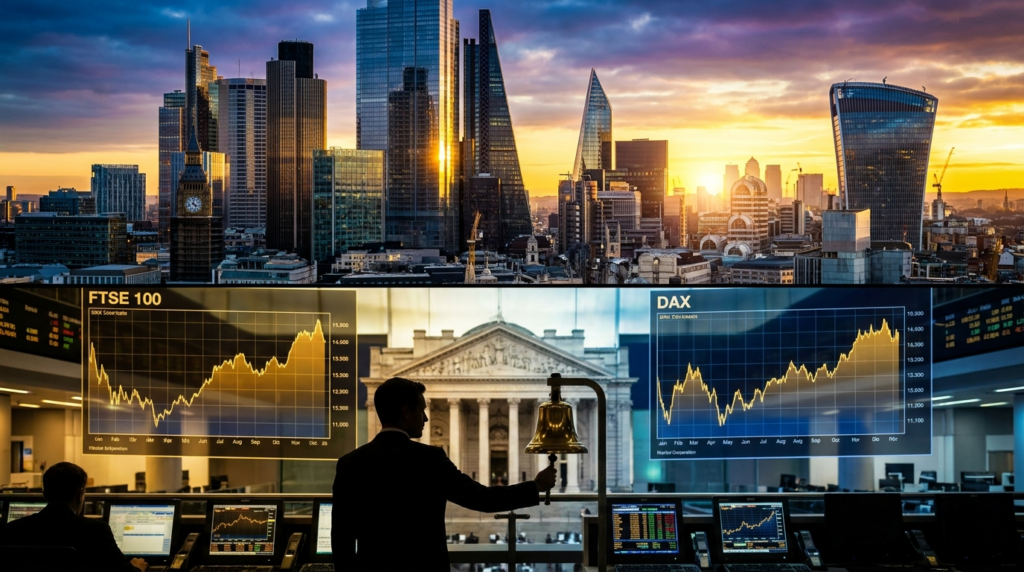
The FTSE 100 is one of the most energy-heavy major indices in the world. Shell and BP together comprise roughly 13% of the index weight. When crude surges above $92, these names print outsized earnings revisions upward. Add in FTSE mining exposure (Rio Tinto, Glencore, Anglo American) which benefits from commodity inflation, and you have an index that could buck the global risk-off trend. The FTSE also benefits from a weakening pound, which inflates the value of its dollar-denominated earnings. Watch for the FTSE to decouple from DAX and Euro Stoxx in the first hour of trading.
Germany’s manufacturing base is the most energy-cost-sensitive in Europe. Automotive (Volkswagen, BMW, Mercedes), chemicals (BASF), and industrials (Siemens) all face margin compression when crude rises above $90. Germany has no domestic oil production of significance and limited LNG import capacity compared to demand. If Hormuz stays shut for more than 48 hours, the DAX is looking at a 2-3% correction from current levels as input cost forecasts get revised. The short trade here is not about the war itself but about the second-order manufacturing impact.
The Euro Stoxx 50 sits between FTSE strength and DAX weakness. TotalEnergies provides energy upside, but the index is still heavily weighted towards banks and consumer discretionary names that suffer in a war-premium environment. ECB rate expectations are now complicated: energy-driven inflation argues against cuts, but economic slowdown argues for them. This indecision will keep Euro Stoxx range-bound unless Hormuz escalation forces a decisive break lower.
4. FX Focus — Everything Through the Hormuz Lens
| Pair | Bias | Hormuz Thesis | Positioning |
|---|---|---|---|
| EUR/USD | Bearish | Euro zone is a net energy importer. Higher crude = wider current account deficit. Spec net short -22,320 contracts on EUR futures. Dollar safe-haven bid adds downward pressure. ECB caught between inflation and growth. | REDUCED |
| GBP/USD | Bearish | UK imports roughly 40% of its oil. Sterling vulnerable despite North Sea production providing partial offset. Spec net long 27,022 contracts on GBP, meaning the crowd is positioned wrong for a Hormuz extension. Crowded long = squeeze risk to the downside. | REDUCED |
| EUR/GBP | Neutral | Both currencies face Hormuz headwinds. EUR slightly weaker due to Germany’s manufacturing exposure. GBP has spec positioning risk. Net effect is a wash, though EUR/GBP could drift lower on DAX weakness transmission. | WATCH |
| USD/JPY | Bullish | Japan’s total oil import dependency makes yen the most Hormuz-sensitive G10 currency. Spec net short -105,136 contracts on yen futures confirms bearish yen positioning. Risk-off normally supports yen, but energy inflation overrides that here. USD/JPY above 147 is the base case. | REDUCED |
| AUD/USD | Mixed | Australia is a net energy exporter (LNG, coal), which provides a natural Hormuz hedge. But AUD is a risk-on currency that suffers in VIX 22+ environments. Spec net long 56,800 contracts. These two forces cancel out. Not a clean trade. | WATCH |
The cleanest FX trade for London is short GBP/JPY. Sterling faces Hormuz headwinds while speculators are positioned long. The yen should find some safe-haven demand during London hours despite its energy vulnerability. The cross gives you bearish sterling exposure without needing to take a dollar view.
5. Key Levels
| Instrument | Bias | Entry Zone | Stop | Target 1 | Target 2 | R:R | Sizing |
|---|---|---|---|---|---|---|---|
| FTSE 100 | Bullish | 8,580-8,620 | 8,520 | 8,700 | 8,780 | 1.8:1 | REDUCED |
| DAX 40 | Bearish | 19,200-19,300 | 19,450 | 18,950 | 18,750 | 2.0:1 | REDUCED |
| Nasdaq 100 (NQ) | Bearish | 28,450-28,550 | 28,750 | 28,100 | 27,800 | 1.8:1 | REDUCED |
| S&P 500 (ES) | Bearish | 7,250-7,280 | 7,320 | 7,180 | 7,100 | 2.0:1 | REDUCED |
| Crude Oil WTI (CL) | Bullish | $92.00-93.00 | $90.50 | $96.00 | $100.00 | 2.4:1 | STANDARD |
| Gold (XAU/USD) | Watching | $4,050-4,080 | $4,020 | $4,150 | $4,200 | 2.3:1 | WAIT |
| Bitcoin (BTC/USD) | Bearish | $62,000-62,500 | $63,200 | $59,500 | $57,000 | 2.1:1 | REDUCED |
| EUR/USD | Bearish | 1.1050-1.1080 | 1.1130 | 1.0980 | 1.0920 | 1.8:1 | REDUCED |
| GBP/USD | Bearish | 1.2720-1.2750 | 1.2810 | 1.2650 | 1.2580 | 1.7:1 | REDUCED |
| USD/JPY | Bullish | 147.20-147.60 | 146.50 | 148.30 | 149.00 | 1.6:1 | REDUCED |
Sizing Note: REDUCED sizing applies across the board except crude oil. War-premium volatility means position sizes should be 30-50% of normal. The risk is not being wrong on direction but being right on direction with a stop that gets run by a headline gap. Wide stops, small size, patient entries.
6. Economic Calendar
The calendar is loaded today, and the interaction between data releases and the Hormuz crisis creates a particularly dangerous combination. PPI is the headline risk because it measures producer input costs before they reach consumers. If PPI prints hot, the Federal Reserve loses its ability to cut rates as a safety net for equity weakness. That is the worst-case scenario: war-driven energy inflation plus no monetary policy support.
| Event | London Time | New York | Impact | Why It Matters |
|---|---|---|---|---|
| Japan GDP (Q1 revised) | 00:50 BST | 19:50 EDT (Wed) | Medium | Baseline for assessing Hormuz damage to Japan. Weak GDP + energy shock = BOJ trapped. |
| UK GDP (monthly, April) | 07:00 BST | 02:00 EDT | Medium | Sets tone for GBP at the open. Weak print amplifies sterling downside from Hormuz. |
| US PPI (Producer Price Index) | 13:30 BST | 08:30 EDT | High | Hot PPI + Hormuz = stagflation fear. Fed cut expectations evaporate. Equities accelerate lower. |
| US Initial Jobless Claims | 13:30 BST | 08:30 EDT | Medium | Labour market resilience check. Strong claims = more Fed patience = no rate cut safety net. |
| Iran/US diplomatic developments | Ongoing | Ongoing | Critical | Any Hormuz reopening headline = crude -$4, equities +2%. Any escalation headline = crude +$4, equities -2%. Binary event risk. |
CPI came in at 4.2% yesterday, which Trump said he “loves.” This is not a throwaway comment. It means the administration is not going to pressure the Fed to cut. PPI today will tell us whether producer-level inflation is confirming or diverging from consumer-level. If both are hot, the stagflation thesis strengthens materially.
7. Geopolitical Watch
The overnight picture has not improved. Here is the sequence that matters:
- Iran shut the Strait of Hormuz in response to US strikes on Southern Iran. This remains in effect.
- Trump held a White House Situation Room meeting to discuss additional possible strikes. Two American sources claim he is considering a “large-scale but short-term operation.”
- Trump claimed a “secret mission” resulted in 100 million barrels crossing Hormuz. His own Energy Secretary said he was “not aware” of it. The credibility gap adds uncertainty, not clarity.
- Iran’s President Pezeshkian responded calling infrastructure threats “a sign of desperation.” This is not language that precedes de-escalation.
- CPI printed 4.2% and Trump said he “loves the inflation.” No political pressure to soften the stance on Iran for economic reasons.
- S&P 500 has erased $3.3 trillion since its June 2nd high. The wealth destruction is accelerating but has not yet triggered political backtracking.
For London, the key question is whether European diplomatic channels produce any movement. France and the UK typically attempt mediation in Middle Eastern conflicts. If a European foreign minister is dispatched overnight, that would shift the probability matrix toward de-escalation. As of this writing, no such announcement has been made.
8. Strategy by Experience Level
Stay flat through the London session. This is not a market where beginners should have exposure. The combination of war-premium gaps, PPI at 13:30, and Hormuz headline risk makes every position vulnerable to stop-hunting and slippage. If you are in cash, you are outperforming anyone who gets caught on the wrong side of a gap. Use this session to study how the FTSE behaves differently from the DAX when crude is elevated. That pattern recognition becomes an edge you can use when conditions normalise. Write down what happens at the London open, what happens when PPI drops, and how crude reacts to any Iran headline. Your future self will thank you for the notes.
Two trades worth considering. First, crude oil continuation with a stop below $90.50, targeting $96. This is a thesis extension from Pre-Asia and the setup has only strengthened overnight. Keep sizing at one-third normal. Second, if the FTSE opens higher than the DAX (which it should given energy weighting), consider a pairs trade: long FTSE, short DAX. This neutralises directional risk and isolates the energy-exposure differential. The pairs trade does not need Hormuz to get worse, it just needs crude to stay above $90. Close both legs before PPI at 13:30 unless you are comfortable holding through event risk.
Four setups. First, the FTSE/DAX pairs trade described above, but sized at half normal and held through PPI with a 150-point stop on the spread. Second, short GBP/JPY below 186.50, targeting 184.00, as sterling faces both Hormuz and spec positioning headwinds while yen benefits from safe-haven flows. Third, crude oil targeting the $96 resistance cluster, adding on any dip to $91.50. Fourth, NQ short below 28,450 into the London/NY overlap, targeting 28,100, using the war-premium reassertion thesis from Pre-Asia. The Oracle earnings fade will complete during London as the overnight tech bid exhausts itself against geopolitical reality. Manage all positions actively around 13:30 PPI. Hot PPI accelerates all bearish equity trades and the crude long. Cool PPI reverses the equity shorts temporarily but does not change the Hormuz thesis for crude.
9. Scenario Analysis
Updated from Pre-Asia based on overnight developments. The diplomatic de-escalation probability has decreased because no back-channel progress has emerged. Controlled escalation probability has increased as the current pattern of tit-for-tat strikes with Hormuz closure appears stable.
Down from 20% in Pre-Asia. No diplomatic progress overnight. Pezeshkian’s “desperation” rhetoric narrows the off-ramp. If this scenario triggers, crude retraces to $88-89, FTSE gives back energy gains, DAX rallies 1.5-2%. GBP/USD recovers. Probability increases only if a European mediator is announced or if Iran signals willingness to negotiate.
Up from 35% in Pre-Asia. This is the current reality. Hormuz partially restricted, tit-for-tat strikes continue, no full military engagement. Crude consolidates $92-96. DAX grinds lower. FTSE outperforms on energy weighting. VIX holds 20-24. This is the base case for London and the scenario most of our levels are calibrated to.
Unchanged from Pre-Asia. Trump’s “large-scale but short-term operation” discussion keeps this probability steady. Additional strikes on Iranian infrastructure push crude above $100. DAX enters correction. FTSE initially holds then follows. Gold reverses higher as true flight-to-safety overrides margin dynamics. Circuit breaker risk on European open.
Unchanged. Regional expansion to include Hezbollah, Houthis, or direct tanker strikes. Crude above $110. Cash is the only position. European energy rationing enters the conversation. Euro collapses. Swiss franc and dollar surge. All risk assets suffer without exception.
10. Positioning Context
| Instrument | Spec Net | Signal |
|---|---|---|
| S&P 500 (ES) | -482,975 | Massive bearish positioning. Institutions already short. Supports our bearish equity bias. |
| Nasdaq 100 (NQ) | -73,259 | Bearish spec positioning in NQ confirms the sell-the-rally environment. |
| Euro FX (6E) | -22,320 | Specs short EUR. Hormuz adds energy-import headwind. Bias confirmed bearish EUR/USD. |
| British Pound (6B) | +27,022 | Specs long GBP. Crowded wrong-way for Hormuz. Squeeze risk to the downside. Contrarian bearish signal. |
| Japanese Yen (6J) | -105,136 | Massive yen short. Energy vulnerability vs safe-haven demand. Cross-currents make USD/JPY less clean. |
| Bitcoin (BTC) | -6,616 | Spec short confirms risk-off positioning. BTC is not a safe haven in a Hormuz event. |
| US Dollar Index (DXY) | -11,176 | DXY spec short despite safe-haven flows. Positioning catch-up likely = dollar strength ahead. |
| US Treasury Bonds (ZB) | -281,959 | Massive bond short. If risk-off intensifies, bond squeeze higher = yields drop = supportive for duration plays. |
The positioning data tells a clear story: institutions were already bearish equities and short bonds before Hormuz. The crisis validates their positioning, which means the selling pressure has conviction behind it. The GBP long is the outlier, a crowded trade that is now wrong-footed by energy fundamentals. That makes GBP downside the highest-probability FX move during London.
11. Analysis Bias
Bearish with energy bifurcation. Risk sits around 78% for the next 12 hours, up from 75% in Pre-Asia. The overnight session confirmed our thesis rather than challenging it. Equities remain bearish across the board. Energy remains bullish with Hormuz supply disruption as the primary driver. Gold stays in WAIT territory until VIX retreats below 20 and margin liquidation exhausts itself. FX is a dollar-strength story with GBP the weakest major due to positioning mismatch. The FTSE is the one European index with structural upside, but even that is a REDUCED sizing trade because a diplomatic headline can unwind the energy premium in minutes. AAII sentiment at 37% bearish (as of last week) has likely worsened given Wednesday’s session. This is a capital preservation environment with selective energy upside.
12. Cross-References
Our overnight setup: Nikkei AVOID, Crude bullish STANDARD, Gold WAIT, NQ bearish REDUCED. All calls confirming through Asian session.
Gold -3.89%, Crude +4.14%, Oracle beat. VIX cascade confirmed. The session that set up today’s London backdrop.
Arriving at 14:00 BST. Updated after PPI and jobless claims. London session recap and NY open setup.
Live institutional briefing dashboard with all 18 sections updated. Full geopolitical risk overlay, sector rotation, and positioning analysis.
This is analysis, not financial advice. Past performance does not guarantee future results. Always manage your risk. Position sizing guidance reflects current market conditions and is not a recommendation to trade. Titan Protect provides research and education for informed decision-making. The geopolitical situation is fluid. Any position taken based on this analysis should be managed actively and sized conservatively.
Deepen Your Understanding
Related articles from the Titan Protect Foundry: