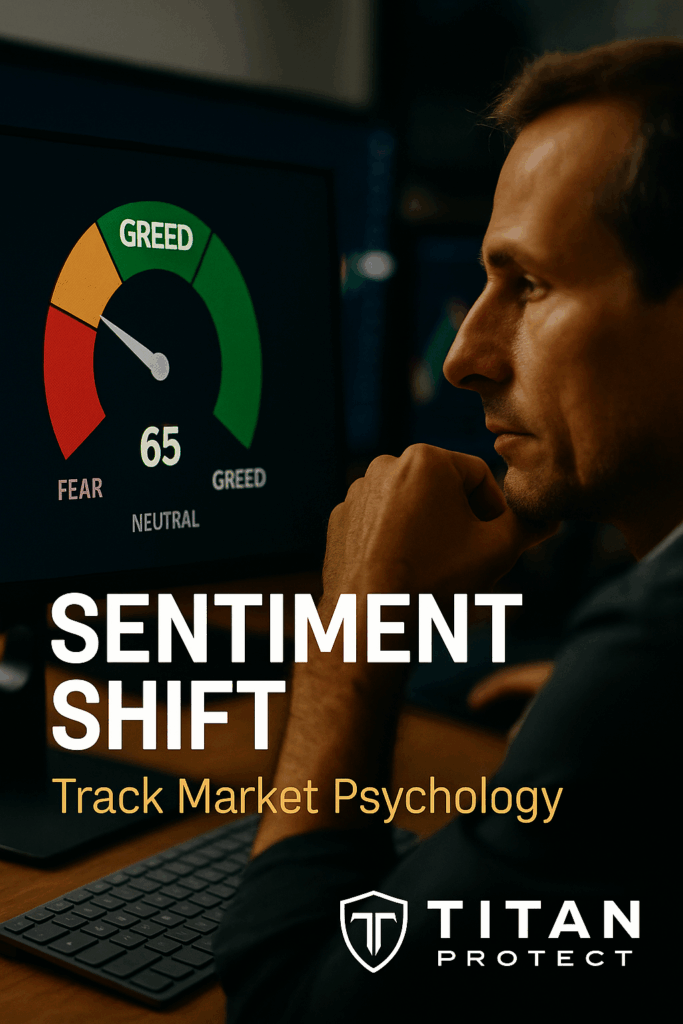
Date: Monday 1 June 2026 | Pre-NY Edition, Post 3 of 4 | Data: Live as of 09:00 EDT
Series: Sentiment Shift — the collective psychology of the market on geopolitical shock day
Published: ~14:00 BST / 09:00 EDT / 22:00 JST (Mon)
The Sentiment Dashboard: Monday 1 June
| Indicator | Reading | vs Friday | Sentiment Signal | What It Means |
|---|---|---|---|---|
| Fear and Greed (CNN) | 59.5 (Greed) | -0.7 from 60.2 | Greed persists post-Iran strikes | Market sentiment barely moved on military action news. |
| VIX | 15.32 | -2.67% from 15.74 | Volatility FELL on Iran news | Options market not pricing the geopolitical risk. Extreme complacency. |
| Dow Jones | 51,032.46 | +0.72% | Large-cap defensive bid | Rotation into Dow components (defensives, energy, industrials). |
| S&P 500 | 7,580.06 | +0.22% | Muted positive. Not conviction buying. | Index holds but breadth is telling a different story. |
| Russell 2000 | 2,919.34 | -0.59% | Small caps selling off | Risk appetite is not broad. Domestic cyclicals being sold. |
| Nasdaq 100 | 30,333.18 | +0.36% | Tech holding but lagging Dow | AI narrative holding. Credit spread risk not yet priced in equity. |
| Bitcoin (BTC) | $73,104 | -0.88% | Crypto selling on Iran news | Not acting as digital gold. Risk-off signal from speculative end. Sentiment risk is around 55%, driven by the gap between complacency and geopolitical reality. |
| ETH | $1,984.20 | -1.75% | Larger crypto selling than BTC | Risk spectrum: the higher-risk end is being reduced first. |
| XRP | $1.31 | -2.00% | Altcoin selling accelerating | Risk-off confirmed in speculative assets even while equities hold. |
| BNB | $693.81 | -3.36% | Largest crypto decline today | Speculative positioning being unwound at the riskiest end of the spectrum. |
The Three-Way Divergence: What It Actually Means
The most important thing happening in today’s sentiment picture is not any single indicator — it is the three-way divergence between equities, crypto, and the VIX. Each is telling a slightly different version of the same story, and putting all three together gives you a picture that is more honest than any one of them alone.
Equities — specifically the large-cap indices — are flat to slightly positive. The Dow is up 0.72%, the S&P is up 0.22%, the Nasdaq is up 0.36%. If you only looked at those numbers, you would conclude that the Iran news has been absorbed and the market is fine. That is the surface reading.
Crypto is down hard. BTC -0.88%, ETH -1.75%, XRP -2.00%, BNB -3.36%. The most speculative, most momentum-driven, most sentiment-sensitive assets are selling while equities hold. This is not random. When speculative assets diverge from equities on a day that should theoretically benefit both (equities holding, crypto acting as “digital safe haven”), the crypto move is the more honest sentiment signal. It says that actual risk appetite is being reduced — just not yet in the instruments that are hardest to exit (large-cap equity positions of institutional size).
And the VIX is at 15.32, down 2.67% on the session. The options market is saying there is less uncertainty today than there was on Friday. That cannot be right. Military action in the Middle East does not make the future more certain. What the VIX decline actually reflects is mechanical: the short-term options that expired Friday removed a lot of premium from the market, and the Monday open rolled into a fresh expiry cycle where market makers have not yet repriced for the new geopolitical risk. Give it 24-48 hours.
Breadth: The Small vs Large Cap Signal
The breadth picture today is telling a clear story. Russell 2000 is down 0.59% while the Dow is up 0.72%. That is a 131-basis-point divergence between the US small-cap index and the large-cap industrial average, on the same morning, in the same economy, reacting to the same news.
Small caps are domestic-focused businesses. They are the companies that feel higher energy costs first because they cannot hedge like large corporations. They are the companies whose borrowing costs are most sensitive to rate expectations because they use floating-rate credit. And they are the companies that investors sell first when they are reducing risk but do not want to trigger index-level moves by selling large-cap names.
The fact that Russell is down while Dow is up is a clean signal that today’s buying in equities is rotation out of domestic cyclicals and into large-cap defensive names — not new risk-on buying. When this pattern appears, it is typically the first stage of a two-stage process: stage one is the rotation (happening now), stage two is when the large-cap index follows the small-cap index lower (not happening yet).
Watch Russell 2,900 as the early-warning level. If it breaks below 2,900 on heavy volume, that is stage one completing and stage two beginning.
The Complacency Gap: Quantifying What Is Wrong
The historical context for VIX on days of significant Middle East military action is instructive. When the Gulf War air campaign began in January 1991, VIX (retroactive calculation) was above 30. When the US invaded Iraq in 2003, VIX moved from the low-20s toward 30 in the weeks following. When Iran-related tensions peaked in early 2020, VIX was already elevated above 15 and spiked rapidly. Today VIX is falling on the news. There are two interpretations.
Interpretation one: this time is genuinely different. The US conducted a limited strike, Iran’s political instability (president resigning) signals internal dysfunction rather than retaliatory capacity, and the market is correct to assess this as contained. The crude move to $90 is the appropriate one-time repricing, not the start of a sustained premium.
Interpretation two: the market is late to reprice. VIX is falling because Friday’s expiry removed premium mechanically, and the new week has not yet seen institutional options buyers come in to price the new risk. By Tuesday-Wednesday, once the dust settles and risk desks have had their Monday evening review calls, options demand increases and VIX moves back toward 18-20. That is not panic — that is correct pricing for a week that contains both geopolitical uncertainty AND NFP.
The combination of 59.5 F&G (complacency), 15.32 VIX (mispriced calm), and Russell -0.59% (early risk-off signal) points toward interpretation two being the more likely near-term path.
Crypto as the Honest Sentiment Proxy
Bitcoin at $73,104 (-0.88%) and the broader crypto complex all selling on Iran news while equities hold is not a contradiction — it is information. Crypto has no institutional inertia. There are no million-contract long positions that take days to unwind. When retail and semi-institutional sentiment turns cautious, crypto moves first. Large-cap equities move last because the cost of unwinding large positions (market impact, redemption cycles, mandate constraints) delays the response.
ETH down 1.75%, XRP down 2.00%, BNB down 3.36%, SOL down 1.49% — the sell-off is broad across the altcoin complex and is proportional to risk level. The higher the risk on the crypto spectrum, the larger the drawdown. That is textbook risk-off behaviour. The fact that it is happening while equities are positive is the signal, not the level. Crypto is telling you what equity markets will do tomorrow or Wednesday when institutional risk managers have had time to digest the weekend’s events.
The COT data from Post 1 confirmed this: asset managers hold only +4,352 net long Bitcoin futures, and leveraged funds are -8,730 net short. There is no institutional bid in crypto right now. The Friday positioning post called Bitcoin an avoid based on the equity divergence. That call has been validated today.
Sentiment Scenario Analysis: Where Does F&G Go This Week?
| Scenario | Probability | Trigger | F&G By Friday | VIX Direction |
|---|---|---|---|---|
| Complacency Holds | 25% | Strikes contained. Crude fades. NFP in-line. | 60-65 (greed extends) | VIX 14-15. Options remain cheap. |
| Gradual Repricing | 45% | Crude holds $90. VIX bid. Russell breaks 2,900. | 48-55 (neutral) | VIX 17-20. Gradual repricing of risk. |
| Fear Spike | 22% | Crude $92-$95. NFP strong. Rate cut doubts grow. | 35-45 (fear) | VIX 20-26. Equities -2 to -3%. |
| Extreme Fear | 8% | Iranian retaliation. Crude $100+. Forced unwind. | Under 30 (extreme fear) | VIX 28-35+. Equity circuit-breaker risk. |
What History Says About Post-Strike Sentiment
The pattern following US military strikes on Middle Eastern targets has been reasonably consistent since the 1990s. The initial market response is typically measured — large-cap equities hold or rise modestly on the view that the action is “definitive,” crude spikes 2-5%, and VIX is somewhat muted if the action is classified as limited. This is day one.
Day two and three are where the sentiment resets. As economic desks publish their energy inflation models, as corporate treasurers begin hedging fuel costs forward, and as bond markets start to price the secondary effects, the initial calm gives way to a more measured assessment. This typically produces VIX moving from the 14-15 range toward 18-20 within 48-72 hours — not panic, but correct repricing.
Day five and beyond depends entirely on whether there is further escalation. If yes, VIX 25+. If no, VIX drifts back toward 15 and the market resumes the prior trend — which in this case is the soft-PCE, rate-cut, dollar-weakness narrative that powered Friday’s all-time highs.
The base case today is that today is day one of that pattern. Monday’s calm is normal. Tuesday-Wednesday is when the repricing begins in earnest. Position yourself accordingly.
Track Record: What Friday’s Sentiment Read Called
Friday’s sentiment post identified F&G at 60.7 as “greedy but not at the extreme that historically marks major tops.” It flagged Bitcoin’s five-day equity divergence as an institutional signal rather than retail noise. It noted that sector rotation into defensives was a quiet tell that not everyone was as calm as the VIX suggested.
Today’s data validates all three of those reads. F&G has barely moved despite Iran news (60.2 to 59.5 — confirming the complacency is structural, not reflexive). Bitcoin is down again (-0.88%), extending the equity divergence rather than reversing it. And the Russell-Dow divergence today is precisely the sector rotation into defensives that Friday’s read identified as a warning signal.
What Friday’s read underestimated was how little the news would move sentiment on day one. The forecast was that F&G would stay in the 55-65 range as the dominant rate-cut narrative competed with geopolitical risk. At 59.5 on Monday morning with Iran news fully available, the complacency is running even hotter than expected. That makes the eventual repricing more sudden when it comes, not more gradual.
Experience Level Guidance
When sentiment and news are this disconnected, the safest thing to do is reduce position size — not because you know which way the market goes, but because you know the gap closes eventually. A F&G at 60 while bombs are dropping is not a stable equilibrium. It resolves. Be smaller when you do not know the resolution direction.
Use the crypto sell-off as your early warning system. If BTC drops below $72,000 today or tomorrow while equities hold, that is stage one of the risk-off rotation spreading. Watch for Russell below 2,900 as the equity confirmation. If both trigger before Wednesday’s ISM Services, the Friday NFP reaction will be larger than the current VIX is pricing.
The asymmetric sentiment trade here is long volatility on the cheap. VIX at 15.32 is pricing a week with less uncertainty than last Friday — which is mathematically absurd given the weekend’s news. Buying VIX exposure (calls, VXX) at these levels with NFP and Iran tail risk in the same week is one of the better risk/reward setups of the year. Defined risk, asymmetric upside if either tail materialises.
This analysis is produced for informational and educational purposes. It does not constitute financial advice or a recommendation to buy or sell any financial instrument. All trading involves risk. Past performance does not guarantee future results. You should always conduct your own research and consider your financial circumstances before making any investment decision. Risk percentages are estimates based on market conditions at time of writing and may change rapidly. Position sizing guidance is general in nature and must be adapted to your own risk tolerance and account size.
Deepen Your Understanding
Related articles from the Titan Protect Foundry: