The EURUSD Framework Journal for June 2026, newest read at the top. Each dated entry is our read on the close, kept as a living record so the framework can be judged over time. This is analysis, not financial advice.
Tuesday 30 Jun 2026
Euro Dollar — Daily Framework Read
Tuesday 30 June 2026 • Titan Macro Desk
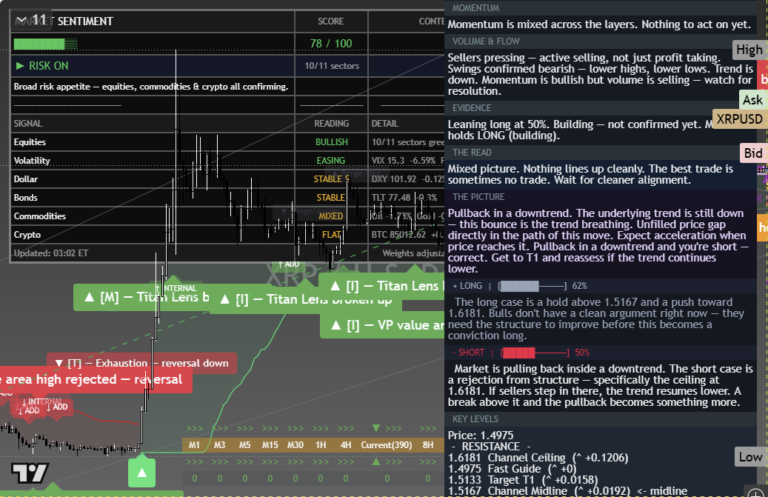
Saturday’s read carried a constructive tone. That has deteriorated. The framework panel now reads MOSTLY SHORT with one layer not yet confirmed. Every timeframe structure is falling together, which is organised selling rather than random noise. The directional conviction has flipped bearish.
The analysis reads bearish. Structure is falling, momentum is aligned to the downside, and the value area has broken lower. Sellers are in control. The one caveat is that one layer has not yet fully confirmed, so this is MOSTLY SHORT rather than unanimous.
Framework Interpretation
Structure
Structure is working against the euro. The bigger picture is losing its grip, and every timeframe structure is falling together. That is not random selling. That is organised. The Titan Lens has broken down, value area lows have been lost, and trend lines are confirming the downside move. The broader dollar strength environment is adding weight to this structural deterioration.
Momentum
Momentum is mixed across the layers but leaning bearish. Nothing to act on yet from a pure momentum perspective, but the bias is clear. Buyers are stepping in on dips but not with enough conviction to reverse the structural damage. The demand that appears is genuine but not yet short-lived enough to suggest exhaustion.
Volume Profile
The value area high has been rejected. Price pushed up, got turned away, and sellers came back in force. The VP value area low from recent sessions has been lost, which means the market is repricing lower. Acceptance below the prior value area is a bearish signal that the framework takes seriously. This is not just a dip. It is a repricing event.
The Call
The analysis reads bearish for EUR/USD. Structure is behind it, momentum is mixed but leaning lower, and volume profile confirms the downside repricing. Rallies into the 1.1380-1.1400 zone should be treated as selling opportunities rather than buying signals. The framework panel is not fully unanimous, which is why this is MOSTLY SHORT rather than a maximum conviction call. But the direction is clear.
Key Levels
Risk Assessment
The direction is established but the framework is not unanimous, which elevates risk from what would otherwise be a low-risk directional read. Month-end rebalancing flows could create counter-trend spikes that test conviction. The 45% reflects these uncertainties against an otherwise clean bearish structure.
Scenario Analysis
20%
Reclaims 1.1400 and holds. Would require a dollar reversal and month-end euro buying to materialise.
25%
Consolidates between 1.1300-1.1400. Market digests the move before the next leg lower.
50%
Continuation lower through 1.1300 toward 1.1260. Structure and dollar strength drive the move.
5%
ECB emergency action or eurozone political shock. Flash crash below 1.1200.
Position Sizing Guidance
STANDARD
REDUCED
AVOID
Standard sizing is appropriate. The direction is clear and the structure supports it, but the lack of full unanimity and month-end flow risk prevent maximum allocation. Risk defined above 1.1440 for any short positions.
Experience-Level Guidance
For Developing Traders
This is an example of a structured bearish read. Notice how the framework is telling you the direction but also flagging that it is not unanimous. That nuance matters. You do not need to act on every read. If you do participate, let the market rally into the 1.1380-1.1400 zone before considering entries. Do not sell into the hole after a move has already extended.
For Intermediate Traders
The sell-the-rally approach is the framework’s preference here. Rallies into the 1.1380-1.1400 value area high offer better risk-reward than chasing the move lower. Define risk above 1.1440 and target 1.1300 for the first take-profit level. The reward-to-risk profile on a pullback entry is significantly better than entering at current levels.
For Advanced Traders
Cross-reference with the DXY read, which is showing dollar strength across the board. EUR/USD weakness is not isolated. It is part of a broader dollar bid that is hitting commodity currencies even harder. The month-end rebalancing could create a temporary euro squeeze, but the structural read says to use any strength as a selling opportunity. The 1.1260 extension target aligns with the trend line cross zone on the longer timeframe.
This content is for informational and educational purposes only. It does not constitute financial advice, a recommendation, or an offer to buy or sell any financial instrument. Trading foreign exchange carries a high level of risk and may not be suitable for all investors. Past performance is not indicative of future results. You should consider your financial situation, investment objectives, and risk tolerance before making any trading decisions. Always conduct your own research. Titan Protect and its contributors accept no liability for losses arising from the use of this material.
Sunday 28 Jun 2026
Euro Dollar — Daily Framework Read
Sunday 28 June 2026 • Weekend Edition • Launch Read
This is the launch edition of our daily framework reads. No prior-day comparison is available. All readings reflect the current structural snapshot as of Friday’s close.
Framework Interpretation
Structure
The Euro is pulling back inside a broader downtrend. Every timeframe is falling together, which is not something you can ignore. The analysis reads this as a market where the path of least resistance remains lower. The pullback has structure to it, but it is a pullback within a downtrend, not a reversal. That distinction matters.
Momentum
Momentum is mixed across the layers. There is some buying stepping in, but it reads as reactive rather than initiative. The framework sees buyers appearing at support zones, but they are not organised enough to flip the broader picture. Momentum is not confirming a base yet. Until it does, the downtrend bias holds.
Volume Profile
Volume profile shows the market is building value lower. The value area high rejection signal is significant because it tells us that attempts to trade above the prior value area are being rejected. Sellers are defending those levels. The trend line cross at a key level reinforces the downside bias.
The Call
The analysis reads this as a sell-the-rally environment. The underlying trend is down, and the pullback formations are unsettling buyers rather than building confidence. If price pushes into the 1.1400-1.1420 zone, that is where the framework sees the best risk-reward for shorts. A break below 1.1340 would confirm continuation. This is not a high-conviction short at current levels, but the bias is clearly downward.
Key Levels
Risk Assessment
The 41% risk factor reflects the mixed momentum readings within the downtrend structure. While the direction is clear, the timing of re-entry carries uncertainty. Buyers are present at support levels, meaning the downside move may not be smooth. Weekend gap risk and potential for a squeeze into resistance add to the risk profile.
Scenario Analysis
20%
Break above 1.1450 invalidates the short thesis. Would require dollar weakness catalyst or major risk-on shift.
30%
Choppy range between 1.1340-1.1420. Market builds energy before the next directional move.
45%
Break below 1.1340 triggers continuation toward 1.1290 and potentially 1.1250. The base case.
5%
Emergency ECB intervention or geopolitical shock. Flash crash or gap scenario.
Position Sizing Guidance
STANDARD
REDUCED
AVOID
Standard sizing is appropriate. The direction is clear but momentum is mixed, which means the timing of re-entry carries risk. Sell into rallies toward 1.1400-1.1420 rather than pressing at current levels. Risk defined above 1.1450.
Experience-Level Guidance
For Developing Traders
This is a textbook example of a pullback in a downtrend. Notice how every timeframe is aligned to the downside. That does not mean you should sell blindly. The framework teaches you to wait for the market to come to your level. A rally into 1.1400-1.1420 would be the entry the framework supports. Selling at current levels, mid-range, offers poor risk-reward. Patience is the edge.
For Intermediate Traders
The value area high rejection is the key signal. The market attempted to trade above prior value and was rejected. That is institutional selling. Consider scaling into shorts on any rally into the 1.1400-1.1420 zone with risk defined above 1.1450. The target sits at 1.1290 initially. Watch for a break of 1.1340 as confirmation of continuation.
For Advanced Traders
The multi-timeframe alignment is compelling but the momentum divergence is worth noting. Buyers are appearing at support, suggesting the next leg down may not be clean. Consider a two-tranche approach: initial short at 1.1400-1.1420 with a second tranche on a confirmed break of 1.1340. Cross-reference with the DXY read for dollar-side confirmation. The GBP/USD long bias creates a natural EUR/GBP short as a relative value play.
This content is for informational and educational purposes only. It does not constitute financial advice, a recommendation, or an offer to buy or sell any financial instrument. Trading foreign exchange carries a high level of risk and may not be suitable for all investors. Past performance is not indicative of future results. You should consider your financial situation, investment objectives, and risk tolerance before making any trading decisions. Always conduct your own research. Titan Protect and its contributors accept no liability for losses arising from the use of this material.
Thursday 25 Jun 2026
Titan FX Desk · Daily Framework Read · Thursday 25 June 2026
EUR/USD: No Clear Edge as Trend Line Crosses Pull in Both Directions After PCE
Confidence: No Clear Edge
Yesterday vs Today
| Signal | Short lean (Wednesday) | WATCHING (Thursday) |
| Shift | Downgraded from short lean to watching. The chart shows trend line crosses at key levels in both directions, value area low tested and bounced, and a Fibonacci retracement level that is being contested. DXY weakened despite hot PCE which is fundamentally bullish for EUR/USD, creating a contradiction with the prior short lean. Macro holds the 0.0637 level as a key parameter. | |
Daily Read
EUR/USD is in no-man’s land. The daily read short yesterday but the DXY’s weakness post-PCE has complicated the picture. The chart shows a market caught between competing forces: trend line crosses at key levels in both directions, a value area low that was tested and bounced, and a Fibonacci retracement level that price is contesting from both sides.
The structure tells a story of indecision. There are bounce signals from the value area low which is constructive, but the overhead structure from the week’s decline creates resistance at every prior pivot. The exhaustion label that appeared at the bounce zone is encouraging for bulls but has not yet produced follow-through. Nothing lines up cleanly enough for the framework to assign a directional edge.
The macro picture favours EUR/USD upside. PCE came in hot but the dollar sold off, which is a significant behavioural signal. When markets do not respond to data as expected, it typically means the move is already priced or the market has a different concern. In this case, the concern appears to be risk appetite rather than rate expectations, which explains why the dollar is weakening despite inflationary data.
The best trade here is to wait. The framework’s watching signal means neither longs nor shorts have an edge at current levels. A break above the trend line cross at the upper boundary of the current range would flip the read to long. A break below the value area low would confirm the short. Until one of those events occurs, this is a sit-on-hands environment.
Key Levels
| Level | Price | Significance |
|---|---|---|
| Resistance 2 | 1.0920 | Prior swing high, full recovery |
| Resistance 1 | 1.0860 | Trend line cross, breakout trigger for long |
| Current Zone | 1.0800 – 1.0850 | No edge zone, watching |
| Support 1 | 1.0750 | Value area low, bounce zone |
| Support 2 | 1.0680 | Major demand zone, breakout short confirmation |
Risk Assessment
Around 55%
Moderate risk. The lack of directional edge means any position is speculative. The structural and macro signals are conflicting. Best approach is to wait for a breakout above resistance or breakdown below support before committing capital.
What to Watch Today
- DXY direction post-PCE: continued weakness is EUR/USD bullish
- ECB commentary or eurozone data surprises
- Whether the value area low bounce produces follow-through above 1.0860
- Quarter-end FX hedging flows from European corporates
This daily read is produced by the Titan FX Desk for educational and informational purposes only. It does not constitute financial advice or a recommendation to buy or sell any instrument. All levels and scenarios are analytical reference points, not trading instructions. Past performance of any level or scenario is not indicative of future results. Always apply your own risk management. Capital is at risk.
Wednesday 24 Jun 2026
Titan FX Desk · Daily Framework Read · Wednesday 24 June 2026
EUR/USD: Euro Breaks Below 1.150 as Dollar Strength Broadens
Yesterday vs Today
Monday 23 June: EUR/USD was firm at 1.159, holding its ground even as European equities sold off. We flagged the disconnect between equity weakness and euro resilience. The 1.16 level was the key reference, and we noted that the DXY was not attracting safe-haven flows.
Wednesday 24 June: The disconnect has resolved, and not in the euro’s favour. EUR/USD dropped 0.71% in yesterday’s session, one of the largest single-day moves in weeks. Price has broken through 1.155 and is now testing 1.150. The framework shows lane breakdowns, consolidation patterns breaking to the downside, and sell-side layers aligning. The bearish case we outlined has materialised.
Daily Read
EUR/USD at 1.1507 is at a critical juncture. The 0.71% decline yesterday was not a random wobble. It was a broad-based dollar move that hit every G10 pair, and the euro bore a proportional share of the selling. The framework is confirming what the price action already told us: the underlying trend is falling, and structure is behind it.
The sell signals are layered. Multiple lane breakdowns are visible, the consolidation that had been building in the 1.155 to 1.160 zone resolved decisively to the downside, and the value area has been violated. This is not a market that is deciding between directions. This is a market that has decided, and it is selling into rallies.
The driver remains the same across all dollar pairs: the greenback is reasserting itself. After weeks of gradual erosion, the DXY has found a floor and is now bouncing. At 101.39, the dollar is still well below the 103 to 104 levels that caused genuine pain earlier in the year, but the direction of travel matters more than the absolute level. The direction is now up for the dollar, and that means down for EUR/USD.
From an ECB perspective, the rate differential story has not changed materially. But the market’s willingness to position for further euro strength has evaporated. When positioning shifts, the unwind can be swift, and that is exactly what we are seeing. The risk-appetite environment is contributing too. If institutions are reducing risk broadly, the long-euro trade that built up over recent weeks is one of the positions being cut.
The 1.150 level is now the line in the sand. It is a psychological round number, a prior support zone, and a level where the framework suggests buyers may attempt to step in. Whether they succeed will depend entirely on whether the dollar rally has legs or runs out of momentum at this stage.
Key Levels
| Level | Price | Significance |
|---|---|---|
| Resistance 2 | 1.1600 | Prior battleground level, now distant overhead |
| Resistance 1 | 1.1550 | Broken consolidation floor, now flipped to resistance |
| Current Price | 1.1507 | Below broken consolidation, testing 1.150 round number |
| Support 1 | 1.1500 | Psychological round number, potential buyer zone |
| Support 2 | 1.1450 | Prior swing low, next structural support |
| Major Support | 1.1380 | Deep support, would signal trend reversal if reached |
Risk Assessment
Around 60%
Elevated risk. The 0.71% single-day move was significant and the framework is aligned to the downside. The primary risk is dollar momentum continuing to build, pushing EUR/USD below 1.150 and toward 1.145. The mitigating factor is that 1.150 is a well-watched level where institutional buyers may defend. ECB speakers this week could also provide a floor if they strike a hawkish tone.
Scenario Analysis
1.150 holds as a floor. Dollar rally stalls as the DXY meets resistance near 101.5. EUR/USD recovers toward 1.155 on short-covering and ECB hawkish rhetoric. The move lower proves to be a washout of weak longs rather than the start of a new downtrend. Position cleansing creates a healthier base for the next leg higher.
1.150 breaks on follow-through selling. Dollar strength broadens as risk-off intensifies. EUR/USD trades toward 1.145 and the recent multi-week uptrend is formally broken. European data disappoints, adding domestic pressure to the euro. The ECB’s relative dovishness versus the Fed becomes the dominant narrative again.
EUR/USD consolidates between 1.148 and 1.155. The market digests the sharp move lower and waits for the next catalyst. Dollar strength moderates but does not reverse. The pair trades with a bearish lean but lacks the conviction for a clean break below 1.150 in a single session.
This daily read is produced by the Titan FX Desk for educational and informational purposes only. It does not constitute financial advice or a recommendation to buy or sell any instrument. Capital is at risk.
Tuesday 23 Jun 2026
Titan Macro Desk · Daily Framework Read · 23 June 2026
EUR/USD: Euro Firm at 1.159 While European Equities Sell Off — A Disconnect Worth Watching
Framework Read
There is a disconnect running through European markets today and EUR/USD sits right at the centre of it. The euro is at 1.159 against the dollar — firm, holding its ground, and showing no sign of weakness despite European equities falling 1.0% to 1.2% across the continent. Normally, when European stocks are in a sustained selloff, the euro weakens as well, as capital rotation and risk reduction tend to push funds out of euro-denominated assets. That is not happening today.
The explanation comes back to the dollar. DXY at 101.2 is stable, not rallying. The dollar is not benefiting from the equity selloff in the way you would expect during a genuine flight-to-safety event. This suggests the current move is more about equity rotation and valuation adjustment than a macro crisis, and the FX market is reading it that way. EUR/USD is effectively in a holding pattern while equities de-risk.
The 1.16 level is the key reference point for EUR/USD. It has been a battleground for several weeks. Above it, the euro maintains its recent strength and the ECB’s policy credibility is intact in the eyes of currency traders. Below it, the dollar asserts itself again and the recent narrative of dollar weakness begins to reverse.
For European exporters, the current EUR/USD level is a genuine operational headwind. A euro trading at 1.16 versus the roughly 1.05 it was at eighteen months ago represents a significant compression in the dollar-equivalent value of European goods sold into the US market. This is being felt in corporate earnings estimates across the DAX and Stoxx 600.
The Iran MOU is a subtle factor here. If the 60-day clock results in energy supply implications, European energy costs could rise, which would be inflationary and complicate the ECB’s path. A more hawkish ECB profile, even if only signalled, tends to support the euro through rate differentials. That is a medium-term consideration, not a today driver.
Key Levels
| Level | Price | Significance |
|---|---|---|
| Resistance 1 | 1.1650 | Near-term ceiling, recent session high area |
| Resistance 2 | 1.1700 | Major psychological level, significant resistance above |
| Current Price | 1.1590 | Holding above 1.16 psychological level |
| Key Support | 1.1550 | Intraday floor, active buyers below this point recently |
| Support 2 | 1.1480 | Prior consolidation zone, meaningful structural support |
| Major Support | 1.1400 | Deep support, would require a significant dollar rebound to reach |
Risk Assessment
Around 40%
Moderate risk. EUR/USD is showing unusual resilience given the European equity backdrop, which reduces the downside risk in the near term. However, the disconnect between equity and FX performance is not sustainable indefinitely. If equities deteriorate further and the dollar eventually finds its safe-haven bid, EUR/USD could correct sharply lower. The 1.1550 level is the near-term line in the sand.
Scenario Analysis
EUR/USD holds above 1.1550 and pushes back toward 1.165. US earnings relieve equity pressure. The dollar stays subdued and the euro extends its relative strength. European equities stabilise and the disconnect between FX and equities closes with equities recovering rather than the euro falling. EUR/USD approaches 1.17 over the next week.
The equity-FX disconnect resolves to the downside. As European equities fall further, capital eventually reduces euro exposure too. US earnings disappoint and the dollar picks up a safe-haven bid. EUR/USD breaks 1.155 and moves toward 1.148. The narrative flips from “dollar weakness” back to “euro overvalued given European growth concerns.”
EUR/USD trades in a 1.155 to 1.163 range through the combined London and New York sessions. No clear breakout. The pair waits for the US earnings night and any resulting dollar move to set the next directional bias. The disconnect with equities persists for now, unresolved.
This framework read is produced by the Titan Macro Desk for educational and informational purposes only. It does not constitute financial advice or a recommendation to buy or sell any instrument. Capital is at risk.
Monday 22 Jun 2026
Euro / US Dollar (EUR/USD)
Daily Read — Monday 22 June 2026
Current Price
1.1468
Daily Change
+0.08%
Thursday Close
1.1459
Session Tone
Grinding Higher
Risk Score
Around 58%
Bias
Neutral With Downside Risk
Week Range
1.1459 – 1.1510
London Open: 08:00 BST
Tokyo Open: 09:00 JST
What Happened
EUR/USD is trading at 1.1468 on Monday, up a thin 0.08 percent from Thursday’s 1.1459. That eight-pip gain is effectively noise. The pair has been trying to build a base above 1.14 for several sessions but lacks a catalyst to push it meaningfully higher, while the Warsh-driven DXY strength has capped the upside near 1.15.
The stalled Switzerland trade talks introduced a fresh layer of European political friction into the week’s narrative. Switzerland and the European Union failing to reach agreement is a market signal that European institutional cohesion remains fragile. While Switzerland is not a eurozone member, the EU trade architecture is closely watched by EUR/USD traders as a proxy for broader European economic confidence. When European negotiations fail publicly, the euro finds it harder to sustain bids.
Warsh’s hawkish posture on Friday shifted the Fed rate expectation curve and pushed short-dated US yields higher. EUR/USD is a rate differential instrument at its core. When US short rates rise and European Central Bank policy remains in a gradual easing trajectory, the mechanically correct flow is to sell euros and buy dollars. The Monday grind higher feels more like month-end rebalancing than a genuine directional shift.
Macro Context: Switzerland, Warsh, and the ECB Trajectory
The three-point macro framework this week for EUR/USD starts with the ECB, moves to the Fed, and ends with European political risk.
ECB trajectory. The European Central Bank has been cutting gradually and signalling further reductions through 2026. That is a structural headwind for the euro. The market has priced in one or two more ECB cuts this year. If any incoming European data softens, that pricing moves to three cuts, and EUR/USD loses its rate support entirely. The euro’s recent resilience has been built on the idea that the ECB will slow its easing once inflation reaches target. If growth weakens faster than expected, that assumption breaks.
Fed hawkishness. Warsh’s comments reinforced what the bond market had already started pricing: the Fed is in no rush to cut. That keeps the USD bid intact for the near term. EUR/USD needs either a dovish Fed pivot or a material improvement in European economic momentum to sustain a move above 1.15. Neither catalyst is visible this week.
Switzerland trade stall. The public failure of Switzerland-EU trade negotiations reflects badly on European political cohesion. Investors looking at European assets as a bloc see this as a reminder that European institutional consensus is harder to achieve than the headlines suggest. This is a background negative for the euro, not an acute risk, but it adds to the list of reasons not to hold large long EUR positions.
Key Levels
| Level | Price | Significance |
|---|---|---|
| Resistance 2 | 1.1600 | Year-to-date high, major structural ceiling |
| Resistance 1 | 1.1510 | Last week’s intraday high, where sellers reappeared |
| Pivot | 1.1468 | Current level, Monday grind zone |
| Support 1 | 1.1420 | Weekly demand zone, prior breakout retest |
| Support 2 | 1.1350 | Monthly structure, loss opens 1.1200 risk |
| Bear Target | 1.1200 | Measured move if 1.1350 gives way on weekly close |
Strategy Tiers
| Tier | Direction | Entry | Stop | Target | R:R |
|---|---|---|---|---|---|
| Scalp | Bearish | Fade 1.1500–1.1510 | 1.1520 | 1.1440 / 1.1420 | 1:4 |
| Intraday | Bearish | Break below 1.1420 with volume | 1.1465 | 1.1350 | 1:1.6 |
| Swing | Bearish | Daily close below 1.1420 | 1.1520 | 1.1200 | 1:2.2 |
| Positional | Watch only | Wait for a weekly close below 1.1350 before entering positional shorts | |||
Scenario Analysis
| Scenario | Probability | Trigger | Target |
|---|---|---|---|
| Sideways | 40% | Pair holds 1.1420–1.1510 range through the week | Range trade |
| Bear | 35% | DXY extends above 101, EU data miss, break of 1.1420 | 1.1350 / 1.1200 |
| Bull | 20% | Soft US data reverses Warsh narrative, break above 1.1510 | 1.1600 |
| Black Swan | 5% | European political shock (elections, bank stress) or Fed emergency | 1.0800 or 1.1800 |
Position Sizing
Directional Swing
REDUCED
50% until 1.1420 breaks
Range Trade
STANDARD
Fade extremes at 1.1510 and 1.1420
Scalp
STANDARD
Short-duration, defined risk
Bull Case
A US data miss this week forces Warsh’s hawkish narrative into retreat. DXY softens from 101 and EUR/USD builds back toward 1.1510. Month-end rebalancing could add fuel if European equity outperformance requires USD selling. Above 1.1510 opens 1.1600 as the weekly target.
Bear Case
DXY holds above 101 through the week, ECB signals accelerated easing on softer European PMI data, and the Switzerland EU trade stall generates fresh European risk headlines. EUR/USD breaks 1.1420 and the measured move to 1.1350 opens. A weekly close below 1.1350 is the signal for the bigger bear leg toward 1.1200.
Experience Level Guidance
Beginner
EUR/USD is one of the most liquid FX pairs in the world, which means spreads are tight and fakeouts are common. This is not the week to take a directional view if you are new to FX. The pair is grinding in a narrow range between 1.1420 and 1.1510, and neither level has been tested convincingly. Watch how the pair behaves near those two boundaries without trading them. Note whether price respects the levels cleanly or breaches them temporarily and snaps back. Those snap-back moves are where inexperienced traders get caught on the wrong side.
Intermediate
The range fade is the cleanest setup. Short the 1.1500–1.1510 zone with a stop at 1.1525 and target 1.1440. Long the 1.1420–1.1430 zone with a stop at 1.1400 and target 1.1490. Both trades respect the current structure and avoid committing to a directional view before the week’s data catalysts are in. If DXY clearly breaks above 101.50 on a daily close, abandon the long side entirely and wait for the range to shift lower before re-evaluating.
Advanced
The structural question for EUR/USD this week is whether the Switzerland trade stall creates a sustained European risk premium or remains a background noise event. Advanced traders should be watching EU sovereign spreads alongside EUR/USD, particularly the Italy-Germany 10-year spread. If the spread widens above 130 basis points while EUR/USD tries to hold 1.1420, the correlation trade is to short EUR/USD toward 1.1350 with confirmation from the spread. The ECB cannot cut and manage sovereign spread risk simultaneously. That dilemma is the underlying vulnerability for the euro in the second half of 2026.
What to Watch This Week
- DXY above 101 — sustained break changes the EUR/USD range floor
- European PMI data — softer readings accelerate ECB easing expectations
- Switzerland-EU trade negotiations — any breakthrough is a euro positive
- ECB speakers — any hint of accelerated rate cuts hits the euro immediately
- US data releases — if they disappoint, the Warsh hawkish narrative cools and EUR/USD gets a bid
- 1.1420 on a daily close basis — loss of this level triggers the downside scenario
- Italy-Germany spread — widening is an early warning signal for EUR weakness
Risk Assessment
Moderate to elevated. Around 58% risk environment. The pair is sitting in a range rather than trending, which reduces the risk of being caught in a sustained directional move, but the underlying macro backdrop is skewed to the downside for EUR. The Switzerland-EU stall, the ECB easing trajectory, and the Warsh-driven Fed hawkishness all point in the same direction. The risk is that a single soft US data point reverses this too quickly for short EUR positions to work on a short time horizon.
Titan Macro Desk — FX Coverage
This content is for informational purposes only and does not constitute financial advice. Past performance is not indicative of future results. Trading involves risk of loss. Always conduct your own research before making any investment decisions.
Thursday 18 Jun 2026
EUR/USD — Daily Framework Read | Thursday 18 June 2026
Titan Macro Desk | Daily Framework Read
EUR/USD closed Thursday at 1.1459, down 1.30 percent. Wednesday’s FOMC hawkish hold and Thursday’s broader dollar rally have pushed the pair through multiple support layers in two sessions. The structure is bearish. Tomorrow is OpEx Friday. The euro has its own central bank story building beneath the surface, and it is not a bullish one.
Where It Sits
EUR/USD is the world’s most liquid currency pair, and it functions as the primary inverse of dollar strength. When the US dollar index climbs, EUR/USD falls. When the DXY was climbing 0.75 percent on Thursday to reach 100.84, this pair was doing its part in the move by dropping 1.30 percent to 1.1459.
The pair closed Thursday near its session lows. There was no meaningful recovery bid late in the New York session. That matters because post-FOMC and post-BOE price action that fails to recover into the close is technically significant. It suggests sellers are not covering into the US close, which removes one of the common safety valves for a quick reversal.
Looking at today’s chart, the framework is fully aligned bearish. Multiple trend lines and value area levels were broken through the session. The shorter-term picture shows clean directional momentum lower, with structure broken and not recovered. Yesterday’s chart was building the same case, but with more indecision at certain levels. Today the indecision is gone.
The pair has moved from approximately 1.1590 at the start of the week to 1.1459 at Thursday’s close — a range of over 130 pips on a five-session basis. For the world’s most liquid FX pair that is a meaningful directional move with institutional participation behind it.
Yesterday vs Today: Building the Bearish Case
Wednesday 17 June: EUR/USD closed at 1.1489, down 0.91 percent. The FOMC decision drove the initial dollar bid. The pair fell through 1.1500 intraday and closed below it — that is a psychologically important breach. The chart from Wednesday showed the framework reading bearish with initial trend line crossings and value area deterioration visible. The sell-off was directional but relatively measured. EUR shorts were taking positions but the move had not fully accelerated yet.
Thursday 18 June: The pair opened with the dollar already bid from Wednesday night’s FOMC aftermath. European session saw limited buying interest. The US session added fresh dollar demand as the broader recovery theme played out with DXY strengthening into the close. EUR/USD closed at 1.1459, a further 30-pip drop from Wednesday’s already-weak close. That does not sound like much in isolation, but it was the continuation of a clean trend that is now printing lower highs and lower lows on a daily basis.
Today’s chart shows the framework having broken through what yesterday’s chart identified as a key holding zone. The pair tested levels that were previously acting as support and closed below them. The sell signals are stacking, not diverging.
| Session | Close | Move | Driver |
|---|---|---|---|
| Wednesday 17 Jun | 1.1489 | -0.91% | FOMC hawkish hold, break of 1.1500 |
| Thursday 18 Jun | 1.1459 | -1.30% | Dollar strengthens further, BOE spill-over |
| Two-day combined | 1.1459 | -2.21% approx | Fed-ECB divergence narrative deepens |
Key Levels
Resistance: 1.1489 to 1.1510. Wednesday’s close and the 1.1500 round number. This zone is now the first line of supply on any bounce. The breach of 1.1500 on Wednesday was meaningful. A reclaim of 1.1500 on Thursday would have been bullish but never happened. That confirmed the level as resistance going into Friday. A bounce to this zone that fails with a rejection candle is the primary short entry signal.
Pivot: 1.1440 to 1.1460. The area around Thursday’s close. The pair needs to either break cleanly below 1.1440 on Friday to open the next leg lower, or recover above 1.1480 to suggest short-covering. Sitting in this zone into the Asian open suggests consolidation before the next move. The pivot zone is where the market decides.
Support: 1.1380 to 1.1400. The next identifiable structural level below current price. A clean daily close below 1.1440 points the pair toward this zone as the next target. This level aligns with a prior range high from the move that established the current broader uptrend, meaning it was previously resistance that became support. That support is now being tested from above over the next few sessions.
Deeper support: 1.1280 to 1.1300. The next significant zone below that. Reaching this level would require a continuation of the bearish trend over one to three weeks and likely a further macro catalyst, such as weak European data or an ECB dovish surprise.
Long Bias Setup
Counter-Trend Long: Support Bounce From 1.1380 to 1.1400
Risk score: around 72%. Counter-trend against the structural read. Lower probability but valid at structural support.
Entry: 1.1380 to 1.1400 on a confirmed rejection candle, ideally in the European session where real euro buyers exist. Stop: 1.1345 (below structural support and below the zone that would confirm a full breakdown). Target one: 1.1459 (Thursday’s close). Target two: 1.1489 to 1.1510 (the supply zone). Risk to reward: roughly 1:1.7 to first target, 1:2.5 to second target.
Why it could work: The 1.1380 to 1.1400 zone is technically significant. A two-session 2.2 percent move into recognised support on OpEx Friday creates the conditions for mechanical short-covering. This is a bounce play, not a reversal. Kill condition: Close below 1.1345. That breaks the structural floor and opens 1.1280.
Short Bias Setup
Continuation Short: Sell the Bounce Into 1.1489 to 1.1510
Risk score: around 52%. This is the primary directional trade that aligns with the structural read.
Entry: 1.1489 to 1.1510 on any bounce that fails at the supply zone. A wick rejection from 1.1500 with a close below 1.1480 is the confirmation signal. Stop: 1.1545 (above the supply zone and above the zone where the bearish structural argument breaks). Target one: 1.1380. Target two: 1.1280. Risk to reward: roughly 1:2 to first target, 1:4.2 to second target.
Why it works: The 1.1500 level is now resistance after the Wednesday break. The ECB is running a more accommodative stance than the Fed. European growth has underperformed. The ECB has already cut and is expected to cut again. That policy gap between the Fed and the ECB structurally caps EUR/USD rallies. Sell the bounce. Kill condition: Two daily closes above 1.1545 with genuine buying volume.
Time Horizons
Intraday (zero to one day): Friday is OpEx. The pair opens near 1.1459. The pivot zone of 1.1440 to 1.1460 is where Friday’s early price action matters. A European session bid that reclaims 1.1480 starts a short-covering drift toward 1.1500. A break below 1.1440 in Asia opens 1.1400 before Europe even arrives. The key signal is whether any bounce can actually close above 1.1480 on Friday, or whether price keeps printing lower intraday highs.
Swing (two to ten days): The bearish trajectory points toward 1.1380 as the first swing target, with 1.1280 as the extended target over the following week to ten days. ECB meeting calendar and eurozone PMI data in the coming week are the catalysts that could either accelerate or pause the move. Any dovish ECB signal or weak European data adds to the downward pressure.
Positional (two to eight weeks): The broader USD bull case depends on whether the Fed can maintain its hawkish hold into Q3. If the US economy softens and the Fed pivots, EUR/USD recovers sharply. The positional bearish case holds while the macro divergence is intact. A monthly close back above 1.1600 invalidates the near-term bearish read and signals a re-test of the 1.1700 area. Below 1.1400 on a monthly close opens the 1.1000 to 1.1100 range as a medium-term target.
Risk Score
EUR/USD risk score: around 65 percent.
- Plus 20 percent for OpEx Friday mechanics. The pair is sitting at a decision zone going into expiry. Option strike concentrations around 1.1500 and 1.1400 could pull price toward either magnet depending on where the largest open interest sits.
- Plus 20 percent for the macro backdrop: FOMC and BOE both within 24 hours means there could be additional central bank commentary over the weekend that shifts the narrative again.
- Plus 15 percent for the 1.1500 breach being fresh. The market has only just broken this level. The early trading sessions of next week will determine whether this becomes a sustained structural shift or a temporary overshoot.
- Plus 10 percent for eurozone weekend risk: any political or economic headline from Europe over the weekend can gap the pair Monday morning.
- Minus 10 percent because the structural trend is clear. The risk is noise and timing, not directional uncertainty.
Elevated but manageable. The direction is clear. The timing on OpEx Friday is the variable to respect.
Scenarios for Friday and Next Week
| Scenario | Trigger | Target | Probability |
|---|---|---|---|
| Continuation lower | Break below 1.1440. Dollar holds 100.50 on DXY. | 1.1380 then 1.1280 | 40% |
| OpEx bounce then resume | Friday squeeze to 1.1490 to 1.1510. Supply zone holds. Bearish resumption Monday. | Bounce fades, 1.1380 next week | 38% |
| Recovery above 1.1510 | Dollar weakens, risk-off returns, EUR safe-haven bid. | 1.1550 to 1.1580 | 22% |
Position Sizing
EUR/USD is the most liquid pair in the world, meaning spreads are tight and slippage is minimal except around major news events. However, on OpEx Friday, the intraday range can spike significantly around the London and New York fixes. Position sizing should account for this.
For the continuation short from 1.1489 to 1.1510 with a stop at 1.1545, the stop distance is 35 to 56 pips depending on entry. Use the wider figure for sizing: a 56-pip stop means that for a one percent account risk on a ten thousand dollar account, position size works out to approximately 0.18 lots. That is a standard single-position size for this type of swing trade.
For the counter-trend long from the 1.1380 to 1.1400 support zone, apply half sizing given the trade goes against the structural read. The entry also requires a confirmed reversal candle, not a market order into the zone. Patience pays more than eagerness here.
What the ECB Factor Means
Unlike the BOE today or the Fed yesterday, the European Central Bank was not in the news on Thursday. But that absence is itself informative. The ECB has already moved to cut rates. Its next scheduled meeting will be watched for guidance on how far and how fast cuts proceed. Meanwhile the Fed is on hold and the BOE just sounded dovish. The ECB is therefore not the most dovish central bank in the room right now — the BOE is — but it is competing in a world where the Fed still holds the highest rates among major central banks.
That interest rate differential structure means EUR/USD carries a yield disadvantage against the dollar. Investors holding euros earn less than investors holding dollars, and that differential is maintained or widened by every day the Fed stays on hold. The structural headwind for EUR/USD is therefore not just about today’s price action. It is about the carry trade dynamics that take months to fully resolve.
The short bias is not a day trade. It is the macro call for the next four to eight weeks. The day-to-day entries and levels are how you execute it with discipline.
This is analysis, not financial advice. Always manage your risk.
Thursday 18 Jun 2026
Titan Macro Desk · Daily Framework Read
EUR/USD — Daily Framework Read
Thursday 18 June 2026 · Closing Data
Framework Read
EUR/USD fell 0.73% to 1.1527 on Thursday — a clean expression of dollar strength following the FOMC’s hawkish hold on Wednesday. EUR/USD is the most liquid currency pair in the world and functions as the primary dollar proxy: when the dollar strengthens, EUR/USD falls; when the dollar weakens, EUR/USD rises. Thursday’s move confirms that the FOMC’s signal — holding rates and signalling fewer cuts than previously expected — has genuinely repriced the dollar higher.
The interest rate differential is the fundamental driver of EUR/USD over the medium term. With the Fed holding at a higher terminal rate and the ECB already in a cutting cycle, the spread between US and Eurozone short-term rates has been moving in the dollar’s favour. When you can earn more yield in dollars than euros, the mechanical demand for dollars increases — currency traders and institutional allocators move capital towards the higher-yielding currency, pushing EUR/USD lower in the process.
The 1.1527 level is technically interesting. EUR/USD has been in a multi-month uptrend from the lows below 1.05 — so this pullback needs to be contextualised as a correction within a longer-term recovery, not the beginning of a reversal. The question is how deep the correction goes. The 1.1400 level is the first major test; below that, 1.1200 comes into play. Both are within reach if the dollar strengthens further on any additional hawkish Fed signals or US data strength.
The macro picture for the euro: European growth remains modest, energy costs are a structural competitive disadvantage versus the US, and the geopolitical risk premium (Ukraine, Iran escalation risk) sits beneath European asset prices. These structural factors explain why the euro has underperformed despite the ECB managing a functioning monetary cycle. The ECB cutting is necessary to support growth — but if it cuts faster than the Fed, EUR/USD faces additional downward pressure.
Wednesday vs Thursday
| Metric | Wednesday | Thursday | Read |
|---|---|---|---|
| EUR/USD | ~1.162 est. | 1.1527 | -0.73% |
| DXY | ~99.8 est. | 100.40+ | Dollar rally |
| Fed stance | Hawkish hold announced | Repricing continues | USD bid sustained |
| ECB vs Fed spread | Narrowing (ECB cutting) | Widening (Fed holding) | EUR structurally weaker |
Key Levels
| Level | EUR/USD | Significance |
|---|---|---|
| Resistance 1 | 1.1620 | Pre-FOMC level — now resistance overhead |
| Resistance 2 | 1.1700 | Range high — needs Fed pivot to reclaim |
| Current Close | 1.1527 | Post-FOMC repricing settlement |
| Support 1 | 1.1400 | Prior consolidation zone and key technical support |
| Support 2 | 1.1200 | Structural floor — break signals larger dollar rally underway |
Bias & What to Watch
Bias: Bearish Euro (Dollar Bid)
The Fed-ECB divergence trade is running. Dollar strength is the primary macro theme post-FOMC. EUR/USD’s next test is 1.1400 support. A break there opens 1.1200 as the next meaningful floor.
The US data calendar is the next catalyst. Any upside surprise in US economic data — jobs, retail sales, or manufacturing — reinforces the Fed’s ability to hold rates and extends the dollar rally. Any downside surprise that raises recession concern would create a relief rally in EUR/USD as the market prices in earlier Fed cuts.
Watch the ECB’s communication closely. If ECB speakers signal comfort with the current level of euro weakness, EUR/USD can continue lower without the ECB providing a floor. If ECB speakers express concern about euro weakness contributing to imported inflation, that verbal intervention can temporarily support the pair. The asymmetry: ECB verbally defending the euro is a weaker signal than BOJ intervention — the ECB does not buy and sell currency directly.
This framework read is produced by the Titan Macro Desk for informational and educational purposes only. It does not constitute financial advice, a personal recommendation, or an inducement to trade. Markets can move against any bias. Past performance and analytical frameworks are not guarantees of future results. Always apply your own risk management. Capital is at risk.
Wednesday 17 Jun 2026
Titan Macro Desk · Post-Close · Wednesday 17 June 2026
EUR/USD — FOMC Day Framework Read
The world’s most traded currency pair absorbs the hawkish Fed shock.
Context: EUR/USD at 1.1586 is under pressure from a straightforward cause — the Fed stayed hawkish while the ECB has been relatively more accommodative. That policy divergence is the core driver of the cross. The DXY surge to 100.40 (+0.87%) reflects this dynamic in aggregate.
Our Framework Read
Bias
Bearish EUR
Driver
Rate Differential
Support
1.1500 Key
EUR/USD is the barometer for global dollar appetite, and today’s reading says the dollar is in demand. The FOMC decision is the cleanest explanation. When the Fed signals that cuts are far away, US assets pay more relative to European equivalents. Capital flows favour USD denominated instruments. The euro is sold against the dollar as a direct consequence.
1.1586 is meaningful on the chart. There is a historical congestion zone between 1.15 and 1.16 that has served as both support and resistance across multiple timeframes. We are now sitting right on top of that zone. Whether it holds as support or breaks depends largely on whether the dollar story has more runway.
The ECB’s position is increasingly awkward. If they remain dovish relative to the Fed, the euro stays under pressure. If they signal they are pausing their own easing cycle, that reduces the rate differential and gives EURUSD a bounce. Any ECB commentary in the days ahead will be read through this lens.
Our read: 1.1500 is the critical short-term pivot. A close below that level opens a path toward 1.1350. A hold above 1.1500 and the pair likely ranges between there and 1.1700 while the market digests the FOMC aftermath and watches what happens at the BOE Thursday and with Iran.
Key Levels
| Level | Price | Context |
|---|---|---|
| Support S1 | 1.1500 | Critical pivot, multi-month congestion zone |
| Support S2 | 1.1350 | Major structural level, long-term demand |
| Resistance R1 | 1.1700 | Pre-FOMC highs, supply zone |
| Resistance R2 | 1.1850 | Would need DXY reversal and ECB pivot |
Risk Assessment
Around 60% risk
Elevated bearish risk for the pair. The rate differential story favours the dollar short-to-medium term. 1.1500 is the key battleground — break and hold below that level, and we reassess toward 1.1350. For now, the FOMC verdict has reset the range lower.
This post is produced by the Titan Macro Desk for informational and educational purposes only. Nothing here constitutes financial advice. Capital is at risk.
Wednesday 17 Jun 2026
Titan Macro Desk · Post-Close · 16 June 2026
EUR/USD — Daily Framework Read
Tuesday 16 June 2026 | FOMC Eve
Session Summary
Current Rate
1.1586
Dollar
MIXED
Framework
WATCHING
Framework Read
Bias
NEUTRAL — FOMC GATED
Framework State
WATCHING
Our Read
EURUSD at 1.1586 is holding in a well-defined range ahead of FOMC. The pair has been trading broadly between 1.14 and 1.17 for several weeks, with neither side willing to commit to a breakout without the macro catalyst to confirm it. FOMC tomorrow is that catalyst.
The euro’s resilience is somewhat surprising given the state of the German economy. The explanation lies in two factors: the ECB has been clearer in its communication than the Fed, reducing EUR-specific volatility, and the dollar itself has been under pressure from mixed US data. When neither currency has a clear fundamental edge, EURUSD grinds within range.
Tomorrow changes that. A hawkish Fed would see the dollar strengthen, pushing EURUSD toward 1.14-1.15. A dovish Fed would see EUR-buying as dollar risk premium unwinds, potentially pushing the pair toward 1.17-1.18. The 1.1500 and 1.1700 levels are the range boundaries to watch.
From a positioning standpoint, the market is not aggressively short EUR or long USD ahead of FOMC. That means a dollar weakening surprise would generate more momentum than a dollar strengthening surprise — short-covering is usually faster and more violent than fresh positioning.
WATCHING. This is a clean range-trade setup awaiting a breakout catalyst.
Key Levels
| Level | Rate | Significance |
|---|---|---|
| Resistance | 1.1700 | Range top — dovish FOMC target |
| Resistance | 1.1650 | Immediate overhead |
| Current | 1.1586 | Mid-range — pre-FOMC hold |
| Support | 1.1500 | Range floor — key support |
| Support | 1.1400 | Hawkish Fed scenario target |
Risk Assessment
Around 55%
- Range-bound pre-FOMC — breakout risk elevated
- Dovish surprise asymmetry favours upside momentum
- ECB-Fed divergence narrative in play
- German growth drag limits EUR upside potential
This framework read is produced by the Titan Macro Desk for analytical and educational purposes only. It does not constitute financial advice or a recommendation to buy or sell any instrument. All market analysis involves uncertainty. Past framework accuracy does not guarantee future performance. Conduct your own research and consult a qualified financial adviser before making investment decisions. Capital is at risk.
Tuesday 16 Jun 2026
Titan Macro Desk · Tuesday 16 June 2026
EUR/USD — Daily Framework Read
The euro is holding up better than most peers against a modestly firmer dollar. Marginal softness of 0.15% reflects the ECB versus Fed policy divergence narrative rather than any euro-specific weakness.
Live Snapshot · 390-Minute Timeframe
Last Price
1.1586
Session Change
-0.15%
Timeframe
390m
Bias
Neutral-Soft
Our Read
EUR/USD at 1.1586 is softer by just 0.15% on the session, and that mild drift lower is almost entirely about the dollar rather than the euro. The Eurozone picture is not deteriorating — if anything, euro area economic data has been quietly stabilising — but the market is in a holding pattern with FOMC Wednesday dominating the FX calendar.
The 390-minute chart shows a pair that has been grinding in a consolidation band roughly between 1.1520 and 1.1660. That is a meaningful range — roughly 140 pips — and neither side has been able to assert itself. The current print at 1.1586 is mid-range with a modest downward lean. It is not aggressive selling; it reads more like positioning reduction ahead of a binary event.
The ECB versus Fed divergence has been the core story for weeks. The ECB has signalled a more cautious approach to cuts than markets had originally priced. The Fed meanwhile has been pushing back on any near-term easing expectations. The net effect is a dollar that has modest support without a strong upside catalyst, and an euro that is neither particularly bullish nor under serious pressure.
What changes that dynamic? Wednesday’s Fed decision is the obvious answer. A hawkish hold — higher-for-longer language maintained or strengthened — could push EUR/USD below 1.1520 and bring 1.1460 into play. A dovish tilt — any mention of September cuts or softer inflation acknowledgement — and the pair likely reclaims 1.1620 quickly, with 1.1660 and 1.1700 as the natural extensions.
For today, the path of least resistance is a quiet drift within range. There is no European data of consequence and the US calendar is also light ahead of tomorrow. This is a pair in suspension, and the right response is patience rather than conviction in either direction until the Fed has spoken.
Key Levels
| Level | Price | Significance |
|---|---|---|
| Major Resistance | 1.1700 | Round-number psychological level. Would need a dovish Fed surprise to reach. |
| Range Top | 1.1660 | Compression ceiling. Multiple tests have failed. Clear upside target post-Fed if dovish. |
| Near Resistance | 1.1620 | First recovery target. Reclaiming this would shift the intraday tone neutral-bullish. |
| Current Price | 1.1586 | Mid-range, marginally soft. Waiting for FOMC direction. |
| Range Base | 1.1520 | Support base of the current consolidation. Failure here turns the picture bearish. |
| Extended Downside | 1.1460 | Structural support below the range. Hawkish FOMC scenario target. |
Risk Assessment
Around 45% — Moderate-Low
Pre-event compression means the actual risk is binary and event-driven. Until Wednesday, the pair is likely range-bound. The risk is in taking a directional position ahead of the Fed and getting caught by an asymmetric move.
Key Risks
- Hawkish FOMC language Wednesday
- Eurozone data miss pre-Fed
- Compression breakout — fast move risk
Supporting Factors
- Euro relatively resilient vs peers
- Risk-on environment (NAS +3%)
- Structural support 1.1520 intact
Cross-Reference
DXY (Dollar Index)
EUR/USD is the largest component of DXY. DXY range-bound ahead of FOMC directly explains the EUR/USD compression. These two move in near-perfect opposition.
Cable is down 0.38% vs EUR/USD’s 0.15% drop. The euro is outperforming sterling today, hence EUR/GBP edging higher.
US Equities
NAS100 +3.06% normally would support EUR/USD via risk-on flows. The muted FX response suggests pre-FOMC caution is capping upside moves.
Iran / Geopolitics
A constructive Iran deal Thursday reduces safe-haven demand and could give the euro a mild tailwind, but this is a secondary factor behind the FOMC outcome.
Scenarios to Watch
Bullish Scenario — Fed Acknowledges Progress
Fed language softens on inflation persistence. Markets reprice cuts back into 2026. DXY weakens. EUR/USD clears 1.1620, targets 1.1660 then 1.1700 on momentum. A decisive daily close above 1.1660 changes the structural picture.
Bearish Scenario — Higher for Longer Confirmed
Fed reinforces patience on rate cuts. Dollar benefits. EUR/USD breaks 1.1520 with conviction, targeting 1.1460 and the broader 1.14 zone. Watch the speed of the break — fast moves through support tend to run further.
This post is produced by the Titan Macro Desk for informational and educational purposes only. It does not constitute financial advice. Framework reads represent our analytical view at the time of writing and may change without notice. All trading carries risk. Past performance is not indicative of future results. Please ensure you understand the risks involved before making any trading decisions.
Titan Macro Desk · Alpha Insights · 16 June 2026
Friday 12 Jun 2026
Daily Ticker Read | Friday 12 June 2026
Euro (EUR/USD) : Downtrend Grinds On Despite Risk-On Tailwind
EUR/USD | Spot FX | Friday 12 June 2026
The Iran de-escalation has driven risk appetite higher across the board, and in theory that should weaken the dollar and support EUR/USD. It has done that to a limited extent. But the analysis panel is reading this pair as still trapped in a downtrend, with momentum continuing to grind lower. The CPI print at 4.2% has kept Fed rate expectations firm, and that is the structural anchor holding the euro down even as sentiment improves elsewhere.
The Read
| Direction | BEARISH LEAN |
| Conviction | Medium |
| Risk Assessment | Around 50% — trend is clear but pace is slow, patience required |
| Estimated Price | ~1.1210 |
| Bias | Bearish — downtrend intact, bounces are for selling |
Yesterday vs Today
Thursday 11 June
Sentiment was mixed with no clear edge for either side. The framework noted it was within the range and watching. Layouts showed active but directionless flow, with the pair failing to find traction on either side. Trend line crossed at a key level, and multiple Titan Lane breakdowns had been logged. The bigger picture was pulling back but short-term structure was choppy.
Friday 12 June
Everything aligns bearish. The analysis panel reads tightness across layers with dollar still holding the edge. Momentum is grinding lower with genuine downside pressure. The risk-on relief from Iran has not translated into euro strength in any meaningful way. Titan Lane breakdowns are confirmed and building. The framework is in a downtrend read and the pullback is a selling opportunity.
What We See
Structure: The chart shows persistent Titan Lane breakdowns across the timeframe. Trend line has crossed at key levels confirming the downside bias. The pair is struggling to hold bounces and each relief pop gets sold. Value area structures are migrating lower, which tells you institutional flow is repricing the fair value of this pair downward. That is the hallmark of a controlled institutional distribution.
Momentum: Genuinely bearish. The framework is reading pressure as persistent and building rather than fading. The Iran de-escalation has not produced a meaningful momentum shift in EUR/USD the way it has in equity indices. That divergence is informative. When risk-on does not lift a pair that should benefit from dollar weakness, it tells you the pair has its own structural weakness pulling it down.
Volume Flow: Nothing firm on the buy side. The panel is clear that this is a pullback in a downtrend, not a reversal. The volume confirmation is on the sell side, with bounces lacking follow-through. The ECB-Fed rate divergence continues to drive the structural flow, and the risk-on rally has not changed that calculus.
The Call: Bearish lean with medium conviction. The trend is grinding lower and the framework is aligned across layers. The Iran relief has not changed the structural picture for EUR/USD. Look to sell bounces toward resistance rather than chasing the move lower. Patience on entry will be rewarded — the trend is doing the work.
Key Levels
| Level | Price | Significance |
|---|---|---|
| Resistance 2 | 1.1320 | Prior breakdown origin — invalidation zone |
| Resistance 1 | 1.1270 | Value area high — sell zone on bounces |
| Current | ~1.1210 | Within downtrend structure |
| Support 1 | 1.1150 | Recent session low cluster |
| Support 2 | 1.1080 | Weekly structural support — extended target |
Risk Assessment
Around 50% — The trend direction is clear and the framework is aligned, which reduces directional risk. The main risk factor is the pace: this is a grinding move, not a fast one, and Friday heading into a weekend with geopolitical variables still in flux adds timing risk. The ECB-Fed divergence underpins the structural short thesis, but any surprise dollar weakness from a dovish Fed shift would invalidate. For now, the trend is doing the work and patience is the correct approach.
Related Alpha Insights
Today’s FX Focus brief covers the full EUR/USD structural analysis. The Macro brief addresses the CPI and rate divergence dynamics. See the Dollar Index and Sterling reads for the broader dollar picture and relative G10 performance.
This content is for informational and educational purposes only. It does not constitute financial advice, a recommendation, or an invitation to trade. All trading involves risk, including the potential loss of principal. Past performance does not guarantee future results. Always conduct your own research and consult a licensed financial adviser before making investment decisions. Alpha Insights is a research publication, not a regulated advisory service.
Friday 5 Jun 2026
EUR/USD — Daily Read | Friday 5 June 2026
Titan Protect Alpha Insights | Rates Repricing Day | analysis as of pre-market 5 June 2026
Market Context
EUR/USD was hit hard on Friday, surrendering significant ground against the dollar following the stronger-than-expected US Non-Farm Payrolls report. The pair had been supported in recent weeks by the ECB’s relatively accommodative tone compared to the Fed’s “higher for longer” positioning, but the NFP shock reinforced the interest rate differential trade in the dollar’s favour and broke that narrative sharply.
The ECB is widely expected to continue cutting rates through the second half of 2026, while Friday’s data pushes the first Fed cut further into the future. This widening differential is fundamentally bearish for EUR/USD in the near term. The pair broke below key technical support levels during the session, triggering stop losses and accelerating the decline.
European economic data has been mixed, with German manufacturing continuing to show stress and French service sector readings below expectations. The combination of a widening rate differential and weak European growth fundamentals creates a challenging backdrop for the euro.
Rate differential is driving dollar strength. The path of least resistance is lower for EUR/USD until the NFP narrative is challenged by weaker US data or Fed dovish communication.
Key Levels
| Level | Price | Significance |
|---|---|---|
| Resistance 2 | 1.0980 | Pre-NFP weekly high |
| Resistance 1 | 1.0880 | 20-day average and Friday intraday ceiling |
| Close / Pivot | 1.0790 | Friday settlement level |
| Support 1 | 1.0720 | May swing low and key structural support |
| Support 2 | 1.0600 | Major long-term support — breach would signal structural dollar strength |
Weekend Setup
EUR/USD is approaching a technically important support cluster near 1.0720. A clean break below this level on Monday would open the 1.0600 zone and suggest the pair is entering a more sustained dollar-strength phase. The rate differential story will remain the dominant driver through Q3 2026 absent a reversal in US data.
Any ECB communication over the weekend that signals an accelerated easing path could provide temporary relief but is unlikely to overcome the fundamental driver until the Fed’s timeline also shifts. EUR/USD bulls need to see US data weaken materially to regain control.
Risk Note: ECB meeting dates and Fed speakers next week can produce sharp intraday reversals in EUR/USD. The pair remains in a range that has been contested for months. A clean break in either direction is likely to attract significant follow-through momentum.
This content is for informational and educational purposes only. It does not constitute financial advice, a personal recommendation, or a solicitation to buy or sell any financial instrument. Past performance is not a reliable indicator of future results. Trading involves significant risk of loss. Always conduct your own research and consult a qualified financial adviser before making investment decisions. Titan Protect Alpha Insights is not authorised or regulated by the Financial Conduct Authority.
Friday 5 Jun 2026
EUR/USD — Daily Read | Thursday 4 June 2026
Published: Thursday 4 June 2026 | Titan Protect Alpha Insights
EUR/USD is holding above 1.16 on the back of a broadly weak US dollar, with DXY sitting below 100. The euro has been a direct beneficiary of the narrative shift away from dollar strength as markets recalibrate Federal Reserve rate expectations. Above 1.16 is a psychologically meaningful level and the pair’s ability to sustain here is being watched by global FX desks heading into NFP.
What the Analysis Shows
The move above 1.16 in EUR/USD is more than just dollar weakness. The ECB has been gradually easing but has done so in a measured way that maintained the credibility of European monetary policy. Eurozone data has not cratered, and the relative rate differential has narrowed enough to make the euro less of an obvious sell against the dollar.
From a technical perspective, the pair has cleared the 1.15 resistance that capped it for much of the earlier part of this year. That level now becomes support. The 1.16-1.17 zone is the next area to prove itself as a base rather than a ceiling.
Bias: Bullish while above 1.1550. The broader dollar weakness trend is the primary driver. ECB easing is mostly priced in and is not a fresh headwind. NFP is the near-term risk. A soft print would extend EUR/USD higher; a strong beat would trigger a sharp reversal toward 1.15.
Key Levels
| Level | Price | Significance |
|---|---|---|
| Support 1 | 1.1550 | Prior resistance, now support |
| Support 2 | 1.1480 | Medium-term base |
| Resistance 1 | 1.1650 | Near-term supply zone |
| Resistance 2 | 1.1750 | Extended target on breakout |
Tomorrow’s Setup
NFP shapes the pair’s direction entirely on Friday. Watch the first 15 minutes after the release for the real signal. A soft number and EUR/USD tests 1.1650. A hot number brings 1.1550 into play immediately. The 1.16 handle is the pivot level for Friday’s trade.
Risk Note: NFP creates acute volatility in EUR/USD. The pair routinely moves 100+ pips in the 30 minutes following the release. Positions held through the print need wider stops or reduced size to account for this normal event-driven volatility.
This analysis is for informational purposes only and does not constitute financial advice. Markets involve risk. Past performance is not indicative of future results. Always conduct your own due diligence before making any investment decisions.
Thursday 4 Jun 2026
Euro / US Dollar (EUR/USD)
Daily Read — Wednesday 3 June 2026
Current Price
1.1600
Daily Change
-0.29%
What Happened Today
EUR/USD fell 0.29% to 1.1600 as the dollar strengthened following the ISM miss. The move mirrors the broader dollar bid story — EUR/USD is the single most influential component of the DXY index, so when the dollar rallies, this pair falls. The 1.16 level is a round-number area that the market is watching closely.
European data has been mixed recently and the ECB cut rates at its last meeting, which has structurally limited the euro’s upside potential. The differential between Fed and ECB rate expectations is not as wide as it once was, but any repricing of Fed cuts (which an ISM miss could trigger if combined with weak NFP) would be euro-positive.
The 1.16 area has acted as a pivot zone over recent weeks. A clean break below 1.1550 opens up a deeper retracement. A hold and bounce keeps the range intact.
Key Levels
| Level | Price | Significance |
|---|---|---|
| Resistance | 1.1720 | Recent swing high |
| Pivot | 1.1600 | Current close / round number |
| Support 1 | 1.1550 | Intraday swing low zone |
| Support 2 | 1.1440 | Monthly demand level |
Current Bias
Dollar bid is the driver. The 1.16 level is holding for now but the path of least resistance is lower unless the DXY turns. A weak NFP Friday could reverse this quickly.
What to Watch Tomorrow
- 1.1550 support hold is critical for near-term technical picture
- Any ECB speaker scheduled — tone on further rate cuts matters
- DXY direction post-US open
- Friday NFP is the week-defining event for all dollar pairs
Risk Assessment
Moderate. Around 52% risk environment. NFP positioning uncertainty keeps the pair in a holding pattern through Thursday.
This content is for informational purposes only and does not constitute financial advice. Past performance is not indicative of future results. Trading involves risk of loss. Always conduct your own research before making any investment decisions.
Tuesday 2 Jun 2026
Bitcoin (BTC/USD) — Daily Framework Read | Tuesday 2 June 2026
Bitcoin (BTC/USD) | Post Close Setup Daily Read | Data basis: 2026-06-02 close
Where It Sits
Structure
Structurally Bitcoin (BTC/USD) has pulled back into the session close. The broader trend remains intact on the daily timeframe but the shorter timeframe has softened. The structure is contested near the 66,868 level.
Momentum
Momentum is firm with the daily timeframe showing clear acceleration. Internal readings sit in the upper portion of the range. The risk is not that momentum fails but that it stalls at round-number resistance and triggers profit-taking.
Volume & Flow
Flow on the session close was measured. Positioning data suggests steady accumulation rather than aggressive directional commitment. The pattern supports continuation rather than reversal.
Key Levels
| Level | Type | Significance | Action Zone |
|---|---|---|---|
| 74,100 | Resistance | Upper range target, prior supply zone | Take profits / fade if rejected |
| 69,300 | Pivot | Mid-range continuation marker | Hold = constructive; lose = consolidation |
| 66,868 | Session close | Reference anchor for next session | Above = continuation; below = mean revert |
| 63,000 | Support | Recent range floor, demand zone | Buy zone with defined stop |
| 58,200 | Major support | Prior breakout retest level | Stop-out below for longs |
Three Scenarios
Continuation
Bitcoin (BTC/USD) holds 66,868 and pushes higher on continued institutional flow and positive macro mood. The 24/7 tape supports trending moves when traditional markets are risk-on.
Range
Bitcoin (BTC/USD) churns around 66,868. Range-bound without a fresh catalyst. Weekend liquidity dynamics can create noise.
Mean Reversion
Bitcoin (BTC/USD) fades on a risk-off shift or specific headline, breaks support. Crypto gives back faster than it gains — size discipline essential.
Risk Score
Risk sits at Around 60%
Risk sits around 60 per cent. Vix at 15.7 supports a measured risk posture. sentiment at 57 is neutral. Crypto carries 24/7 liquidity risk and higher-beta positioning. Standard sizing with defined stops — discipline beats conviction.
How to Walk It
Entry / Stop / Target structure:
- Long 63,000 pullback | Stop 58,200 | Target 69,300 | R:R 2:1
- Long 69,300 breakout | Stop 66,868 | Target 74,100 | R:R 1.5:1
- Fade 74,100 rejection | Stop above resistance | Target 66,868 | R:R 2:1
Experience-level guidance:
Beginner: Reduce size to half your standard. Trade only the cleanest setup from the entries above. If the tape opens against your bias, do nothing — wait for the second hour, when the institutional flow has tipped its hand.
Intermediate: Use the levels table to define the trading range. Fade the extremes with defined stops, take profits before the round-number resistance levels.
Advanced: The vol regime supports defined-risk structures around the key pivot levels. Keep notional small relative to your book — asymmetric speculation, not core positioning.
Continue Reading
The macro frame driving this read is unpacked in the session briefs:
Check the latest session briefs on the site.
This analysis is for educational and informational purposes only. It does not constitute financial advice. Always manage your risk independently and in accordance with your own financial circumstances.