3 July 2026
Alibaba at $113: The Chinese E-Commerce Giant in Distribution
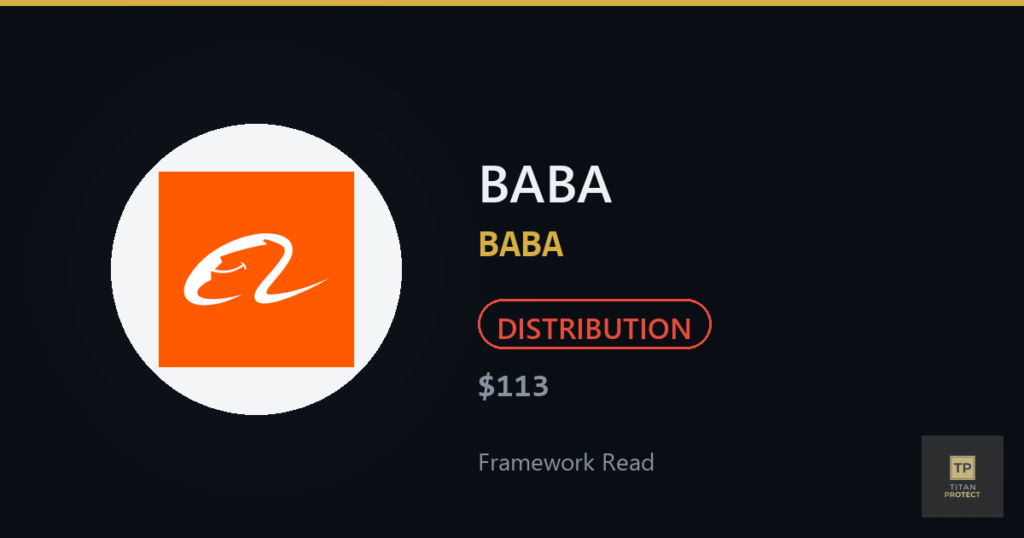
BABA trades at $113 in a distribution regime. After years of regulatory destruction that took the stock from $319 to under $70, the partial recovery is now stalling as institutional capital rotates away.
Regime Classification: Distribution
| Metric | Reading | Implication |
|---|---|---|
| Current Price | $113 | Recovered from $60 lows but stalling |
| Regime | Distribution | Institutional selling into recovery rally |
| Sector | Consumer Cyclical | Chinese e-commerce, cloud, fintech |
| Geopolitical | US-China tensions | ADR delisting risk remains background concern |
What the Regime Data Actually Says
Alibaba’s distribution regime at $113 tells a specific story. The stock’s rally from $60 attracted institutional buying from those who believed the worst of China’s regulatory crackdown was over. Those buyers have now begun selling. Not because the crackdown returned, but because the recovery has stalled and the catalysts for further upside have not materialised.
Distribution after a recovery rally is different from distribution at highs. At $113, Alibaba is still far below its $319 peak. The distribution here represents institutions taking profits on a tactical trade rather than exiting a long-term position at full value. The question is whether they will re-enter at lower prices or whether this rally was the last gasp.
The Regulatory Aftermath
Jack Ma’s October 2020 speech criticising Chinese regulators triggered the most dramatic regulatory assault on a private company in modern history. The Ant Group IPO was cancelled. Alibaba received a $2.8 billion antitrust fine. The company was forced to restructure. The message was clear: no Chinese company, regardless of size, is beyond the reach of the state.
The crackdown has eased. Eddie Wu has restructured the company into six business units. The cloud division was retained rather than spun off. But the fundamental lesson remains: the Chinese government can intervene in Alibaba’s business at any time, for any reason, with no recourse for shareholders.
The BABA + JD Distribution Pattern
Both Alibaba and JD.com sit in distribution simultaneously. When the two largest Chinese e-commerce companies share the same regime, it is a sector signal. Institutional capital is reducing Chinese tech exposure broadly, not just making company-specific decisions. The reasons are multiple: geopolitical risk, domestic economic weakness, competitive pressure from PDD/Temu, and fundamental uncertainty about China’s consumer recovery.
The Valuation Argument
At 8-9x forward earnings with a massive cash position, Alibaba is statistically cheap by any metric. The company generates substantial free cash flow and has deployed billions in share buybacks. By pure numbers, this is a value stock.
But valuation arguments have been wrong on BABA for five years running. The stock was “cheap” at $200, “cheap” at $150, “cheap” at $100, and “cheap” at $70. The regime data does not care about P/E ratios. It measures what institutional capital is doing. And institutional capital, despite the low multiples, is selling.
The Geopolitical Discount
Alibaba trades at a permanent geopolitical discount to its Western peers. Amazon trades at 3x Alibaba’s valuation despite similar revenue and lower margins. This discount reflects ADR delisting risk, VIE structure concerns, US-China tensions, and the regulatory risk described above. Whether this discount is rational or excessive depends on your assessment of geopolitical risks that no financial model can quantify.
Strategy Considerations by Tier
| Approach | Consideration |
|---|---|
| China Bulls | Distribution suggests the recovery trade is mature. If you have China conviction, wait for accumulation signals before adding. |
| Value Investors | Statistically cheap, but value traps thrive when valuations are low and regimes are hostile. Discipline required. |
| Global Diversification | Chinese tech exposure through ETFs may be preferable to single-stock risk during distribution. |
The Bottom Line
Alibaba at $113 in distribution is the stock that has humbled more value investors than any other in recent memory. The business generates enormous cash flow, trades at rock-bottom multiples, and remains the dominant e-commerce platform in the world’s second-largest economy. None of that has prevented five years of institutional selling. The distribution regime says the current recovery rally has run out of institutional support. Until geopolitical risks diminish or a new domestic growth catalyst emerges, the data favours caution over conviction.