Alpha Insights | Post 13 | Friday 5 June 2026
When both gold and crude decline on the same day, the market is not in risk-off mode. It is in rates repricing mode. The distinction changes everything about how you read next week.
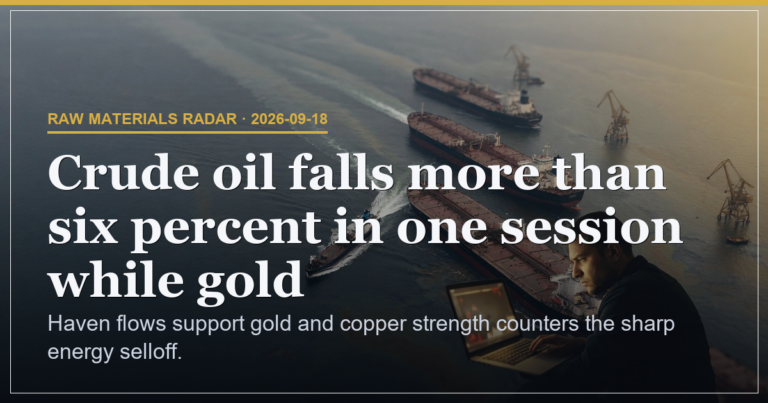
Commodity markets today delivered a signal that is more important for interpretation than many equity watchers appreciate. Gold fell 2.69 per cent. Crude fell 3.06 per cent. Those are not minor moves. But the fact that they fell together — and that gold fell in particular — is the tell. This was not a risk-off selloff. This was a rates repricing event, and commodities reflected that classification perfectly.
Commodity Performance: Friday
| Commodity | Close | Daily Change | Primary Driver |
|---|---|---|---|
| Gold (XAU/USD) | $4,355 | -2.69% | Real rates rising — opportunity cost increases |
| Crude Oil (WTI) | $90.19 | -3.06% | Iran premium removed + rates headwind |
| Silver (XAG/USD) | Est. down | ~-3% to -4% | Gold correlation + industrial demand concerns |
| Copper | Est. down | ~-2% | Growth concerns, dollar strength |
| Natural Gas | Est. mixed | Domestic story | Less correlated to Iran situation |
Gold: The Real Rate Mechanism Explained
Gold is the asset that most clearly demonstrates the “rates repricing, not risk-off” thesis. In a pure risk-off environment, fear dominates and capital flows to perceived safe havens. Gold is one of the classic safe havens. But gold’s relationship with real interest rates runs counter to its safe-haven characterisation in certain environments.
Here is the logic: Gold pays no interest. It generates no cash flow. Its only return is price appreciation. When real interest rates rise (nominal rates minus inflation expectations), holding a zero-yielding asset becomes proportionally less attractive compared to holding a Treasury bond that pays a positive real yield. Institutional holders of gold are making a rational calculation: if I can earn 2-3 per cent real in a Treasury, why hold gold which pays nothing?
Friday’s hot NFP print raises expected real rates because it both pushes nominal yields higher (via Fed hawkishness) and may reduce inflation expectations (strong labour market does not necessarily mean more inflation if supply chains remain stable). That combination is the most toxic environment for gold. The -2.69 per cent move is the market’s instantaneous response to that calculation.
Crude Oil: Two Independent Bearish Catalysts
Crude oil’s -3.06 per cent decline is the product of two separate bearish drivers coinciding on the same day. The first is the rates repricing. Higher US rates slow growth expectations. Slower growth means lower energy demand forecasts. Lower demand forecasts pressure crude prices.
The second is geopolitical. Secretary Bessent’s confirmation that the Iran conflict has been “halted” removes the risk premium that had been embedded in crude prices since the conflict began. That premium was not large — perhaps $2-4 per barrel — but its sudden removal adds directional pressure to a market that was already facing the macro headwind from rates. The combination produced the -3.06 per cent session.
Crude Price Driver Breakdown
~-1.5 to -2%
~-1 to -1.5%
-3.06% total
Crude at $90: The Key Reference
The $90 level in crude is the next psychological threshold. The market closed at $90.19, fractionally above it. A clean daily close below $90 would confirm the breakdown and open the door to the $87-88 support zone. That would be a significant development for two reasons: it would confirm the Iran premium is fully priced out, and it would suggest the demand-side growth fears from rates are also having a tangible effect.
The constructive case for crude: lower prices reduce energy costs for consumers and businesses, which could partially offset the headwinds from higher borrowing rates. If crude falls toward $85-88, it starts to become a deflationary tailwind that could actually soften the inflation picture and give the Fed room to ease later in the year. That is the counter-narrative to watch.
Gold Technical Levels
| Level | Type | Context |
|---|---|---|
| $4,450-4,480 | Resistance | Prior consolidation — now ceiling |
| $4,355 | Friday close | Post-breakdown level |
| $4,300-4,320 | Support 1 | Prior range low — first test |
| $4,200 | Support 2 | Only in extreme scenario |
Raw Materials Outlook
| Commodity | Near-Term Bias | Key Variable | Risk |
|---|---|---|---|
| Gold | Bearish near-term | Real rates — CPI next week | Around 60% |
| Crude Oil | Bearish near-term | $90 hold; OPEC response | Around 55% |
| Silver | Bearish near-term | Gold lead + industrial demand | Around 60% |
| Copper | Neutral — watch China | Chinese demand stimulus | Around 45% |
The raw materials complex has been repriced today. The Iran premium is gone. Real rates are higher. Dollar strength adds to the headwind. The only commodity that could find an independent bid is copper, if China provides meaningful stimulus to its industrial sector. Watch Beijing’s policy response to the global slowdown narrative that Friday’s NFP has helped create.
Alpha Insights is for informational purposes only. Commodity prices are subject to extreme volatility and are affected by geopolitical, macroeconomic, and supply-chain variables beyond analytical prediction.
Deepen Your Understanding
Related articles from the Titan Protect Foundry: