Date: Tuesday 2 June 2026 | Post-Close Edition, Post 01 of 19 | Data: Jun 1 close, locked 00:09 UTC Jun 2
Series: Macro Pulse — the economic and rate picture. How this week’s data and geopolitics interact with the September cut base case.
Published: ~21:00 BST / 16:00 EDT / 05:00 JST (Wed)
The Hormuz Variable: Energy Inflation Is Back on the Table
Twenty percent of global oil transits the Strait of Hormuz every day. Iran’s Speaker Ghalibaf released his first statement since halting negotiations with the US, and it was unambiguous: complete blockade. WTI moved from $87.36 to $92.38 in a single session. That is not a geopolitical risk premium — it is supply disruption pricing. The market is not asking whether oil might go higher; it has already bid the physical channel.
Here is why that matters for the rate picture. The Fed’s September cut base case was built on a specific set of conditions: core PCE continuing to decline, energy costs stable, real consumer spending moderating but positive. Crude at $88–$90 was the ceiling most strategists pencilled in for that scenario to hold. We closed Monday at $92.38. A single day’s close does not break the disinflation thesis. But a week of sustained $92+ crude — layered on top of Friday’s NFP — starts to complicate the language Powell uses in the next press conference.
The critical observation here is the gold-crude divergence. Gold fell 1.07% on Monday while crude surged 5.75%. In a pure fear scenario — geopolitical panic, flight to safety — both assets rise together. They diverged. That tells you the market is pricing supply shock, not systemic fear. Supply shock inflation is a different problem for the Fed than demand-pull inflation. It is harder to cut rates through it and easier to look like you waited too long.
Gold down 1.07% while crude up 5.75% in the same session is a clear signal: institutions are not running for safety — they are pricing a physical supply disruption. For the Fed, a supply-driven crude spike is harder to cut through than a demand-driven one. September is not off the table yet. But the language just got more complicated.
Goldman Sachs on Bonds: Flatter Real Rates and What That Actually Means
Goldman’s current bond view is one of the few pieces of institutional guidance that still points in a bullish direction for risk assets. Their read is that the recent bond rally was driven by two forces: flatter real rate curves at the front end, and lower front-end inflation expectations. Translating that: the bond market believes that inflation will continue to fall near-term, that the Fed will not need to hike again, and that the first cut is a question of when not if.
The second part of GS’s read is that easing financial conditions are providing a meaningful GDP boost. This is important because it means the market is not pricing a recession — it is pricing a soft landing where conditions are loose enough to support growth while inflation slowly normalises. That is the scenario that justifies stretched equity positioning. It is also the scenario that crude at $95+ would begin to undermine.
The tension is visible in the COT data. Asset managers were net long over 464,000 US Treasury contracts as of last week’s report. That duration bet is a direct expression of the “rates come down” thesis. If crude holds above $92 through this week and Friday’s NFP comes in strong — say 250K+ — those bond longs face a repricing. Not a collapse, but a painful unwind in a market that is already crowded in the same direction on equities.
The NFP Setup: Consensus 175K, Straddle Pricing 0.39% — Market Has Not Priced a Surprise
Friday’s Non-Farm Payrolls print is the week’s primary binary event. Consensus is sitting at 175,000 jobs. That is a reasonable number — not hot enough to scare the Fed, not weak enough to force a panic cut. The problem is the track record. In the last six NFP releases, four have surprised the consensus by more than 100,000 jobs. That means the “base case” print has come in wrong more often than right on the upside alone.
The options market has priced the full week’s SPY move at 0.39%. That is the straddle cost — the combined price of a call and put that lets you profit in either direction. For context, a week with NFP, live military action in Hormuz, and 24 scheduled economic releases should carry a higher implied move than that. The market has either correctly identified that the Hormuz situation stays contained and NFP comes in on-consensus, or it has mispriced both tails simultaneously.
The distribution of outcomes is not symmetric. A 250K+ NFP pushes the September cut back, puts pressure on bond longs, and — combined with crude staying elevated — introduces real CPI revision risk. A 100K or sub-consensus print opens the door for an emergency rate path repricing in the opposite direction, where bond positions win but equity longs get caught in a growth-scare selloff. The 0.39% straddle pricing is not accounting for either of those scenarios adequately.
SPY weekly straddle at 0.39% implies ~±$2.96 total move by Friday. SPY is at $758.54. Max pain at $754 sits just inside that range. A 250K+ NFP surprise alone could move SPY more than the straddle prices. That gap between straddle pricing and realistic tail distribution is the week’s defining tension.
The Dollar’s Non-Reaction: What DXY Flat Tells Us
DXY closed Monday essentially flat at approximately 99. That is striking. US forces conducted a military strike inside the Strait of Hormuz. In a normal geopolitical risk-off playbook, the dollar surges as global capital rushes into the reserve currency. That did not happen. The dollar barely moved.
There are two ways to read a flat dollar on a military escalation day. The first, and more optimistic reading, is that the FX market correctly assessed the action as limited and surgical — not the start of a broader regional conflict. In that scenario, dollar flatness is a signal that sophisticated capital does not see a systematic risk event developing. The second reading is more concerning: the dollar’s structural downtrend — driven by the US fiscal deficit running at -6% of GDP and persistent current account imbalances — is so entrenched that even a military event cannot generate a sustainable flight-to-safety bid. That is the reading where the dollar is not a refuge asset anymore.
For macro positioning, a weak dollar environment is typically equity-positive and commodities-positive. DXY around 99 continues to support the gold debasement narrative and provides some relief on import-cost inflation. But the absence of a dollar safe-haven premium also means the market has no cushion if Hormuz escalates further. If crude moves toward $100 and the dollar still does not bid, energy inflation feeds directly into domestic CPI without the offset of currency appreciation reducing import costs.
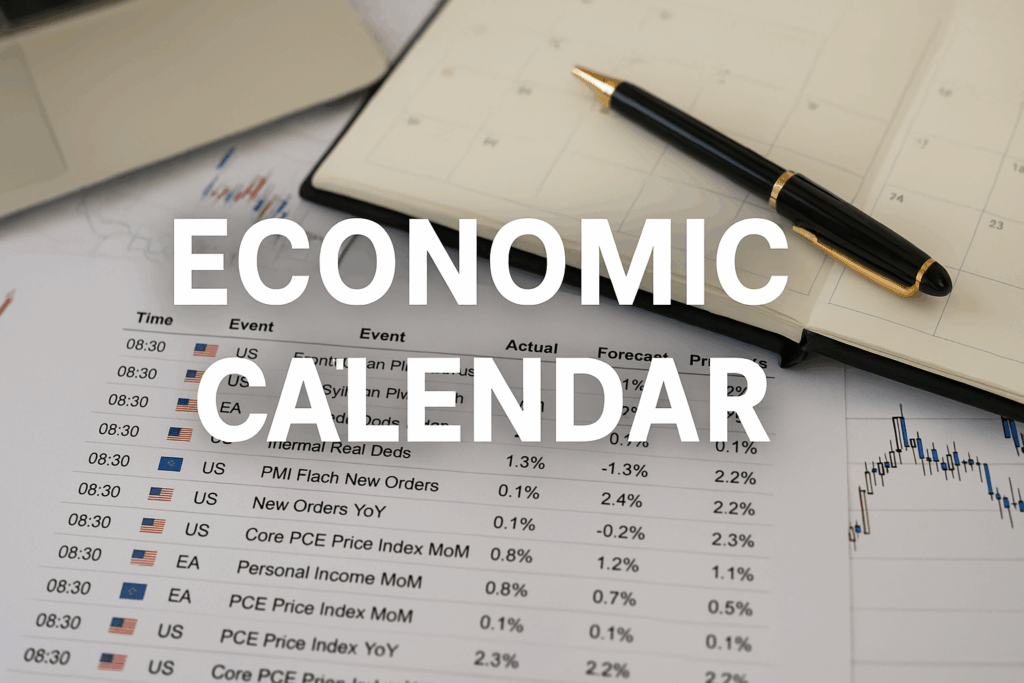
Economic Calendar: 24 Events, One That Matters
There are 24 scheduled economic releases and events across this week. The honest assessment: most of them are noise relative to Friday’s NFP. But several are worth tracking as confirmation or contradiction of the rate-cut thesis heading into Friday.
| Day | Event | Why It Matters | Rate-Cut Watch |
|---|---|---|---|
| Tue Jun 3 | ISM Manufacturing PMI | Activity gauge. Contraction adds cut pressure. | Below 50 = cut-supportive |
| Tue Jun 3 | Fed Gov Waller (Stablecoins Panel) | Waller off-topic but any rate commentary will move markets. | Watch for any Hormuz/energy commentary |
| Wed Jun 4 | ISM Services PMI | Services are 70% of US GDP. Majority of NFP jobs are here. | Strong services = hot NFP risk on Friday |
| Thu Jun 5 | Jobless Claims | Weekly signal. Tight claims = NFP beats more likely. | Sub-220K claims = risk-off for bond longs |
| Thu Jun 5 | Trade Balance | Energy import costs will be embedded. Deficit may widen on crude surge. | Wider deficit = dollar-negative, commodities-positive |
| Fri Jun 6 | NON-FARM PAYROLLS | Consensus 175K. Last 4/6 prints beat by 100K+. This is the week’s decision point. | Everything resolves here. Sept cut lives or dies on this print. |
The sequencing is the key. ISM Services on Wednesday gives the best preview of what Friday will look like. A hot services number is not just a data point — it is a warning that the NFP employment component may have remained tight. If services beat Wednesday and jobless claims stay below 220K on Thursday, the market going into Friday’s open will have to re-price upside NFP risk. The 0.39% straddle will have been mispriced across the entire pre-NFP window.
Macro Snapshot: Monday 1 June Close
| Indicator | Level | Change | Macro Signal | Rate-Cut Implication |
|---|---|---|---|---|
| Crude WTI | $92.38 | +5.75% | Supply disruption pricing — Hormuz chokepoint | Negative. Sept cut threatened if $92+ holds through June. |
| Natural Gas | $3.19 | -3.10% | Energy complex not fully in lockstep — selective crude premium | Gas pullback limits utility-cost CPI component spillover |
| Gold | $4,511.60 | -1.07% | Supply shock not fear — gold confirms no systemic panic | Confirms market still sees real rates falling. Debasement bid intact. |
| Silver | $75.12 | -0.66% | Industrial demand proxy steady — no recessionary signal | Neutral. Growth expectations intact. |
| DXY | ~99 flat | +0.27% | No safe-haven bid on military action — structural dollar weakness | Dollar not defending against crude inflation passthrough |
| EUR/USD | — | -0.13% | Modest EUR softness — Europe more exposed to energy shock | ECB cut path also complicated by Brent crude above $93 |
| USD/JPY | — | +0.23% | Yen weakening — no BoJ panic intervention yet | Yen weakness amplifies Japan’s energy import bill via Brent |
| S&P 500 | 7,599.96 | +0.26% | Complacent response to Hormuz strike. GS conditions still supportive. | Crowded long + low vol premium = asymmetric downside if macro turns |
| Nasdaq 100 | 30,513.86 | +0.60% | Semi strength (Samsung HBM4E news) supporting tech | Tech earnings week could amplify either direction |
| Russell 2000 | 2,905.76 | -0.47% | Small caps lagging — rotation to quality, not conviction buying | Small caps are rate-sensitive. Divergence from large caps is a tell. |
| VIX | 16.05 | +4.77% | Rose on the day but still low for NFP week + Hormuz | VIX at 16 with this calendar is the market’s biggest mispricing candidate |
| SPY Max Pain | $754 | vs $758.54 spot | Gravitational pull of $4.54 below spot | Max pain ladder: $754 > $751 > $742 by Jun 5 expiry |
| F&G Index | 59.1 | Greed | Complacent. Greed reading with military action in Hormuz. | Sentiment-driven positioning makes the correction faster when it comes |
How Macro Catalysts Become a Positioning Problem
Post 00 established that asset managers are at the most stretched net long S&P positioning of this cycle — over 1 million contracts. That number is not abstract. It represents the accumulated conviction of institutional money that the soft landing scenario holds, that rates come down, and that equities continue to grind higher. Every one of those contracts has a stop, a margin requirement, and a risk manager who gets nervous when headlines change.
The macro catalysts this week are exactly the type that test crowded positioning. Not because any single data point will break the bull case — but because the sequence of three events (ISM Services Wednesday, Claims Thursday, NFP Friday) arriving against a backdrop of $92 crude and ongoing Hormuz tension creates a compounding uncertainty that crowded trades cannot absorb as efficiently as they can when the picture is clean.
The small caps tell the early story. Russell 2000 fell 0.47% while Nasdaq rose 0.60% on the same day. Small caps are more domestically exposed, more leveraged to borrowing costs, and less able to absorb an energy-cost increase in their margins. When institutional money rotates from small caps to mega-cap quality on a day that should have been risk-off, it is not a sign of confidence — it is a sign of defensive repositioning inside a long-only mandate. The door has been opened. Whether the macro data this week forces it wider is the question.
Scenarios for the Week — Probabilities and Consequences
NFP prints 150–190K. Hormuz tension de-escalates mid-week. ISM Services comes in below 55. Crude pulls back toward $88–$90. Bond rally resumes. Sept cut back to high-probability. SPY tests $762–$765. Crowded long wins this week.
NFP prints 175–225K — beats consensus but not dramatically. Hormuz stays in headline risk (no physical disruption). Crude holds $90–$94. VIX drifts to 18–19. Max pain gravity pulls SPY toward $754–$751. Week ends flat to slightly lower. Market stays in wait-and-see mode on Sept cut.
NFP prints 280K+ AND Hormuz disruption becomes physical (tanker incidents, closed shipping lanes). Crude breaks above $95–$97. Sept cut pushed to December or removed from near-term pricing. Bond longs begin an orderly but painful unwind. VIX spikes toward 22–25. SPY tests $742 max pain gravity or lower. Crowded long begins to exit.
NFP misses badly (sub-100K) AND Hormuz closes physically. Recession fear + energy shock simultaneously. Emergency cut expectations priced. Equities fall on growth scare. Bond longs and equity longs both get hit in the chaos leg before the cut-pricing leg provides relief. Gold surges as the only clean asset. DXY collapses.
Strategy by Experience Level
| Tier | Approach | Position Sizing | Key Gate |
|---|---|---|---|
| Developing | Stay in cash or minimum exposure until NFP Friday resolves. This week’s macro picture has too many unpriced variables for active directional bets without a clear edge. | 25% of normal size maximum. No overnight carries through Wed/Thu data. | Do not initiate new longs above SPY $758 with max pain at $754. |
| Intermediate | Hedge existing longs with put protection through Friday. Consider energy exposure (XLE/crude) as a hedge against Hormuz escalation. Watch ISM Services Wednesday for NFP tell. | 50% normal size on any new directional exposure. Full size on hedges. | If crude breaks $95, re-evaluate ALL equity longs immediately. |
| Advanced | The straddle mispricing is the week’s trade. 0.39% implied move vs realistic 1–2% move distribution. Consider straddle or strangle positions that benefit from volatility expansion regardless of direction. The NFP tail is the catalyst. | Scale vol positions across Tue–Thu. Exit or roll before NFP morning if gamma has paid. | Gate: straddle only makes sense if VIX stays below 18 pre-NFP. Above 18 and the premium has already expanded — the trade has moved. |
Post 00 (Positioning Pressure) → this post → Post 02 (Sentiment: VIX vs F&G at 59 — which is right?) → Post 03 (Volatility: why 16 is the wrong number) → Post 04 (Setup Radar: levels, entries, targets) → Post 08 (Options: max pain ladder analysis) → Post 11 (FX: DXY flat — structural story or containment signal?) → Post 13 (Commodities: crude-gold divergence deep-dive)
- Crude at $92 is not a temporary spike — it is Hormuz supply risk being priced. If it holds above $92 through the week, the September cut base case weakens materially. The Fed cannot easily cut through a supply-shock energy inflation episode.
- The straddle at 0.39% is the week’s structural mispricing. NFP with a 4/6 100K+ surprise track record plus live Hormuz risk does not belong inside a 0.39% weekly implied move. Something will widen — either via vol expansion pre-NFP or via the print itself.
- Wednesday’s ISM Services is the NFP preview. A services beat on Wednesday changes the entire risk calculus for Thursday-Friday. That is the day the market gets its first real read on whether Friday’s print will test the 1M+ net long institutional position.
Deepen Your Understanding
Related articles from the Titan Protect Foundry: