You took the trade. You were right. The chart did exactly what you said it would do. Then twenty minutes in you closed the position. Two hours later, the move you predicted finished. Without you.
The Most Common Failure In Retail Trading

This is not bad analysis. It is not bad timing. It is the inability to sit with a winning position long enough to collect what you forecast. The reason is psychological, not strategic. The brain does not weigh five hundred pounds of profit and five hundred pounds of profit equally. It weighs the second five hundred at half the value of the first.
This is called diminishing marginal utility, and Daniel Kahneman won a Nobel Prize describing it. In trading, the first profit you see triggers a powerful urge to lock it in. Every additional pound of unrealised profit feels less important than the pound already on screen. So you close. You feel relief. You congratulate yourself for “taking the win.” And the trade keeps going without you.
The Fix Is Not Willpower
The fix is structural. The half-in, half-out framework removes the choice from the heat of the moment. You decide before you take the trade what you will do at each level. You write it down. You execute mechanically.
Tier One — Enter
You enter the full position at your planned entry. Stop loss is set immediately. Risk is calculated. You are now in.
Tier Two — Half Off At First Target
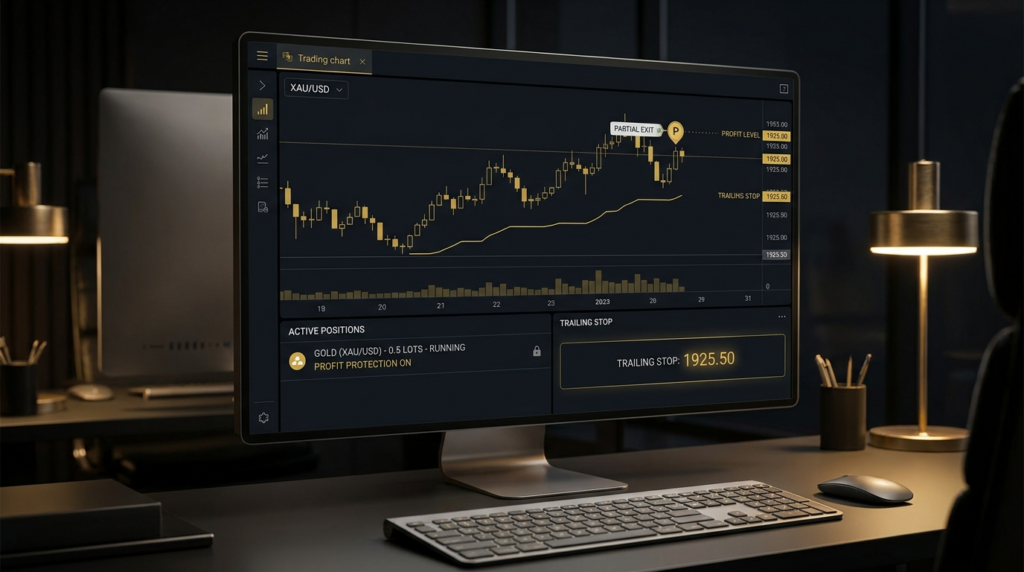
When price reaches your first target — typically a one-to-one reward to risk — you close fifty percent of the position. You move the stop to entry on the remaining fifty percent. You are now in a free trade. Your worst case from this point is breakeven. Your best case is unlimited.
Tier Three — Let The Runner Run
The remaining fifty percent stays open until either price reaches your structural target — usually a tier one resistance from the confluence framework — or until price reverses through your trailing stop.
Why The System Works
It satisfies the psychological need to lock something in. You took half the position off. The brain stops screaming.
It puts you in a free trade with no further risk. You are no longer trading with money — you are trading with house money. The pressure to defend a paper profit disappears.
It lets you participate in the full move when it actually happens. Most weeks, half your trades will hit tier two and reverse. That is fine — you locked in one R. The remaining handful will run to tier three and pay you three to five R on the back half. Those are the trades that pay for the year.
The Maths
If your average loss is one R and your average tier two exit is one R, you break even on the half you take off. The other fifty percent — the runners — are pure expectancy. If even one in three of those runners reaches three R, your overall expectancy is positive without changing your win rate at all.
Look at any week of professional trading and you will find this pattern. The pros are not better at picking entries. They are better at letting trades work. They have removed the urge to close at the first sign of profit by structuring the exit before the entry.
The Five-Step Rule
01
Take the position.
02
Set the stop.
03
Hit tier one — close half.
04
Move stop to entry.
05
Let the back half run to structure or trail.
That is the whole framework. Five steps. No decisions in the heat. No paper-profit panic.
Closing Reframe
The next time you close a winning trade twenty minutes in and watch it finish two hours later without you — remember this. The trade was not the problem. Your exit framework was the problem. Fix the framework, keep the trade.
This is analysis, not financial advice. Trading involves substantial risk. Always manage your risk and trade your own plan.
Deepen Your Understanding
Related articles from the Titan Protect Foundry: