3 July 2026
Roblox at $43: The Metaverse Play That Stopped Being a Joke
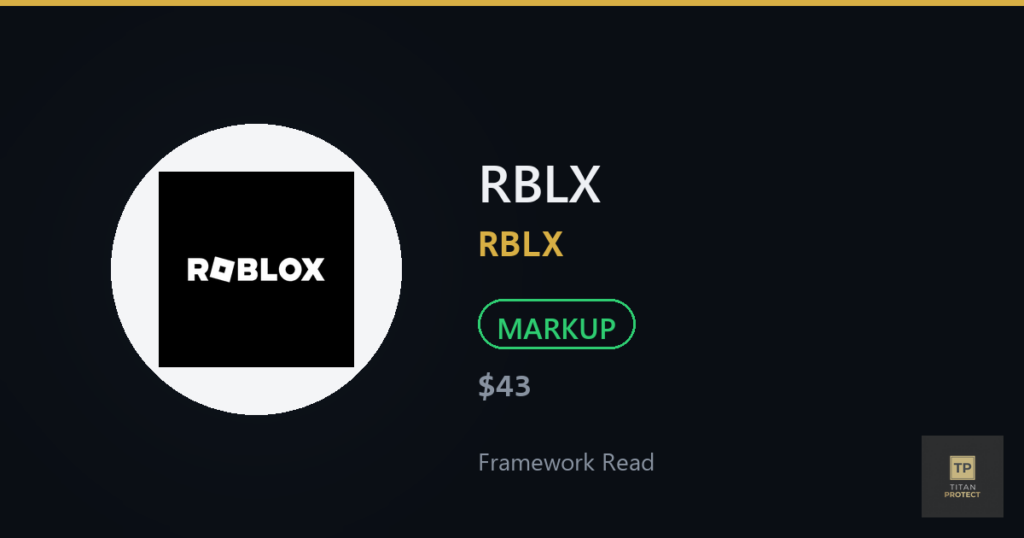
RBLX sits in a markup regime at $43. While every other metaverse company crashed and burned, Roblox quietly built the platform that 80 million daily users actually want.
Regime Classification: Markup
| Metric | Reading | Implication |
|---|---|---|
| Current Price | $43 | Rising from $25 lows, institutional trend established |
| Regime | Markup | Active institutional accumulation driving price higher |
| Sector | Communication | Gaming/social platform, user-generated content |
| DAU Trend | 80M+ daily active users | Engagement metrics support revenue growth |
What the Regime Data Actually Says
Roblox is in markup, which means institutional capital has made a decision: this business is worth more than the current price. That decision is backed by sustained buying that shows up clearly in the positioning data. The trend is up, the volume confirms it, and the fundamental trajectory supports it.
At $43, RBLX has nearly doubled from its 2024 lows. The sceptics who called it a children’s game have been proven wrong by the data. The platform’s expansion into older demographics, advertising, and creator monetisation has transformed the investment thesis from “kids play Roblox” to “Roblox is the social infrastructure for Gen Alpha and increasingly Gen Z.”
Why the Demographics Matter
The most underappreciated aspect of Roblox is demographic lock-in. Children who grew up on Roblox are now teenagers who still use Roblox. The platform’s average user age has been rising steadily, contradicting the narrative that users would “age out.” When your platform grows with its users rather than losing them, you have something far more valuable than a game. You have a social network.
The advertising implications are enormous. Brands pay premium rates to reach young, engaged audiences. Roblox’s immersive advertising format generates higher engagement than traditional display or video ads. As this revenue stream scales, it adds a high-margin layer to the existing bookings-based model.
The Profitability Question
Roblox remains free cash flow negative on a GAAP basis, which gives bears ammunition. Developer payouts consume a significant portion of revenue, and infrastructure costs scale with user growth. The path to profitability exists but requires continued revenue per user expansion without proportional cost increases.
The markup regime suggests institutional investors believe profitability is coming. They would not be building positions in a business they expect to burn cash indefinitely. The question is timing, and the regime says the market is willing to wait.
Competition and Moat
Roblox’s moat is its developer ecosystem. Over 4 million developers create experiences on the platform, and top developers earn millions annually. This creates a virtuous cycle: more developers mean more content, more content attracts more users, more users attract more developers. Breaking this cycle would require a competitor to simultaneously attract both sides of the marketplace, which is extraordinarily difficult.
Fortnite Creative and Minecraft remain competitors, but neither has replicated Roblox’s breadth of user-generated content or its developer economy. The moat is real.
Comparing to Other Markup Names
RBLX joins Shopify, Spotify, and SoFi in the markup cohort. What these companies share is a clear business model evolution that institutional capital believes in. They restructured, found their path, and the market is rewarding execution with sustained buying.
Strategy Considerations by Tier
| Approach | Consideration |
|---|---|
| Growth Investors | Markup regime supports participation. User growth and advertising scaling provide the fundamental backing. |
| Risk-Conscious | No GAAP profitability yet. Size positions for the probability that the path to profit takes longer than expected. |
| Tactical | Consolidations within markup regimes are normal. Use regime data to distinguish healthy pullbacks from regime shifts. |
The Bottom Line
Roblox at $43 in markup is the market saying the metaverse is not dead, it just looks different from what Meta promised. It looks like 80 million daily users building, playing, and socialising on a platform that grows with them. The regime supports constructive positioning, with the caveat that profitability remains a future event rather than a present reality.