Date: Monday 1 June 2026 | Pre-NY Edition, Post 6 of 19 | Data: Live as of 09:00 EDT
Series: Hot Zones – sector rotation, institutional flow analysis, where the real positioning is happening
Published: ~14:00 BST / 09:00 EDT / 22:00 JST (Mon)
The Iran Rotation Playbook: Who Benefits, Who Pays
When oil-producing nations are involved in military conflict, the standard institutional sector rotation is well-established. Energy and defence move into the first rotation layer because the revenue implications are direct: higher crude prices lift energy company earnings, and military action drives near-term defence contract expectations. Utilities move into the second layer because they are defensive instruments – low beta, dividend-supported, sought by institutions reducing growth exposure while not going fully to cash.
The sell side of the rotation is equally predictable but less discussed. Consumer discretionary sells because higher energy prices compress household spending capacity. Financials, particularly small-cap regionals and consumer-credit lenders, sell because the higher-for-longer interest rate implication of $90 crude delays the rate-cut cycle that small-cap credit businesses depend on. Real estate investment trusts sell for the same reason – they are leveraged rate-cut plays, and crude at $90 directly challenges the September cut base case.
The nuanced layer is technology. The AI bond issuance data noted that AI companies have issued $140 billion in investment-grade bonds year to date – 49% of total IG issuance. When a geopolitical shock creates selling pressure, the assets that come off first are the ones where profit-taking yield is highest. The equal-weight S&P to cap-weighted ratio at 1.1 near historic lows confirms that concentration in large-cap tech is extreme. When pressure arrives, the most overextended positions lead the distribution.
Sector Performance Table: Monday 1 June 2026
| Sector | ETF Proxy | Direction | Iran Driver | Flow Signal | Week Outlook |
|---|---|---|---|---|---|
| Energy | XLE | Strong bid | Crude +3.08% direct revenue lift. Nat gas +2.74% confirms. | Institutional buying confirmed. COT rebuilding. | Hold if crude above $88. Reduce if crude fades toward $86. |
| Defence/Aerospace | ITA | Strong bid | US military action = contract expectations + short covering. | Momentum buyers plus short covering simultaneously. | Geopolitical momentum trade. Reduce if Iran contained mid-week. |
| Utilities | XLU | Mild bid | Defensive rotation out of growth names. | Quiet institutional accumulation. Not aggressive flow. | Hold as defensive hedge. Not a momentum trade. |
| Technology | XLK | Mild pressure | Profit-taking in highest-gain sector. Energy cost pressure secondary. | Institutional light distribution at highs. NDX lagging Dow 36bp. | Watch NDX vs Dow divergence extending as a rotation signal. |
| Financials | XLF | Selling | Rate-cut delay from crude inflation = NIM compression outlook. | Institutional reduction confirmed. Rate-cut bet unwinding. | Underweight all week. Rate-cut probability falling with crude at $90. |
| Consumer Disc. | XLY | Selling | Energy costs squeeze household spending capacity directly. | Leveraged reduction. Not yet panic but directional. | Avoid. Iran keeps this sector under pressure all week. |
| Real Estate | XLRE | Clear selling | REIT multiples require rate cuts. Iran delays them materially. | Institutional exit. First sector to reflect rate-cut probability decline. | Avoid entirely. Most sensitive sector to the crude-inflation-rate chain. |
| Materials | XLB | Mild bid | Gold and silver uplift from geopolitical premium. | Passive lift from metals. Not independent institutional flow. | Follows metals. If gold bids at the entry zone, materials get a passive lift. |
The Institutional Exit: What the Selling Sectors Tell You
The sector that tells you the most about institutional intent on Iran day is not energy – everyone expects energy to rise. The most informative exit is real estate. REITs are long-duration assets. Their valuation depends entirely on the rate path. When crude rises 3.08% and geopolitical risk raises the probability of persistent energy inflation, institutions that hold REITs for their rate-cut premium unwind those positions immediately. That exit is visible before the bond market itself explicitly moves.
The financial sector exit is the confirmation. Small and mid-cap financials are rate-cut dependent for their net interest margin expansion story. When crude adds 3% to inflation expectations, the NIM expansion trade deteriorates. The institutional exit from financials on a day when the headline index is positive is a sophisticated read: they are not reacting to today’s data; they are repositioning for a week in which Thursday’s data and Friday’s NFP may confirm that rate cuts are further away than the market was pricing on Friday.
The consumer discretionary sell is the most forward-looking signal. Crude at $90 adds approximately $15-$20 per week in fuel costs for the average American household – directly at the expense of discretionary consumption. The sector is pricing that outcome right now, not next quarter.
The Technology Distribution Signal
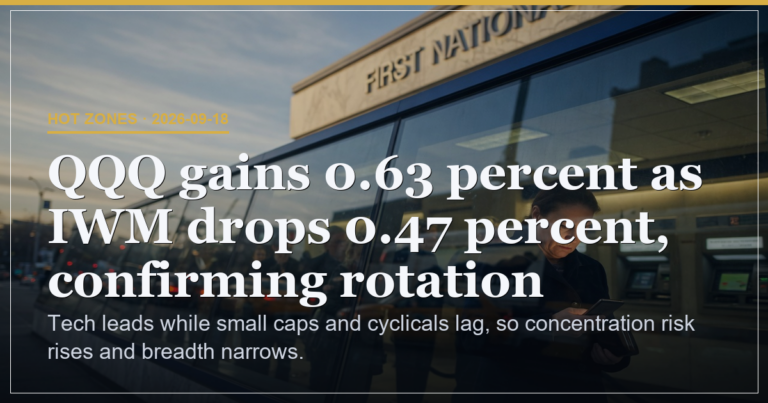
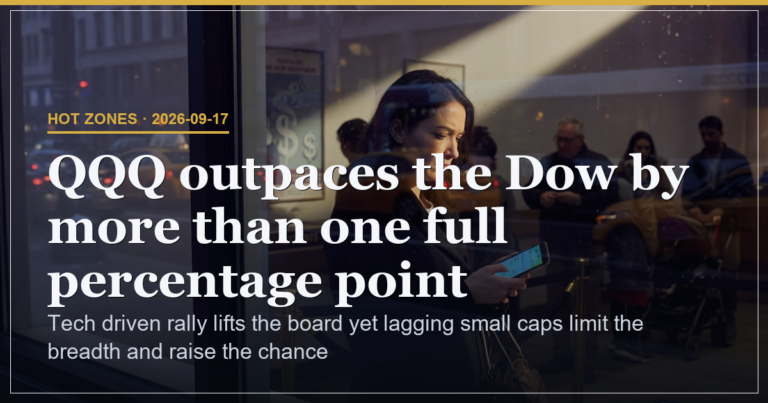
The NDX at 30,333 is up only 0.36% compared to the Dow’s 0.72%. That 36 basis point underperformance on an energy shock day is the subtle tell. Technology is where the most stretched institutional positions sit. When geopolitical risk rises and institutions reassess risk appetite, the assets with the most accumulated gains and the most concentrated positioning are the first to see light distribution. This does not mean sell technology aggressively. It means that if you are long NDX expecting it to carry the market higher this week, the rotation signals suggest the Dow is the vehicle for continued upside – not NDX.
The AI bond issuance data from Post 1 adds a specific risk: $140 billion in IG bonds issued YTD by AI companies represents 49% of all investment-grade issuance. If geopolitical risk raises credit spreads even modestly, a disproportionate share of that repricing falls on the sector that has driven most of the equity market multiple expansion. The tech distribution on Iran day is the first visible signal of that repricing possibility.
Gold Miners: The Leveraged Expression of the Gold Bid
Gold miners (GDX) are the leveraged expression of the gold structural bid mapped in Post 5. Miners amplify the gold move – typically 2-3x the percentage move in spot gold. If gold reaches the $4,480-$4,510 entry zone and gold is the right trade as Post 5 argued, GDX at that point is a higher-risk, higher-reward expression of the same thesis. The Iran geopolitical bid adds the same second layer to miners that it adds to spot gold. Position sizing should be proportionally smaller than direct gold given the leverage, but the directional logic is identical: two stacking drivers (debasement + geopolitical) underneath a controlled pullback from a recent high.
Hot Zone Signals: Week Ahead Roadmap by Sector
| Day | Sector to Watch | Catalyst | Bullish Signal | Bearish Signal |
|---|---|---|---|---|
| Monday | Energy, Defence, REIT | ISM Manufacturing 15:00 BST | XLE holds above Friday close + crude stays $89+ | XLRE accelerates lower – rate-cut odds falling hard |
| Tuesday | Financials, Consumer Disc. | JOLTS Job Openings | JOLTS soft – financials recover, rate-cut odds firm | JOLTS strong – financials extend lower on NIM concern |
| Wednesday | Technology, Gold miners | ADP + ISM Services | ADP weak – tech recovers. Gold miners (GDX) bid. | ADP strong – tech distribution accelerates. VIX reprices. |
| Thursday | All sectors – repositioning | Claims + pre-NFP positioning | Claims above 230K – defensive rotation complete. Hold defence + energy. | Claims below 210K – all rate-cut plays sell simultaneously. |
| Friday | NFP – binary rotation trigger | Non-Farm Payrolls 13:30 BST | Soft NFP – financials, REITs, discretionary all recover simultaneously | Strong NFP + crude above $90 – rate-cut priced out. Everything rate-dependent sells hard. |
Track Record: What Friday Hot Zones Called
Friday’s Hot Zones post identified NZD/USD as the clearest risk-on FX expression – confirmed, currently at 0.5972 near the entry zone identified. It identified that the financial sector was the most sensitive to the rate-cut narrative – confirmed, financials are the clearest selling sector today with crude at $90 directly challenging the rate-cut base case. It identified Bitcoin not functioning cleanly as a risk proxy – confirmed, BNB -3.36%, BTC -0.88% while equities are positive. The one call requiring an update: Friday’s post did not specifically flag defence/aerospace because there was no geopolitical catalyst at that point. The Iran news has made defence stocks the single-session leader. That is not a miss – it was a non-existent catalyst. The framework for reading the rotation applies regardless of the specific trigger.
Experience Level Guidance
Use the sector table as a filter, not a trade list. If you are considering a financial or real estate stock this week, note that both sectors are under institutional selling pressure due to the rate-cut delay from crude at $90. The same trade that worked last week (financials on rate-cut optimism) has a direct headwind this week. That headwind is not visible in the chart – it requires understanding the Iran-crude-inflation-rate-cut chain laid out here.
The energy sector (XLE) bid is legitimate and supported by the COT crude data – leveraged funds covering shorts, managed money rebuilding. An XLE position alongside the crude dip-buy mapped in Post 5 expresses the same Iran energy story from two angles. Both positions reduce by Thursday. Watch for XLE options call premium building through Tuesday as confirmation that institutional commitment to the energy trade is extending beyond Monday.
The equal-weight to cap-weighted S&P ratio near historic lows creates a pair trade: long XLE (underweight, catching a bid) against short XLK or QQQ (overweight, seeing marginal distribution). The pair captures the rotation theme without depending on the market’s direction. If Iran escalates, energy catches a bigger bid and tech sells harder – the pair wins both ways. If Iran de-escalates and crude fades, reduce both legs quickly and preserve capital for the NFP binary.
This analysis is produced for informational and educational purposes. It does not constitute financial advice or a recommendation to buy or sell any financial instrument. All trading involves risk. Past performance does not guarantee future results. You should always conduct your own research and consider your financial circumstances before making any investment decision. Risk percentages are estimates based on market conditions at time of writing and may change rapidly.
Deepen Your Understanding
Related articles from the Titan Protect Foundry: