Titan Playbook Series
Titan Playbook 04: Swing Trading
Multi-day holds, entry on pullbacks, and the patience that separates swing traders from day traders who forgot to close.
The Swing Trading Edge
Swing trading occupies the middle ground between the constant screen time of day trading and the very long hold periods of trend following. A swing trade typically lasts one to ten days, sometimes stretching to two or three weeks on larger timeframe setups. The core idea is to capture one identifiable leg of a move: a clear directional impulse within a larger structure, entered on a pullback or consolidation, with a defined exit once that leg has delivered.
The practical appeal for most independent traders is significant. Swing trading does not require watching a screen all day. The 1-hour and 4-hour charts used for setup identification move slowly enough that a trader checking the market twice a day, once in the morning and once in the evening, can manage positions effectively. This makes it one of the few serious approaches that genuinely coexists with a day job or other commitments.
That accessibility comes with a trade-off that most people underestimate before experiencing it. Overnight and weekend gap risk is real. A position entered on a clean technical setup can open the following morning at a significantly different price if news breaks outside market hours. Managing that risk through position sizing and careful timing around known events is not optional. It is the central skill of swing trading.
Entry on Pullbacks
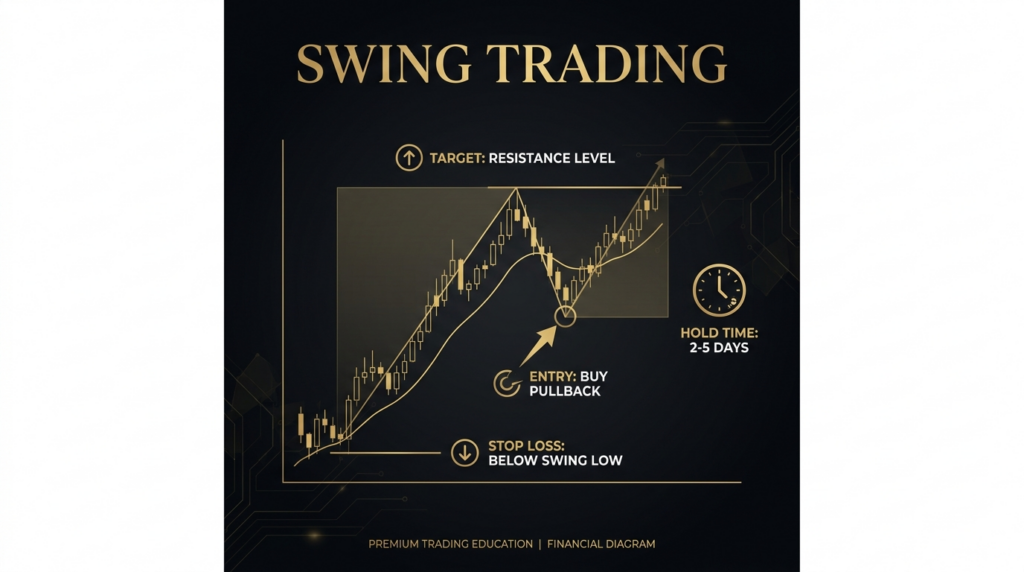
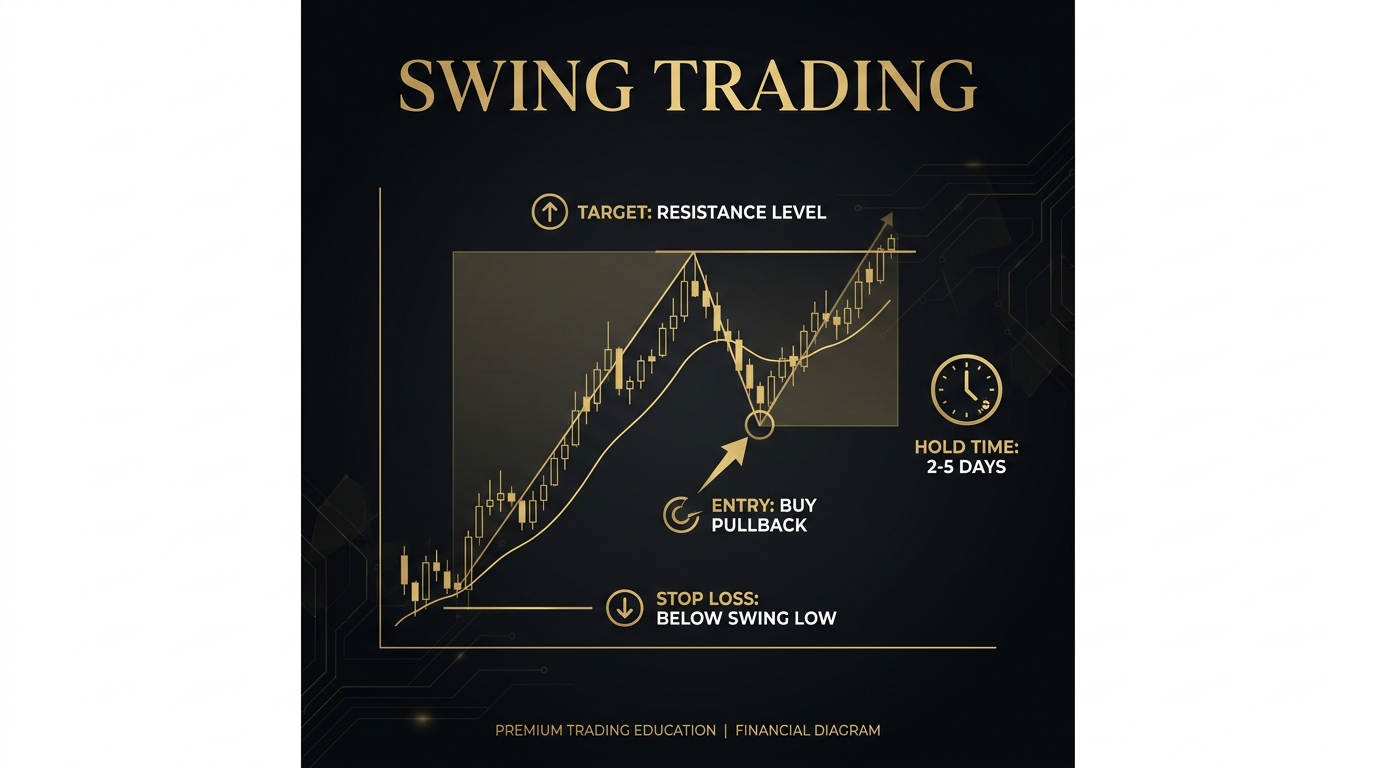
The textbook swing trading entry is not at the start of a move. It is at the first meaningful retracement within an established directional context. A market that has broken above a significant resistance level, consolidated for a few sessions, and begins to pull back toward that former resistance, now acting as support, offers a defined risk swing entry. The invalidation point is clear. The potential reward is calculable. The structural context supports the trade.
Chasing extended moves is the most common swing trading error. A market that has already moved 150 points in two days without a meaningful pullback is not a swing trade entry. The risk/reward at that point is poor. The stop required to protect the position is wider than the remaining realistic target. Discipline around entry timing is what separates traders who compound over months from those who give back gains in a single position they should not have taken.
Patience is the core swing trading skill. You will miss moves waiting for pullbacks that never come. That is the cost of the approach. The moves you do catch will have better entry prices, tighter stops, and more defined risk profiles than entries chased at extension. Over time, the quality of entries compounds into meaningfully better performance than pure momentum chasing.
Managing Overnight Gaps
Every overnight hold carries gap risk. The market closes at one price and opens at another. That gap can work for you or against you, and you have no control over which one it will be. What you do control is the size of the position and whether the structure of the trade justifies the exposure.
Several practices reduce gap risk without eliminating overnight holds entirely. Avoiding holds through scheduled high-impact events, particularly central bank decisions, non-farm payrolls, and CPI releases, removes the most extreme gap scenarios from the picture. Sizing swing positions smaller than intraday positions, because the stop is wider and the overnight exposure is real, keeps individual gap losses within manageable bounds. Using correlated instruments as an informal hedge when the primary position is large is a technique used by professional swing traders to reduce directional exposure without closing the core position.
Weekend gaps deserve separate attention. Holding positions over a Friday close means carrying two extra days of news flow without any ability to react. Many swing traders have a standing rule against holding significant positions over the weekend unless the trade is already substantially in profit and the stop has been moved to a level that reflects that.
Trail vs Target: When to Use Each
Once a swing trade is working, the decision of how to exit becomes the most important remaining question. Two approaches dominate: a fixed target set at entry, or a trailing stop that adjusts as the move extends.
Fixed targets work well when the structural case for the trade has a clear destination. A market moving back to test a prior swing high, for example, has an identifiable target. Exiting at or near that level locks in the expected return from the structural argument and avoids the risk of watching a profitable trade retrace into a loss waiting for more.
Trailing stops work better when the trade is entering a clear trend and there is no obvious reason why it should stop at any particular level. Trailing above recent swing lows in a rising market allows the position to run as long as structure remains intact, without giving back excessive profit on normal pullbacks. The trade-off is accepting that some retracement will occur before the trail triggers, which requires a different psychological relationship with the position than a hard target approach.
Many experienced swing traders use a combination: take partial profit at the first structural target, then trail the remainder. This approach locks in a positive expected outcome while keeping exposure to the potential for a larger move.
| Factor | Swing Trading | Day Trading |
|---|---|---|
| Hold Duration | 1 to 10 days, sometimes longer | Minutes to hours, flat by session close |
| Overnight Risk | Present, must be sized for | None, all positions closed |
| Screen Time Required | 1-2 checks per day sufficient | Active presence during session |
| Typical Stop Width | Wider, structural, 20-80 points on indices | Tighter, 5-20 points on indices |
| Position Size | Smaller (wider stop, overnight risk) | Can be larger relative to risk amount |
| News Event Impact | High, avoid holding through major events | Manageable within session, close before releases |
| Primary Timeframe | 1-hour to 4-hour for setup identification | 5-minute to 30-minute |
| Trade Frequency | Low, 2-8 trades per week | Higher, 2-6 per session |
Action Items
- Set your position size for swing trades based on the wider stop width required. A swing stop twice as wide as an intraday stop means half the lot size for the same account risk.
- Mark all high-impact economic events in your calendar for the next two weeks. Decide in advance whether you will close positions before each one or hold with reduced size.
- Define a rule about Friday holds. Write it into your trading plan before you have an open position on a Thursday afternoon.
- On your next swing trade, decide at entry whether you are using a fixed target, a trailing stop, or the partial-profit hybrid. Do not change the approach mid-trade.
- Review your last ten trades and check how many were entries on pullbacks versus momentum entries. Calculate the average risk/reward for each category.
Continue Learning
- Titan Playbook 03: Day Trading
- Titan Playbook 05: Trend Following
- What Is a Stop Loss?
- Risk/Reward Ratio Explained
- Pre-Market Routine