Trader Mindset Series
Motivation gets you started. Routine keeps you consistent. Consistency builds an edge.
Why Routine Beats Motivation
Every trader has days where they do not want to look at a chart. The session brief is dull, nothing is moving, or the last few trades stung. Motivation tells you to skip it. Routine sits down at the desk anyway.
Successful trading is not about inspiration. It is about showing up to the same process, day after day, until the edge in your system compounds. Surgeons do not rely on feeling motivated before an operation. Pilots do not skip the pre-flight checklist when they are tired. These are professionals with processes, and that process protects them and everyone depending on them.
For a trader, the routine does three things. It puts you in the right mental state before the market opens. It gives you a framework for decisions during the session, so you are not inventing ideas on the fly. And it forces a review period after the session that most traders skip entirely, which is where the actual learning happens.
The Three Phases of a Trading Day
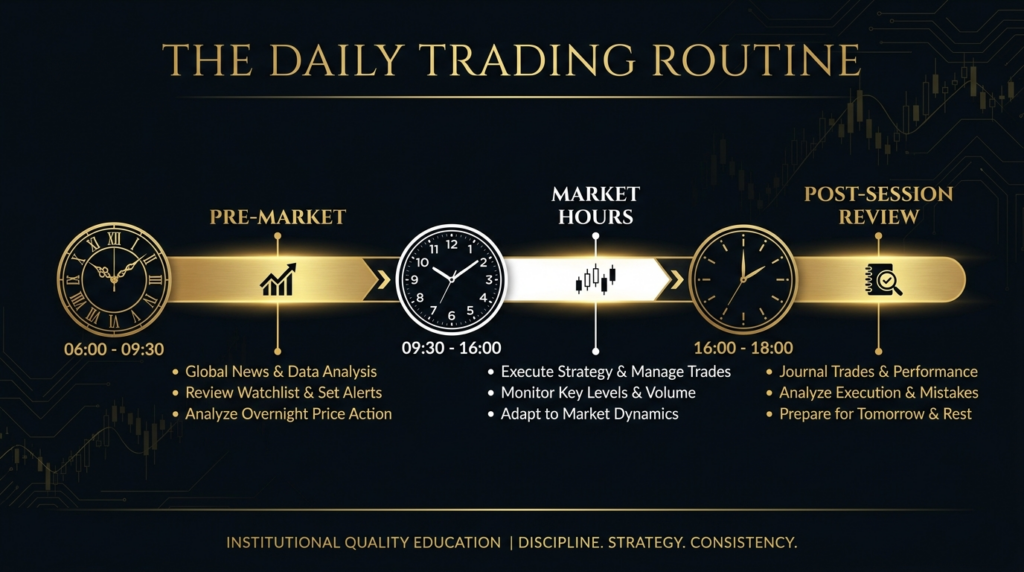
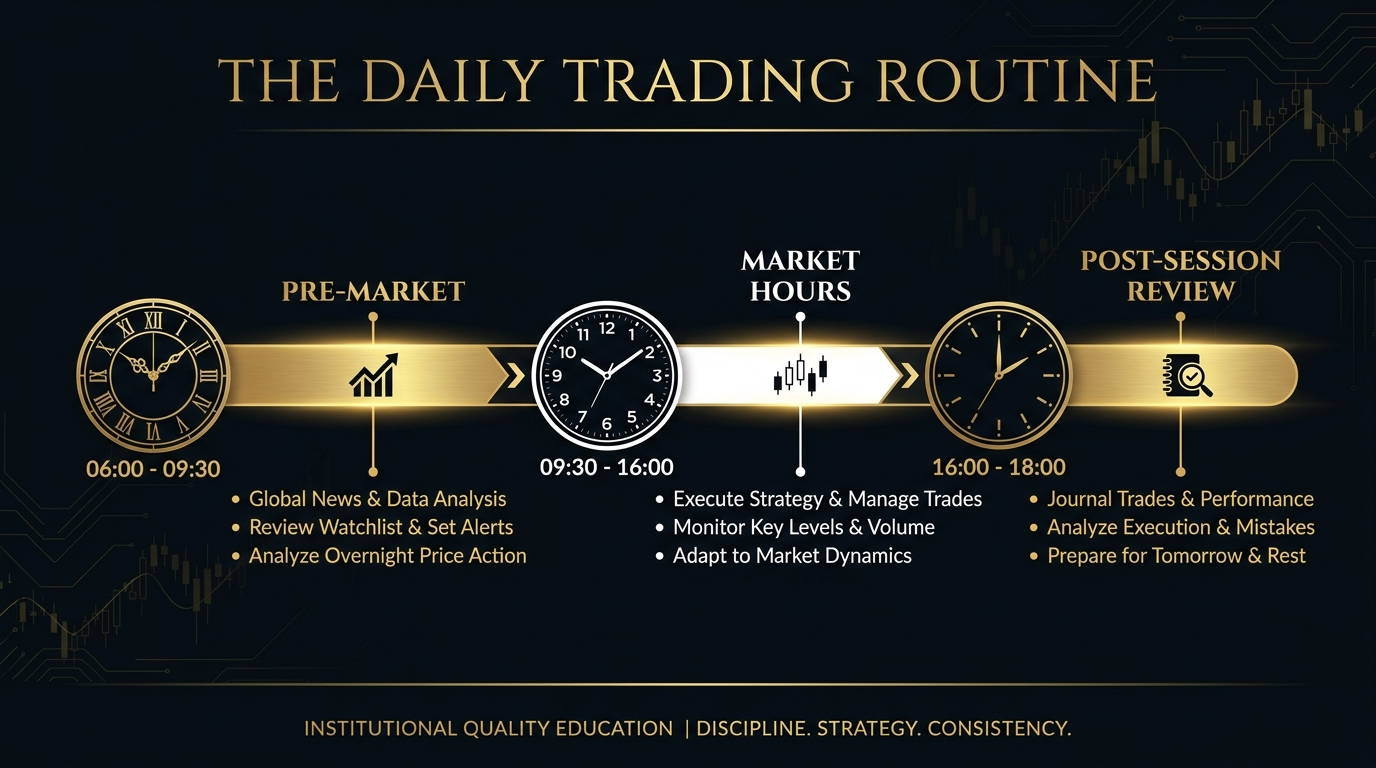
A sustainable routine has three distinct phases: preparation before the market opens, execution during the session, and review after it closes. Each phase has a job. If one collapses, the others suffer.
Phase 1 — Pre-Market Preparation
This is the 30 minutes before you take a single trade. Most traders underestimate how much this determines the quality of their session. Walking into a session without a plan is like driving somewhere new without checking the route first. You might get there, but probably not efficiently.
In pre-market prep you are asking: what happened overnight, where are the key levels, what is the macro context, and what am I looking for today? You are not trying to predict every move. You are building a set of scenarios: if this happens, I do this. If that happens, I do that.
You also want to flag the economic calendar. An interest rate decision or CPI release mid-session changes the rules. Spreads widen, gaps appear, and stops that looked sensible suddenly get run. Know when the events are before you size up.
Phase 2 — Session Execution
During the session, your job is to execute the plan you built in Phase 1, not to make a new plan on the fly. If a setup develops that was not in your pre-market notes, it is worth pausing before acting. Ask whether it meets your criteria. If yes, take it. If you are not sure, wait.
Avoid overtrading by having a daily loss limit. When you hit it, the session is over. This is not weakness. It is recognising that once you have given back a set amount, the probability of making good decisions drops sharply. Every professional desk has a daily loss limit. Prop firms enforce them automatically.
Phase 3 — Post-Session Review
This is the part most traders skip, which is exactly why most traders do not improve at the rate they expect. The review is where you turn experience into education. Without it, you are repeating the same patterns indefinitely.
The review does not need to take an hour. Ten focused minutes covers it. Review every trade taken: was the setup valid, was the entry clean, was the stop placed correctly, was the management disciplined? Note what you would do differently. Flag it for the weekly review where patterns across multiple sessions become visible.
A Sample Daily Routine
The exact times will vary depending on your timezone and the instruments you trade. The structure below is built around a London-open day trader, but the sequence applies to any session.
| Time | Activity | Purpose | Duration |
|---|---|---|---|
| 07:30 | Overnight review, Asia session recap | Context before London opens | 10 mins |
| 07:40 | Economic calendar check | Flag high-impact events, mark times | 5 mins |
| 07:45 | Key levels on charts (daily + 4H) | Mark where the structure is | 10 mins |
| 07:55 | Write session plan: scenarios and criteria | Decision framework for the session | 5 mins |
| 08:00 | Session opens, watch-only for first 15 mins | Observe direction, avoid the open spike | 15 mins |
| 08:15 | Active trading window | Execute plan, manage positions | Up to 4 hrs |
| 12:00 | Lunchtime flat or hold review | Reassess open positions before NY open | 10 mins |
| Session close | Post-session review and journal entry | Lock in the learning, not just the P&L | 10 mins |
Adapting the Routine to Your Timezone
If you are trading the New York open rather than London, shift the prep block to 13:30 UK time or 08:30 US Eastern. The sequence is identical. If you are a swing trader checking charts once a day, your routine compresses to a single 30-minute block: overnight recap, key levels update, plan for the next 24 hours.
The point is not to copy someone else’s schedule. It is to have your own consistent sequence that you do not deviate from. A US-based trader who runs a 20-minute prep at 8am Eastern every day will outperform a UK trader who spends two hours some days and five minutes other days.
Consistency of process, not volume of process.
What a Routine Cannot Do
A routine will not tell you whether to buy or sell. That is your edge, your criteria, your system. What the routine does is make sure you show up to the decision in the best possible state, with the right information, in the right frame of mind.
When traders break their routine, usually because of excitement, boredom, or a recent bad run, the quality of their decisions drops. Not because the market changed. Because they changed their preparation. The routine is the invisible work that makes the visible results possible.
Action Items
- Write out your current daily routine as it actually happens, not as you wish it would. Be honest about what you skip.
- Build a 30-minute pre-market block with three fixed tasks: overnight recap, calendar check, key levels. Run it for five consecutive sessions.
- Set a daily loss limit. Decide the number now, when you are calm, not in the middle of a losing session.
- Add a 10-minute post-session review to your routine this week. Review each trade against your plan, not against the outcome.
Continue Learning
Trader Mindset Series
← Understanding Risk-to-Reward
Next in Series
Building Your Pre-Market Routine →