Russell 2000 (RTY) – Daily Read
6 September 2026 | Index | Titan Macro Desk
2,968.3
Russell 2000 (RTY) is consolidating within a broader advance, but the near term balance has tilted defensive. Last price 2,968, 0.0 percent lower on the day. That unchanged surface masks a softer structure underneath: it is trading in the lower half of its one-month range, below the one month average 3,010, and the structure reads as a pullback, slipping under the one-month average while the longer trend still points up. The clear view is cautiously constructive, but buyers need to reclaim lost ground before this becomes a credible continuation rather than a deeper reset.
The macro tension is unusually important for small caps. A stronger labor backdrop has pushed bond yields higher and revived concern that monetary policy may tighten, while incoming inflation data now carries greater weight. That combination raises the financing hurdle for smaller companies, which generally depend more heavily on domestic credit conditions and have less balance sheet flexibility than large multinational peers. At the same time, resilient employment can support domestic demand, so the growth message is not outright bearish. RTY is therefore caught between better activity and a less forgiving cost of capital. Momentum roughly 1.6 percent down over the last two weeks shows that the rates concern is currently winning at the margin, though not yet breaking the broader upward structure.
The nearer round number handles at 3,000 and 2,950 define the immediate contest. Reclaiming 3,000 would show that buyers can absorb the rates shock and would put the one month average 3,010 back within reach. Sustained trade above 3,010 would improve the structure by turning a former ceiling into support. Holding 2,950 matters because it keeps the pullback orderly and prevents weakness from accelerating toward a shelf of support at 2,917, about 1.7 percent below. That shelf is the key defensive line, where dip buyers must prove the longer trend remains intact. The month swing high 3,070, about 3.4 percent above the current price, is the decisive upside barrier. The three month range 2,756 to 3,070 shows that this ceiling is also the top of the broader balance, giving any breakout more significance.
The bull path is straightforward: if 2,950 holds, then a recovery through 3,000 and 3,010 would signal that selling pressure is being absorbed. If that recovery attracts follow-through, then a decisive move above 3,070 opens the path toward 3,120. The bear path begins if rebounds repeatedly fail beneath 3,000 and 3,010. If sellers then force acceptance below 2,950, pressure should migrate toward 2,917. Losing 2,917 exposes 2,756, because the market would have broken its main shelf and reopened the lower boundary of the broader range.
The principal risk to the constructive view is a renewed rise in yields driven by firm inflation expectations or a more restrictive policy outlook. The principal risk to the bearish path is that yields settle while domestic growth remains resilient, restoring demand for rate-sensitive cyclicals. A failure to defend 2,917 invalidates the pullback thesis. Conversely, sustained acceptance above 3,070 invalidates the cautious stance. Net, RTY remains an uptrend undergoing a meaningful test, with 2,950 controlling immediate tone and 2,917 separating consolidation from structural damage.
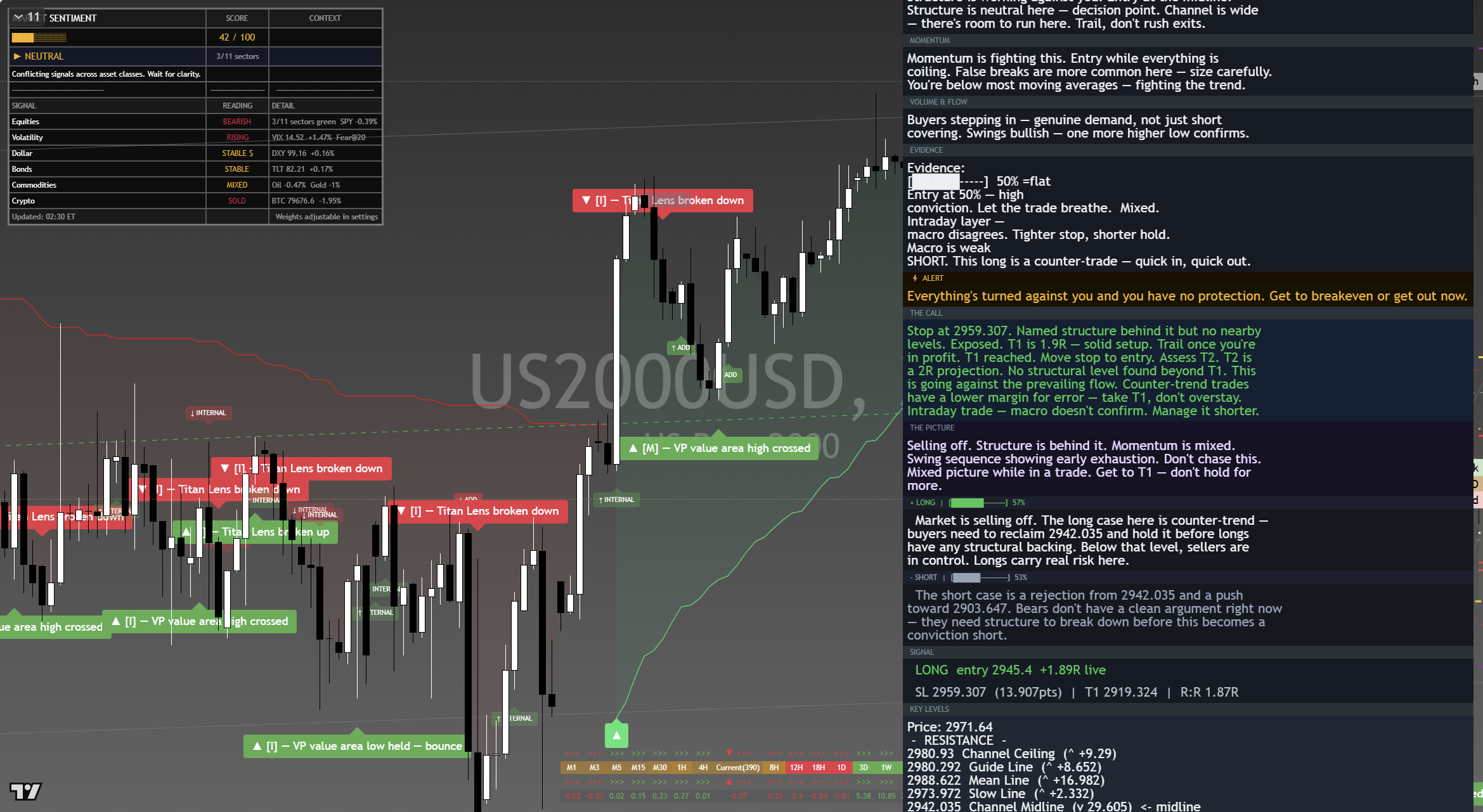
The chart above is the full daily read: structure, momentum, the levels that matter, and where the current price sits against them. Read it top to bottom for the complete picture, and pair it with our session briefs for the wider market context.
This is analysis, not financial advice. It reflects our multi-factor framework and is not a recommendation to buy or sell. Always do your own research and manage your risk.