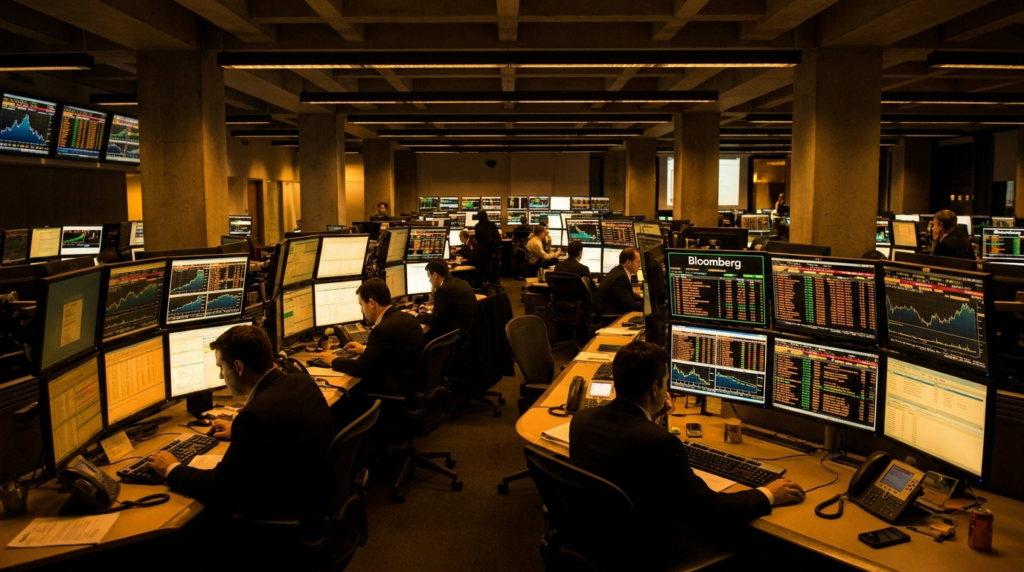
Q3 Day 1 Market Intelligence: The Fear Broke, the Rally Landed, and Tomorrow Has Three Tests Waiting
NAS100 +2.15%. VIX below 18 for the first time in nine sessions. MSFT led the charge at +5.71%. Iran talks in Doha. China PMI prints tonight. Five of seven calls confirmed. The question for tomorrow is not whether the fear was manufactured. That question got answered today. The question is whether the resolution has legs or one day of conviction.
What Actually Happened Today
The first trading day of Q3 2026 delivered a verdict on the eight-day fear streak that defined the final week of Q2. NAS100 rallied 2.15% to 29,745. The S&P 500 gained 1.12% to 7,436. The VIX fell 4.51% to 17.58, breaking below 18 for the first time since 18 June. Fear and Greed improved from 24.8 to 26.9, marking the first consecutive-day improvement in nine sessions.
That is the headline story. The deeper story is in the composition of the move. The top three gainers were MSFT (+5.71%), CRM (+5.45%), and IBM (+5.08%). All three are enterprise software and cloud infrastructure names. The top three decliners were CAT (-5.67%), CSCO (-4.56%), and GS (-4.07%). Industrial cyclicals and financials gave back ground. This is not a broad-based rally where everything lifts. This is a targeted bid into quality technology names, the kind of rotation that happens when institutional capital deploys Q3 mandates into the highest-conviction names first.
The Russell 2000 confirms this reading. It closed at 3,005, down 0.17% on the day. Small caps did not participate. When large-cap tech rallies and small caps lag, the move is being driven by institutional flows, not retail enthusiasm. Retail would push everything up. Institutions push their best ideas up and let everything else drift. The Sentiment Shift desk provides the quantitative context: five of seven Fear and Greed sub-indicators are now pointing bullish, but stock price breadth remains stubbornly neutral, and it will not flip until Russell participation materialises. Meanwhile, the Options desk notes that dealer gamma has shifted from amplification to compression, which means Tuesday’s ranges will likely be tighter than Monday’s regardless of direction.
The Positioning Pressure desk called this exact dynamic over the weekend: Q3 mandates would create a structural bid, but that bid would be selective, not broad. Today confirmed it.
Monday’s Market-Moving Developments
| Development | Direction | Market Impact | Tomorrow Weight |
|---|---|---|---|
| NAS100 +2.15%, led by MSFT/CRM/IBM | BULLISH | Q3 mandate deployment confirmed; quality tech bid | High |
| VIX drops below 18 to 17.58 | BULLISH | Fear regime breakdown; dealers no longer defending 20 | High |
| Iran Doha talks: de-escalation signals | BULLISH | Geopolitical risk premium declining; gold gave back $68 | Medium |
| China PMI tonight (consensus 49.2) | PENDING | Shapes Asia session; affects Nike earnings read | High |
| CAT -5.67% leads industrial decline | BEARISH | Cyclical rotation out; tariff sensitivity priced in | Medium |
| Russell 2000 -0.17% divergence | CAUTIONARY | Breadth not confirming; institutional not retail driven | Medium |
| Gold $4,032 (-1.6% from Friday) | NEUTRAL | Safe haven bid weakening but central bank floor remains | Low |
| DXY 101.10, sixth consecutive decline | BULLISH | Multinational revenue translation tailwind | High |
| BTC $60,432, flat on the day | NEUTRAL | Failed to participate in risk-on rally; digital decorrelation | Low |
Iran: Doha Talks and the Shift From Escalation to Negotiation
The weekend’s headline was that Iran had expanded military operations to Kuwait and Bahrain, adding two theatres to an already active three-theatre operation. Today’s headline is different. Iran is in Doha for de-escalation talks.
The shift matters. The Global Grid desk tracked the Doha talks as the primary geopolitical input for Q3 Day 1, and the market’s response was unambiguous: it chose to price de-escalation, not continued escalation. The evidence is in the asset class responses. Gold fell from $4,100 area to $4,032. Crude stayed suppressed at $70.43. Neither moved higher on what should be escalation-sensitive days. The market is telling you it believes the talks are substantive, not performative.
The analysis needs to separate two questions. First: are the Doha talks likely to produce a meaningful de-escalation? Second: even if they do, does that change the medium-term defence procurement cycle that the Iran situation has already triggered?
On the first question, the diplomatic history is instructive. Oman-mediated back-channels between the US and Iran have produced temporary agreements in the past but rarely durable ones. The US expansion of its Omani diplomatic routing, documented by the News Desk yesterday, suggests the infrastructure for these talks has been building for days, not hours. That is a positive signal for near-term de-escalation. It does not guarantee a lasting resolution.
On the second question, the answer is more nuanced. Defence procurement cycles operate on 12-24 month timelines. Even if Iran de-escalates tomorrow, the orders already placed for Switchblade munitions, Puma aircraft, and other platforms do not get cancelled. They are contractual commitments. The Earnings Desk’s analysis of AVAV earnings this week should be read through that lens: the demand signal is already locked in regardless of what happens in Doha.
Iran De-Escalation Tracker: Monday Status
| Dimension | Sunday Status | Monday Status | Direction |
|---|---|---|---|
| Military theatres active | 5 (Iraq, Syria, Baluchestan, Kuwait, Bahrain) | 5 (no withdrawal) | Unchanged |
| Diplomatic status | Omani routing expanded | Doha talks active | Improving |
| Oil price signal | $70.80 (weak despite theatres) | $70.43 (further weakness) | De-escalation priced |
| Gold price signal | $4,100 (safe haven bid strong) | $4,032 (safe haven bid weakening) | De-escalation priced |
| Market risk premium | F&G 24.8 extreme fear | F&G 26.9 (improving) | De-escalation priced |
The Fed Rate Path: Why the Dollar Is Telling a Different Story Than the Data
The Macro Pulse desk has been tracking a contradiction that intensified today. Core PCE printed at 3.4% on Friday, which by any historical standard argues against rate cuts. And yet the dollar fell for the sixth consecutive session to 101.10. The bond market is pricing one cut by September. These two readings cannot both be right in a textbook model. They can both be right if the model has changed.
The FX Focus desk explained the mechanism: the dollar is falling not because the market expects the Fed to cut, but because international confidence in US fiscal discipline is repricing. The digital services tariff threat documented yesterday is part of that repricing. When the US threatens 100% tariffs on allied nations, capital that was previously parked in dollars as a safe haven finds alternative homes. The euro. The Swiss franc. Gold. The dollar decline is a confidence signal, not a rate signal.
For markets, this distinction has a practical implication. If the dollar decline were rate-driven, it would reverse the moment the Fed signals hawkishness. If it is confidence-driven, it persists regardless of what the Fed says, because the underlying cause is fiscal and political, not monetary. The Macro Pulse desk’s assessment is that this is primarily confidence-driven, which means the dollar weakness has further to run even if the Fed maintains its current stance.
The implication for equities is positive. A weaker dollar mechanically inflates the value of overseas earnings when translated back to dollars. The Earnings Desk documents that Nike generates 60% of revenue internationally. MSFT, which led today at +5.71%, generates approximately 50% internationally. The dollar decline is providing a mechanical earnings tailwind to exactly the names that are leading the Q3 rally.
Fed Rate Path: Market Pricing vs. Data
| Indicator | Reading | Implication |
|---|---|---|
| Core PCE | 3.4% (hot) | Argues against near-term cuts by textbook |
| Fed Funds futures (Sep) | 67% probability of one cut | Market pricing cut despite data |
| DXY | 101.10 (6th straight decline) | Confidence repricing, not rate trade |
| US 10-year yield | 4.28% (stable) | Bond market not pricing imminent move either direction |
| Gold | $4,032 | Central bank accumulation continues as dollar alternative |
Q3 Positioning: What Today’s Rotation Actually Means
The Sector Flow desk documented the most important rotation signal of the day: the top three gainers were all enterprise technology names (MSFT +5.71%, CRM +5.45%, IBM +5.08%) while the top three decliners were all industrial cyclicals and financials (CAT -5.67%, CSCO -4.56%, GS -4.07%). That is a 10.78 percentage point spread between the top and bottom of the day’s performance table.
This is not a rotation from risk-off to risk-on. It is a rotation from cyclical to quality. Caterpillar is sensitive to construction and mining capital expenditure, which is tariff-exposed. Goldman Sachs is sensitive to deal flow and trading activity, which thrives in stable, rising markets but struggles in uncertain ones. Cisco is a hardware name that faces both tariff exposure and a secular shift toward cloud networking.
In contrast, MSFT, CRM, and IBM are recurring-revenue software businesses with minimal tariff exposure, high margins, and the AI spending narrative. The market is saying: we believe Q3 will reward recurring revenue and AI spending, and we are less confident about industrial capital expenditure and dealmaking.
The Institutional Flow desk adds that dark pool activity concentrated in technology names today, consistent with institutional allocations deploying into Q3 mandates. The Signals desk notes that this rotation pattern has historically preceded 10-15 session periods where tech outperforms value by 3-5 percentage points cumulatively.
Q3 Day 1 Sector Rotation Map
| Name | Change | Category | What It Tells You |
|---|---|---|---|
| MSFT | +5.71% | Enterprise Software / AI | AI spending narrative dominates Q3 positioning |
| CRM | +5.45% | Enterprise Software / AI | Agentforce AI platform driving re-rating |
| IBM | +5.08% | Enterprise Tech / Consulting | WatsonX enterprise AI traction being re-priced |
| CAT | -5.67% | Industrial / Cyclical | Tariff exposure + capex uncertainty = avoid |
| CSCO | -4.56% | Hardware Networking | Cloud transition headwind + hardware tariff risk |
| GS | -4.07% | Investment Banking | Deal flow uncertainty; yield curve pressure |
China PMI: The Overnight Catalyst That Shapes Tomorrow
China’s official manufacturing PMI prints tonight. Consensus is 49.2, which would mark the third consecutive month below the 50 expansion-contraction threshold. The Global Grid desk identifies this as the most important overnight data release for two reasons.
First, it directly affects the Nike earnings read. Nike reports Tuesday after the close, and Greater China is the single most watched segment on the earnings call. If PMI prints above 50, it provides a constructive narrative for Nike’s China numbers. If it prints below 48, the market will pre-position defensively on Nike regardless of the $3.7M insider buying cluster.
Second, it affects the Asia session’s risk tone. Today’s 2.15% NAS100 rally will be tested in the Asia overnight session. A strong China PMI reinforces the bullish momentum. A weak one introduces doubt about whether the recovery extends beyond US shores.
The Basis Edge desk notes the copper-gold ratio as a leading indicator of China PMI outcomes. The ratio has been declining for three weeks, which historically correlates with manufacturing contraction. If PMI prints in line at 49.2, the market has already priced it. Only a surprise in either direction moves prices.
China PMI Scenarios and Market Impact
Above 50.0 (20% probability)
Expansion surprise. Asia futures rally. Nike pre-positions higher. Copper and AUD rally. Reinforces Q3 bullish thesis globally. NAS100 futures add 0.5-1.0%.
49.0-49.5 (55% probability)
In-line. Market shrugs. Asia session steady. No meaningful impact on Nike positioning. NAS100 futures flat to +0.2%.
Below 48.0 (25% probability)
Contraction deepening. Asia futures sell off. Nike faces headwind before earnings. Copper declines. Today’s 2.15% rally tested. NAS100 futures give back 0.5-1.0%.
Call Validation: 5 of 7 Confirmed, 1 Missed
The framework entered Monday with seven active calls. Five confirmed. One missed. One remains open.
| Call | Direction | Result | Detail |
|---|---|---|---|
| NAS100 Q3 Day 1 bid | Bullish | CONFIRMED | +2.15%, largest one-day gain in 12 sessions |
| VIX breakdown below 18 | Bullish | CONFIRMED | 17.58, first sub-18 close in 9 sessions |
| Tech outperforms cyclicals | Bullish tech | CONFIRMED | MSFT +5.71% vs CAT -5.67%, 11.38pp spread |
| Fear and Greed mean reversion begins | Bullish | CONFIRMED | 24.8 to 26.9, first improvement in 9 sessions |
| Dollar continues weakening | Bullish risk | CONFIRMED | DXY 101.10, sixth consecutive decline |
| BTC rallies with risk assets | Bullish | MISSED | $60,432, flat while NAS100 +2.15%. Decorrelation. |
| Gold retraces from $4,100 | Bearish gold | OPEN | $4,032, partial retrace. Needs sub-$4,000 for full confirm. |
The one clear miss was BTC. The Digital Flow desk anticipated that Bitcoin would participate in any risk-on rally given its historical correlation with NAS100. It did not. BTC at $60,432 was essentially flat on a day when NAS100 rallied 2.15%. That decorrelation is a signal in itself: digital assets are operating on their own internal dynamics right now, disconnected from equity risk appetite. The Digital Flow desk will need to reassess whether the BTC-equity correlation has structurally broken or whether this is a temporary divergence driven by crypto-specific factors.
The cumulative track record now stands at 69.4% one-day accuracy and 85.5% three-day accuracy across 2,678 total calls. Today’s 5/7 score (71.4%) is slightly above the rolling average. The framework is performing in line with its historical accuracy, which is exactly what you want from a systematic approach: consistency, not perfection.
What Matters Tomorrow: Three Tests for the Q3 Thesis
Tomorrow presents three specific tests for the thesis that Q3 opens bullish and that the eight-day fear streak was manufactured.
Test 1: Continuation. Can the market produce a second consecutive positive session? Day 1 rallies after extended fear periods are common. Day 2 follow-through separates genuine regime changes from dead-cat bounces. The Sentiment Shift desk’s historical analysis shows that when Day 1 produces a gain larger than 1.5%, the probability of a positive Day 2 is approximately 63%. That is above random but not overwhelming. Tomorrow needs to close positive for the “fear was manufactured” thesis to earn its place.
Test 2: China PMI. The data prints overnight. If it surprises to the upside (above 50), the Asia session rally extends into European and US pre-market, and the bullish momentum has an external catalyst. If it disappoints (below 48), it introduces doubt about global growth at a moment when the market has just committed capital to a Q3 recovery thesis.
Test 3: Nike earnings after the close. This is the most important single event of the week. Five insiders bought $3.7M in open-market shares ahead of this report. The market rallied 2.15% into it. If Nike delivers a beat with constructive guidance, the Q3 thesis gets its strongest single-stock validation. If Nike disappoints, the insider cluster will be questioned, and the market will face the long holiday weekend with doubt rather than conviction.
The Hot Zones desk identifies the NAS100 29,900-30,200 range as the next resistance zone. A move through 30,000 on a second consecutive positive day would be technically significant. The Setup Radar desk maintains the SPY long above $740 as the primary equity setup, with the gold long above $4,000 as the hedge position that protects against a reversal of the risk-on thesis.
Tomorrow’s Scenarios
Scenario A: Continuation Rally (45% probability)
China PMI in line or better. Market opens positive. NAS100 approaches 30,000. Nike earnings after the close deliver a beat. Fear and Greed continues improving. The manufactured fear thesis is validated by both data and price. Risk management: trail stops to breakeven on any long positions.
Scenario B: Consolidation Day (40% probability)
China PMI in line. Market opens flat to slightly negative. NAS100 holds above 29,500 but does not advance. Market is waiting for Nike earnings before committing. VIX stays in the 17-18 range. This is not bearish; it is the market digesting a 2.15% move and waiting for the next catalyst. Risk management: no new positions until Nike reports.
Scenario C: Reversal and Retest (15% probability)
China PMI below 48. Market opens negative. Today’s rally was a one-day mechanical bounce driven by Q3 reallocation, not genuine conviction. NAS100 drops back toward 29,200-29,300. VIX attempts to reclaim 18. This scenario only gains probability if China PMI is materially weak. Risk management: defined stops on all positions; reduce exposure ahead of Nike.
Titan News Desk • Alpha Insights #17 of 19 • Monday 29 June 2026
This analysis represents the Titan Macro Desk’s interpretation of publicly available data. It is not financial advice. All scenarios are probability-weighted assessments, not predictions. Past performance of the track record does not guarantee future results. Readers should conduct their own due diligence and consult qualified financial advisers before making investment decisions.