NZD/USD – Daily Read
13 September 2026 | Forex | Titan Macro Desk
0.5816
NZD/USD is caught between a constructive longer-term trend and a clearly weakened near-term structure. Last price 0.5816, 0.0 percent higher on the day, leaves the pair down near the floor of its one-month range rather than showing a meaningful rebound. The desk view is cautiously bearish while price remains below the recent value area, but not structurally bearish while nearby support holds. That distinction matters because current weakness may still be a pullback within an advancing trend, yet the market is close enough to support that the next decisive move should determine whether buyers regain control or the correction becomes materially deeper.
The macro backdrop is unusually conflicted for the kiwi. Recent Reserve Bank of New Zealand tightening gives the currency domestic rate support, reflecting concern that energy-driven inflation could become persistent. At the same time, higher fuel costs weigh on household demand and complicate the economic recovery. Strong export-sector conditions offer an offset, but NZD/USD is also exposed to global risk appetite, commodity sentiment, and expectations around the approaching Federal Reserve decision. The dollar side of the pair can therefore dominate even if New Zealand fundamentals remain relatively resilient. Momentum roughly 1.3 percent down over the last two weeks shows that traders have recently preferred dollar exposure or reduced kiwi risk, and the flat daily change suggests that pressure has paused rather than clearly reversed.
The one month average 0.5901 is the immediate measure of whether the pullback is repairing. Price is below it, and the structure reads as a pullback, slipping under the one-month average while the longer trend still points up. The nearer round number handles at 0.5900 and 0.5800 frame the active battlefield. The former should attract selling from traders trapped above current price, while the latter can draw defensive demand because it sits close to a shelf of support at 0.5795, about 0.4 percent below. Holding that shelf preserves the case for basing. Losing it would signal that buyers have failed at the most obvious nearby defence. The month swing high 0.5990, about 3.0 percent above the current price, is the key upside barrier. The three month range 0.5629 to 0.5990 shows that price is still inside a broad consolidation despite the longer trend.
If buyers defend 0.5800 and 0.5795, then stabilization can develop into a recovery toward 0.5900 and 0.5901. Acceptance above that area would show that the pullback has been absorbed and would shift attention back to the range ceiling. A decisive move above 0.5990 opens the path toward 0.6000, with the breakout carrying more weight because it clears both the month swing high and the three month range boundary. If rallies fail beneath 0.5900 and sellers force price through 0.5795, then losing 0.5795 exposes 0.5629. That bear path would represent range expansion, not routine noise.
The main risk to the bearish near-term bias is a rapid repricing of relative central-bank expectations that weakens the dollar and validates New Zealand’s firmer policy stance. Conversely, deterioration in global risk appetite or renewed energy stress would challenge the longer-trend support story. A sustained recovery above 0.5901 invalidates the immediate bearish read; a clean loss of 0.5795 invalidates the pullback-only interpretation. Net, the pair is vulnerable but not broken, with support defence determining whether this is accumulation or the start of a deeper unwind.
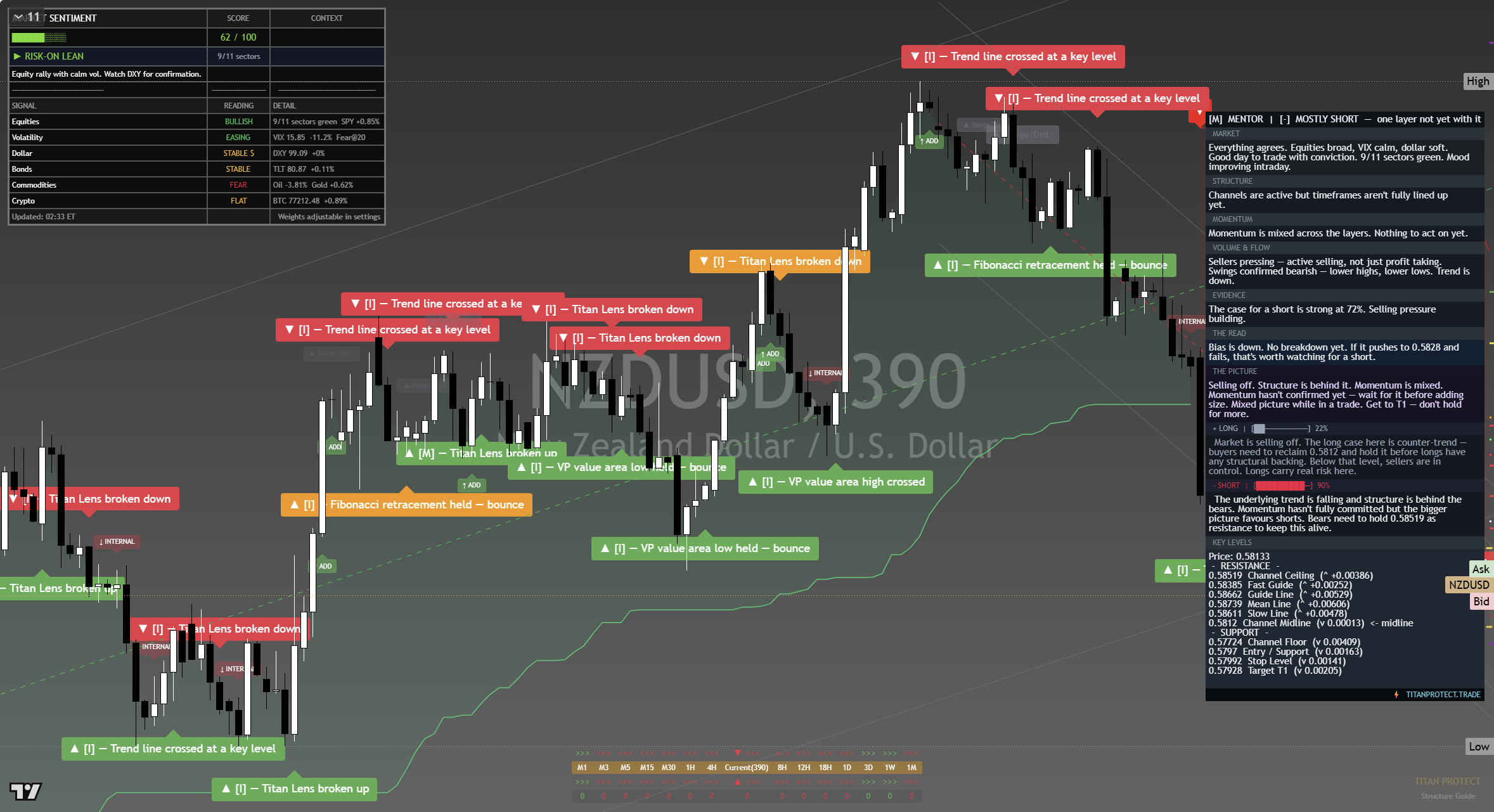
The chart above is the full daily read: structure, momentum, the levels that matter, and where the current price sits against them. Read it top to bottom for the complete picture, and pair it with our session briefs for the wider market context.
This is analysis, not financial advice. It reflects our multi-factor framework and is not a recommendation to buy or sell. Always do your own research and manage your risk.