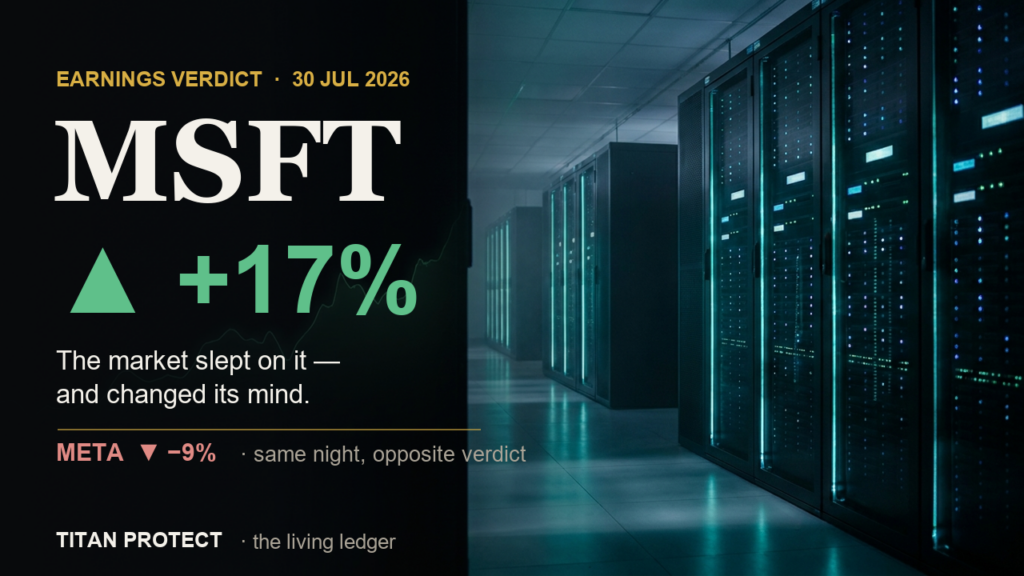
Two of the world’s largest companies reported on the very same night, both spending fortunes on the same bet, and the market first flinched in one direction, then, a session later, delivered the opposite verdict. This is the entry that matters more than the headline: not the knee-jerk after the bell, but what the market decided once it had slept on the numbers. Microsoft finished the next session up roughly 17%. Meta finished down roughly 9%. The same night, the same question, opposite answers.
What the Market Actually Did
The first reaction after the bell is noise; the considered verdict is the session that follows. Here is the verified price action, close to close.
| Name | Prior close | Post-earnings | Verdict |
|---|---|---|---|
| Microsoft (MSFT) | $390.54 | ~$457 (+17%) | Delivery rewarded |
| Meta (META) | $585.61 | ~$532 (−9%) | Spend punished |
Both companies are pouring fortunes into the AI build-out. The market is no longer paying for that spend as a story; it is grading whether the spend is converting into visible, revenue-bearing delivery on a timeline investors can see. Microsoft’s cloud engine gave the market a reason to look through the capex. Meta’s did not, quite, and a great franchise got marked down nine per cent in a session to enforce the point. The lesson is the discipline this ledger exists to teach: a beat is not a catalyst, the composition of the beat is.
Our Pre-Earnings Read, Scored
Going into the print, our dated entry on Microsoft called it the toll-booth on a decade-long AI build-out, on sale at a fair rather than frothy price — forward earnings multiple near 19.7x, risk around 45%, and a clean pass on both recognised ethical standards. The read was never that Microsoft would double overnight; it was that you were being offered a dominant, screened franchise at a reasonable price while the crowd fretted. A session later the market re-rated it 17% higher. The thesis was not clever forecasting of a number — it was refusing to sell a fairly priced toll-booth because of short-term capex noise. That is the entry, and it stands.
On Meta the same discipline reads the other way: a strong core business is not a licence to spend without a visible return, and the market said so. Both names sit comfortably inside a values-conscious screen on the nature of their revenue, but our framework’s job is not to cheerlead a franchise — it is to separate the fairly priced from the story-priced, and to say so before the outcome is known.
The Ethical Lens
Both Microsoft and Meta are core technology businesses — software, cloud and advertising — whose revenue nature sits inside most values-based and Shariah-aware screens; the real screening work is on the financial ratios, not the storefront. For a protection-first investor the takeaway is not which name to chase but the behaviour on display: the market punished open-ended spending without a visible return, which is exactly the kind of undisciplined, uncertain commitment a values-conscious framework is built to avoid. Buy the disciplined compounder at a fair price; do not fund ambition on faith.
The bottom line: the same night handed two mega-caps opposite verdicts, and the verdict that counted was the one the market reached after it thought about it, not the one it blurted after the bell. Microsoft’s fairly priced delivery was rewarded; Meta’s spend-ahead-of-return was marked down. Our pre-earnings read on Microsoft — own the toll-booth at a fair price, ignore the capex noise — scored. We record it dated, and we do not edit it to look cleverer than it was. That is how this ledger compounds: one honest entry per name, per earnings, building a depth no thin comment section can match.
Price moves are verified close to close. This is educational analysis, not financial advice. Always manage your risk.