Trader Mindset Series
Copying another trader’s method is the fastest way to lose money with a strategy that works perfectly for someone else.
Why Style Matters Before Strategy
The internet is full of trading strategies that have worked for someone. Breakout plays, mean reversion, trend following, scalping during news events. Some of these approaches are genuinely sound. But a large number of traders who try them fail, not because the strategy is bad, but because the style of trading it requires is incompatible with who they are and how they live.
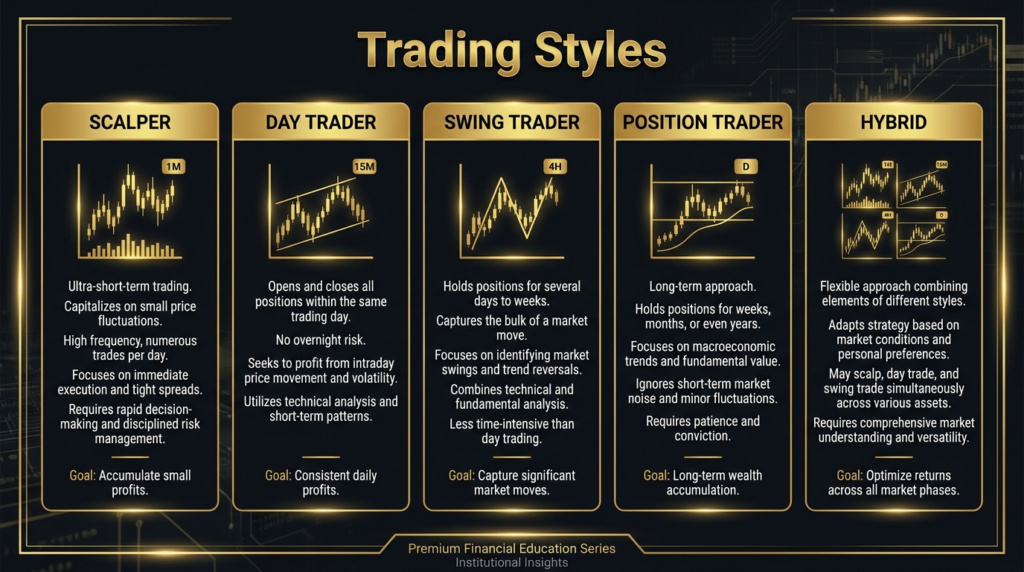
A scalper is at their desk for three to six hours a day, executing dozens of trades on a 1-minute chart, taking a few points at a time. A position trader might check their charts once a day, hold for weeks, and need the psychological resilience to sit through a 200-point drawdown without panic-closing. These are entirely different skill sets, different time commitments, and different temperaments.
Before you worry about which indicator to use or which market to trade, the single most important question is: what style of trading fits your actual life and personality?
The Five Main Trading Styles
| Style | Typical Timeframe | Average Hold Time | Daily Screen Time | Min. Capital | Best Suited For |
|---|---|---|---|---|---|
| Scalping | 1m – 5m | Seconds to minutes | 4-8 hours | £2,000+ | High-focus individuals, low spread markets, fast reaction |
| Day Trading | 5m – 30m | Minutes to hours, flat by close | 2-5 hours | £5,000+ | Those with a defined session window and structured prep |
| Swing Trading | 1H – 4H | 1-5 days | 30-60 mins | £3,000+ | Part-time traders, those with a day job, patience-oriented |
| Position Trading | Daily – Weekly | Weeks to months | 15-30 mins | £10,000+ | Macro-oriented, high drawdown tolerance, long-term view |
| Hybrid | Multiple | Mix of above | 1-4 hours | £8,000+ | Experienced traders with a base style and secondary layer |
How to Identify Which Style Fits You
This is less about preference and more about honest self-assessment. The following questions help identify a realistic starting point.
How much time can you commit each day? If you have a full-time job and two hours in the evening, you are not a day trader. You might be a swing trader or a position trader. If you try to scalp during lunch breaks, you will execute poorly on the entries that matter and miss the ones that do not fit around your schedule.
How do you feel when a trade moves against you by 20 points? If your immediate instinct is to check the P&L every 30 seconds and consider closing, you are not built for position trading with wide stops. If a small loss in the red feels completely fine because you know the stop is where it is supposed to be, you can handle larger timeframes.
Do you find watching tick-by-tick price movement energising or exhausting? Some traders are sharper and more focused under the pressure of a 1-minute chart. Others find it noise, and perform better when they are not watching every fluctuation. Neither answer is wrong. They point to different styles.
What is your current capital base? Scalping with a small account is mathematically difficult because spread costs eat into small targets. Position trading with a small account means the stop distances are proportionally enormous relative to the account. This is a practical constraint, not a moral judgement.
The Importance of a Base Style
Professional traders have a base style. Even those who operate across multiple timeframes have a primary method they return to when conditions are unclear, when they are in a drawdown, or when they are testing new markets. The base style is the one they know most thoroughly, have the most repetitions with, and trust under pressure.
Without a base style, traders drift. They scalp for a week because they saw a screenshot of someone making money intraday. They switch to swing trading when the scalping gets choppy. They look at a macro trade on the weekly after a slow month. None of these styles gets enough repetitions to develop into a genuine edge.
Choose a base style. Commit to it for a minimum of three months. Build the repetitions. Only after you have a solid base should you consider layering in a complementary style.
Why Copying Someone Else’s Style Fails
This happens constantly. A trader sees someone post a 1:5 swing trade, copies the exact entry the next time that setup appears, and stops themselves out three times in a row before the move happens. They conclude the strategy does not work.
What they missed is context. The trader they copied holds through 60-point drawdowns because they have done it a hundred times and trust the setup. The person copying holds for 15 points before panic-closing. Same trade, completely different result, because the psychological and experiential foundation is different.
Style is not just about timeframe. It is about the entire ecosystem of decisions around a trade: how you manage it, how long you hold, how you handle being wrong, what your process looks like before and after. All of that comes from building your own system, not borrowing someone else’s outputs.
Action Items
- Answer the four self-assessment questions honestly. Write down your answers. They point to a style.
- Pick one base style and commit to it for 90 days without switching, even if results are slow to develop.
- Review your trading history for style drift. Count how many times you switched approach in the last three months.
- If you have been copying setups from others, identify whether their style matches yours before the next trade, not after.
Continue Learning
Trader Mindset Series
← How to Build a Trading Routine
Trader Mindset Series
Building Your Pre-Market Routine →