Titan Playbook Series. Article 6 of 10
The Noise Problem Is Getting Worse
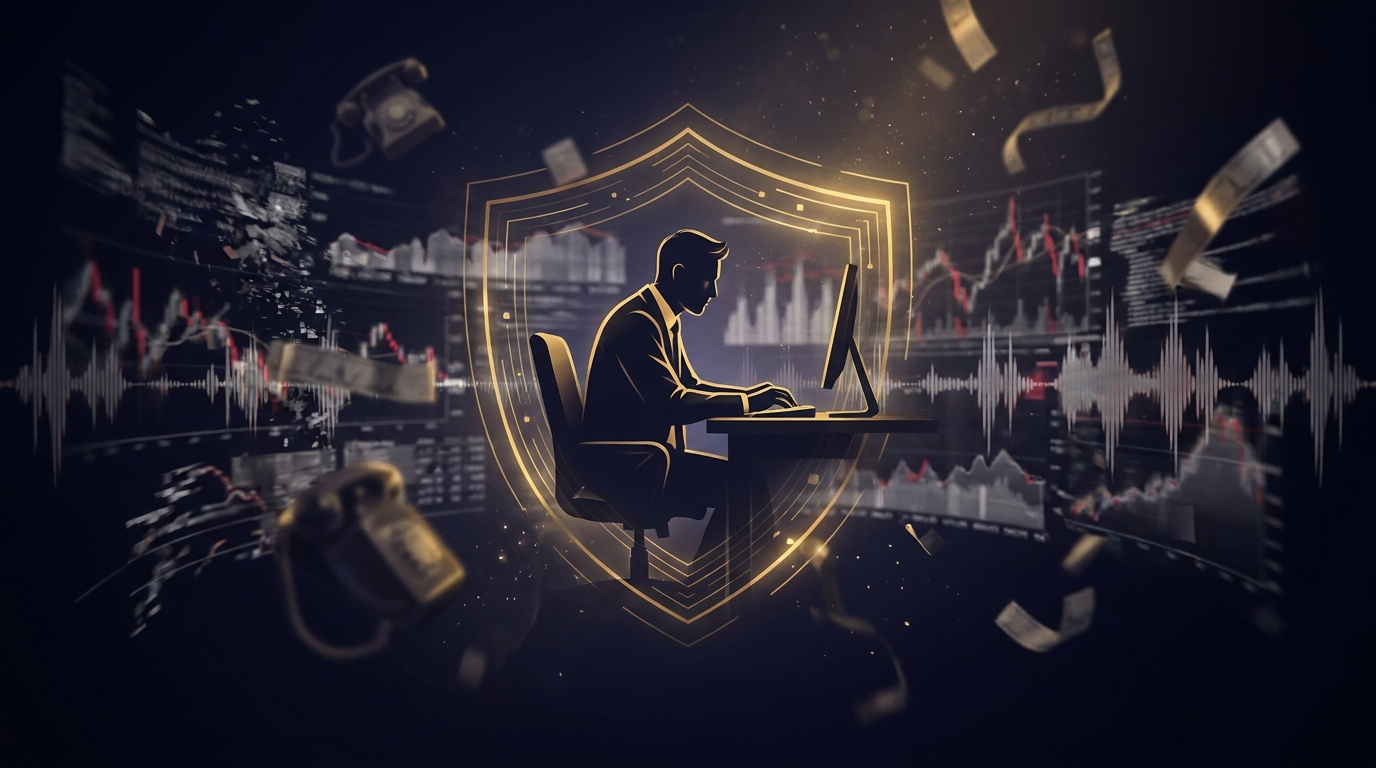
Traders in 2026 face a level of informational noise that did not exist a decade ago. Financial Twitter, Discord servers, Telegram groups, CNBC, Bloomberg, Reddit — every one of these channels is competing for your attention during the exact hours when that attention has the highest value. And the problem is not that the information is worthless. Some of it is genuinely relevant. The problem is that you cannot tell the signal from the noise in real time, and the attempt to do so degrades your ability to read the actual market in front of you.
The traders who make consistent money have one thing in common: they protect their focus during market hours like it is a finite resource. Because it is.
How Social Media Actively Damages Your Trading
Social media during trading hours does three damaging things simultaneously.
First, it introduces second-hand conviction. You have a valid setup forming on your chart. Then you see someone with 50,000 followers declaring the opposite direction with absolute certainty. Your setup is still valid. But now there is doubt — not analytical doubt, social doubt — and doubt at the wrong moment costs you either the trade or the discipline to manage it properly.
Second, it creates manufactured urgency. “This is moving now. Get in.” “Breaking: Fed headline.” “Short this immediately.” Every one of these messages is designed to produce a reaction. Reaction is the enemy of process. You do not trade reactions. You trade setups.
Third, it shifts your focus from price to commentary. The market tells you everything you need to know through price, volume, and structure. Commentary is someone else’s interpretation of what price is doing, filtered through their own biases, positions, and desire for engagement. You are outsourcing your analysis to strangers who may not be accountable for the consequences.
The News Cycle Is Not Your Friend
Most retail traders believe they need to follow financial news closely to trade well. This is largely false, and in many cases the opposite is true.
Here is what the news cycle actually does: it confirms moves that have already happened. By the time a story reaches mainstream financial media, institutional money has already positioned. The price has already moved. You are reading a post-mortem dressed as a forecast.
The relevant question is not “what did the news say?” but “how did price react to the news?” A bullish headline that produces a bearish price reaction tells you far more than the headline itself. That divergence between news and price action is information. The headline alone is noise.
There are exceptions — scheduled high-impact events like central bank decisions, non-farm payrolls, CPI releases — where the headline moves markets significantly and immediately. You should know these dates in advance and have a clear rule about whether you trade them at all. Many experienced traders simply step aside during these windows rather than attempt to trade into unknowable binary outcomes.
Building a Distraction-Free Trading Environment
The environment shapes the behaviour. Most traders try to manage distraction through willpower alone. That works occasionally and fails reliably. The more durable solution is to engineer the environment so that distractions require effort to access rather than effort to resist.
Start with the physical space. If you trade from a home office or a corner of a room, that space needs to communicate one thing: work. Phone in another room, not face-down on the desk. Other browser tabs closed before the session opens. Notifications muted across all devices, not merely silenced. The small friction of having to walk to another room to check your phone is, in practice, enough to stop most impulsive checks.
Then address the digital environment. Browser extension blockers — Cold Turkey, Freedom, or similar — can lock specific domains during specific hours. Set them to block social media and news sites from thirty minutes before open to thirty minutes after close. The exception list should be small and deliberate: your charting platform, broker, and any essential reference sites.
Separate trading browser profiles are worth the setup time. A dedicated Chrome or Firefox profile with only market-relevant bookmarks and no social logins removes the default pathways your habits normally follow. It also signals to your brain that this profile means work.
The Focus Sprint Method
You cannot sustain six hours of unbroken concentration. Neither can most professionals in any field. The solution is structured attention, not heroic willpower.
Try the sprint approach adapted for trading:
- 25-minute trading sprints: Full focus, nothing else open, no interruptions.
- 5-minute breaks: Stand up, step away from the screens, look at something that is not a monitor. This is physiologically important, not optional.
- After 4 sprints: A 15-minute longer break before resuming.
This is the Pomodoro Technique applied to trading. It works because it respects the brain’s natural attention cycle rather than fighting it. You will find that your analysis quality in the sprint periods significantly exceeds what you produce during a distracted three-hour sitting.
Building the Habit Progressively
If your current environment is chaotic, a sudden complete lockdown will not stick. Build the habit in layers:
- Days 1–3: Phone out of the trading room during active sessions. Nothing else changes.
- Days 4–7: Add browser blockers for social sites during market hours.
- Week 2: Set up a dedicated trading workspace with a clean browser profile.
- Week 3: Run a full notification-free session from pre-market preparation through post-close review.
Each layer compounds on the last. By week three, the environment is doing most of the work. The habit is formed because you built it incrementally, not because you relied on motivation that was never going to last.
Your focus during trading hours is directly proportional to your results. This is not a soft skill — it is a performance variable. The market does not care whether you were distracted when you made the decision. The best traders are not smarter. They are less distracted. Engineer your environment before you sit down, and let the environment do the work that willpower cannot sustain.
Actionable Takeaways
- Put your phone in another room for your next session. Not face-down on the desk — another room.
- Install a site blocker and configure it now, before you need it during a live session.
- Review your last losing trade. Was there a moment where external commentary introduced doubt or changed your decision? Note it.
- Know your scheduled high-impact events for the week and decide in advance whether you are trading them or stepping aside. Do not decide in the moment.