ALPHA INSIGHTS · MACRO PULSE · 20 MAY 2026
Reads Post 00 positioning context · NY 01:52 | London 06:52 | Tokyo 14:52
Yesterday’s Calls — Track Record
GBP/USD flagged 1.3385-1.3395 as key level. Today: 1.3394. Price is sitting precisely at that zone. Pre-London gap on FTSE called correctly — closed at 10,331, essentially flat after the Iran-driven open surge settled. Regime transition (equities weaker, dollar bid) continued as called: SP500 -0.67%, DXY stable at 99.32.
Let me put it simply. The US 30-year bond yield hit 5.19% yesterday, its highest since July 2007. That pre-dates the financial crisis. G7 government bond yields are averaging around 4.7%, which is 0.5 percentage points above where they were at the peak of the 2008 meltdown. Japan’s 10-year government bond yield broke above 2.80% for the first time in history. This is not background noise. This is the macro story of 2026, and it has not been fully priced into equities yet.
Meanwhile, the incoming Federal Reserve chair’s first policy move is being priced by futures markets as a rate hike, not a cut. Mortgage rates in the US hit 6.75%, the highest since July 2025. Housing affordability is at an all-time low. All of this is happening while the S&P 500 trades at 7,353. The market has its foot on the accelerator while the macro data suggests it should at least be easing off.
Macro Dashboard — 20 May 2026
| Indicator | Level | Change | Context |
|---|---|---|---|
| US 30Y Yield | 5.19% | New 19-yr high | Above 2008 crisis peak on G7 avg |
| US 3M VIX | 21.12 | +0.96% | Term structure steepening vs spot 18.06 |
| DXY (Dollar Index) | 99.32 | +0.02% | Flat — range-bound despite yield surge |
| EURUSD | 1.1602 | -0.45% | Pulling back after recent surge above 1.16 |
| GBPUSD | 1.3394 | -0.28% | At key 1.3385-1.3395 support zone |
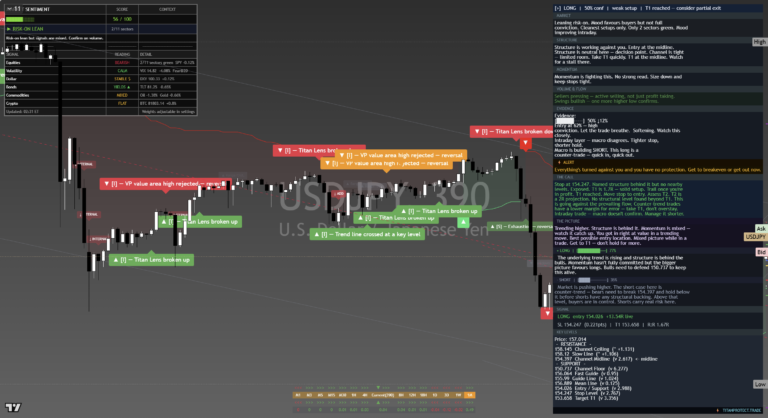
| USDJPY | 158.94 | +0.05% | JGB yield at historic high — BoJ watch |
| USDCHF | 0.7898 | +0.67% | CHF losing safe-haven bid, risk-on signal |
| Crude Oil WTI | $103.56 | -3.91% | Iran deal talk, jet fuel output at record highs |
| Gold | $4,467 | -0.87% | Profit-taking, USD marginally firm |
The Bond Market Is the Story
The 30-year at 5.19% is not a blip. This is the bond market delivering a verdict on US fiscal policy, and that verdict is: we want more compensation to hold this debt. The US household is now sitting on $31 trillion in equity wealth accumulated since 2023, and simultaneously watching their 30-year mortgage cost climb to 6.75%. That is a wealth effect story on one side and an affordability crisis on the other. Both are real, and they are pulling in different directions for consumer spending.
What makes this particularly sharp is the Fed transition. Powell’s term is ending. Kevin Warsh is incoming. And futures markets are pricing rate hikes as his first move. That is an extraordinary signal. If the market is right, the rate cycle has not ended — it has paused. This matters enormously for the equity multiple. Every percentage point off the 30-year moves trillions in discounted cash flow models.
MACRO RISK SIGNAL
The market-implied probability of a rate hike as Kevin Warsh’s first move is not a small fringe view — it is the base case implied by futures. If this is correct, every equity valuation model that assumed rates were heading toward 3.5% needs to be recalibrated toward 5.5%+. That recalibration has not fully happened. The S&P trades as if cuts are coming. The bond market disagrees. One of them is wrong.
Dollar Dynamics — The Quiet Story
Despite bond yields surging, the dollar is barely moving. DXY at 99.32 is essentially flat. In a normal macro environment, a yield spike of this magnitude would have the dollar sprinting higher. The fact that it is not tells you something important: the market is not reading these yields as a US-positive story. It is reading them as a US-negative story — yields rising because of fiscal stress, not because of economic strength.
That is why EURUSD is holding above 1.16 and GBPUSD is not collapsing despite UK macro uncertainty. The COT data from Post 00 confirms this: asset managers are long EUR, specs are long GBP. The institutional view is that the dollar is capped, even with yields at 19-year highs. This is a meaningful macro contradiction — if yields were a growth signal, the dollar would be rallying hard. It is not.
USDJPY at 158.94 deserves separate treatment. Japan’s 10-year government bond yield breaking above 2.80% for the first time in history is not a minor event. It means the Bank of Japan’s yield curve control policy is under genuine pressure. If the BoJ allows yields to drift higher to defend the yen, USDJPY comes back down — and that matters for the Nikkei, which fell 1.37% overnight as a result. Specs are short JPY by 70,000 contracts. Any BoJ surprise and that short cover move will be disorderly.
MACRO OPPORTUNITY
GBPUSD at 1.3394 is sitting at the exact support zone flagged yesterday. COT is bullish GBP. The macro story is that sterling has outperformed because the UK yield spike is seen as less alarming than the US fiscal picture. If this holds, GBPUSD bounces from here toward 1.3480+. Clean entry, clear stop (1.3355), well-defined target.
Oil: The Iran Variable
Crude dropped 3.91% to $103.56. That is significant movement. The US Senate advanced a bill to end the Iran war in a 50-47 vote, and Trump commented that Iran is “begging to make a deal.” If a genuine Iran de-escalation materialises, WTI could fall toward $95, which is disinflationary. That would be good for bonds (lower inflation = lower yields) but potentially negative for energy equities.
The counterpoint: US oil refineries are producing record proportions of jet fuel following the Iran conflict’s disruption to global routes. Demand destruction from high prices is a live risk, but the supply picture is more complex than a simple “Iran deal = oil down” read. Watch Brent at $110.51 — if it breaks $107, the Iran deal trade has legs. If it holds above $110, the market is not fully pricing a deal.
Sector Rotation Signal (Yesterday’s Close)
| Sector | Change | Macro Read |
|---|---|---|
| Energy (XLE) | +1.17% | War premium still present despite Iran talk |
| Healthcare (XLV) | +1.10% | Defensive rotation, yield-immune earnings |
| Utilities (XLU) | +0.91% | Yield plays rotating into high-div defensives |
| Real Estate (XLRE) | +0.43% | Surprising given 6.75% mortgage — oversold bounce |
| Consumer Defensive (XLP) | +0.22% | Large dark pool print in IYK (consumer staples) |
| Technology (XLK) | -0.64% | Growth stocks discounted by higher yields |
| Financials (XLF) | -1.24% | Credit stress + curve flattening pressure |
| Industrials (XLI) | -1.18% | Economic slowdown risk priced in |
| Consumer Cyclical (XLY) | -1.11% | Affordability squeeze biting |
| Basic Materials (XLB) | -2.35% | Worst performer — global slowdown read |
The sector rotation tells you the macro story better than any single data point. Defensives (healthcare, utilities, consumer staples) are the only sectors with green print. Cyclicals (materials, industrials, consumer discretionary, financials) are all negative. This is a late-cycle rotation. Money is moving to companies whose earnings do not depend on economic growth continuing at this pace.
Strategy Tiers
| Tier | Trade | Entry | Stop | Target | R:R |
|---|---|---|---|---|---|
| Scalp | GBPUSD long | 1.3385-1.3395 | 1.3355 | 1.3440 | 1:1.5 |
| Intraday | EURUSD long | 1.1580-1.1605 | 1.1545 | 1.1660 | 1:1.8 |
| Swing | Crude WTI short | 107-108 | 110.50 | 97-98 | 1:2.5 |
| Positional | Long defensives, short cyclicals | Sector pairs | Varies | Multi-week | 1:3+ |
Scenario Analysis
| Scenario | Probability | What Triggers It | Market Impact |
|---|---|---|---|
| Bull: yields stabilise | Around 25% | Iran deal finalised, oil collapses, inflation falls | Yields drop, equities re-rate higher, DXY falls |
| Sideways: rangebound yields | Around 40% | No catalyst, markets drift, vol stays low | Defensives outperform, cyclicals lag, FX choppy |
| Correction: yield spike | Around 28% | Warsh hike signal, fiscal news triggers sell | Equities -5 to -8%, DXY rally, gold rally |
| Black Swan: BoJ surprise | Around 7% | BoJ raises rates hard, global carry unwind | USDJPY crashes, global vol spike, EM sell-off |
Risk Rating and Position Sizing
Overall Macro Risk: Around 70% — the combination of 19-year high bond yields, a Fed transition pricing hikes not cuts, record-high mortgage rates, and a bond-equity divergence that has not yet resolved makes this a genuinely high-risk macro environment. The sector data (defensives winning, cyclicals losing) confirms the market knows this, even if headline indices have not corrected fully.
| GBPUSD / EURUSD longs | STANDARD | COT + dollar cap thesis intact |
| Crude short (via rebound) | STANDARD | Iran deal catalyst building |
| Long defensives / short cyclicals | REDUCED (75%) | Valid thesis but pairs can be volatile |
| Buying growth on yield dip | AVOID | Multiple compression risk is real at these levels |
How to Use This — By Experience Level
BEGINNER
When bond yields rise this aggressively, it costs more to borrow money everywhere — mortgages, business loans, credit cards. Companies that depend on cheap money to grow (tech, small caps) get hurt most. Companies that generate cash regardless of the economy (healthcare, utilities, consumer staples) hold up better. This is why you are seeing the sector split today. The safe play in this environment is to stick with the sectors that are not dependent on rates coming down.
INTERMEDIATE
The dollar-yield divergence is the key tell for FX traders. Normally, yields this high pull the dollar up with them. The fact that DXY is flat at 99.32 despite the 30-year at 5.19% tells you the yield rise is not a growth signal — it is a debt burden signal. That means EUR and GBP longs remain valid because the dollar’s safe-haven premium is not being triggered. Watch EURUSD at 1.1580 — if it holds there, the anti-dollar positioning from Post 00 is intact.
ADVANCED
The BoJ story is probably the most under-priced macro risk in this data set. Japan’s 10-year at 2.80% for the first time in history means the BoJ’s yield curve control is under existential pressure. The yen carry trade — where institutions borrow cheap JPY and buy risk assets globally — is the biggest hidden leverage in global markets. If the BoJ has to let yields run to defend the yen or address inflation, the carry unwind would hit everything: US equities, EM, crypto. Specs are short JPY by 70,000 contracts. That short is the risk. Any BoJ surprise announcement is the trigger for a disorderly move. Keep position sizes disciplined and have a USDJPY stop plan.
Continue the Story
Post 00 showed you the positioning fault line — specs vs asset managers. This post explains the macro engine driving it: bond yields at 19-year highs and a Fed transition that could mean hikes, not cuts. Post 02 asks whether the crowd has caught up — the fear and greed gap from yesterday is the test. Post 03 closes with what options markets are pricing for near-term vol.
Data locked: 05:52 UTC · 20 May 2026 | NY: 01:52 ET | London: 06:52 BST | Tokyo: 14:52 JST
For informational purposes only. Not financial advice. All positions carry risk. Past analysis does not guarantee future accuracy.