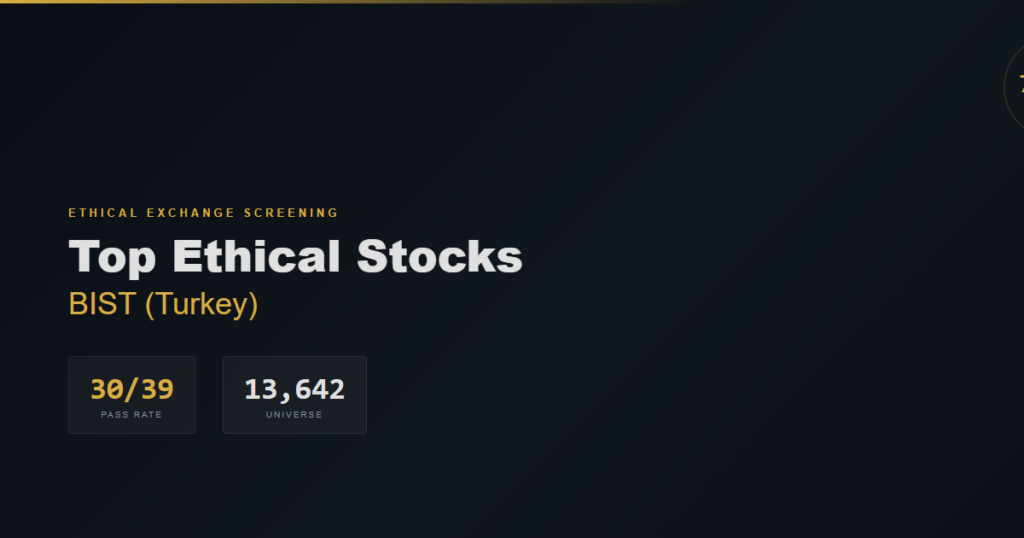
Top Ethical Stocks on BIST (Turkey): A Multi-Framework Analysis for 2026
Screening 39 tickers across Shariah compliance, ESG, socially responsible investing, and faith-based criteria. Published by Alpha Insights Ethical Screener.
Why BIST Matters for Ethical Investors
Borsa Istanbul (BIST) is the gateway to one of the world’s most complex and compelling investment stories. Turkey straddles Europe and Asia, operates a NATO-member economy with a $900+ billion GDP, and has a population of 85 million — the majority Muslim but with a secular constitutional framework that creates a distinctive regulatory environment for Islamic finance.
Unlike the GCC or Malaysia, where Islamic finance is embedded in the regulatory DNA, Turkey’s approach to participation banking (the local term for Islamic banking) and Shariah-compliant products is newer and still evolving. The Capital Markets Board of Turkey (CMB) introduced the BIST Participation Index in 2011, tracking stocks that pass the Turkish participation banking criteria — a methodology that draws from AAOIFI principles but adapts them to Turkey’s specific market structure.
BIST itself is one of the oldest stock exchanges in the world, tracing its roots to the Ottoman-era Dersaadet Securities Exchange founded in 1866. Today it lists over 500 companies across a diversified economy: automotive (Ford Otosan, TOFAS), airlines (Turkish Airlines), retail (BIM), heavy industry (Eregli Steel), telecommunications (Turkcell), and a large banking sector that is split between conventional and participation banks.
For ethical investors, Turkey’s market offers both opportunity and complexity. The opportunity lies in accessing a large, diversified economy at valuations that are often significantly discounted to global peers — a consequence of Turkey’s well-publicised macroeconomic volatility. The complexity lies in navigating currency risk, regulatory shifts, and the fact that Turkey’s largest sectors (banking and energy) are precisely those where ethical screening generates the most exclusions.
Our Screening Methodology
Our multi-framework screening for Turkish equities integrates:
- Shariah/AAOIFI compliance: Cross-referenced against the BIST Participation Index methodology and independently verified using AAOIFI thresholds. Turkey’s participation banking criteria use total-interest-bearing-debt-to-market-cap and total-interest-earning-assets-to-market-cap ratios, both capped at 30%.
- ESG scoring: Environmental metrics (industrial emissions, energy mix), social indicators (labour standards, community engagement), and governance quality (independence, related-party transactions in holding company structures).
- Socially Responsible Investing (SRI) criteria: Turkey’s market includes alcohol producers (Anadolu Efes) and defence companies (Aselsan) that trigger SRI exclusions. Banking sector failures are the largest exclusion category.
- Faith-based screening: Multi-tradition analysis, with conventional banking being the primary disqualifier across Islamic, Christian, and other faith-based usury restrictions.
- Environmental impact assessment: Turkey’s heavy industry (steel, cement, petrochemicals) and its coal-dependent energy mix make environmental screening particularly consequential.
Full methodology on our Ethical Trading Screener page.
The Numbers: BIST Ethical Screening Summary
The failure pattern on BIST is instructive. Turkey’s banking sector is large and liquid — banks like Garanti BBVA, Akbank, Isbank, and Yapi Kredi are among the most traded stocks on the exchange. All operate conventional interest-based banking models and fail both Shariah and faith-based usury screens. In contrast, Turkey’s participation banks (Kuveyt Turk, Albaraka Turk, Turkiye Finans) pass these screens but are either unlisted or have limited liquidity. This creates a practical challenge for ethical investors: the most liquid stocks on BIST are often the ones that fail ethical screens.
Top 10 Ethical Stocks on BIST
Scores as of latest screening cycle. Compare any ticker at /compare-tickers/. Full country guide: /country-guides/.
Spotlight: Top 3 Ethical Stocks
1. BIM Magazalari (BIMAS.IS) — Blended Score: 67.3
BIM is Turkey’s largest discount grocery retailer, operating over 11,000 stores across Turkey and with expanding operations in Morocco and Egypt. The business model — selling essential consumer goods at competitive prices — passes ethical screens cleanly across all frameworks. There is no involvement in prohibited activities (BIM does not sell alcohol, unlike some Turkish retailers), debt ratios are conservative for a retail operation, and revenue purity is not a concern.
BIM’s multi-framework profile is strong. ESG scores benefit from its role in food accessibility (serving lower-income communities), efficient supply chain management (reducing waste), and corporate governance that has steadily improved since its 2005 listing. SRI frameworks approve the positive social impact of affordable food retail. Faith-based screens find no objectionable activity. Environmental scores are moderate — the retail footprint generates emissions, but BIM’s efficiency-focused model means lower per-store energy consumption than many competitors.
Key financials: market capitalisation around TRY 250 billion, consistent revenue growth of 40-60% annually (driven partly by Turkish inflation), and a store expansion rate that makes it one of the fastest-growing retailers in any emerging market. BIM has been a consistent outperformer on BIST over the past decade.
2. Turkish Airlines (THYAO.IS) — Blended Score: 65.1
Turkish Airlines (Turk Hava Yollari) is the national flag carrier and one of the world’s largest airlines by destinations served, reaching over 340 airports across 129 countries. The airline’s hub at Istanbul Airport leverages Turkey’s geographic position between Europe, Asia, Africa, and the Middle East — a strategic advantage that no other carrier can replicate.
Turkish Airlines passes Shariah screens on business activity (air transport is permissible) and, unusually for an airline, manages its debt ratios within AAOIFI thresholds despite the capital-intensive nature of aviation. The airline’s halal catering programme for Muslim-majority routes adds a layer of Shariah alignment. ESG scores are mixed: aviation is inherently carbon-intensive, but Turkish Airlines has invested in newer, more fuel-efficient aircraft (A350, 787) and publishes detailed sustainability reports. SRI frameworks evaluate the airline neutrally — it provides essential connectivity but faces the sector-wide emissions challenge. Governance is strong for a state-affiliated company, with detailed financial disclosure and board independence.
Key financials: market capitalisation around TRY 200 billion, strong revenue recovery post-pandemic, and profitability that has made it one of the best-performing airline stocks globally. The stock benefits from structural demand growth driven by Istanbul’s hub position.
3. Ford Otosan (FROTO.IS) — Blended Score: 63.8
Ford Otosan is a joint venture between Koc Holding (Turkey’s largest conglomerate) and Ford Motor Company. It manufactures Ford vehicles and commercial trucks at facilities in Kocaeli and Eskisehir, and it is Ford’s largest commercial vehicle production base globally. The company exports to over 70 countries.
Ford Otosan passes Shariah screens comfortably: automotive manufacturing is permissible, financial ratios are healthy (the Koc-Ford partnership ensures conservative balance sheet management), and revenue is derived entirely from vehicle production and sales. ESG performance is strong for the automotive sector: the company has committed to EV production (the E-Transit is manufactured in Turkey), has ISO 14001-certified production facilities, and publishes comprehensive sustainability reports. SRI frameworks approve the company’s contribution to employment (over 14,000 direct employees) and technology transfer. The main environmental concern is the inherent emissions of internal combustion engine production, which the EV transition is addressing.
Key financials: market capitalisation around TRY 180 billion, consistent profitability driven by commercial vehicle demand, and a dividend yield that varies with export revenue (denominated partly in EUR, providing a natural hedge against TRY depreciation). Ford Otosan is one of the highest-quality industrial stocks on BIST.
Multi-Framework Comparison: How Different Ethical Lenses See Turkish Stocks
Turkey’s market creates some of the sharpest framework divergences in our global coverage. The banking sector is the primary battleground: well-governed, profitable banks that score highly on governance metrics fail categorically on Shariah and faith-based screens.
How to Invest: Access by Region
United States
Interactive Brokers provides direct BIST access, trading in Turkish Lira (TRY). Several Turkish companies have ADRs on US exchanges: Turkcell (TKC) on the NYSE and Turkish Airlines (TKHVY) on OTC markets. The iShares MSCI Turkey ETF (TUR) provides passive exposure on the NASDAQ. Currency warning: TRY has depreciated sharply against USD — from approximately 1.5/USD in 2013 to over 30/USD by 2025. This is the defining risk factor for foreign investors in Turkish equities.
United Kingdom
Interactive Brokers UK and Saxo Markets offer BIST access. The Turkcell ADR provides an alternative entry point. UK-based emerging market funds may carry Turkish exposure, though many have been underweight due to macro concerns. The HSBC MSCI Turkey UCITS ETF trades on the LSE. TRY/GBP volatility is extreme — factor this into position sizing.
Europe
European investors can access BIST through Saxo Bank and Interactive Brokers. The Lyxor MSCI Turkey UCITS ETF trades on multiple European exchanges. Turkey’s EU candidacy status (albeit stalled) means that European regulatory frameworks treat Turkish securities more favourably than many emerging markets — MiFID II classification is standard. FX hedging is critical for Euro-based investors.
Asia & Middle East
Turkey’s membership in the Organisation of Islamic Cooperation (OIC) and its participation banking sector make it of natural interest to GCC and Southeast Asian Islamic investors. Interactive Brokers is the most practical access route. For institutional investors, IS Investment and Garanti Securities offer direct brokerage services. Turkey is included in MSCI Emerging Markets indices, meaning Asian institutional investors may already carry passive exposure through EM mandates.
Regulatory Context: Turkish Capital Markets
The Capital Markets Board of Turkey (SPK/CMB) regulates Borsa Istanbul and all capital market activity. Key features for ethical investors:
- BIST Participation Index: Launched in 2011, tracks stocks that pass participation banking (Islamic finance) criteria. Managed in collaboration with Katilim Bankalari (participation banks). The index methodology uses 30% thresholds for interest-bearing debt and interest-earning assets relative to market capitalisation.
- Participation banking regulation: The Banking Regulation and Supervision Agency (BDDK) regulates participation banks separately. Turkey has four participation banks: Kuveyt Turk, Albaraka Turk, Turkiye Finans, and Vakif Katilim.
- Sustainability reporting: The CMB introduced mandatory sustainability reporting for listed companies in 2021, phased by company size. Borsa Istanbul has launched an ESG data platform and sustainability indices.
- Foreign ownership: Generally unrestricted for most sectors. Strategic sectors may have limits. Turkey’s bilateral investment treaties with over 80 countries provide legal protections for foreign investors.
- Settlement: T+2 settlement. Takasbank (Istanbul Settlement and Custody Bank) handles clearing and settlement.
- Withholding tax: Zero withholding tax on capital gains for foreign investors on BIST-listed equities. Dividends are subject to 10% withholding, potentially reduced under tax treaties.
For halal reviews on specific Turkish tickers, visit Is It Halal?. For the full Turkey country guide, see /country-guides/.
Disclaimer: This article is for informational and educational purposes only and does not constitute financial, investment, or religious advice. Ethical screening scores are based on publicly available data and our proprietary methodology. They do not guarantee Shariah compliance, ESG alignment, or suitability for any specific investment mandate. Turkey’s macroeconomic conditions, including high inflation and currency volatility, present risks that are independent of ethical screening outcomes. Always consult a qualified financial adviser and, where relevant, a recognised religious authority before making investment decisions. Past performance is not indicative of future results. Alpha Insights by Titan Protect is not a licensed financial adviser.