Dow Theory: The Foundation of Technical Analysis
Trading Theories & Theorists Series. 1/10
The Six Tenets of Dow Theory
1. The Market Discounts Everything
Dow believed that stock prices reflect all available information. earnings, economic conditions, interest rates, geopolitical events, and even crowd psychology. This principle, now taken for granted, was revolutionary in the late 19th century when fundamental analysis dominated.
Modern Application: When you see a stock gap up on “no news,” remember. the market knew something before you did. The chart reflects the collective wisdom (and madness) of all participants.
2. The Market Has Three Trends
Dow classified market movement into three categories:
Primary Trend (Major Trend): Lasts months to years. This is the “tide”. the long-term direction you want to trade with, not against. In today’s terms: the bull or bear market.
Secondary Trend (Intermediate): Lasts weeks to months. These are corrections within the primary trend. pullbacks in bull markets, rallies in bear markets. Dow suggested these typically retrace 1/3 to 2/3 of the primary move.
Minor Trend (Short-term): Days to weeks. Daily fluctuations that Dow considered “market noise.” Modern equivalent: day-to-day volatility that traps impatient traders.
The Rule: Trade with the primary trend, use secondary trends for entry timing, ignore minor trends.
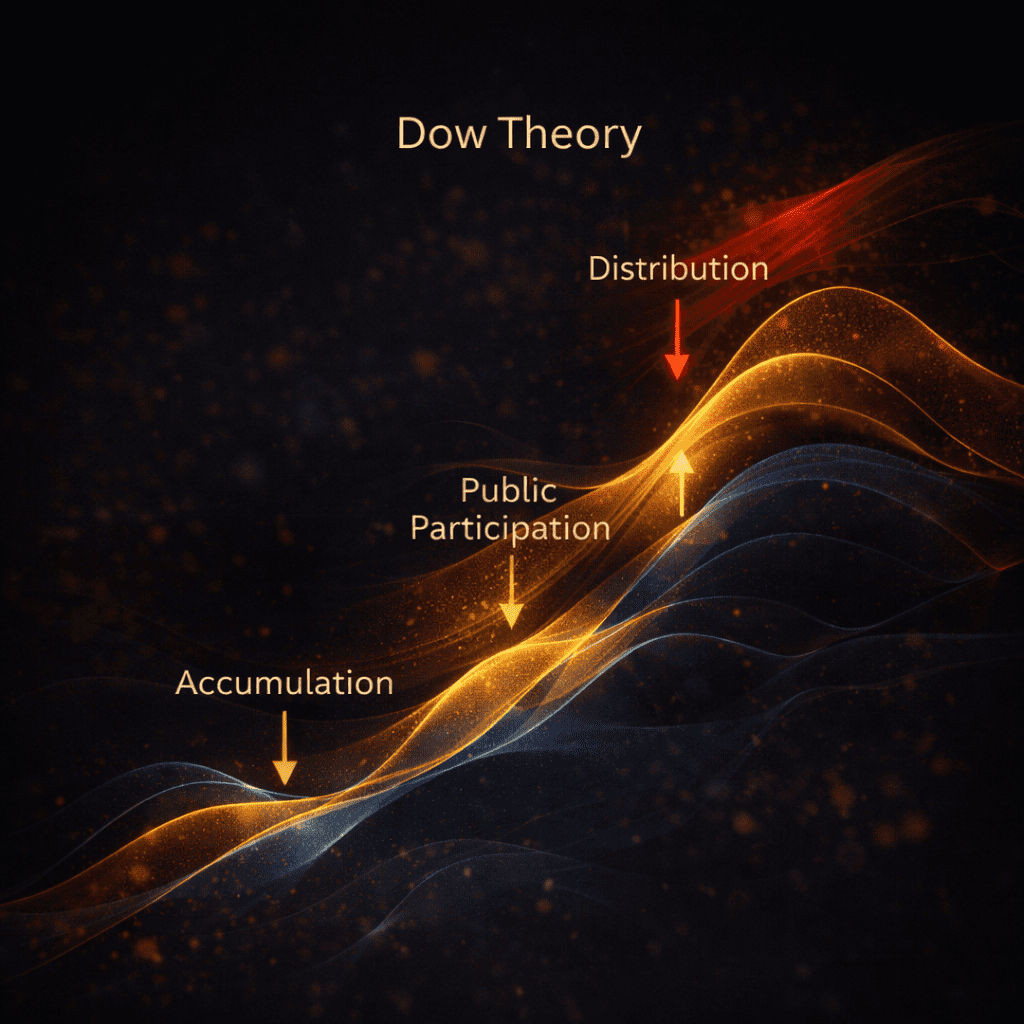
3. The Three Phases of Primary Trends
Accumulation Phase: Smart money buys while the public is pessimistic. Prices drift sideways, volume is low, and sentiment is negative. This is where professionals build positions before the crowd catches on.
Public Participation Phase: The trend becomes obvious. Retail investors pile in, volume increases, and news turns positive. This is the longest phase and where most trend-following profits are made.
Distribution Phase: Smart money sells to the public. Prices may surge on high volume (climax), but momentum fades. The trend reverses, and the cycle begins again.
Sound Familiar? These phases. accumulation, markup, distribution, markdown. form the basis of modern Wyckoff analysis and countless trading strategies.
4. The Averages Must Confirm Each Other
Dow created two indexes: the Industrial Average (manufacturing) and the Railroad Average (transportation, the lifeblood of commerce). His insight: for a true economic trend, both production and distribution must move together.
If industrials make new highs but transports don’t, the economy isn’t actually moving goods. The trend is suspect.
Modern Application: Today we use the Dow Jones Industrial Average (DJIA) and the Dow Jones Transportation Average (DJTA). The principle extends to sector confirmation. if tech stocks rally but semiconductor stocks (the “picks and shovels”) lag, question the rally’s sustainability.
5. Volume Confirms the Trend
Dow believed volume should increase in the direction of the primary trend. Rising prices on rising volume = healthy uptrend. Rising prices on falling volume = weakening trend (fewer buyers pushing prices up).
Volume Signals:
6. A Trend Continues Until It Doesn’t
Dow’s most practical advice: trends persist. A primary trend continues until definitive reversal signals appear. This sounds simple, but it fights human nature. we want to predict tops and bottoms.
The Dow discipline: Wait for confirmation. Don’t anticipate reversals; react to them.
Practical Applications for Today’s Trader
1. Trend Identification
Use Dow’s three-trend framework to answer: What game am I playing?
2. Confirmation Checklist
Before entering a trade, Dow would ask:
3. The 1-2-3 Reversal Pattern
Simplifying Dow’s reversal signals:
Only after step 3 does Dow consider the trend reversed.
Dow Theory vs. Modern Technical Analysis
The Core Remains: Price action reveals everything. Trends persist. Volume validates. Confirmation matters.
Further Reading
This article is part of the Trading Theories & Theorists series. Explore the complete series to build your foundation in market analysis.
← Back to [Trading Theories & Theorists](/trading-theories/) | Continue to [Elliott Wave Theory](/elliott-wave-theory/) →
Get the daily framework intelligence
Trade the framework, not the noise.
The principles in this article are how we read markets every day. Members get the live application: daily Pre-Asia, Pre-London, Pre-NY and Post-Close briefs across 20+ instruments, the indicator suite, the Foundry library, and live community.
Free Explorer tier · No card required · Upgrade when you’re ready