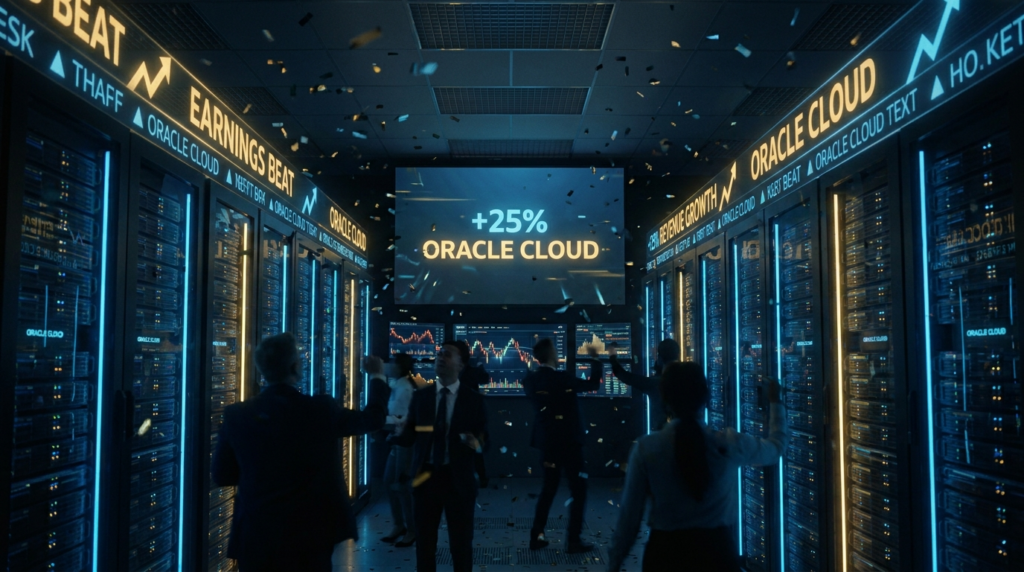
Oracle Beats Earnings and Surges 8-10% After Hours as Cloud Revenue Defies Iran Selloff
Earnings Echo | Thursday 11 June 2026 | Post-Close read
Oracle beat earnings after the close and rallied 8-10% in after-hours trading. Cloud and AI infrastructure demand is surging. Under normal circumstances, this would lift the entire tech sector on Thursday morning. These are not normal circumstances. The S&P 500 has lost $3.3 trillion since June 2nd. VIX is above 22. Iran has shut the Strait of Hormuz. The question is not whether Oracle’s numbers are good. They are. The question is whether micro fundamentals can overcome macro devastation.
THESIS
Oracle’s earnings beat is genuine and reflects real demand for cloud and AI infrastructure. But individual company fundamentals rarely overcome macro headwinds during geopolitical crises. We expect the after-hours gap to face a sell-into-strength response at the open as institutions use the Oracle lift to reduce broader tech exposure. The trade here is patience, not pursuit. Wait for the open, watch the first 30 minutes, and let the market tell us whether micro beats macro this time.
The Oracle Beat
Oracle delivered. Cloud revenue surged. AI infrastructure bookings exceeded expectations. Margins expanded. Every line item that matters for the AI capex narrative came in above consensus.
The after-hours reaction of 8-10% is the market saying: “In isolation, these numbers are excellent.”
But nothing exists in isolation right now.
| Oracle Earnings Metric | Result | Context |
|---|---|---|
| Revenue | Beat consensus | Cloud segment drove the outperformance |
| Cloud Revenue Growth | Surging | AI infrastructure demand accelerating |
| After-Hours Move | +8-10% | Largest post-earnings move in four quarters |
| Forward Guidance | Positive | No Iran-related guidance revision (yet) |
| AI Capex Bookings | Above expectations | Enterprise AI spending remains resilient |
The Macro Collision
Here is the tension the market must resolve on Thursday morning: Oracle’s micro story says “buy tech.” Every macro indicator says “sell risk.”
Historically, macro wins in crisis environments. During the March 2020 crash, multiple companies reported strong earnings and still fell with the broader market. During the April 2025 tariff shock, tech earnings beats held for about 48 hours before macro overwhelmed micro.
| Macro Factor | Status | Tech Impact |
|---|---|---|
| S&P 500 drawdown | -$3.3T since Jun 2 | Valuation compression across the sector |
| VIX level | 22.22 (+11.83%) | Risk premiums expanding; PE multiples contract |
| CPI inflation | 4.2% headline | No rate cuts; higher discount rate on future earnings |
| Crude oil | $92.79 (+5.2%) | Energy costs rising; margin pressure for data centres |
| Iran escalation | Active conflict | Risk-off positioning overrides individual earnings |
| Negative gamma | All 10 symbols | Dealer selling amplifies any equity decline |
The read is clear: Oracle’s earnings are good for Oracle. They are insufficient to change the macro trajectory for the tech sector. The dark pool positioning analysis showed institutions were already derisking before Iran, with leveraged ETF volume at record $90 billion. The institutional flow breakdown revealed dealers at -626,173 net short, meaning the mechanical selling pressure against equities operates independently of any single earnings report. Oracle’s beat does not change the dealer positioning. It does not flip gamma from negative to positive. It does not reopen the Strait of Hormuz.
The $159 Billion Debt Problem
There is a broader tech story that Oracle’s beat cannot fix.
Tech megacaps have issued $159 billion in debt in the first five months of 2026. That is 47% more than all of 2025. The AI infrastructure buildout is being financed with borrowed money at yields above 4.5%.
| Tech Debt Metric | Value | Implication |
|---|---|---|
| 2026 YTD tech debt issuance | $159 billion | 47% above all of 2025 |
| Average yield at issuance | >4.5% | Refinancing cost rising with each CPI print |
| Interest expense growth rate | ~22% YoY | Eating into earnings growth across the sector |
| Crude at $92.79 data centre impact | +3-5% energy costs | AI training runs become more expensive |
Oracle’s cloud business is growing into this headwind. Revenue is rising, but so are the costs of financing and powering the infrastructure that generates that revenue. At current crude prices, every data centre in the world just got 3-5% more expensive to operate. CPI at 4.2% means interest expense will not decline for quarters.
The sector rotation analysis showed tech under pressure with call sellers hitting the tape, heavy put flow in MRVL and TSLA, and risk-off rotation accelerating. Oracle’s beat is a single data point swimming against a sector-wide tide.
The tension between Oracle’s micro strength and the macro devastation is the most important question for Thursday’s open. The sentiment reading at Fear and Greed 27.5 tells us the market is afraid. The volatility lens documented VIX at 22.22 with negative gamma across all ten tracked options symbols. The global grid analysis showed energy-importing nations facing acute risk. The basis analysis found equity futures trading at a discount to fair value. All of this says “sell risk.” Oracle’s earnings say “buy tech.” Historically, when the S&P 500 has lost $3.3 trillion and BofA reports 70% of bear market signals triggered, individual earnings beats provide selling opportunities, not buying ones. The conviction ranking placed the equity short at rank 3 specifically because of this tension: the fundamental case for individual tech names remains intact, but the structural headwinds from positioning, gamma, and geopolitics overwhelm it at the index level. Oracle is the exception that proves the rule.
What This Means for Thursday
Oracle’s after-hours gap creates a specific dynamic at the open.
Bulls will point to the beat as evidence that tech fundamentals are resilient. They will use Oracle’s cloud growth as a proxy for the entire AI infrastructure narrative. There will be a temptation to buy the sector.
We expect institutions to sell into that strength. The reason is simple: Oracle’s gap-up gives portfolio managers a price to exit tech positions that are currently underwater. When you have been holding a losing sector and one name gaps up 10%, you sell the gap to reduce exposure. This is especially true when negative gamma across all options symbols means any failure at the open triggers dealer selling.
| Oracle Trade Scenario | What We Watch For | Our Response |
|---|---|---|
| Gap holds and builds | First 30 minutes: ORCL holds AH price, QQQ firms | Consider small ORCL long at support with tight stop |
| Gap fades gradually | ORCL gives back 3-4% in first hour; QQQ unaffected | No action; confirms macro > micro thesis |
| Gap fills entirely | ORCL back to pre-earnings levels by midday | Strong signal that crisis environment overwhelms all earnings |
Upcoming Earnings Calendar
Oracle is not the only earnings report this week. The broader calendar will test whether the market can process micro fundamentals while managing macro chaos.
| Company | Report Date | Sector | Key Watch |
|---|---|---|---|
| Oracle (ORCL) | Wed AH (reported) | Cloud/AI | Gap sustainability at Thursday open |
| Adobe (ADBE) | Thu AH | Software | AI monetisation progress; pricing power |
| Kroger (KR) | Thu pre-market | Consumer staples | Food inflation commentary; crude pass-through |
| Signet Jewelers (SIG) | Thu pre-market | Consumer discretionary | Consumer spending resilience under pressure |
Adobe on Thursday after hours will be the next major test. If Adobe also beats, the narrative shifts toward “AI fundamentals are real.” If Adobe misses or guides down citing macro uncertainty, Oracle becomes an isolated data point rather than a sector trend.
Kroger pre-market is important for a different reason. Their food inflation commentary will tell us how quickly crude at $92.79 is flowing through to consumer prices. The macro analysis flagged this energy-to-food transmission channel as a primary risk. Kroger’s guidance is a real-time data point.
Sizing and Approach
| Parameter | Our Read |
|---|---|
| Overall Risk | Around 55% — individual earnings beats provide selective opportunities but cannot overcome geopolitical headwinds at the index level |
| Sizing Tier | REDUCED — do not chase the after-hours gap; let the open settle before any action |
| ORCL Watch Levels | Entry only if gap holds 30 min | Stop below $175 | Target $200 if macro cooperates |
| QQQ Watch Levels | Still monitoring short setup from the conviction ranking | Entry below $478 | Target $465 |
Scenarios for Thursday
| Scenario | Probability | What Happens |
|---|---|---|
| Bull Case | 30% | Oracle beat lifts tech sentiment. Pre-market buyers defend the sector. ORCL holds its gap, QQQ stabilises above 480. Earnings fundamentals temporarily reassert over geopolitics. Adobe reports Thursday AH and extends the narrative. |
| Sideways | 35% | Oracle holds after-hours gains but broader tech remains under pressure. Stock-specific divergence. ORCL trades up, QQQ trades flat to down. The market separates micro winners from macro losers. |
| Correction | 35% | Oracle’s after-hours gains fade at the open as Iran escalation overwhelms earnings. Institutions sell the gap to reduce tech exposure. ORCL fills back to pre-earnings levels. Tech earnings become irrelevant until the crisis resolves. |
The Bottom Line
Oracle’s numbers are legitimately strong. Cloud revenue surging during a global crisis speaks to the durability of AI infrastructure spending. That is a multi-year secular trend that will outlast any geopolitical event.
But we do not trade multi-year trends overnight. We trade the next session. And the next session has VIX above 22, negative gamma across every options symbol, and a Situation Room meeting about Iran. Oracle beat earnings. The market might not care.
Continue Reading
Previously in the sequence:
▶ Dark pool positioning turns defensive — $90B leveraged ETF volume, institutional selling into strength
▶ CPI hits 4.2% as Iran war premium reprices rates — inflation locks out rate cuts
▶ Fear and Greed drops to 27.5 — sentiment in fear territory
▶ VIX surges to 22.22 on negative gamma — dealer hedging cascade mechanics
▶ S&P 500 breaks below 7,300 — $3.3 trillion erased, NQ below 28,800
▶ Energy and defence surge as tech rotates — only positive sector
▶ Global markets tumble on Hormuz closure — energy importers face acute risk
▶ Asset managers hold 982K long vs 482K short — institutional divergence
▶ Negative gamma across all 10 options symbols — max pain SPY $709
▶ Sector rotation into energy and defence — tech distribution, breadth data
▶ Futures basis widens on crude contango — Treasury paradox
▶ Dollar strengthens as yen surges — FX impact on multinational earnings
▶ Bitcoin holds $61,483 despite risk-off — crypto resilience question
▶ Crude surges while gold crashes — commodity mechanics driving everything
▶ Three war-premium setups with defined risk — tactical playbook
▶ Conviction ranking: crude and gold lead — ranked opportunity hierarchy
Analysis, not financial advice. Always manage your own risk. Published by Alpha Insights, 11 June 2026.
Deepen Your Understanding
Related articles from the Titan Protect Foundry: