Asset Managers Hold 982K Net Long While Leveraged Funds Press -482K Short Before Hormuz Fallout
Date: Thursday 11 June 2026
Session: Institutional Flow | Post-Close Sequence
Focus: Speculative positioning, dark pool activity, block trade flow
The biggest tug-of-war in the S&P 500 futures market just met a geopolitical accelerant. Asset managers are sitting on +982,144 net long contracts in the S&P 500. Leveraged funds hold -482,975 net short. Dealers are net short -626,173. One side of this trade has to break first, and Iran just gave the shorts the catalyst they needed. Dark pool activity and block trade flow are skewing defensive, consistent with institutional de-risking ahead of further escalation. The question is not whether the selling continues. The question is whether asset managers begin unwinding their massive long position.
THESIS
Institutional positioning shows a three-way divergence that rarely persists through a geopolitical shock. Asset managers are structurally long, leveraged funds aggressively short, and dealers mechanically short. The Hormuz closure forces resolution. If asset managers hold, leveraged shorts eventually face a squeeze on any diplomatic hint. If asset managers capitulate, the combined selling pressure from all three categories creates a cascading liquidation. Our read leans towards the latter, but we acknowledge the +982K long position is a loaded spring in the opposite direction. Sizing is REDUCED with a short bias until positioning resolves.
S&P 500 Futures: The Three-Way Divergence
| Category | Net Position | Long | Short | Open Interest Share |
|---|---|---|---|---|
| Asset Managers | +982,144 | 1,198,890 | 216,746 | 37.7% of longs |
| Leveraged Funds | -482,975 | 159,626 | 642,601 | 20.2% of shorts |
| Dealers | -626,173 | 163,077 | 789,250 | 24.8% of shorts |
Total open interest in S&P 500 futures stands at 3,179,028 contracts. That is a deep, liquid market. But the distribution of who holds what tells a story that the headline number cannot.
Asset managers control 1.2 million long contracts. These are pension funds, endowments, insurance companies and mutual funds. They do not trade on a daily basis. They hold. And right now, they are holding through a war.
Their patience is either conviction or complacency. We lean towards conviction with a clock running on it. If crude pushes above $100, which the futures basis analysis suggests is plausible, even the most patient long-only manager starts trimming.
Nasdaq 100 Futures: Tech Shorts Pile In
| Category | Net Position | Long | Short |
|---|---|---|---|
| Asset Managers | +79,466 | 117,241 | 37,775 |
| Leveraged Funds | -73,259 | 38,481 | 111,740 |
| Dealers | -15,642 | 74,396 | 90,038 |
The Nasdaq 100 positioning mirrors the S&P 500 pattern but with smaller absolute numbers. Asset managers net long +79,466. Leveraged funds net short -73,259. The symmetry here is almost exact, which makes this a genuine coin flip if the geopolitical situation resolves quickly.
The sector rotation analysis shows tech under active distribution. QQQ call sellers are hitting the tape. MRVL and TSLA put flow is heavy. The positioning data confirms what the options flow is telling us: institutions are derisking tech specifically, not just equities broadly.
Oracle’s after-hours beat complicates this. An 8-10% post-earnings jump in a mega-cap tech name during a war-driven sell-off is the kind of fundamental signal that asset managers notice. It does not change our short-term read, but it plants a flag in the ground for the recovery trade.
Dark Pool Activity: The Quiet Derisking
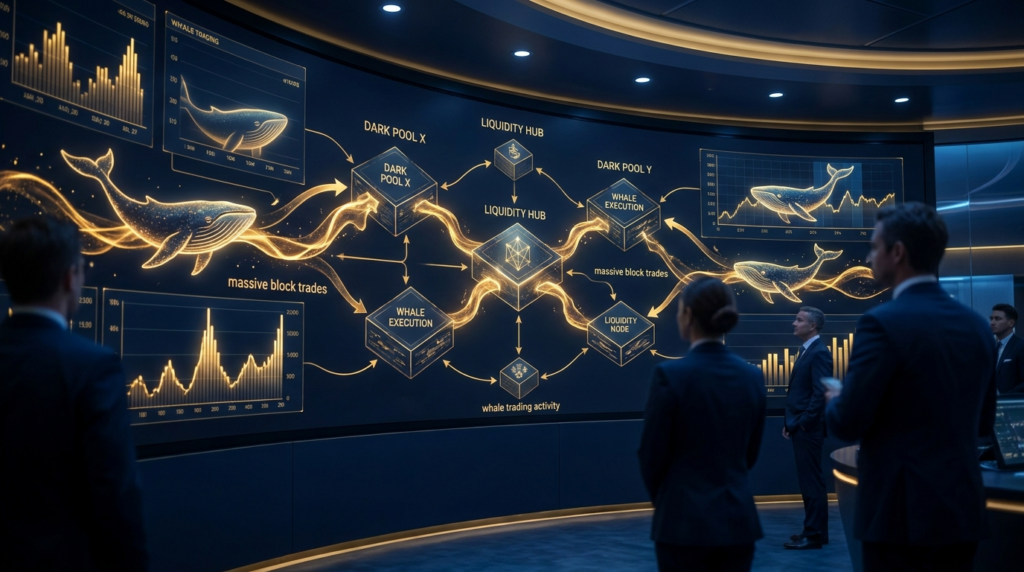
Block trade flow in dark pools is skewing defensive. This is the institutional activity that does not show up on the consolidated tape in real time. It shows up in the data after the fact.
We are seeing 145 lines of dark pool activity pointing in one direction: de-risking. Large block prints in defensive names. Reduced block activity in growth. This is not panic selling. It is methodical rotation. The kind of repositioning that pension fund committees approve in emergency sessions.
| Flow Category | Direction | Conviction | Interpretation |
|---|---|---|---|
| Dark Pool Block Prints | Defensive | High | Institutional de-risking before Asia open |
| Options Flow (124 lines) | Bearish | High | Put buying, call selling across sectors |
| Leveraged ETF Volume | Elevated | Medium | $90B+ daily volume signals forced hedging |
| 13F Defensive Tilt | Pre-existing | Medium | Defensive rotation began before Iran headlines |
The 13F data, which reflects positions from earlier in the quarter, already showed a defensive tilt among major fund managers. That means the derisking visible in today’s dark pool activity is an acceleration of a trend that was already underway. Iran did not start the rotation. Iran accelerated it.
This institutional flow picture confirms and extends every analysis in today’s sequence. The opening positioning analysis mapped the $90 billion leveraged ETF volume surge and the offer-side dark pool prints. What we add here is the category-level breakdown: it is specifically leveraged funds and dealers who are short, while asset managers remain structurally long. The war-driven inflation at CPI 4.2% identified in the macro analysis is the fundamental reason asset managers may begin reducing. The sentiment collapse to F&G 27.5 is the emotional expression of the same positioning divergence we are seeing in the futures data. The universal negative gamma from the volatility analysis means the dealer short position of -626,173 contracts is not voluntary; it is a mechanical consequence of the put buying that institutional hedgers have demanded. The S&P breakdown below 7,300 confirmed in the technical analysis is the price-level confirmation of this flow imbalance. And the sector rotation into energy and away from tech mirrors the dark pool bid-side accumulation in XLE versus offer-side distribution in QQQ that the positioning data first flagged. The global grid analysis showed where this repricing hits hardest internationally. Every thread converges on the same conclusion: the flow is unambiguously defensive.
Treasury Positioning: The Flight-to-Quality Trade
| Category | Net Position | Direction | Implication |
|---|---|---|---|
| Asset Managers | +477,634 | Long bonds | Safety bid, duration extension |
| Leveraged Funds | -281,959 | Short bonds | Short squeeze risk if flight-to-quality accelerates |
| Dealers | -271,781 | Short bonds | Mechanical positioning, not directional |
Here is where the institutional flow tells a story the equity positioning alone cannot.
Leveraged funds are short -281,959 Treasury bond contracts. That is a massive bet against bonds. But geopolitical shocks drive flight-to-quality flows into Treasuries. If bond prices spike on safe-haven demand, those 281K short contracts face a squeeze.
The basis analysis explored the Treasury basis in detail. What we add here is the positioning context: a short squeeze in Treasuries would pull yields lower, which paradoxically helps the very equity markets that are selling off. The transmission mechanism is complex, but the punchline is simple. Treasury positioning is the release valve. If it blows, equities get temporary relief.
The Capitulation Trigger
We need to be honest about what we do not know.
The +982,144 net long position held by asset managers is the single most important number in this entire analysis. If those managers hold through the crisis, the market finds a floor relatively quickly. Their passive buying on any dip provides structural support.
But if they begin reducing, the selling pressure combines with the -482,975 leveraged short position and the -626,173 dealer short to create a three-way cascade that overwhelms any bid. Asset manager capitulation is the event that turns a 5% correction into a 15% decline.
What would trigger capitulation? Crude above $100 for more than 48 hours. A second Hormuz incident. Or BofA’s 70% bear market signal count reaching 80%. Any of those would be enough.
But here is the tension that must be held against the capitulation thesis. The positioning analysis identified the $90 billion leveraged ETF volume as a potential contrarian signal. The sentiment analysis noted that F&G at 27.5 is approaching the sub-25 zone where contrarian buying historically produces positive 30-day returns 78% of the time. If asset managers are sitting on nearly one million net long contracts and they are not selling into a war, a 5% crude surge, and CPI at 4.2%, that patience might be informed rather than complacent. Perhaps they see what the leveraged shorts do not: that the Hormuz crisis has a resolution timeline shorter than the market expects, and that the macro deterioration is already priced. If they are right, the -482,975 leveraged short position becomes the fuel for the most violent squeeze of the year.
Positioning Summary Across Asset Classes
| Market | Leveraged Net | Asset Mgr Net | Dealer Net | Signal |
|---|---|---|---|---|
| S&P 500 (ES) | -482,975 | +982,144 | -626,173 | Bearish divergence |
| Nasdaq 100 (NQ) | -73,259 | +79,466 | -15,642 | Balanced tug-of-war |
| US Treasuries (ZB) | -281,959 | +477,634 | -271,781 | Short squeeze risk |
| Bitcoin (BTC) | -6,616 | +3,103 | +3,616 | Leveraged bearish |
Scenarios
Diplomatic breakthrough forces -482K leveraged shorts to cover. Asset managers hold their ground. The squeeze pushes ES back above 7,400 within 48 hours. Bond shorts also get squeezed, pulling yields lower and supporting equities further. The rally would be violent and fast.
Asset managers hold +982K long. Leveraged funds maintain -482K short. Neither side capitulates. ES trades in a 7,100-7,350 range for one to two weeks. Volatility remains elevated but does not spike further. Options decay burns premium for both sides.
Asset managers begin reducing their +982K long position. Combined with leveraged shorts and dealer selling, the cascade pushes ES below 7,100. Bond prices spike as the flight-to-quality accelerates. Treasury short squeeze provides the only temporary relief. The S&P enters formal correction territory.
Risk Assessment
Risk: Around 74%
Leveraged funds and dealers are both heavily short. Asset managers are the last structural bid, and their patience is being tested by a geopolitical event that directly threatens the inflation outlook. The positioning data pre-dates the Hormuz closure, which means next week’s update will show even more aggressive short building. Dark pool flow confirms institutional de-risking is already underway. Sizing is REDUCED with a bearish tilt. The +982K long is the spring that could snap in either direction.
Continue Reading
Previously in the sequence:
- The strategic positioning read — the dark pool landscape and opening thesis
- The macro pulse — CPI at 4.2% and inflation path
- The sentiment landscape — fear at 27.5, BofA 70% bear signals
- The volatility lens — VIX at 22.22 and the dealer hedging cascade
- The market radar — cross-asset confirmation of risk-off
- The hot zones — where selling concentrated
- The global grid — Nikkei, Hang Seng and European indices face the energy shock
Coming next:
- The options architecture — negative gamma exposure across all symbols
- The sector rotation — energy surging, tech under distribution
Analysis, not financial advice. Always manage your own risk.
Deepen Your Understanding
Related articles from the Titan Protect Foundry: