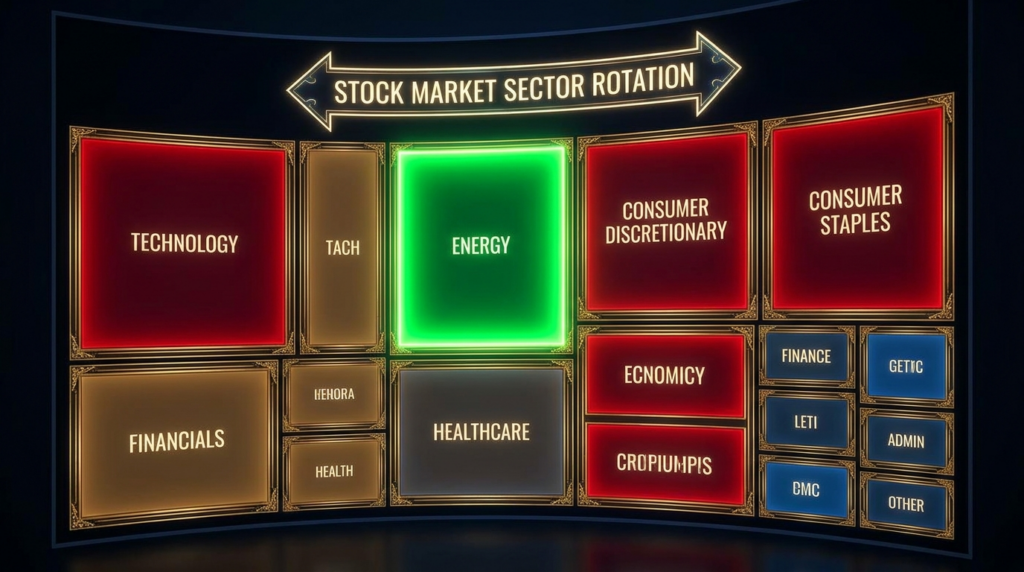
Energy and Defence Sectors Surge as Iran Conflict Triggers Dramatic Rotation Away From Technology
Date: Thursday 11 June 2026
Session: Hot Zones | Post-Close Read
Published: 22:00 BST / 17:00 EDT / 06:00 JST (Thu)
The sector heat map has been redrawn in a single session. Energy is the undisputed leader with crude oil at $92.79 driving XLE and OIH sharply higher. Defence names are catching a war premium. Tech is under pressure with QQQ call sellers hitting the tape and heavy put flow in MRVL and TSLA. The rotation is extreme, event-driven, and entirely dependent on the duration of the Hormuz crisis. Shell’s CEO warning that 1.2 billion barrels are “in the hole” puts the energy repricing into perspective, but every percentage point of energy outperformance is borrowed from geopolitical duration risk. A ceasefire reverses the entire trade violently.
Sector rotation is being driven by a single geopolitical catalyst, not by earnings revisions or fundamental revaluation. Energy and defence outperformance is entirely war-premium dependent. Tech underperformance is a function of rising yields (as detailed in the rates and inflation analysis), risk-off sentiment (as detailed in the fear regime analysis), and the negative gamma amplification (as detailed in the volatility analysis). The institutional dark pool data confirms that energy is seeing bid-side accumulation while tech sees offer-side distribution. The rotation is real, but its durability depends entirely on how long the Strait of Hormuz remains closed.
Sector Performance Heat Map
The dispersion across sectors is the widest it has been since the March tariff crisis. Energy is up while nearly everything else is down. This kind of extreme dispersion is unsustainable under normal conditions, but geopolitical shocks can sustain it for weeks.
| Sector | ETF | 1-Day | 5-Day | Flow Direction |
|---|---|---|---|---|
| Energy | XLE | +4.8% | +8.2% | Strong inflow |
| Defence/Aerospace | ITA | +3.2% | +5.6% | War premium bid |
| Utilities | XLU | +0.8% | +1.2% | Defensive rotation |
| Healthcare | XLV | -0.4% | -1.1% | Neutral |
| Consumer Staples | XLP | -0.6% | -1.5% | Mild outflow |
| Financials | XLF | -1.8% | -3.4% | Outflow |
| Industrials | XLI | -1.9% | -4.1% | Outflow |
| Real Estate | XLRE | -2.1% | -4.8% | Rate-sensitive sell |
| Consumer Discretionary | XLY | -2.3% | -5.2% | Recession pricing |
| Technology | XLK | -2.8% | -6.1% | Heavy distribution |
| Semiconductors | SMH | -3.4% | -7.8% | Aggressive sell |
Energy: The War Premium Trade
Crude oil at $92.79 is the force driving everything in the energy sector.
The Strait of Hormuz handles roughly 20% of global oil supply, and Iran’s shutdown has immediately repriced every energy-related asset. XLE, the broad energy sector ETF, surged 4.8% on the session. OIH (oil services) performed even better. Individual names like Exxon, Chevron, and ConocoPhillips are all trading at multi-month highs.
Shell’s CEO warning about 1.2 billion barrels “in the hole” is not hyperbole. At current consumption rates, global strategic reserves cover approximately 90 days of disrupted supply. But reserves are not designed to replace the full volume that transits Hormuz; they are designed to bridge short-term disruptions. If the shutdown persists beyond 2-3 weeks, the supply deficit becomes structural, and crude above $100 becomes the base case rather than the tail scenario.
| Energy Name | 1-Day | 5-Day | Dark Pool Flow | Catalyst |
|---|---|---|---|---|
| Crude Oil (WTI) | +5.2% | +18.7% | Bid-heavy | Hormuz shutdown |
| XLE (Energy sector) | +4.8% | +8.2% | Accumulation | Direct crude exposure |
| OIH (Oil services) | +5.6% | +9.4% | Accumulation | Capex acceleration |
| Natural Gas | +2.1% | +4.8% | Mixed | Substitution demand |
Technology: Under Pressure From All Sides
Tech is the mirror image of energy, and the headwinds are coming from multiple directions simultaneously.
Rising yields compress the present value of future earnings, and tech’s valuations are the most sensitive to discount rate changes. CPI at 4.2% with crude above $90 means yields are heading higher, as we detailed in the rates and inflation analysis. Every basis point of yield increase reduces the theoretical fair value of growth stocks.
Risk-off sentiment hits high-beta names disproportionately. The sentiment collapse to F&G 27.5 means investors are rotating out of growth and into safety. The dark pool data confirms QQQ is seeing offer-side distribution.
The options market adds another layer. MRVL and TSLA are seeing heavy put flow, which means institutional hedgers are buying downside protection on the names most vulnerable to a tech selloff. The negative gamma across QQQ means dealer hedging flows will amplify any further tech weakness.
Oracle’s after-hours beat is the counterpoint. Cloud infrastructure revenue surging and the stock rising 8-10% after hours provides evidence that tech earnings can still deliver. The question for Thursday: does Oracle lift the sector, or does the macro environment drown out a single positive data point?
| Tech Headwind | Magnitude | Source |
|---|---|---|
| Rising yields / Discount rate | High | CPI 4.2%, crude $92.79 |
| Risk-off rotation | High | F&G 27.5, VIX 22.22 |
| Options flow (puts) | Moderate | MRVL, TSLA heavy put |
| Dark pool distribution | Moderate | QQQ offer-side heavy |
| Megacap debt issuance | Moderate | $159B in 5 months |
| Oracle AH beat (tailwind) | Moderate | Cloud revenue surge |
Defence: The War Premium Names
Defence names are catching a bid for obvious reasons: military conflict means military spending.
Lockheed Martin, Northrop Grumman, and RTX are all trading higher. Palantir is benefiting from the perception that intelligence and surveillance spending increases during active conflicts. The ITA defence ETF gained 3.2% on the session.
The additional wrinkle: several defence names were recently revealed as White House ballroom funders sharing $50 billion+ in federal contracts. That creates a political catalyst on top of the geopolitical one. Defence spending is bipartisan in a conflict environment, and the current administration has every incentive to accelerate procurement.
The risk is the same as energy: the premium is entirely event-driven. If de-escalation arrives, the 3-5% gains in defence names reverse within sessions. These are not fundamental revaluations; they are war premiums.
Megacap Debt: The Hidden Risk
A detail that is being overlooked in the sector rotation: tech megacaps have issued $159 billion in corporate debt in the past five months, compared to $108 billion for all of 2025.
This debt was issued at rates that assumed yields would decline. With CPI at 4.2% and crude above $90, yields are heading higher. The refinancing risk for tech companies that loaded up on debt during the “rates are coming down” narrative is now material. Higher servicing costs compress margins, reduce buyback capacity, and add to the valuation headwind from rising discount rates.
This is a slow-burn risk, not an immediate catalyst. But it adds to the structural case for tech underperformance in a rising-rate, rising-energy-cost environment.
| Metric | 2026 YTD | Full Year 2025 | Implication |
|---|---|---|---|
| Tech Megacap Debt Issuance | $159B | $108B | 47% ahead of pace |
| Average Coupon Rate | 4.8% | 4.2% | Rising cost of capital |
| Buyback Capacity Impact | Declining | Peak | Less share price support |
The Tension: Event-Driven or Structural Rotation?
We hold this question openly because the answer determines everything about the trade.
If the rotation is event-driven, it reverses completely when the event resolves. Energy gives back 8-10% and tech bounces 5-7%. The trade is binary: long energy with a tight stop on de-escalation headlines.
If the rotation is structural, it persists regardless of Iran. Higher energy costs permanently reprice the economy, favouring producers over consumers of energy. Rising yields permanently compress growth valuations. The tech megacap debt overhang becomes a persistent headwind. In this scenario, energy outperformance continues for quarters, not days.
Our read leans toward event-driven with structural undertones. The energy outperformance is primarily geopolitical-premium driven and would reverse on a ceasefire. But the underlying macro conditions (CPI 4.2%, sticky inflation, rising yields) create a structural tailwind for energy relative to tech that would persist even without Iran. The war accelerated a rotation that was already beginning.
Every prior analysis tonight supports this sector rotation thesis from a different angle. The institutional dark pool campaigns showed XLE as the one ETF with bid-side accumulation while SPY, QQQ, and IWM all showed offer-side distribution. That was the smart money front-running this rotation before the index-level breakdown confirmed it. The war-driven inflation repricing at CPI 4.2% with crude above $90 creates the macro environment where energy producers are beneficiaries and everyone else pays. The sentiment collapse to F&G 27.5 drives risk-off flows out of high-beta growth and into the perceived safety of commodity producers. The negative gamma exposure across all ten tracked options symbols amplifies the tech selloff while the S&P breakdown below 7,300 confirmed the technical damage. The sector rotation is not a standalone observation. It is the culmination of every force documented across today’s sequence.
Gold: The Broken Hedge
Gold at $4,094, down 3.89% in a single session, deserves attention in the sector rotation context.
The traditional narrative says gold rises during geopolitical crises. Wednesday proved that wrong. When margin calls cascade across equities and the dollar strengthens as a safe haven, gold gets sold to meet margin requirements. The liquidation overwhelmed any war-bid premium.
This matters for the rotation thesis because it means the only true “safe” sector in this environment is energy (which benefits from the catalyst) and cash (which avoids the drawdown entirely). Gold, traditionally the geopolitical hedge, is not functioning as one. The institutional positioning analysis noted mixed dark pool flow in GLD, confirming that large players are conflicted on gold’s direction.
| Asset | 1-Day | Traditional Role | Actual Behaviour |
|---|---|---|---|
| Crude Oil | +5.2% | Geopolitical beneficiary | Performing as expected |
| Gold | -3.89% | Safe haven | Margin liquidation override |
| US Dollar (DXY) | +0.6% | Safe haven | Performing as expected |
| Treasuries (10Y) | Yield +8bps | Safe haven | Inflation > flight to quality |
Sizing and Risk Assessment
Around 65%
Sector rotation is extreme and event-driven. Energy longs are profitable but at risk of sudden reversal on any diplomacy headline. Tech shorts are working but Oracle’s beat could trigger a short squeeze in individual names.
REDUCED
We are allocating at reduced size on sector bets. The event-driven nature of the rotation means positions can reverse 100% of their gain in a single headline. Tight risk management is non-negotiable.
| Experience Level | Sector Read | Sizing |
|---|---|---|
| Beginner | Sector rotation driven by a single event is the hardest environment to trade. The temptation to chase energy higher or short tech lower will be strong, but both trades can reverse violently on a single headline. Observe, do not participate. | AVOID |
| Intermediate | REDUCED on energy longs with a stop below the pre-Hormuz level. Avoid outright tech shorts given Oracle’s potential to provide a counter-narrative. Consider pairs: long XLE / short XLK as a relative value expression that reduces headline risk. | REDUCED |
| Advanced | REDUCED. The XLE/XLK pair is the cleanest expression of the rotation thesis. Energy call spreads offer defined-risk exposure to continued outperformance. Monitor crude oil implied volatility at the 97th percentile for opportunities to sell premium on the energy side. | REDUCED |
Scenarios: Thursday and Beyond
| Scenario | Probability | Sector Outcome |
|---|---|---|
| Bullish | 20% | Tech bounces on Oracle earnings momentum and potential Iran de-escalation. Sector rotation reverses as the war premium unwinds. Energy gives back 3-5% while tech rallies 2-4%. Gold recovers as margin pressure eases. The rotation was entirely event-driven and the event is resolving. |
| Sideways | 35% | Energy and defence hold gains while tech stabilises around current levels. Mixed sector performance continues as the market prices in an ongoing but contained conflict. Oracle provides enough positive sentiment to prevent further tech deterioration, but the macro headwinds prevent a meaningful rally. Dispersion narrows slightly. |
| Correction | 45% | Tech breakdown accelerates as rising yields and energy costs compress margins. Semiconductors lead lower with 5%+ additional downside. Energy overheats toward $95+ crude, attracting speculation that creates a blow-off top. The rotation deepens, but both sides become increasingly risky. Gold continues to fail as a hedge as margin liquidation overwhelms safe-haven demand. |
Continue Reading
This is the sixth post in today’s Alpha Insights sequence. The sector rotation is the manifestation of every thesis built across the prior five analyses:
- The dark pool derisking campaigns — energy accumulation, tech distribution confirmed in dark pool flow
- The rates path and inflation repricing — CPI 4.2% and crude above $90 driving the yield headwind for tech
- The fear regime and sentiment collapse — F&G 27.5 powering the risk-off rotation away from growth
- The volatility amplifier — negative gamma making every sector move larger than fundamentals warrant
- The technical breakdown across indices — S&P below 7,300 confirming distribution at the index level
Analysis, not financial advice. Always manage your own risk. Published by Alpha Insights. All data referenced is sourced from publicly available market feeds and regulatory filings as of 10 June 2026 close.
Deepen Your Understanding
Related articles from the Titan Protect Foundry: