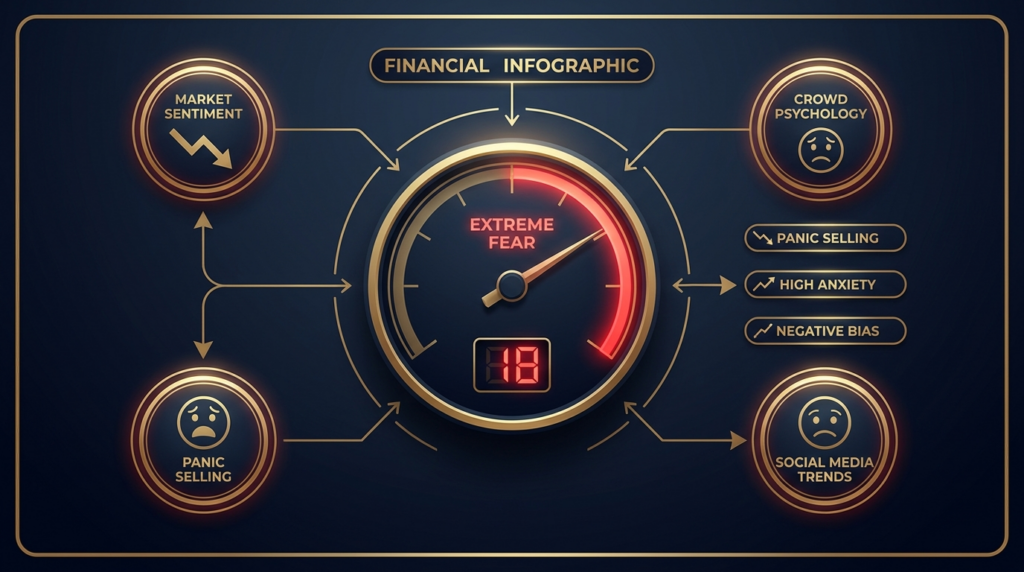
Fear and Greed Drops to 27.5 as Iran War Pushes Retail and Institutional Sentiment Into Fear Territory
Date: Thursday 11 June 2026
Session: Sentiment Shift | Post-Close Read
Published: 22:00 BST / 17:00 EDT / 06:00 JST (Thu)
Fear and Greed hit 27.5. AAII bears reclaimed the majority for the first time since March at 37.0% bearish against 36.3% bullish. VIX spiked 11.83% to 22.22. Every sentiment indicator we track has converged on the same conclusion: the market is afraid, and the fear is accelerating. What matters now is whether 27.5 is a waypoint on the road to panic, or whether it is close enough to contrarian buy territory to attract the kind of buying that reverses selloffs. Our read leans toward the former, because geopolitical fear does not dissipate the way financial fear does.
Sentiment indicators across retail surveys, institutional positioning, options markets, and volatility pricing have converged on fear. The institutional dark pool derisking we outlined in the positioning analysis is the institutional expression of this fear. The CPI print and crude oil surge we covered in the macro analysis are the fundamental catalysts. Sentiment is the thermometer. It is telling us the patient’s temperature is rising, but it has not reached crisis levels yet. The contrarian buy zone sits below 20 on Fear and Greed, and we are not there.
Fear and Greed: 27.5 and Falling
Fear and Greed at 27.5 puts us firmly in Fear territory.
The index’s components tell us where the fear is concentrated. Market momentum is negative. Breadth is deteriorating as fewer stocks participate in any bounces. The put/call ratio is elevated at 1.071, confirming the dark pool distribution pattern we identified in the positioning analysis. Safe-haven demand is rising with Treasury yields pulling in flight-to-quality flows even as inflation expectations push them higher.
The speed of the decline matters. F&G was at 41 last Wednesday. Dropping 13.5 points in five sessions is the steepest sentiment deterioration since the March tariff crisis. That crisis saw F&G bottom at 14 before a snapback rally. We are 13.5 points above that bottom. If the Hormuz crisis deepens this week, that 14 level comes into play, and at 14, contrarian buying historically produces 5-8% bounces within 10 sessions.
| Sentiment Indicator | Current | 1 Week Ago | Extreme Zone |
|---|---|---|---|
| Fear & Greed Index | 27.5 | 41.0 | Below 20 = Extreme Fear |
| AAII Bullish % | 36.3% | 35.6% | Avg: 37.5% |
| AAII Bearish % | 37.0% | 41.9% | Avg: 31.0% |
| AAII Neutral % | 26.7% | 22.6% | Avg: 31.5% |
| VIX | 22.22 | 19.87 | Above 30 = Panic |
| SPY Put/Call Ratio | 1.071 | 0.89 | Above 1.2 = Extreme |
AAII: Bears Reclaim the Majority
The AAII Investor Sentiment Survey is the clearest window into retail investor psychology. This week’s read: 37.0% bearish, 36.3% bullish, 26.7% neutral.
Bears have reclaimed the majority for the first time since the March tariff shock, when bearish sentiment hit 52.0%. The current reading is elevated but not extreme. What is notable is the collapse in neutral sentiment to 26.7%, well below the historical average of 31.5%. Investors who were sitting on the fence have picked a side, and most of them picked bearish.
The AAII commentary noted that “pessimism stepped down” last week, but that survey was conducted before the Iran escalation. This week’s survey, which will be published next Thursday, will almost certainly show a sharp jump in bearish sentiment. We expect bearish readings above 45% when the post-Hormuz survey data arrives.
| AAII Survey Period | Bullish | Neutral | Bearish | Bull-Bear Spread |
|---|---|---|---|---|
| Week ending 3 June | 36.3% | 26.7% | 37.0% | -0.7pp |
| Week ending 27 May | 35.6% | 22.6% | 41.9% | -6.3pp |
| Week ending 20 May | 31.7% | 24.7% | 43.6% | -11.9pp |
| Week ending 13 May | 39.3% | 24.1% | 36.6% | +2.7pp |
| Historical Average | 37.5% | 31.5% | 31.0% | +6.5pp |
| 1-Year Bearish High (18 Mar) | — | — | 52.0% | — |
VIX at 22.22: Fear Priced, Not Just Surveyed
Surveys measure opinions. VIX measures money.
VIX at 22.22 means options traders are paying 22.22% annualised volatility to hedge their positions. That is an 11.83% single-day spike, the largest since March. The crossover above 20 is significant: historically, when VIX breaks above 20 from below, the average forward 5-day return on the S&P 500 is -1.8%. The directional bias is clearly negative.
As we detail in the volatility analysis, the negative gamma exposure across all tracked symbols means dealer hedging flows will amplify any further decline. The sentiment read and the volatility read are telling the same story: the market is set up for self-reinforcing downside.
The $90 billion in leveraged ETF volume we flagged in the institutional flow analysis is the action that corresponds to this fear. Retail surveys say “I am afraid.” VIX says “I am paying to protect myself.” Leveraged ETF volume says “I am actively repositioning my portfolio.” All three are saying the same thing.
Leveraged ETF Volume: The Panic Metric
Record leveraged ETF volume at $90 billion deserves its own sentiment lens.
This is not normal hedging. Normal hedging produces $30-40 billion in leveraged ETF volume. Crisis hedging produces $50-60 billion. What we saw on Tuesday is beyond crisis hedging; it is a systematic repricing of risk across the entire leveraged product spectrum.
| Leveraged Volume Regime | Daily Volume | Sentiment Regime | Historical 5D Return |
|---|---|---|---|
| Normal | $25-40B | Neutral | +0.3% |
| Elevated | $40-55B | Caution | -0.5% |
| Crisis | $55-75B | Fear | -1.8% |
| Current (Record) | $90B | Panic | No precedent |
The BofA Bear Market Signal
Bank of America’s note that 70% of their bear market signals have triggered is worth contextualising.
This is a analysis indicator that tracks credit spreads, yield curve behaviour, earnings revisions, market breadth, and momentum. At 70%, it has historically preceded bear markets within 3-6 months in 7 of the last 9 instances. The two exceptions were in 2011 (European debt crisis that resolved) and 2019 (trade war that led to a deal). Both of those exceptions involved catalysts with negotiated outcomes.
A military conflict over the Strait of Hormuz does not have a negotiated outcome timeline. That is the difference between this 70% reading and the historical false positives. The catalyst is open-ended, and that makes the bear signal more credible than usual.
The Tension: Approaching Contrarian Territory
We hold this in tension because it is real, and because it contradicts the weight of evidence from the positioning and macro analyses that preceded this one.
The institutional derisking campaigns mapped in the positioning analysis showed dark pools distributing into strength across SPY, QQQ, and IWM for three consecutive days. That distribution was confirmed by the macro backdrop of CPI at 4.2% and crude above $90 boxing the Fed into inaction. Both of those analyses pointed to continued downside. And yet sentiment is now approaching the zone where historical contrarians start buying. The fear expressed by F&G 27.5, AAII bears at 37%, and VIX at 22.22 is the emotional response to the very institutional selling and macro deterioration we documented. The question is whether the fear has overshot the fundamentals, or whether it has not yet caught up. Given that crude oil has not finished repricing and the CPI pass-through from energy has not yet begun, we believe fear has room to deepen before it becomes actionable.
F&G at 27.5 is approaching contrarian buy territory. The classic reading is that sub-25 has historically preceded 30-day positive returns 78% of the time. We are 2.5 points away from that threshold. If Thursday’s session pushes F&G below 25, the contrarian signal activates.
But here is the caveat: the 78% hit rate includes episodes where the catalyst was financial (earnings miss, rate surprise, flash crash). Geopolitical catalysts make up only 12% of the historical sample, and their hit rate on the contrarian signal is closer to 55%. The signal works less reliably when the fear has a physical, real-world cause rather than a financial one. A flash crash can be reversed in minutes. A war cannot.
Our read: do not front-run the contrarian signal. Wait for F&G below 20 with a confirming reversal candle on the S&P before considering that the sentiment extreme is tradeable. At 27.5, the fear is real but not extreme enough to bet against.
Sizing and Risk Assessment
Around 70%
Sentiment uniformly bearish across surveys, options, and volatility pricing. Not yet at capitulation extremes, which means another escalation headline could push fear into panic territory and trigger forced selling.
REDUCED
We are allocating at reduced size and watching for the F&G sub-20 contrarian signal. Until then, sentiment supports the bearish thesis from the positioning and macro analyses.
| Experience Level | Sentiment Read | Sizing |
|---|---|---|
| Beginner | Fear is rising but not yet at extremes that historically mark bottoms. The worst action is panic-selling into fear. The second worst action is buying the dip too early. Patience is the correct posture. | AVOID |
| Intermediate | REDUCED exposure. Set alerts for F&G below 20 and VIX above 28. Those are the levels where contrarian opportunities historically emerge. Do not anticipate them. | REDUCED |
| Advanced | REDUCED. Consider sentiment mean-reversion strategies only after F&G prints below 15 with volume confirmation. The current 27.5 is a fear zone, not a capitulation zone. The March bottom was at 14. | REDUCED |
Scenarios: Thursday and Beyond
| Scenario | Probability | Sentiment Outcome |
|---|---|---|
| Bullish | 15% | F&G drops below 20 and triggers a contrarian buy signal. A snapback rally catches bears off-guard, fuelled by the 483,000 ES short contracts covering simultaneously. Oracle’s after-hours beat provides the narrative cover for “it’s not as bad as feared.” This requires Iran headlines to stabilise within 24 hours. |
| Sideways | 30% | Fear persists but stabilises in the 25-30 range on F&G. The market chops in a narrow range as sentiment waits for the next headline. AAII bearish readings plateau around 40%. VIX holds 20-23. No resolution, no capitulation. The grind that exhausts both bulls and bears. |
| Correction | 55% | Fear deepens toward panic as Iran escalation continues and earnings guidance deteriorates. F&G drops below 20. AAII bearish spikes above 50% on next week’s survey. VIX pushes above 28. The negative gamma exposure amplifies the move, and forced selling overwhelms any dip-buying. The March low in sentiment becomes the target. |
Continue Reading
This is the third post in today’s Alpha Insights sequence. The sentiment picture builds on the institutional positioning and macro analyses:
- The dark pool derisking campaigns — $90 billion leveraged volume and institutional short positioning
- The rates path and inflation repricing — CPI 4.2%, crude above $90, Fed boxed in
- The volatility amplifier and gamma exposure — how VIX 22.22 translates into self-reinforcing selling
- The technical breakdown across indices — S&P below 7,300, key levels and patterns
- The energy surge and sector rotation — where the money is actually flowing
Analysis, not financial advice. Always manage your own risk. Published by Alpha Insights. All data referenced is sourced from publicly available market feeds and regulatory filings as of 10 June 2026 close.
Deepen Your Understanding
Related articles from the Titan Protect Foundry: